International Research Journal of Engineering and Technology (IRJET) Volume: 09 Issue: 06 | Jun 2022
www.irjet.net
e-ISSN: 2395-0056 p-ISSN: 2395-0072
Diabetic Retinopathy Detection Kandula Sundar1, Grandhi Rama Janardhana2, Yaswanth Sai Bojja3 1,2,3 Student
of Dept. Of CSE, Vignan’s Foundation for Science , Technology & Research,Vadlamudi. ---------------------------------------------------------------------***---------------------------------------------------------------------
Abstract - Diabetic retinopathy is the prime cause of
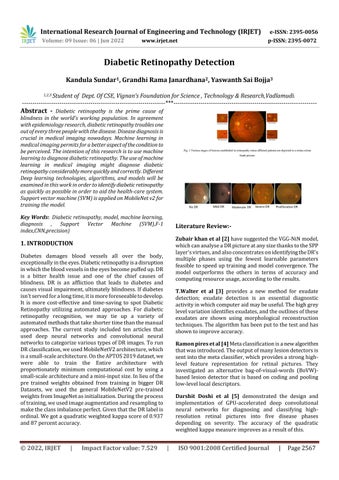
blindness in the world's working population. In agreement with epidemiology research, diabetic retinopathy troubles one out of every three people with the disease. Disease diagnosis is crucial in medical imaging nowadays. Machine learning in medical imaging permits for a better aspect of the condition to be perceived. The intention of this research is to use machine learning to diagnose diabetic retinopathy. The use of machine learning in medical imaging might diagnose diabetic retinopathy considerably more quickly and correctly. Different Deep learning technologies, algorithms, and models will be examined in this work in order to identify diabetic retinopathy as quickly as possible in order to aid the health-care system. Support vector machine (SVM) is applied on MobileNet v2 for training the model. Key Words: Diabetic retinopathy, model, machine learning, diagnosis , Support Vector Machine (SVM),F-1 index,CNN,precision)
Literature Review:Zubair khan et al [2] have suggested the VGG-NiN model, which can analyse a DR picture at any size thanks to the SPP layer's virtues, and also concentrates on identifying the DR's multiple phases using the fewest learnable parameters feasible to speed up training and model convergence. The model outperforms the others in terms of accuracy and computing resource usage, according to the results.
1. INTRODUCTION Diabetes damages blood vessels all over the body, exceptionally in the eyes. Diabetic retinopathy is a disruption in which the blood vessels in the eyes become puffed up. DR is a bitter health issue and one of the chief causes of blindness. DR is an affliction that leads to diabetes and causes visual impairment, ultimately blindness. If diabetes isn't served for a long time, it is more foreseeable to develop. It is more cost-effective and time-saving to spot Diabetic Retinopathy utilizing automated approaches. For diabetic retinopathy recognition, we may tie up a variety of automated methods that take shorter time than the manual approaches. The current study included ten articles that used deep neural networks and convolutional neural networks to categorize various types of DR images. To run DR classification, we used MobileNetV2 architecture, which is a small-scale architecture. On the APTOS 2019 dataset, we were able to train the Entire architecture with proportionately minimum computational cost by using a small-scale architecture and a mini-input size. In lieu of the pre trained weights obtained from training in bigger DR Datasets, we used the general MobileNetV2 pre-trained weights from ImageNet as initialization. During the process of training, we used image augmentation and resampling to make the class imbalance perfect. Given that the DR label is ordinal. We got a quadratic weighted kappa score of 0.937 and 87 percent accuracy.
© 2022, IRJET
|
Impact Factor value: 7.529
T.Walter et al [3] provides a new method for exudate detection; exudate detection is an essential diagnostic activity in which computer aid may be useful. The high grey level variation identifies exudates, and the outlines of these exudates are shown using morphological reconstruction techniques. The algorithm has been put to the test and has shown to improve accuracy. Ramon pires et al [4] Meta classification is a new algorithm that was introduced. The output of many lesion detectors is sent into the meta classifier, which provides a strong highlevel feature representation for retinal pictures. They investigated an alternative bag-of-visual-words (BoVW)based lesion detector that is based on coding and pooling low-level local descriptors. Darshit Doshi et al [5] demonstrated the design and implementation of GPU-accelerated deep convolutional neural networks for diagnosing and classifying highresolution retinal pictures into five disease phases depending on severity. The accuracy of the quadratic weighted kappa measure improves as a result of this.
|
ISO 9001:2008 Certified Journal
|
Page 2567