Smart Hydroponics system

Page 1

International Research Journal of Engineering and Technology (IRJET) Volume: 09 Issue: 06 | Jun 2022

www.irjet.net

e-ISSN: 2395-0056 p-ISSN: 2395-0072

Smart Hydroponics system Adhila Unas1, Amrutha Dilip2, Ansal Sayeed3, Ms Chaithanya G Nair4 Electronics and Communication, Ilahia College of Engineering and Technology, Mulavoor, Kerala, India. Electronics and Communication, Ilahia College of Engineering and Technology, Mulavoor, Kerala, India ---------------------------------------------------------------------***--------------------------------------------------------------------carried out include checking of water content in the Abstract - High yielding and high grade of crops are 1,2,3

4Professor,

installation, the nutrients, the size of the PH, the temperature and humidity of the air, which must be under the given quantity. If the quantity of one of the elements is excess or lacking, it can result in the inhibition of plant growth. This, of course, automatically impacts the selling price of hydroponic plants that are expensive. Therefore, although the method of hydroponics is the solution to the current problem of limited land, the complexity of treatment is an obstacle in its implementation. These problems can be overcome by combining hydroponic farming methods, the IoT technology, and a control system to make a smart controlling that can automatically control plants nutrition and water needs.

essential in modern day agriculture. This can only be achieved by smart farming technology which is used for making farms more intelligent in sensing its controlling parameters. Hydroponics is a type of horticulture and a subset of hydroculture which involves growing plants, usually crops, without soil, by using mineral nutrient solutions in an aqueous solvent. Hydroponics agriculture comes up as a solution to limited agricultural land that can lead to a decline in agricultural production capacity. These kinds of plants need a precise amount of nutrient every time to grow ideally. Hydroponics offers many advantages, notably a decrease in water usage in agriculture. Internet-ofThings (IoT) is a technology that enables regular monitoring of every aspect of human life. The emergence of IoT has allowed farmers to automate the hydroponic culture. IoT can be a solution to monitor the nutrition needs of the plants periodically. The application of solar powered system is also very necessary here due to current energy challenges facing by this new automated hydroponics system. If one such part gets fail, it compromises the working of entire system. So, it is necessary to detect that kind of failure. This paper proposes a solar powered automated hydroponics system for an energy efficient hydroponics precision agriculture based on the IoT concept.

But this automated hydroponics require high energy due to motors and other current consuming components. Solar energy generation is an effective method for energy usage. Solar panels are now widely used for various applications both domestic and industrial alike. The decreasing price of solar panels inspires many companies and agencies to patronize its usage. Another problem facing by the hydroponics system is component failure especially after making the hydroponics system automated. Because the number of motors is more in automated hydroponics system. Failure in one of their operations compromise the entire working of system. This problem can be avoided by using current sensing resistor in the circuit. By utilizing internet of thing (IOT) technology, each sensor device can communicate or send data to a cloud server to be processed and monitored in real time. Each sensor is connected to ESP32 to control plant needs automatically.

Key Words: IoT, Horticulture, solar powered system, hydroponics, Agriculture

1. INTRODUCTION Agricultural methods using hydroponics are one of the possible alternatives to be able to do agriculture even without extensive agricultural land. Hydroponics comes from Greece, hydro means water, and ponous means work. Hydroponics is a method of planting plants without using soil medium, but using a medium of water mixed with mineral nutrient solution. The advantage of hydroponic farming methods is that it does not require soil medium with vast land for agriculture, but agriculture can be done in a narrow area with water medium. Each hydroponic plant is also treated without using pesticides, so it is safer to consume. Hydroponic farming methods need special treatment in controlling water temperature, water level, and acidity (pH) of nutrient solutions. To be able to produce plants that are good until the harvest period, they must carry out these treatments with regular checks every day. Examinations

© 2022, IRJET

|

Impact Factor value: 7.529

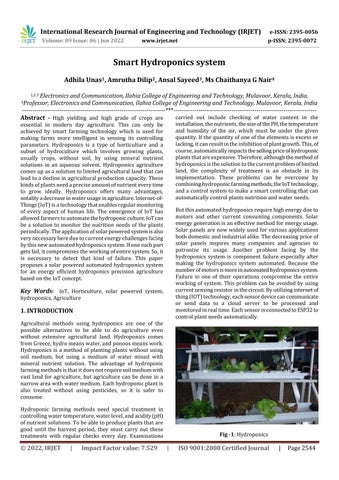
Fig -1: Hydroponics

|

ISO 9001:2008 Certified Journal

|

Page 2544


Turn static files into dynamic content formats.
Create a flipbook