International Research Journal of Engineering and Technology (IRJET) e ISSN: 2395 0056
Volume: 09 Issue: 06 | Jun 2022 www.irjet.net p ISSN: 2395 0072
International Research Journal of Engineering and Technology (IRJET) e ISSN: 2395 0056
Volume: 09 Issue: 06 | Jun 2022 www.irjet.net p ISSN: 2395 0072
1PG student, Dept. of Civil Engineering, KMEA Engineering College, Kerala, India
2 Asst.Professor, Dept. of Civil Engineering, KMEA Engineering College, Kerala, India ***
Abstract - In general, a structure collapses gradually when one of its critical members fails, causing adjacent elements to fail and be damaged. In building structures, progressive collapse often starts when the vertical members like columns fail. Progressive collapse is defined as a condition that begins with a local failure, leads to the collapse of neighbouring members, and then triggersadditionalcollapses. Theinfluence of seismic force resistance capacity and progressive collapse resistance capacityofmoment resistingframesondualsystem response is examined in this study. When the seismic force resistance share of moment frames in dual systems was increased, the structure became more robust against progressive collapse when the moment frame experienced column loss.
Experimental work was conducted to analyse the effect of energy dissipation beams on the behaviour of dual braced moment resisting frames in seismic and progressive collapse. Energy dissipation beams will act as a ductile fuse to absorb energy. This system is one of the simplest and cheapestpassive energy dampers. This study analysed a dual frame with inverted V braces with and without energy dissipation beams
Key Words: Seismic analysis, Progressive collapse, Energy dissipation beam, Dual braced moment resisting frame, SAP2000, Time history analysis, Pushover analysis
Advancesinthemethodsofanalysisanddesignofstructures and the development of performance based concepts, together with the observation of collapses in many structuresasaresultofnaturalandnon naturalevents,have directed researchers towardinvestigation ofstructures in conditions far beyond the service conditions which are generally considered in conventional designs. There have beenorarebeingbuiltahugenumberofmoment resisting frame buildings. Additionally, more are being planned for construction around the world. These structures serve a variety of social and practical purposes. Although several researchers have worked on the seismic design of a dual systemofmoment resistingframes,veryfewstudieshave beenconductedwithregardtotheirprogressivecollapse.In building structures, progressive collapse often starts with omittingverticalmemberslikecolumns.Thefailureofmain vertical members might happen due to abnormal and
extremeloadingssuchasearthquakes,gasexplosions,fires, and accidental impact of a vehicle. If the building's continuity,ductility,andredundancyareinsufficient,itwill collapse,potentiallycausingsignificantcasualties.
Inthispaper,theeffectofthehorizontalenergydissipation beamontheseismicandprogressivecollapseresistanceof dual braced moment resisting frames was analysed. Progressive collapse resistance decreases from lower to upperstoriesundercolumnremovalsfromdifferentstories atthesamelocation[3].Beamsmainlyresistcollapsebythe flexuralcapacitytospandamagedparts,andbeamsonlower stories have higher flexural capacity because of higher seismic demand duringdesign[3]. Theenergydissipation beamisdesignedtoactasafusebyyieldinganddissipating energy[2].
The study is limited to seismic and progressive collapse analysis.ThestructureanalysedisadualinvertedV braced moment resisting frame. Only a few parameters like displacement, base shear, and progressive collapse resistancearestudied.SAP2000softwareisused
The main objective of this research is to study the performanceofenergydissipationbeamsontheseismicand progressive collapse resistance of dual braced moment resistingframes.Toexaminethebehaviourofadual braced momentresistingframewithandwithoutenergydissipation beams,asix storeybuildingisconsidered.Thentheselected structure with and without energy dissipation beams was modelledandanalysedinSAP2000softwareandtheresults are compared. Nonlinear static pushover analysis was carriedouttostudytheprogressivecollapseoftheframe. Nonlinear dynamic analysis (time history analysis) was carriedouttostudytheseismicperformanceoftheframe.
Theanalysedstructuralmodelsweredualsystemswithan inverted V bracing configuration. The buildings were six storey residential buildings with four bays and plan dimensionsof24mx24m.Eachstoreyhadaheightof3.2 metresandaspanof6metres.Thebeamsandcolumnswere
2022, IRJET | Impact Factor value: 7.529 | ISO 9001:2008 Certified

International Research Journal of Engineering and Technology (IRJET) e ISSN: 2395 0056
Volume: 09 Issue: 06 | Jun 2022 www.irjet.net p ISSN: 2395 0072
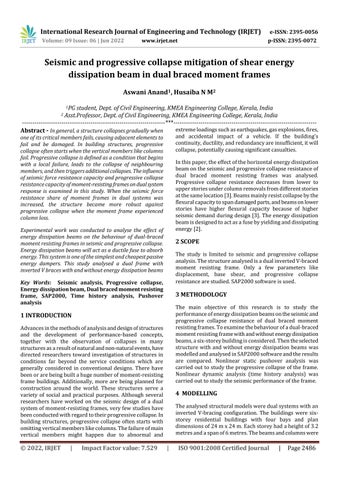
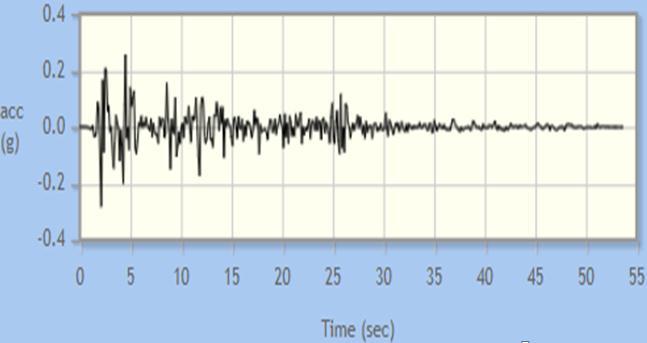
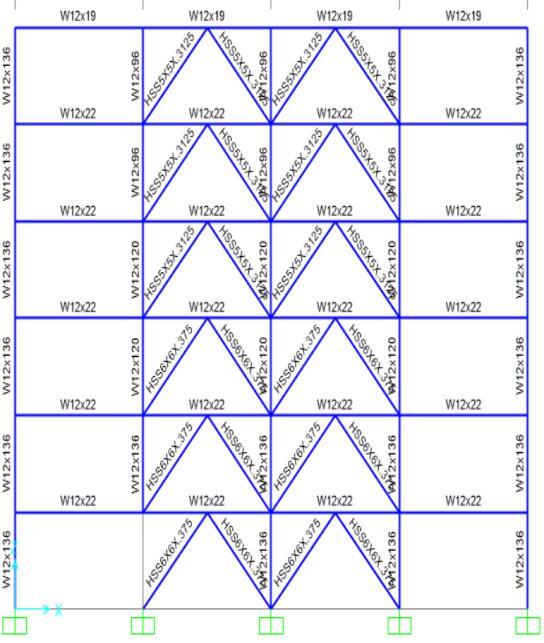
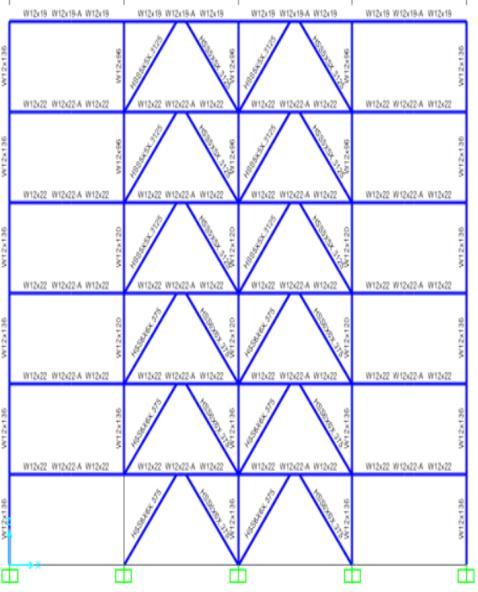
wide flanged.ThecrossmembersweremadeofASTMA992 steel, while the braces were seismically compact, square hollowsteelsections(HSS).Thedesigneddeadandliveloads were6.5and2.0kN/ ,respectively.Auniformlineardead loadequalto4.0kN/mwasappliedtoperimeterbeamsto considerwall loads.Asperthejournal,thedesignseismic loadwasobtainedfromASCE7(2016).Thebuildingswere designedforseismicdesigncategoryD(highseismicrisk). Table1showsthemembersizesofthemodel.Thestructures withandwithoutenergydissipationbeamsweremodelled asshowninFig.1(a)and(b).
Storey Column Beam Brace Internal Externa l Interna l Externa l
W 12×136 W 12×136 W 12×35 W 12×22 HSS 6×6×3/8
W 12×136 W 12×136 W 12×35 W 12×22 HSS 6×6×3/8

W 12×120 W 12×136 W 12×35 W 12×22 HSS 6×6×3/8
W 12×120 W 12×136 W 12×35 W 12×22 HSS 5×5×5/16
W12×96 W 12×136 W 12×35 W 12×22 HSS 5×5×5/16
W12×96 W 12×136 W 12×35 W 12×19 HSS 5×5×5/16
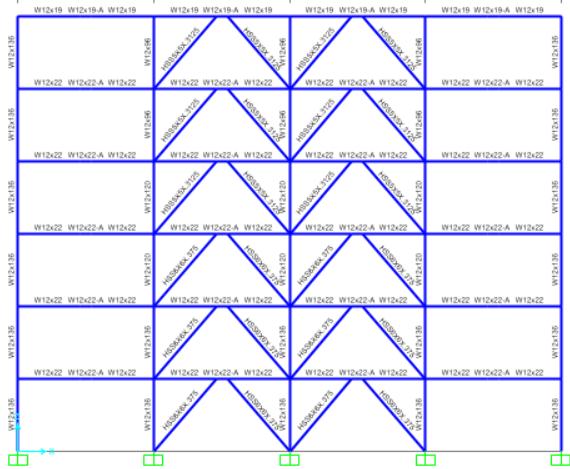
In this study horizontal energy dissipation beams were provided between braces to act as a fuse by yielding and dissipatingenergywhilepreventingthebucklingofthebrace members.Theperformanceoftheenergydissipationbeam ishighlyinfluencedbythelinklengthandtheplasticshear strength( toplasticmomentstrength( )ratio.Using plasticanalysis and canbewrittenas:
= (d 2 )


= (b ).(d )+


Where , are the web and flange yield strength, respectively,
isthewebthickness,distheoverallbeamdepth,and is the flange thickness and b is the flange width. In order to impose shear yielding before bending yielding of the horizontallink,thelinklengthemustbelimitedto:
e≤ =1.6
AccordingtoAISCseismicprovisions, linkswithe≤1.6are energydissipationbeamsthatyieldprincipallyinshearand have a maximum link rotation of 0.08 rad under design seismicstress.Asaresult,theframe'sdriftangleθ,maybe representedintermsofthelinkrotationangleɣ,asfollows:
Fig.1(a)Dualbracedmomentresistingframewithout EDB
=
ThesteelusedforenergydissipationbeamwasofgradeFe 250. Grade of steel used for the energy dissipation beams shouldbelessthangradeofsteelusedforothermembers.
2022, IRJET | Impact Factor value: 7.529 | ISO 9001:2008 Certified Journal
International Research Journal of Engineering and Technology (IRJET) e ISSN: 2395 0056
Volume: 09 Issue: 06 | Jun 2022 www.irjet.net p ISSN: 2395 0072
= 250 N/mm, = 6.604 mm, d = 312.67 mm, =10.795mm,b=102.362mm =277458.9971N =118364105N.mm


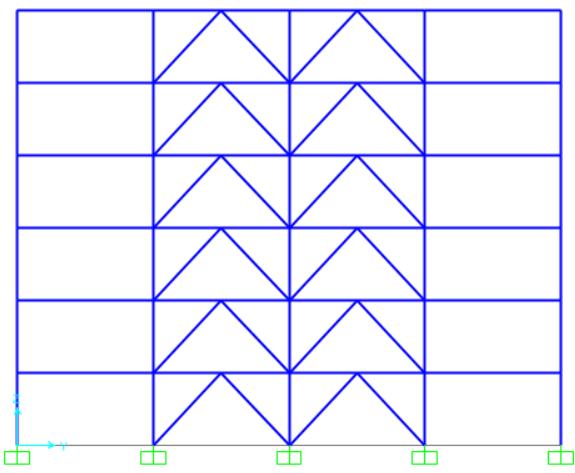
Thebesttechniqueforevaluatingstructuralreactionsunder earthquake excitations defined by ground acceleration records is time history analysis, which is a nonlinear dynamic analysis. A number of short time increments are used to evaluate the performance. A representative earthquaketimehistoryforthestructurebeinganalysedis requiredtoperformsuchastudy.Groundmotionshavebeen selected to perform the dynamic analysis of the current study. The ground motion records are obtained from the PEER Strong Motion Database (http://peer.berkeley.edu/smcat/). Fig 2 provides the accelerationtimehistoryfortheearthquakegroundmotion used in the current analysis. Since earthquake resistant designconsiderstheshearatbaseasagoverningparameter, the parameters studied in this analysis were mainly base shearanddisplacement.
In this paper, two different sets of models were analysed. Eachsetofmodelsincludesthreemodels.Inthefirstset, all ofthemodelsconsideredwerewithoutEDB.Inadditionto this,differentcolumnswereeliminatedfromeachmodel.In thefirstmodel,theleft sidecornercolumnwaseliminated, andthesecondmodelwaswithoutthesecondcolumnfrom the left side of the ground floor. In the third model, the eliminated column was the middle column on the ground floor. The next set of models considered was with EDB betweenbraces,andthecolumneliminatedfromeachmodel was the same as the first set. In accordance with the UFC guidelines, the gravity load combination “ (1.2D+0.5L)” wasappliedtobaysadjacenttotheremovedcolumnatall floors above that. The gravity load combination “(1.2D +0.5L)”wasappliedtotheotherbays.Deadandliveloads arerepresentedbyDandL,respectively.Eq.(1)(UFC2016) wasusedtoderivethedynamicincreasefactorfornonlinear staticanalysisinsteelbuildings =1.08+0.76/( +0.830) Eq.(1)
where istheplasticrotationangle,and istheyield rotation.
Thentheanalysisofthemodelwascarriedouttodetermine the progressive collapse resistance or load factor of the structure The load factor is defined as the ratio of the applied load at step of the pushdown analysis to the total progressivecollapseloads.
Fig3(a)&(b)showstheonesetofmodelsforprogressive collapseanalysis
Fig.2Accelerationtimehistoryrecordfortheearthquake groundmotion
In progressive collapse analysis, it is assumed that the primarymembersthatlosetheirload bearingcapabilitydue toanearthquakeareremovedfromthestructure,andthen the structure is analysed. Some columns are chosen for removal, and the progressive collapse analysis is stated Theseareusuallyonthelowestfloorandareattachedtoa bracedandmomentframe.Thisisanewtrendinthefieldof progressivecollapse,inwhichthecolumnisremovedasa resultofanearthquakeandthen astructureisthathasbeen damaged by an earthquake, which is known as ‘seismic progressivecollapse’.Pushoveranalysiswascarriedoutto study the performance of moment resisting frames with bracingandenergydissipationbeamsandwithoutenergy dissipationbeams.
Fig3(a)FramewithoutEDBandwithoutsecondcolumn inthegroundfloor
2022, IRJET | Impact Factor value: 7.529 | ISO 9001:2008 Certified Journal
International Research Journal of Engineering and Technology (IRJET) e ISSN: 2395 0056
Fig3(b)FramewithEDBandwithoutsecondcolumnin thegroundfloor
The structural performance of the investigated building modelsacrosstime,duringandaftertheapplicationofthe seismicloadisdeterminedusingtime historyanalysis The resultoftimehistoryanalysisisshowninTable2.
Table2.ResultsofTimeHistoryanalysis
MODEL DISPLACEMENT (mm) BASESHEAR(kN)
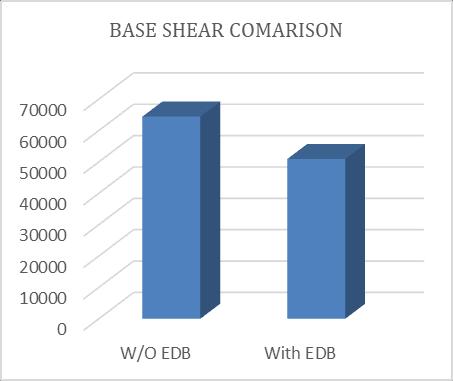
WithoutEDB 121.919 64425
WithEDB 118.339 50922
The results are compared and analysed. The comparison graphsareshowninCharts1and2.
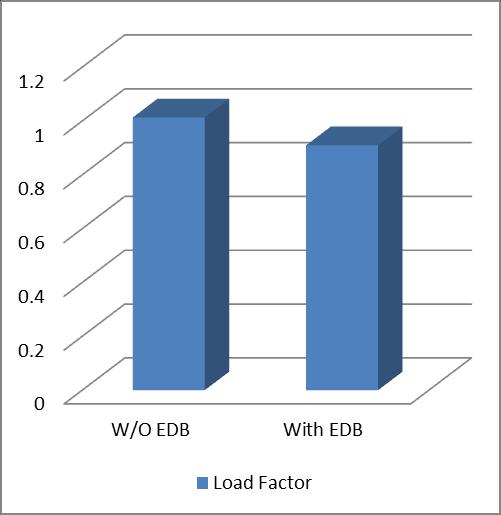
Chart2Comparisonofbaseshearforframeswithand withoutEDB
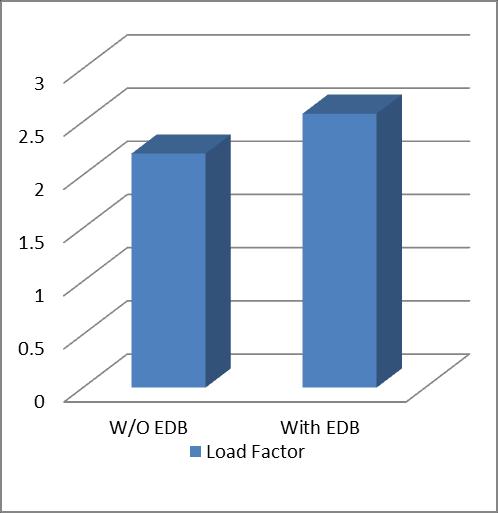
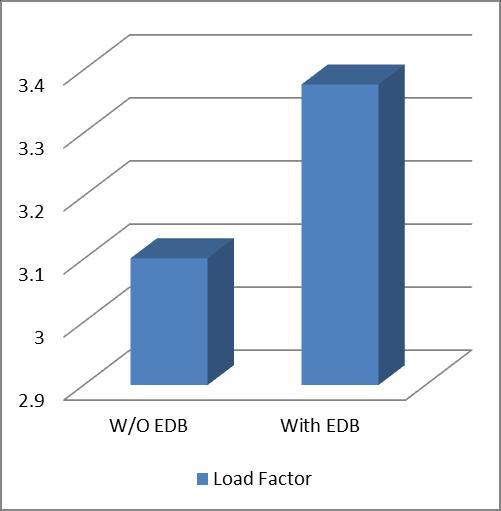
Theprogressivecollapseresistancesofframesobtainedafter staticpushoveranalysiswerecomparedtoidentifytheeffect of energy dissipation beams on moment resisting frames during earthquakes. The load factors of frames with and without energy dissipation beams were compared. The resultsoftheinvestigationareshowninTable3.
MODEL PROGRESSIVECOLLAPSERESISTANCE(kN)
W/Ocorner column W/O second column W/O third column
WithoutEDB 1.01 2.205 3.10
WithEDB 0.91 2.575 3.37
Chart3(a),(b)&(c)showsthecomparisonofprogressive collapseresistancevaluesofframeswithandwithoutEDB.
Chart1Comparisonofdeformationforframeswithand withoutEDB
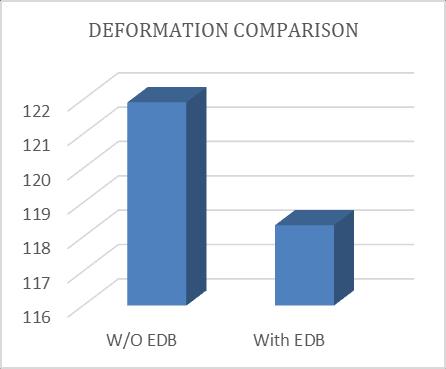
Chart3(a)Withouttheleftcornercolumninthe groundfloor
Volume: 09 Issue: 06 | Jun 2022 www.irjet.net p ISSN: 2395 0072 © 2022, IRJET | Impact Factor value: 7.529 | ISO 9001:2008 Certified Journal
International Research Journal of Engineering and Technology (IRJET) e ISSN: 2395 0056
Volume: 09 Issue: 06 | Jun 2022 www.irjet.net p ISSN: 2395 0072
Chart3(b)Withoutthesecondcolumnfromtheleft sideinthegroundfloor
Chart3(b)Withoutthesecondcolumnfromtheleft sideinthegroundfloor
Thisresearchstudiedtheeffectofenergydissipationbeams ondualbracedmomentframesinresistancetoseismicand progressivecollapse.Pushoveranalysishasbeenperformed to study the effect of energy dissipation beams on progressivecollapseresistanceofthemomentframe.Atime history analysis has been carried out to study the seismic performance. In both cases, the structure with an energy dissipationbeamhasanimprovedresistancetoprogressive collapseandseismicforces.Asaresultoftheinvestigation, thefollowingobservationsweremade:
Theresultoftimehistoryanalysisshowsthatthe energydissipationbeamsreducethedisplacement oftheframesby3%andbaseshearby23%.
The structure with EDB has lower maximum displacement and base shear compared to the structurewithoutEDB.
Theprogressivecollapseresistanceobtainedinthe caseofcornercolumnremovalofaframewithEDB waslessthantheframewithoutEDB.
But in the other two cases, the EDB shows much improvementintheprogressivecollapseresistance offramewithEDBoverframewithoutEDB.
EDBimprovedtheprogressivecollapseresistance by15.48%and8.35%forframewithoutsecondand thirdcolumnrespectively.
FromtheoverallresearchitcanbeconcludedthatEDB improves the seismic and progressive collapse resistanceofdualbracedmomentframes
[1] MaryamMusavi Z, MohammadRezaSheidaii, “Effect ofseismic resistance capacity ofmoment frames onprogressive collapse response ofconcentrically braced dual systems”, Asian Journal of Civil Engineering,2021
[2] MohamadGhasemVetra,AliGhamarib,JackBouwkamp, “Investigating the nonlinear behavior of Eccentrically BracedFramewithverticalshearlinks(V EBF)”Journal ofBuildingEngineering10,47 59,ElsevierLtd.,2017
[3] Mohsen Ali Shayanfar, Mohammad Mahdi Javidan, “Progressive Collapse Resisting Mechanisms and Robustness of RC Frame Shear Wall Structures”, J. Perform.Constr.Facil.,ASCE,2017
[4] H.Mirjalali,M.Ghasemi, M.S.LabbafzadehJeung, “Effect of bracing type andtopology onprogressive collapse resistance ofeccentrically braced frames” , Korean SocietyofSteelConstruction,2019
[5] MojtabaHosseini,NaderFanaieandAmirMohammad Yousefi, “Studying the vulnerability of steel moment resistant frames subjected to progressive collapse”, IndianJournalofScienceandTechnology,2014
[6] Paul W. Richards and Shannon S., “Cyclic Behavior of ReplaceableShearFuseConnectionsforSteelMoment Frames”, JournalofStructuralEng.,ASCE,2019