International Research Journal of Engineering and Technology (IRJET) e-ISSN:2395-0056

Volume: 09 Issue: 06 | June 2022 www.irjet.net p-ISSN:2395-0072
International Research Journal of Engineering and Technology (IRJET) e-ISSN:2395-0056
Volume: 09 Issue: 06 | June 2022 www.irjet.net p-ISSN:2395-0072
Batham Geeta1, Akhtar Saleem2, Rajesh Bhargava3
1PhD Scholar, UIT RGPV, Bhopal, India, 2 Professor, UIT RGPV, Bhopal, India, 3 Professor, RGPV, Bhopal, India. ***
Abstract: In this study, an extensive literature review has been conducted to understand the increased potential of HVFA concrete in recent years. HVFA concrete performance depends on material ingredients and mixture proportioning, which leads to denser and relatively more homogenous particle packing. However, sustained research studies in producing HVFA usingvariousmineraladmixturesuchasultra fineflyash,classCandFflyash,linestonepowder,GGBS,Silicafume,Alccofine undervariouscuringconditionsarestudieshereandadatabasewascompiledfromvariousresearchandfieldstudiesonthe fresh and hardened properties of high volume fly ash concrete using mineral admixture. The literature review revealed that thecuringtime,flyashcontent,choiceofmineraladmixturesanditscontentarethemainfactorsthatcontrolthemechanical and durability properties. Although various research have been conducted on HVFA concrete still there are challenges regarding the selection of mineral admixture and its content in HVFAC. This study helps to better understand the potential andcapabilitiesofHVFAusingvariousmineraladmixtureinconcrete,whichwillminimizethedrawbackofHVFAandprovide sustainableconstructionmaterialtotheconstructionindustry.
Keywords: high volume fly ash concrete, mineral admixtures, workability, compressive strength, flexural strength, split tensilestrength.
The term of high volume fly ash (HVFA) concrete is firstly introduced by Malhotra at CANMET in the 1980s. The HVFA concrete is the concrete with at least 50 % of the Portland cement by mass is replaced with ASTM class F or class C fly ash [Mehta and Malhotra, 2005]23 The 15% 20% fly ash by mass of the total cementitious material is good for workability and cost economy of concrete but it may not be enough to sufficiently improve the durability to sulfate attack, alkali silica expansion, and thermal cracking [Sarath et. al., 2011]9. The definition of HVFA concrete given by [Mehta and Malhotra, 2005]23are(i)Minimumof50%offlyashbymassofthecementitiousmaterialsmustbemaintained(ii)Lowwatercontent, generallylessthan130kg/m3ismandatory(iii)Cementcontent,generallynomorethan200kg/m3isdesirable.Themixture design of HVFA should be economical and sustainable for achieving denser matrix, reduced porosity and improved internal microstructure, leading to superior mechanical and durability properties. The use of High Volume Fly Ash concrete in constructionisasolutiontoenvironmentaldegradationbeingcausedbycementindustry.Theconceptverymuchfitsintothe era of sustainable development. As cement industry, itself, is responsible for 7% of world’s carbon dioxide emissions, responsibleforglobalwarming,attentionneedstobedrawnbyconstructionindustrytosolvetheproblem [VanitaAggrawal et.al.,2010]10
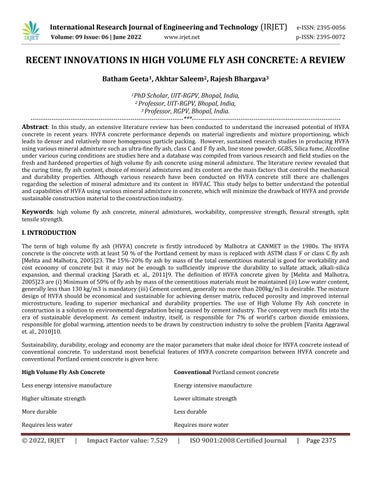
Sustainability,durability,ecologyandeconomyarethemajorparametersthatmakeidealchoiceforHVFAconcreteinsteadof conventional concrete. To understand most beneficial features of HVFA concrete comparison between HVFA concrete and conventionalPortlandcementconcreteisgivenhere.
High Volume Fly Ash Concrete
Lessenergyintensivemanufacture
Higherultimatestrength
Moredurable
Requireslesswater
Conventional Portlandcementconcrete
Energyintensivemanufacture
Lowerultimatestrength
Lessdurable
Requiresmorewater
International Research Journal of Engineering
Technology
e ISSN:2395 0056
Volume: 09 Issue: 06 | June 2022 www.irjet.net p ISSN:2395 0072
Usesawasteby product
Createsfewerglobalwarminggases
Usesvirginmaterialsonly
Createsmoreglobalwarminggases
Comparison clearly demonstrates that HVFA concrete is more environmentally friendly and has more desirable technical propertiesthanconventionalconcrete(GreenResourceCenter,2004).HVFAChasexcellentworkability,lowheatofhydration, adequate early age and high later age strengths, reduced drying shrinkage, reduced micro cracking, excellent durability characteristicswhilebeing moreeconomical andenvironment friendly whencompared toconventional concrete [T.P.Singh, 2007]8. [Ghafoori et. al., 1997]24 concluded that good strength, stiffness, drying shrinkage and resistance to wear and repeatedfreezingandthawingcyclescouldbeobtainedwithconcretescontaining bottomash. [SiddiqueandKadri,2012]25 reported reinforcement of high volumeflyashconcrete with natural fibres.Incorporation of highvolume flyashinconcrete resultsinmanyadvantagessuchasreducedwaterdemand,improvedworkability,reductioncracksduetothermalanddrying shrinkage, enhanced durability to reinforcement corrosion sulphate attack, and alkali silica expansion [P Kumar Mehta, 2004]26. Someofthebenefitsofhighvolumeflyashinconcretereportedbymanyresearchersarecompiledhere.
TheapplicationofconcreteinconstructionisasoldasthedaysofGreekandromancivilization.Butfornumerousreasons, the concrete construction industry is not sustainable. It consumes a lot of virgin materials and the principal raw material of concrete i.e. cement is responsible for green house gas emissions causing a threat to environment through global warming. Therefore,theindustryhasseenvarioustypesofconcreteinsearchofasolutiontosustainabledevelopment.Infrastructural growth has witnessed many forms of concrete like High Strength Concrete, High Performance Concrete, Self Compacting ConcreteandthelatestintheseriesisHighVolumeFlyAshConcrete(HVFC).Theparadigmhasshiftedfromonepropertyto other of concrete with advancement in technology. The construction techniques have been modernized with focus on high strength,denseanduniform surfacetexture,more reliablequality,improveddurabilityandfasterconstruction [10]. Ano.of mineral admixtures are used in HVFA concrete to achieve these desired properties as a partial replacement of cement concrete. Proper selection of mineral admixture and its mix proportion in HVFA concrete is relatively more beneficial it enhances properties like strength, stability, and provide future sustainable material than the cement. However, previous researchstudiesinproducingHVFA concreteusingvariousmineraladmixturesuchasultra fineflyash,classCandFflyash, limestonepowder,GGBS,Silicafume,Alccofineundervariouscuringconditionsarestudiedandreviewedhere.Adatabaseis preparedfromvarious researchandfieldstudiesonthefreshand hardened propertiesofhighvolumeflyashconcrete. This studywillhelpinselectionofpropermineraladmixture,itscontentandcuringconditionstoenhancethebeneficialfeaturesof HVFAconcrete.
A no of studieshave been conducted on use of mineral admixture in HVFAconcrete suchasclassc flyashin HVFAconcrete [Shrivastava and Bajaj, 2012]1, [Sravana, and Rao, 2006]3, [Soni and Saini, 2014]5, [Krishnaraj and Ravichandran, 2020]14 andinhighstrengthconcrete[G.K.Kateet.al.,2013]4,classFflyash[AlaaM.Rashadet.al.,2014]13,FlyashinHVFAconcrete [Nikhil T. R., 2012]2, [S. Lokesh et. al., 2013]6, [T.P. Singh, 2007]8, [Jeong Eun Kim et. al., 2016]11, GGBS and silica fume in concrete[Jeong EunKimet.al.,2016]11,[AlaaM.Rashadet.al.,2014]13,limestonepowder[DaleP.Bentz,2012]21,[DaleP. Bentz,2014]22andAlccofineinHPC[InduLidooet.al.,2017]12 Thebriefliteraturereviewofthelateststudiesareasfollows. [ShrivastavaandBajaj,2012]1investigatedtheperformanceofFlyAsh(FA)inthesoilstabilizationwithreplacementitwith differentsoilfor10to60%.Inthisinvestigation,theengineeringpropertieslikecompactionofsand,sand+flyash(SF) @(10, 20,30,40&50)andsand+flyash+soil(SFS)@(1:1:1,1:1.5:0.5)hadbeentestedandresultsarecompared.Authorproduced M20,M50andM70withtargetmeanstrengthof26.25MPa,56.36MPaand78.69MPa.Replacementofcementbyflyashwas foundtobe20%,35%,50%and70%.Thecompressivestrengthwasdeterminedby150×150×150mmmouldandflexural strength by 600 × 150 × 100 mm prism. Author investigated the fresh and hardened properties like slump, temperature, modulus of elasticity, modulus of rigidity. The results showed that up to 50% replacement of cement can be used for constructionwithinadditionreduces12%overallcost.
International Research Journal of Engineering and Technology (IRJET) e ISSN:2395 0056
Volume: 09 Issue: 06 | June 2022 www.irjet.net p ISSN:2395 0072
[Nikhil T. R., 2012]2 conducted experimental study in three stages. In the first stage compatibility test is made to select the type of cement. Second stage preliminary investigations such as consistency, specific gravity, initial and final setting time of cement and sieve analysis of fine aggregates and coarse aggregates were carried out on materials used. In the third stage concretemixproportioningwasdoneasperthedraftcode(IS:10262)andcubes,beamsandcylinderswerecastedandtested. The cubes beams and cylinders were tested properly in uniaxial compressive testing machine, flexural testing machine and splittensiletestingmachineattheageof7,14,28and56days.Authorconcludedthat55%replacementofcementbyflyashis theoptimalpercentabovewhichstrengthdecreases.
[Sravana, and Rao, 2006]3 conducted test on M20, M30, M40, and M50 grades of concrete containing OPC and studied the effect of thermal cycle to the concrete produced at different temperatures. The compressive strength of concrete at various thermal cycles i.e. 7, 28, 45 and 90 were evaluated and compared. Author revealed that concrete containing fly ash addition wasmoreeffectiveinresistingtheeffectofthermalcyclesthanordinaryandflyashreplacecementconcrete.
[G. K. Kate et. al., 2013]4 conducted experimental investigation carried out to evaluate the shrinkage of High Strength Concrete. High Strength Concrete is made by partial replacement of cement by fly ash. The shrinkage of High Strength Concretehasbeenstudiedusingthedifferentmixesfromaminimumof10%tomaximumof70%.Fromthetestresultsofthe aboveinvestigationitcanbeconcludedthattheshrinkagestrainofHighStrengthConcreteincreaseswithincreaseinflyash content.Therateofincreaseinshrinkagewithtimeisuniformforlowflyashcontent,whereasitgenerallyincreasesafter 28 daysforhighvolumeofflyashandthehighvolumeflyashconcreteyieldsslowstrengthdevelopmentatanearlyage.
[Soni and Saini, 2014]5 investigated effect of mineral addition in concrete on strength and durability characteristics at high temperatures.Authorproducedconcretemixproportionsof1:1.45:2.2:1.103withawatercementratioof0.5byweight.The percentages of replacements were 30, 40 and 50 % by weight of cement. Specimens were prepared and tested in the laboratory. Compressive strength, split tensile strength and modulus of elasticity were performed at room temperature at 80˚C, 100˚C, and 120˚C for all types of fly ash concrete at different curing at the age of 28 days and 56 days. Test results showedthatthecompressivestrength,splittensilestrengthandmodulusofelasticityofconcretehavingcementreplacement upto30%wascomparabletothereferenceconcretewithoutflyash.Withtheincreaseintemperature,compressivestrength ofconcretemixeswith30%,40%and50%offlyashascementreplacementdecreasesby11.4%,30.1%,28.9%,and27.5%at 120˚Cwhencomparedtoroomtemperature.
[S. Lokesh et. al., 2013]6 uses fly ash as light weight aggregate in concrete. Fly ash as a waste material from thermal power plant was converted into light weight aggregate (i.e., production of fly ash based aggregates either by bonding or sintering technique)foruseinconcreteasporouslightweightinnature.Authorproducedfourtrialmixes(C100&NA100,C100&NA60 FA40, C60F40& NA60FA40 and C60F30S10& NA60FA40) M25 grade of concrete and with water cement ratio 0.3. 12 no. of eachspecimenwereproducedinthelaboratory.Sizeofcube,beamandcylinderare150x150x150,100x100x500,150dia.& 300 height respectively. Author found such light weight aggregate concrete with high volume fly ash cement has all the attributes of high performance concrete i.e. excellent mechanical properties, lower permeability, superior durability and environmentalfriendlynature.Authorconcludedlightweightaggregateconcretemadewithcementmortarincombineduse offlyashwithsilicafume,hasimprovedthestrengthdevelopmentininitialdays
[Coppola etal., 2018]7used fivedifferenttypesofcement(CEMI,CEMII/A LL,CEMIII/A,CEMIII/B,andCEMIV accordingto EN 197 1)withsiliceous flyash(FA)orultrafineflyash(UFFA)toproducemortar.Replacementpercentage were5%, 15%, 25%, 35%, and 50% of cement mass. Author conducted research to study the rheological and physical performance of mortars. Results indicate that compressive strength of mortars with UFFA is considerably higher than that of mixtures containingtraditionalFA,bothatearlyandlongages.Moreover,experimentaldatarevealthatreplacementofcementwithup to 25% of UFFA determines higher compressive strength at 7, 28, and 84 days than plain mortars (containing cement only), regardless of the type of cement used. Mortars manufactured with 35% or 50% of UFFA show slightly lower or similar compressivestrengthcomparedtothereferencemortar(containingcementonly).
[T.P. Singh, 2007]8 shared Indian experience in field performance of high volume fly ash concrete. Author presents the properties of HVFAC with 50% Fly ash used on two demonstration projects in New Delhi, India. Author prepared three differentmixes30MpaPlainconcrete,40MpaHVFACand30MpaHVFACfortheprojecttoconstructa100 mstretchofroad pavement 7m wide at Fatehpur Beri, Mehrauli and New Delhi in HVFAC. The road stretch carries heavy traffic including
e ISSN:2395 0056
Volume: 09 Issue: 06 | June 2022 www.irjet.net p ISSN:2395 0072
overloaded trucks during day as well as night. The new concrete pavement was designed as a 270 mm thick slab in 30 Mpa gradeconcrete,laidontheexistingasphaltpavement.TheauthorinvestigatedthatHVFACisindeedanexcellentmaterialwith later age properties superior to conventional concrete, namely compressive strength, flexural strength, elastic modulus, abrasion resistance and permeability. From the viewpoint of sustainable development, it is a strongly viable solution as a buildingmaterialintheyearsahead.
[Sarathet.al.,2011]9preparedadetailedliteraturereviewoncontributionofflyashtothepropertiesofMortarandConcrete. Authorstudiedvariousresearchpaperandpreparedadatabaseoneffectofflyashreplacement(bycement)onvariousfresh and hardened properties of concrete such as workability, setting time, bond strength , compressive strength, split tensile strength and flexural strength etc. Author also provide platform for effect on other properties drying shrinkage, thermal cracking,durabilityofHVFAconcrete.Author reported significant influenceofflyashinimprovingthe propertieslike water requirement, workability, setting time, compressive strength, durability of mortar and concrete. Investigation clearly demonstrates that fly ash is an effective pozzolan which can contribute the properties of concrete. Fly ash blended concrete can improve the workability of concrete compared to OPC. It can also increase the initial and final setting time of cement pastes. Fly ash replacement of cement is effective for improving the resistance of concrete to sulfate attack expansion. The higheristhecompressivestrengthofconcrete,theloweristheratioofsplittingtensilestrengthtocompressivestrength.
[VanitaAggrawalet.al.,2010]10preparedareviewpaperonconcretedurabilityofhighvolumeflyashconcrete.Theresearch discusses the development of high volume fly ash concrete for construction with reference to its predecessors like HSC and HPC.Authorprovideexcellentliteratureonuseofflyashinconcreteforgettingstartfurtherresearchonuseofhighvolumes offlyashinconcretepavements.Authorreportedthatincorporatingflyashinconcretereducesthecompressivestrengthat earlyagesbutthereisadrasticincreaseinthecompressivestrengthatlaterages.Theearlystrengthisreducedfurtherifthe percentage of replacement is increased. But, on the other hand when the percentage of replacement is increased the water/ binder ratio gets reduced, thereby, increasing the later age compressive strength. Also, it is observed that the later age strengthofconcreteshavingmorethan40%replacementofcementbyflyashsuffersadverselythough water/binderratiois graduallyreduced.Forconcreteswithlessthan40%replacementofcement,thecharacteristicstrengthat28daysisonhigher side. Whereas, for concrete with 40% replacement of cement, the 28 days compressive strength is at par with that of plain concrete.Theconcretewithmorethan40%replacementofcementshowlesser28daysstrengthbutgainsbetterstrengthat 90daysorlater.
[Jeong Eun Kim et. al., 2016]11 conducted experimental study to investigate mechanical properties of energy efficient concrete with binary,ternaryandquaternaryadmixture at differentcuringages. Authorpreparedvarious mix proportion in combination offlyash,silica,and blastfurnaceslag replacement percentagesforfly ashranges15to30whereassilica fume percentageusedwas5toproduceenergyefficientconcrete.Slumptestforworkabilityandaircontenttestwereperformedon freshconcretes.Compressivestrength,splittingtensilestrengthweremadeonhardenedconcretespecimens.Foreachbatch, cylindrical molds of size 100 mm X 200 mm (4 X 8 in.) were cast for the determination of compressive strength, splitting tensile strength and modulus of elasticity of energy efficient concrete. Investigation showed use of silica fume increased the compressive strengths, splitting tensile strengths, modulus of elasticity and Poisson’s ratios. On the other hand, the compressivestrengthandsplittingtensilestrengthdecreasedwithincreasingflyash.
[Indu Lidoo et. al., 2017]12 prepared an experimental program to design high performance concrete (M100) using mineral admixture alccofine 1203 and fly ash. The different combinations with Alccofine as the replacement to cement by 8%, 10%, 12%&14%,alongwiththeincorporationofFlyAshby10%wereprepared.Theworkabilityandcompressivestrengthofthe Fly ash mix by varying the different percentages of Alccofine is recorded and the percentage of Alccofine is optimized by researchers. Then for this optimized mix, cube specimens 150 x 150 x 150 mm were casted and tested for Compressive strength. Author prepared a lot of trials of combination of 1:1.3:2.6 of cement, fine Aggregates and Coarse Aggregates with 10% of Fly ash and 10% of Alccofine. Author reported ALCCOFINE 1203 the future generation pozzolona as a substitute for partialreplacementofnormalcements
[AlaaM.Rashadet.al.,2014]13Inthisstudy,Authorpartiallyreplacedportlandcement(PC)withaClassFflyash(FA)atlevel of70%toproducehigh volumeFA(HVFA)concrete(F70).F70wasmodifiedby replacingFAatlevelsof10and20%with silica fume (SF) and ground granulated blast furnace slag (GGBS) and their equally combinations. All HVFA concrete types were compared to PC concrete. After curing for 7, 28, 90 and 180 days the specimens were tested in compression and
International Research Journal of Engineering and Technology (IRJET) e ISSN:2395 0056
Volume: 09 Issue: 06 | June 2022 www.irjet.net p ISSN:2395 0072
abrasion. The various decomposition phases formed were identified using X ray diffraction. The morphology of the formed hydrateswasstudiedusingscanningelectronmicroscopy.TheresultsindicatedhigherabrasionresistanceofHVFAconcrete blendedwitheitherSForequallycombinationsofSFandGGBS,whilstlowerabrasionresistancewasnotedinHVFAblended withGGBS.
[Krishnaraj and Ravichandran, 2020]14 conducted experimental program to understand the strength improvement and microstructural behaviorof ultra fineflyashparticles. Theyuse synthesisandcharacterizationtechniquesfor analyzingthe flyashmortarandmasonryprism. Itwasfoundthattheultra fineflyashmasonryblockshowshighercompressivestrength, higherresistancetoshear,higherbondingbetweentwobrickscompareto conventionalmasonryblocks.Authorinvestigated process of grinding alters the particle size and specific surface area but not shown any variation in chemical composition. Overall, investigations show that additional use of 45% ultra fine fly ash in construction applications without compromising thequality.
[S.Abbas et.al.,2016]15studiedvariousresearchpapersand prepareda databaseon the material characterizationofUHPC anditspotentialforlarge scalefieldapplicability.AuthoremphasisonMechanicalPerformance,Durability,Sustainabilityand Implementation Challenges in production of ultra high performance concrete. Research shows that UHPC provides a viable and long term solution for improved sustainable construction owing to its ultrahigh strength properties, improved fatigue behaviorandverylowporosity,leadingtoexcellentresistanceagainstaggressiveenvironments.TheAuthorrevealedthatthe curing regimes and fiber dosage are the main factors that control the mechanical and durability properties of UHPC. Author investigatedProductionofUHPCusinglocallyavailablematerialsundernormalcuringconditionscanreduceitsmaterialcost.
SupplementaryCementitiousMaterial (SCM)playimportantroleonstrengthpropertiesofHVFAconcreteandHSCconcrete. Physical and chemical properties of SCM affects HVFA and HSC to large extent. Use of SCM such as class c fly ash in HVFA concrete [Shrivastava and Bajaj, 2012]1, [Sravana, and Rao, 2006]3, [Soni and Saini, 2014]5, [Krishnaraj and Ravichandran, 2020]14andinhighstrengthconcrete[G.K.Kateet.al.,2013]4,classFflyash[AlaaM.Rashadet.al.,2014]13,FlyashinHVFA concrete[NikhilT.R.,2012]2,[S.Lokeshet.al.,2013]6,[T.P.Singh,2007]8,[Jeong EunKimet.al.,2016]11isverycommonto provideeconomical,ecological,greenconcreteandtominimizeenvironmental problem. Flyashismostcommonlyusedasa pozzolona in concrete. Pozzolonas are siliceous and aluminous materials, which in a finely divided form and in presence of water, react with calcium hydroxide at ordinary temperatures to produce cementitious compounds [Vanita Aggrawal et. al., 2010]10 A FA particle distribution will typically consists of particle ranging from slightly greater than 150 micrometers to submicron size. Mehta has reported that a majority of the reactive particle in FA are actually less than 10 micrometers in diameter [Mehta P. K., 1985]31.It wasobserved thatincrease in flyashcontent resultsinimproved workability.[PoonC. S., 2000]46reportedthatconcretewitha28dayscompressivestrengthof80MPacouldbeobtainedwithalow calciumflyash contentof45%.Thesphericalparticleshapeofflyashalsoparticipatesinimprovingworkabilityofflyash concrete Useoffly ash increases the absolute volume of cementitious materials (cement plus fly ash) compared to non fly ash concrete; therefore,thepastevolumeisincreased,leadingtoareductioninaggregateparticleinterferenceandenhancementinconcrete workability[Sarathet.al.,2011]9.[ShrivastavaandBajaj,2012]1,[NikhilT.R.,2012]2and[G.K.Kateet.al.,2013]4 reported increaseinworkabilitywhile[Sravana,andRao,2006]3foundreductioninworkabilitythereforesuperplasticizerdosagewas usedtomaintaintheworkability.OptimumpercentageofFAcontentforworkabilityfound50%and55%for[Shrivastavaand Bajaj,2012]1and[NikhilT.R.,2012]2.
It was observed that lower the water binder ratio higher the performance of HVFA concrete. [Jeong Eun Kim,]11 found the lower the value of W/B ratio, the higher is the compressive strength of concrete. The fly ashes actually function as a kind of mineral waterreducers. UFFAdisplaysa strongtendencytoreduce waterdemand forcomparable workability assilica fume concrete,a10%reductionintotalwatercontenttogetherwithasmuchas40%reductioninHRWR,waspossible [K.H.Obla et.al.,2003]28 [Jiangand Malhotra,2000]20 haveshownthat withHVFAconcretemixtures,dependingon thequalityof fly ash and the amount of cement replaced, up to 20% reduction in water requirements can be achieved. The phenomenon is attributable to three mechanisms. First, fine particles of fly ash get absorbed on the oppositely charged surfaces of cement
e ISSN:2395 0056
Volume: 09 Issue: 06 | June 2022 www.irjet.net p ISSN:2395 0072
particlesandpreventthemfromflocculation.Thecementparticlesarethuseffectivelydispersedandwilltraplargeamounts of water that means that the system will have a reduced water requirement to achieve a given consistency. Secondly, the sphericalshapeandthesmoothsurfaceofflyashparticleshelptoreducetheinterparticlefrictionandthusfacilitatemobility Thirdly,the“particlepackingeffect”isalsoresponsibleforthereducedwaterdemandinplasticizingthe system[Sarathet.al., 2011]9.
Duetoitslowerdensityandhighervolumeperunitmass,flyashisamoreefficientvoid fillerthanPortlandcement [Mehta, 2004]26.Experimentalstudiesby[LiYijinetal.,2004]29haveshownreductioninwaterdemandwhencementisreplacedby HVFA [Copeland et al. 2001]27 and [Obla et al., 2003]28 reported 10 % reduction in water demand when 50% cement replaced by ultra fine fly ash. [Jiang and Malhotra, 2000]20 reported 20% reduction in water requirements can be achieved. Maximum reduction depends up on quality of fly ash and the amount of cement replaced. [Rafat Siddque, 2013]30 use high volumeclassFflyashtoreplacefineaggregate.Duetoincreaseincementitiousmaterialsinthemixture,continuousreduction inwaterdemandwasobservedwiththeincreaseinreplacement %. Some waterbinderratioused byvarious researcherfor variousgradesare0.4forHVFAM 60withFAreplacement40 65%[NikhilT.R.,2012]2,0.3forlowvolumeflyashconcrete withFAreplacement10 25%and0.3forhighvolumeflyashconcretewithFAreplacement40 70%[G.K.Kateet.al.,2013]4, 0.5 for FA replacement 30 50 % [Soni and Saini, 2014]5. [Sravana, and Rao, 2006]3 used w/B ratio 0.55, 0.50 0.42 and 0.38 normalconcreteand0.36,0.33,0.30and0.27forHVFAconcrete.
Freshconcretewithreplacementofcementbyflyashrequiredlowersuperplasticizerascomparedtotheotherconcretesand decreasedwiththeincreaseinpercentagereplacementofflyash.Thisisduetothesmallsizeofsolidandsphericallyparticle shapesofflyashwhichreducesthefrictionbetweencementandaggregates andresultsinanincreaseofworkabilityoffresh concrete [Namagga and Rebecca, 2009]16. The required SP dosage significantly depends on the compatibility between the mixture ingredients and the type of SP used. Improved compatibility can lead to lower SP dosage [S. Abbas et. al., 2016]15. Withsuperplasticizers,concretewithaslowas0.2W/Cratioispossiblewithgoodworkabilityanda strengthashighas83 Mpaispossibleattestageof28days [ACICommittee211,1993]17. Themaximumstrengthreportedwithflyashandsuper plasticizerisabout60Mpa,[Swamy,R.N.,1985]18 [KumarB.et.al.,2007]19studiedthesuitabilityofsuperplasticizedHVFA concreteforpavements.He concludedthatHVFA concretewith50% 60%flyashcanbedesignedtomeetthe strengthand workabilityrequirementofconcretepavements.
Useofhighvolumeflyashisnotbeneficialtoreplacecementcontentonly.IncorporationofHigherreplacement(forfineand coarse aggregate) of fly ash in concrete also reported improved performance of concrete. High volume fly ash is used in recycled concrete aggregate and light weight aggregate also [Rafat Siddque, 2013]30 used high volume class F fly ash to replace fine aggregate. Replacement percentages were 35, 45 and 55. Author reported resistance to all properties (compressive strength, splitting tensile strength, flexural strength, modulus of elasticity and abrasion) continued to increase with the increase in fly ash percentages at all ages. Increase in strength was found mainly due to densification of the paste structureduetopazzolanic action betweenflyashand calciumhydroxide liberated asa result ofhydration ofcement. At28 days maximum increase in compressive strength, splitting tensile strength, flexural strength and modulus of elasticity were found41%,21%,17%and23%respectively.Maximumdepthofwearwasfoundat60minutesabrasiontimeforallmixes. [RafatSiddique,2003]39conductedexperimentalstudytoreplacefineaggregatebyflyash.Itwasobservedthatcompressive strengthofconcreteat10%,20%,30%,40%,and50%fineaggregatereplacementbyflyash,werehigherthanthecontrolmix atallages.[Namagga,2009]16demonstratedthatthecompressivestrengthoftheflyashconcreteincreasedwithanincrease in the number of days that it was cured. [Lokesh et al., 2013]6 Use fly ash aggregate to replace natural aggregates with combinationofcementandsilicafume.Threetrialmixeswereprepared(trial I,40%flyashaggregates+60 natural; trial II, 40 % fly ash aggregates +60 natural aggregates+ 40 % cement replaced by fly ash; trial III, 40 % fly ash aggregates +60 natural aggregates+40%cementreplacedby(30%flyash+10%silicafume)).Compressivestrengthofallthreetrialwere foundmorethan25MPa,Similarlyflexuralstrengthandsplittensilestrengthwerefoundsatisfactory;authorrecommended theuseofhighvolumeflyashin lightweightaggregateconcrete(trial III)forstructuralcomponents.
International Research Journal of Engineering and Technology (IRJET) e ISSN:2395 0056
Volume: 09 Issue: 06 | June 2022 www.irjet.net p ISSN:2395 0072
The necessity of high performance concrete is increasing because of the increasing demand of the construction materials in the construction industry. Efforts for improving the performance of concrete over the past few years suggest that cement replacement materials along with Mineral & chemical admixtures can improve the strength and durability characteristics of concrete. Alccofine and Fly ash are pozzolanic materials that can be utilized to produce highly durable and economical concrete composites [Indu Lidoo et. al., 2017]12. [Jeong Eun Kim et. al, 2016]11 reported use of silica fume results in increasedcompressivestrength,splittensilestrength,modulusofelasticityandpoissonsratio. Theenhancementsinstrength dependonthecontentofSFintheHVFAconcretematrix. [AlaaM.Rashadet.al.,2014]13reportedenhancementinstrength was 5.8 % at 7 days, related to F70, whilst it reached 40 % at 28 days. Increasing the dosage of SF from 10 to 20 % with combination of 50 % FA led to further increasing in compressive strength values at all ages. The increases in compressive strengths were107.6,191.4,127.4and105.1%atagesof7,28,90and180days,respectively,relativetoF70. Authorfound higherabrasionresistanceofHVFAblendedconcretefoundwithSFandcombinationofSF+GGBS withclassF fly ash.Lower abrasion resistance in HVFA concrete found GGBS. [S. Lokesh et. al., 2013]6 observed compressive strength increases when silicafume(10%)isusedasmineraladmixtureinconcreteandlossofstrengthscanbecompensatedinitially.
ThePoissonratioisabasicfactorinanalyzing,designingandimportantattributeofthemechanicalresponseofanymaterials. Poisson’sratioisdefinedastheratioofthetransverseextensionstraintothelongitudinal contractionstrainin compression [Jeong Eun Kim et. al, 2016]11 Author performed tests on specimens with strain gauge units and tensile strain gauge units. Poisson’sratiointhisstudywere rangedfrom0.101 to 0.236.Authorfound poisonsratioofsilica fumeconcreteareslightly larger than those of normal concrete. Poisson’s ratio of SF5 specimens were larger than those of other specimens. This is attributedtothefactthatsilicafumeparticlesareverysmall,comparedwithflyashandblastfurnaceslagparticles.The ultra fine silica fume particles enter the relatively coarse cement inter particle space. Thus components fineness was effected by particlesizeofsilicafume.Thistrendissimilartothatofcompressivestrength. [InduLidooet.al.,2017]12reportedaddition of10%silicafumewithclasscflyashandalccofineprovidebetterresults.
The coal fired power plants generate considerable solid wastes that included fly ash (FA) up to 700 million tons per years worldwide that can be used in cement and concrete production due to its pozzolanic characteristics [Ahmaruzzaman, 2010]41, [Yao, Z.T. et. al., 2015]42, [González, A.et, al, 2009]43 This allows to reduce gross energy requirement (GER), CO2 emissions (Global Warming Potential: GWP), and consumption in natural resources, since FA can partially replace Portland cementinconcreteandmortarproduction[Coppola etal.,2018]7. FromtheInvestigationcarriedoutusingultra fineflyash indicatesthatintheconstructionindustryitcanalsobeconsideredtousetheEcosustainablematerialwhichisrelevanttothe conventionalmaterial.Itisalsousefulforminimisingtheusageofnaturalresourceswhichareusedforproducingthecement material.Thiswillmakethelowimpactonthecontaminationoflandbydisposingthewasteproducts.Thefuturestudiesmay conducttheprocessofballmillingmaybeconcentratedtheenergyinvolvedintheprocessandcostanalysis [Krishnarajand Ravichandran,2020]14 The literature surveyedreportedthatincorporatingflyash inconcretehas positive effectonalmost all properties searched and reviewed here. Literature review showed that the properties of concrete are enhanced when HVFA concert is produced using mineral various mineral admixture such as ultra fine fly ash, GGBS, Silica fume, Alccofine undervariouscuringconditions.EffortsforimprovingtheperformanceofHVFAconcreteoverthepastfewyearssuggestthat cement replacement materials along with mineral & chemical admixtures can improve the strength and durability characteristics of concrete. The technology to create HVFA concrete is economical and environment friendly and thus the technologyshouldbepromotedandexploredfurther.
1. Yash Shrivastava and Ketan Bajaj., “Performance of Fly Ash and High Volume Fly Ash Concrete in Pavement Design” 2012 IACSITCoimbatoreConferencesIPCSITvol.28(2012),Singapore.
2.NikhilT.R.,“DesignandEvaluationofHighVolumeFlyashConcreteforRigidPavements WhiteTopping”,IndianJournalof AppliedResearch,Volume:1|Issue:12|September2012,
International Research Journal of Engineering and Technology (IRJET) e ISSN:2395 0056
Volume: 09 Issue: 06 | June 2022 www.irjet.net p ISSN:2395 0072
3. P. Sravana, P. Srinivasa Rao, “ Effect of Thermal Cycles on Compressive strength of High Volume Fly ash Concrete”, 31st ConferenceonOurWorldinConcrete&Structures:16 17August2006,Singapore.
4.GunavantK. Kate, PraneshB.Murnal,Effect ofAdditionofFlyashonshrinkage characteristicsinhighstrengthconcrete”, InternationalJournalofAdvancedTechnologyinCivilEngineering,ISSN:2231 5721,Volume 2,Issue 1,2013.
5. D.K. Soni and Jasbir Saini, “Mechanical Properties of High Volume Fly Ash (HVFA) and Concrete Subjected to Evaluated 1200C Temperature”, International Journal of Civil Engineering Research. ISSN 2278 3652 Volume 5, Number 3 (2014), pp. 241 248©ResearchIndiaPublications
6.S.Lokesh,M.G.RanjithKumar,S.Loganathan,“EffectiveUtilizationof HighVolumeFlyashwithLightWeightAggregatein ConcreteforConstructionIndustry”,InternationalJournalof AdvancedStructuresandGeotechnicalEngineering ISSN2319 5347,Vol.02,No.04,October2013.
7. Luigi Coppola, Denny Coffetti, and Elena Crotti, “Plain and Ultrafine Fly Ashes Mortars for Environmentally Friendly ConstructionMaterials”,19March2018JournalSustainability.
8.T.P.Singh.,“Fieldperformanceofhighvolumeflyashconcrete TheIndianExperienceby,MCD RoadProject,NewDelhi, 2007.
9.SarathChandraKumar.Bendapudi,,P.Saha,“ContributionofFlyashtothepropertiesofMortarandConcrete”,International JournalofEarthSciencesandEngineering,Volume04,No06SPL,pp1017 1023,October2011.
10. Vanita Aggrawal., S. M. Gupta., S. N. Sachdeva, Concrete Durability through High Volume Fly ash Concrete (HVFC) A Literaturereview,InternationalJournalofEngineeringScienceandTechnologyVol.2(9),2010,4473 4477.
11.Jeong EunKim,Wan ShinPark,Young IlJang,Sun WooKim,Sun WoongKim,Yi HyunNam,Do GyeumKim,andKeitetsu Rokugo, “Mechanical Properties of Energy Efficient Concretes Made with Binary, Ternary, and Quaternary Cementitious BlendsofFlyAsh,BlastFurnaceSlag,andSilicaFume”,InternationalJournalofConcreteStructuresandMaterialsVolume10, Number3Supplement,pp.S97 S108,September2016.
12. Indu Lidoo, Sanjeev Naval, Rajeev Sharda, “Design of High Performance Concrete (HPC) M100 Using Mineral Admixture (Alccofine 1203) and Fly Ash”, International Interdisciplinary Conference on Science Technology Engineering Management PharmacyandHumanitiesHeldon22nd 23rdApril2017,inSingapore.
13. Alaa M. Rashad, Hosam El Din H. Seleem, and Amr F. Shaheen, “1315 Effect of Silica Fume and Slag on Compressive Strength and Abrasion Resistance of HVFA Concrete”, International Journal of Concrete Structures and Materials Vol.8, No.1, pp.69 81,March2014.
14L.Krishnaraj,P.T.Ravichandran, “Characterisation ofultra fineflyashassustainable cementitiousmaterial formasonry construction”, Articlehistory:Received4March2020Revised4July2020Accepted12July2020Availableonlinexxxx.
15. S. Abbas, M. L. Nehdi, and M. A. Saleem, “Ultra High Performance Concrete: Mechanical Performance, Durability, Sustainability and Implementation Challenges”, International Journal of Concrete Structures and Materials Vol.10, No.3, pp.271 295,September2016.
16.Namagga andRebecca A.Atadero,“Optimizationof FlyAshinConcrete:HighLimeFlyAshasAReplacementforCement andFillerMaterial”,2009WorldofCoalAsh(WOCA)Conference,May4 7,2009,Lexington,KY,USA.
17. ACI Committee 211, ‘Guide for Selecting Proportions for High Strength Concrete with Portland Cement and Fly ash’, ACI 211,4R 93,ACIMaterialsJournal,Vol.90,No.3,pp.272 283,1993.
18.Swami,R.N.,‘HighStrengthConcrete MaterialPropertiesandStructuralBehaviour’,ACISP 87,HighstrengthConcrete, AmericanConcreteInstitute,Detroitpp.119 146,1985.
International Research Journal of Engineering and Technology (IRJET) e ISSN:2395 0056
Volume: 09 Issue: 06 | June 2022 www.irjet.net p ISSN:2395 0072
19. Kumar B., Tike G.K. and Nanda P.K., ‘Evaluation of properties of high volume fly ash concrete for pavements’, Journal of MaterialsinCivilEngineering,Vol.19,No.10,pp.906 911,2007.
20 Jiang,L.H.,andMalhotra,V.M. ‘ReductioninWaterDemandofNonAir EntrainedConcreteIncorporatingLargeVolumeof FlyAsh.CementandConcreteResearch.30(11):1785 1789,2000.
21 DaleP.Bentz,TaijiroSato,IgordelaVarga,W.JasonWeiss,“Finelimestoneadditionstoregulatesettinginhighvolumefly ashmixtures”,Cement&ConcreteComposite,3411 17,2012
22. Dale P. Bentz, Ahmad Ardani, Tim Barrett, Scott Z. Jones, Didier Lootens, Max A. Peltz, Taijiro Sato, Paul E. Stutzman, JussaraTanesi,andW.JasonWeissMulti Scale,“InvestigationofthePerformanceofLimestoneinConcrete,Constructionand BuildingMaterials,2014.
23. Mehta P K and Malhotra, V.M., “High Performance, High Volume Fly Ash Concrete: materials , mixture proportion, properties, construction practice and case histories, Supplementary Cementing Materials for Sustainable Development, Inc., Ottawa,Canada,2005
24. Ghafoori N., Cai Y., Ahmadi B., ‘Use of dry bottom ash as a fine aggregate in roller compacted concrete’, ACI Special Publication(SP 171),p.487 507,1997.
25.SiddiqueR.,KadriE. H.,‘PropertiesofHigh VolumeFlyAshConcreteReinforcedwithNaturalFibres’,LeonardoJournalof Sciences,21(11),p.83 98,2012.
26. Mehta, “High Performance, High Volume Fly Ash Concrete for Sustainable Development”, International Workshop on SustainableDevelopmentandConcreteTechnology,May20 21,2004Beijing,China.
27. Kevin D. Copeland, , Karthik H. Obla, Russell L. Hill, Ph.D., and Michael D. A. Thomas, “The Ultra Fine Fly Ash for High PerformanceConcrete”,ConferenceProceedingPaper,ASCEJournalofConstructionandMaterial,2001.
28. Karthik H. Obla, Russell L. Hill, Michael D. A. Thomas, Surali G. Shashiprakash, and Olga Perebatova, “Properties of ConcreteContainingUltra Fine FlyAsh”,ACIMaterialJournalsVol.100Issues5,pp426 433,2003.
29.LiYijin,ZhouShiqiongYinJian,andGaoYingle,“TheEffectofflyashonthefluidityofcementpastemortarandconcrete”, ProceediaEngineeringInternationalworkshoponsustainabledevelopmentandconcretetechnology,CentralSouthUniversity PRC,2004.
30 Rafat Siddiue, “Properties of fine aggregate replaced high volume class F fly ash concrete”, Leonardo Journal of sciences, Vol.22pp79 90,2013.
31 Mehta, P. K., ‘Influence of fly ash characteristics on the strength of Portland fly ash mixtures,’ Cement and concrete research,V.15No.4,pp669 674,1985.
32.JerathS.andHansonN.,‘Effectofflyashcontentandaggregategradationonthedurabilityofconcretepavements’,Journal ofMaterialsinCivilEngineering,Vol.19,No.5,pp.367 375,2007
33.C.B.Shah,ParthThaker andPavniDPandya,“High volume replacementofcement byprocessedflyash”Tecnical Artical CEPTUniversity,India.
34. Hu Jin, Li Mengyuan, “The properties of high strength concrete containing super fine fly ash and lime stone powder”, Technicalpaper,AppliedMechanicsandMaterials, Vol.477 478pp926 930,2014,TransTechPublications,Switzerland.
35 QiangWang,PeiyuandRengguangLiu,“EffectofSteelSlag SuperFineFlyMineralAdmixtureashandOrdinaryFlyashon the properties of concrete”, Technical paper, Material Science Forum, Vol. 743 744 pp 926 930, 2013, Trans Tech Publications,Switzerland.
International Research Journal of Engineering and Technology (IRJET) e ISSN:2395 0056
Volume: 09 Issue: 06 | June 2022 www.irjet.net p ISSN:2395 0072
36. Gengying Li and Xiaozhong Wub, “Influence of fly ash and its mean particle size on certain engineering properties of cementcompositemortars”,CementandConcreteResearch35,1128 1134,2005.
37 JoJacobRajuandJinoJohn,“Strengthstudyofhighvolumeflyashconcretewithfibres”,InternationalJournalofAdvanced structuresandGeotechnicalEngineering,Vol.3No.01,2013
38 SataVanchai,ChaiJaturapitakkul,andKraiwood Kiattikomol,“Influenceofpozzolanfromvariousby productmaterialson mechanicalpropertiesofhigh strengthconcrete”,ConstructionandBuildingMaterials,21,1589 1598.43,2007.
[39]SiddiqueR.,‘PerformancecharacteristicsofhighvolumeclassFflyashconcrete’,CementandConcreteResearch,Vol.34, pp.487 493,2004.
40.PradeepKumarGupta,March,“HighvolumeflyashconcreteRoad”,International Journal ofEngineering Technologyand AdvancedEngineeringvol.3Issue3,2013.
41.Ahmaruzzaman,M.Areviewontheutilizationofflyash.Prog.EnergyCombust.Sci.36,327 363,2010.
42.Yao,Z.T.;Ji,X.S.;Sarker, P.K.;Tang,J.H.;Ge,L.Q.;Xia,M.S.;Xi,Y.Q.,‘Acomprehensivereviewontheapplicationsofcoalfly ash’.Earth Sci.Rev.141,105 121,2015
43.González,A.;Navia,R.;Moreno,N.,‘Flyashesfromcoalandpetroleumcokecombustion:Currentandinnovativepotential applications’.WasteManag.Res.,27,976 987,2009.
44 Zaldiwar Cadena A. A., Diaz Pena I., Gonzalez lopez J. R. Vazquez Acosta F., Cruz Lopez A., Vazquez Cuchillo O., Vazquez RodriguezF.andSerrato AriasL.M.,“Effectofmillingtimeonmechanicalpropertiesofflyashincorporatedcementmortars”, Technicalpaper,AdvanceMaterialResearch,Vol.787pp286 290,2013,TransTechPublications,Switzerland.
45 J. Hoppe Filho, M. H. F. Medeiros, E Pereira, P Helene M. ASCE and G. C. Isaia, “High volume fly ash concrete with and withouthydratedlime:Chloridediffusioncoefficientfromacceleratedtest”,ASCEJournalofMaterialsinCivilEngineering vol. 25pp411 418,2013.
46. Poon C. S., ‘Study on high strength concrete prepared with large volumes of low calcium fly ash’, Cement and Concrete Research,30(3),p.447 455,2000.