1
Volume: 09 Issue: 06 | June 2022 www.irjet.net p ISSN:2395 0072

1
Volume: 09 Issue: 06 | June 2022 www.irjet.net p ISSN:2395 0072
2
***
Abstract: In this paper, uses a photovoltaic (photovoltaic) array, battery energy storage (BES), diesel generator set (DG), and grid based EV charging station (CS) for island and grid connectivity modes. Provides endless charging with and connected DG set. Charging stations are primarily designed to charge electric vehicle (EV) batteries using a solar system and BES. However, when the battery is depleted and the PV system creates a field that is inaccessible, the charging station intelligently absorbs electricity from the grid or DG Set (diesel generator). However, the power of the DG set is always deducted to operate at 80 85% load to achieve efficient fuel economy under all load conditions. In addition, the charging station regulates the generator voltage and frequency in the same way as a battery, without a mechanical speed controller. Also, ensure that the power drawn from the mains or DG set has a power factor of 1 (UPF) even with an indirect load. In addition, the electrical output of the PCC (Standard Connection Point) is compatible with the mains voltage / generator for continuous charging. Charging stations also enable the transfer of real / active power of the car, return of the car, and transmission of the car's power to the car, increasing the efficiency of the charging station. The operation of the charging station has been experimentally verified using a prototype developed in the laboratory.
Keywords: EV Charging Station, Solar PV Generation, Power Quality, DG Set
Electricvehicles(EVs)arenowconsideredoneofthemost efficientmeansoftransportationwithzerotowingemissions. Consideringthebenefitsofelectricvehicles,therearealready 3millionvehiclesontheroadandareexpectedtoexceed100 million by 2030 [1]. However, the implementation of the proposed system requires rechargeable infrastructure and high energy capacity. In addition, electric vehicles are sustainable only when electricity from renewable and sustainablesourcesisneededforcharging.
However, generating electricity using fossil fuels does not reduce pollution and removes fossil fuels from vehicles to power plants. Therefore, by using renewable energy sources to generate electricity, we can completely eliminate emissions and benefit from nature. Among the various renewable energy sources available, PV arrays, wind, hydro, and fuel cell based energies, PV is available almost everywhere,whetherinoroutofthecountry.Therefore,itis the best solution for EV charging. City [2]. The Indian subcontinent is available almost all year round. Unlike solar systems, wind and hydropower are specific. Wind power is veryusefulincoastalareas,andhydropowerisusefulinhills. Renewable energy based charging stations are the most likely solution for EV charging, but when integrated into existing charging systems, they introduce additional power conversion phases that increase system complexity and powerconsumption.Inaddition,eachchangephaserequires individual control and integration with existing controls. Therefore, it is important to design an integrated multifunctional and multimodal system with integrated controls.Coordinationbetweendifferentsourcesisessential.
Much effort has been made to improve charging stations based on renewable energy. Ugil Murella et al. [3] discussed the importance of renewable energy for the sustainability of EVchargingstations.Mulietal.[4]Usesolarenergytocharge the EV with a double headed high power EV charger. However,thedesignedchargerdoesnotprovideACcharging. Monterio et al. [5] introduced a 3 hole converter to connect the same PV component and EV charger. However, the designedchargerignoresthecurrentdistortionofthepower grid generated by the charger. Shin et al. [6] We propose a modified Z source converter for PV design of the same element/gridconnectedtotheEVcharger.
However, the charger is not designed to work on the island. Therefore, EV charging cannot be provided without the grid. Chaudharietal. [7] Described a hybrid model that combines battery storage management to reduce operating costs forchargingstationsandmaximize PV output.Kineavy etal.[8]usestheenergygeneratedatthePVsite(installedin a commercial building) in combination with an EV charging
International Research Journal of Engineering and Technology (IRJET) e ISSN:2395 0056
Volume: 09 Issue: 06 | June 2022 www.irjet.net p ISSN:2395 0072
station to minimize the impact on the power grid (in uncertain circumstances) on a variety of solar powers. We are proposing to use a photovoltaic system. Zhang. [9] Studied full charging of EV charging stations in a dual chargingmodeoperatingenvironment.
Powerful charging stations for PV arrays (CS) are also suitable for deployments that provide the highest quality service at minimal cost while minimizing the impact of the charging network [10]. Kandasa myetal. [11] Investigate the loss of battery life in commercial buildings based on the PV array system. Wind power CS is also beneficial for EVs as it can be used day and night, and many publications are availableinthisarea[12] [14].
Due to the large amount of energy stored in EV batteries, EVs are also widely used as a power source to provide a variety ofcompatibleservices.Shin etal.[15] introducedPV array based CS to provide active grids, active power filters, and homes with a place to charge and run vehicle capacity. Saxena et al. [16] Use grids connected to EV and residential PV array systems. Razmi et al. [17] proposed a power management strategy to control a variety of integrated PV live battery systems for grid and standalone applications. Erdincetal. [18] and Kikuzato et al. [19], Hafizetal. [20] Introduced the following smart home functions B. EV. It can beusedasstoragetopower bothconsumersandconsumers fromhometohomeandfromgridtogrid.
Adetailedanalysisoftherevisedmanualsuggeststhatthe work presented in the renewable energy charging station area focuses on improving various aspects of charging, including: B. Renewable energy source, final device size, driving pattern, charging time, charging cost, charging plan, etc.However,inthecurrentscenario,onlyahandfulofbooks userenewableenergychargingstations.
In addition, there is not much discussion about the performance of charging stations under real world conditions. In addition, most books only discuss CS performanceingridtiemodeorislandmode.However,since itisanoperationmodeonlyingridtiemode,evenifthesun (solar radiation) is available, if the grid is not available, the PV panel cannot be used. Similarly, in standalone operation, PVpoweriscutoffbytheremainingsolarradiation.
Therefore,a backuppower supplyisrequiredtominimize the effects of fluctuating solar radiation. However, once the battery is fully charged, maximum power point tracking (MPPT) should be turned off to prevent overcharging of the stored battery. Therefore, this document introduces PV arrays, grids, power storage, CS based DG sets, DG connection grids and connection mode DG sets operating on the island to ensure that PV power is used in all operating conditions. increase. Other publications [15] describe both
ways to connect to islands and grids. However, the two modes are controlled separately and automatic mode switchingbetweenthetwomodesisintroduced.
Therefore, withouta power supplyin automaticswitching mode,thesamePVpowersupplywill beinterruptedandEV charging cannot continue. Therefore, this document introducesthelogicofautomaticmodeswitching.Thisallows the controller to automatically switch between different operating modes depending on the output power of the PV member and the need to charge the EV. Due to nighttime availability and the temporary nature of the PV system, accumulators with the same PV components are used for continuousandreliableCSperformance.
However,duetothelimitedstoragecapacityofthebattery, itisnotalwayspossibletoprovideabackupcopy.Therefore, if the same PV power is not available, CS will need grid support and power storage will be excluded. However, due to the limited availability of the grid, especially in remote areas, a DG set may be required to maintain charge continuity. However, the performance of the DG set is affected by the type of load and is not fully utilized. In general, DG sets are designed for a very limited number of harmonicswithacurrentload[21].
Therefore, EV chargers typically use a converter and then slowdownusingapowerfactoradjustmentcircuitandaDC DCconverter,soEVchargingistheperformanceoftheDGset due to the presence of harmonics in the current EV.Will greatlyaffect.
However,inthisdocument,duetotheharmonics oftheEV chargerprovidedbythepower converter(VSC)andcurrent operatingrequirements,theDGsetwillalwaysbechargedat least 80% of the estimated value. The main contributions to thispaperare:
• PV design and test validation using the same components, power storage and integrated DG grid set supports uninterrupted DC and AC charging of electric vehicles.
•An integratedcontroller design thatallowsthe charging stationtooperateinislandmode,grid,andconnectedDG Set withjustoneVSC,withouthardwareswitching.
• Switching mode design that allows the charging station tosimplyswitchmodesforcontinuouscharging.
• Vehicle to Grid (V2V) control system for Car to Grid (V2V) charging and Car to Grid (V2G) power support design forgridsupport.
• Operation of active power plant filters to reduce line currentsothatpowerexchangeoccursatapowerfactorof1.
2022, IRJET | Impact Factor value: 7.529 | ISO 9001:2008 Certified Journal |
International Research Journal of Engineering
Technology (IRJET) e ISSN:2395 0056
Volume: 09 Issue: 06 | June 2022 www.irjet.net p ISSN:2395 0072
This is required to comply with the charging station and the IEEE 519standard.
• DG frequency and voltage control strategies different fromautomaticfrequencycontrol.
•AstrategytosupplyadditionalPVparticipantsgenerated fromthegridtoavoidbatteryovercharging.
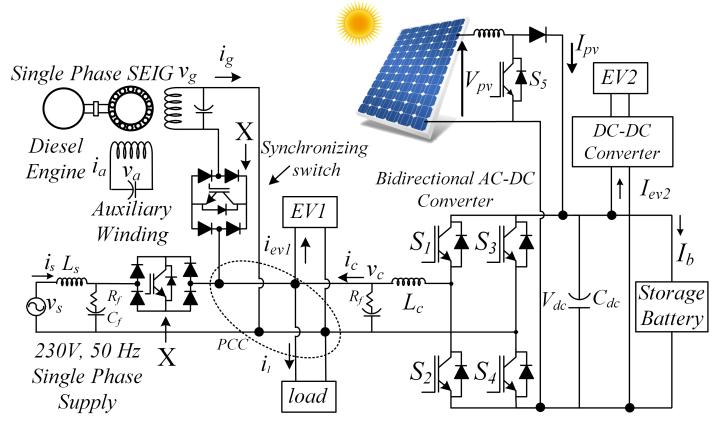
As shown in Figure 1, the presented charging station uses solarpower,batteries,DGsets,andgridpowertochargethe EVandpowertheloadconnectedtothechargingstation.The PVarrayisconnectedtoaDCvoltagesourceconverter(VSC) port with a boost converter, and the battery is connected directly totheDCport.
The grid, single phase SEIG (Self Excited Induction Generator),EV,andindirectloadareconnectedtotheACside of the VSC via a link inductor. PCC ripple filters are used to eliminatetheexchangeofharmonicsbetweenthemainsand the current generator and make these currents sinusoidal. The excitation capacitor is connected to the SEIG auxiliary window. Small capacitors are also connected to all SEIG major curves. Synchronous switches are used between the main / DG Set and the PCC to control the connection / disconnectionofthemain/DG Set'schargingchannels.
island controller produces 230V and 50Hz internal voltage references according to the concept shown in Figure 2. It combines frequency and continuity signs to generate a reference voltage. The generated reference is compared to the terminal voltage of the converter. The converter finally provides a current reference converter after electrical error is reduced using proportional integral (PI) control. The current generation error reductions and references are displayed.Representedas.
In grid tie mode, the controller is responsible for determiningtheamountofpowerbeingmodifiedbythegrid. InDGkitconnectionmode,theDGkitoperatesinfixedpower mode for maximum fuel efficiency. However, in both cases, the controller must compensate for the current demand for thecorrespondingactiveEV.
Thisisachievedbymeasuringthecurrentgridindicatoror DGsetfromthecurrentEVingridconnectionmode,whichis currentlylimited.OnlytheactivecurrentofthecurrentEVis considered. However, in the DG set connection mode, the current reference DG set is measured using both active EV current and active EV current. In this task, Adaptive Notch Suppression (ANC) outputs the current frequency of the EV. As you proceed with sampling and logic acquisition, all zero power exceeds the quadrature unit template to provide the mostactiveandefficientcurrentpowerrespectively.

VariouscontrolstrategiesusedintheCS,arediscussedhere
CS on island control guarantees stable CS performance even in the absence of a grid. In other words, AC and EV DC chargingremainsthesame,andsolarpowergenerationisnot interrupted. DC charging and solar power can be controlled by batterieswithout making manychangestothecontroller. However,ACchargingrequiresaseparateVSCcontrollerthat uses voltage readings in the output range, as electrical standards are not available without a grid. Therefore, the
By using a single DG set, the frequency and power of the DG setiscontrolledusingtheVSCshortcutcontroller.Inanother tuning, the frequency is tuned through the active power and thevoltageistunedthroughtheactivepower.Therefore,two PIcontrolsareusedtocontrolvoltageandfrequency.
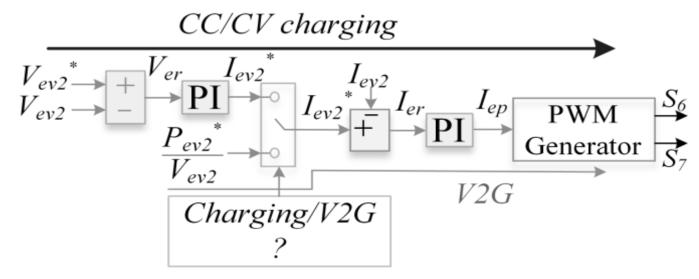
The EV connected to the DC port via a DC DC converter is controlledbycurrent/continuousvoltage(CC/CV).TheEV will be charged in CC mode until the terminal voltage of the EV battery reaches the voltage corresponding to the fully charged state. However, as soon as you get close to the desired terminal, the voltage will almost completely go into chargingmodeandEVchargingwillgointoCVmode.TheCC
© 2022, IRJET | Impact Factor value: 7.529 | ISO 9001:2008 Certified Journal | Page2167
International Research Journal of Engineering and Technology (IRJET)
e ISSN:2395 0056
Volume: 09 Issue: 06 | June 2022 www.irjet.net p ISSN:2395 0072
/ CV charging mode is controlled by two PI controls, as showninFigure3.
Charging stations operate in different ways depending on power generation and charging requirements, so individual switchingstrategiescanhelpyoumakesmoothchangesfrom onemodetoanotherand notinterruptthechargingprocess. Is required. Generated in the connected grid and placed on the islands of the DG set in the connected mode is the condition under which the logic switching mode is built. In thistechnique,thephasedifferencebetweenthetwovoltages is detected first and the regulator synchronizes the two voltagesinphase.
connected to the PCC. The production of photovoltaics exceeds the charging demand of electric vehicles, so the rest of the production is stored in electricity storage. In 0.32 seconds,thesunlightchangesfrom1000W/m2to300W/ m2. As a result, the same PV capacity is reduced and the battery starts charging and keeps charging. At 0.48 seconds, thesamePVpowerwillbe zeroandthebatterywillrunout. Thebatteryfullysupportschargingaslong asSOC>SOCmin. Afterthebatteryiscompletelydischarged,thecontrollerwill connect the CS to the grid after synchronization. After 0.79 seconds, CS started drawing power from the grid. From this point onwards, CS is supported by the DG Set due to grid availability and battery storage capacity, as shown in Figure 5.7. From the imitation results, we can see that the charging stationautomaticallychangesmodesaccordingtothepower generationanddemand.
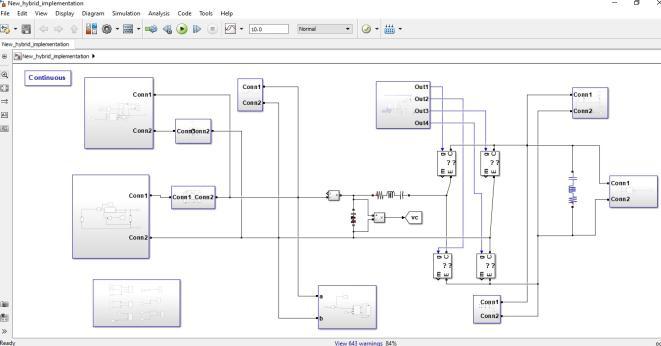
Fig.2UnifiedcontrolofVSCforstandaloneandgridandDG setconnectedmode
Fig4Simulinkmodelofchargingstationtopology
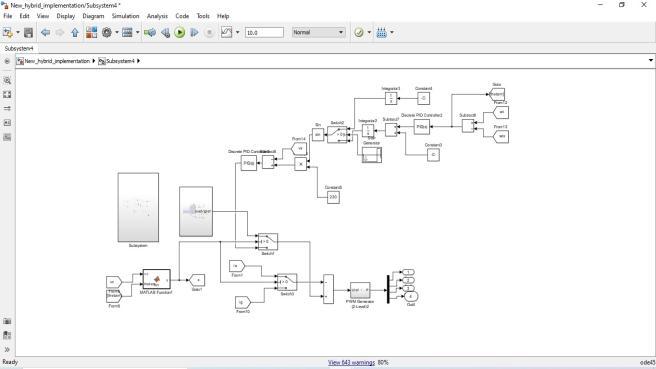
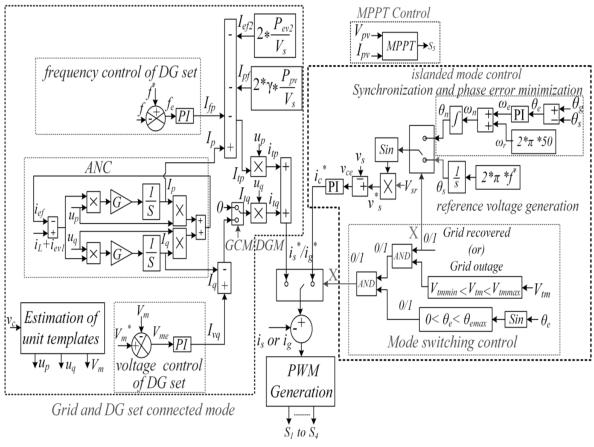
Fig5.Simulinkmodelofcontrolschemesforunified controlofVSC
Fig.3EV2controlforCC/CVchargingandV2Gpower transfer
ThesimulationresultsshowninFigures5.5to5.10showthe uninterrupted operation of CS. Initially, the CS operates in islandmodeandispoweredbythesamePVtochargetheEV
© 2022, IRJET | Impact Factor value: 7.529 | ISO 9001:2008 Certified Journal | Page2168
International Research Journal of Engineering and Technology (IRJET) e ISSN:2395 0056
Volume: 09 Issue: 06 | June 2022 www.irjet.net p ISSN:2395 0072
Fig6.SimulatedoutputscurrentsofEV1(iev1),EV2 (iev2)andload(iL)
Fig9Simulatedoutputcurrentofgenerator(ig)
Fig10Simulatedoutputofgeneratorvoltage(Vg)andDC linkvoltage(VC)
Fig7SimulatedoutputscurrentsofPVcurrent(Ipv)& batterycharginganddischargingcurrent(ib)
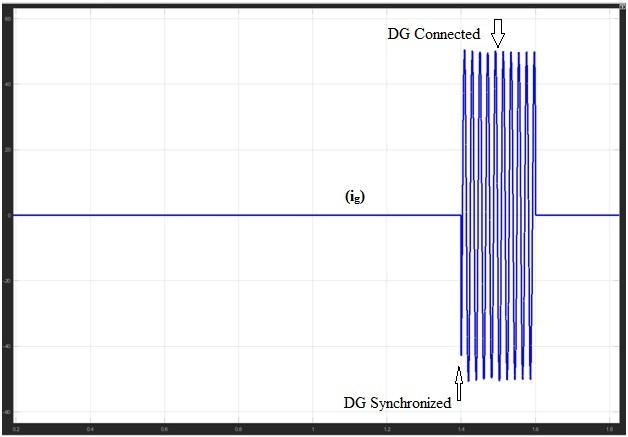
Fig8Simulatedoutputvoltagesofsupplyvoltage(VS)and DClinkvoltage(VC)
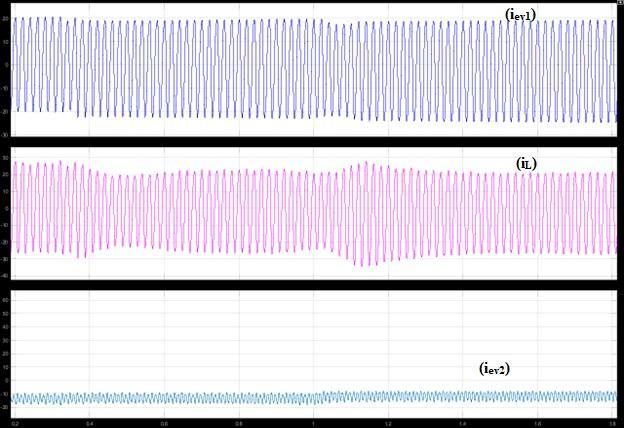
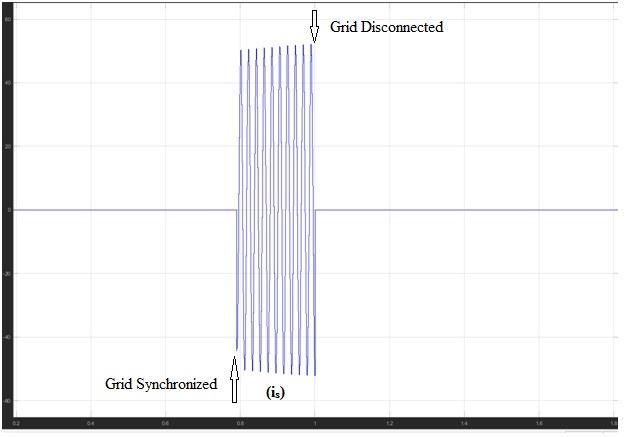
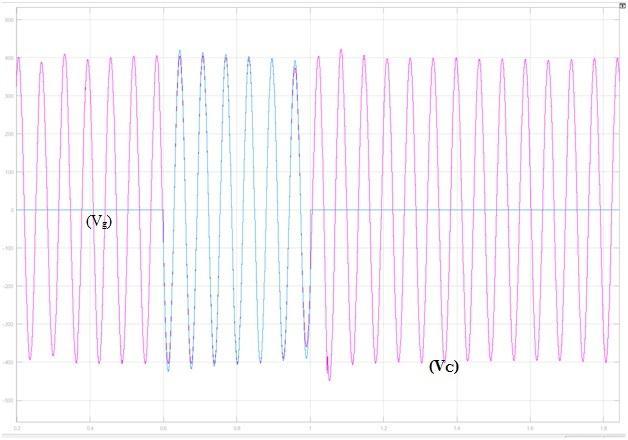
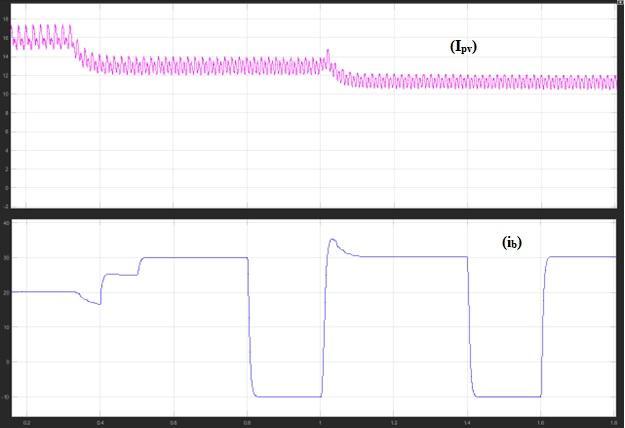
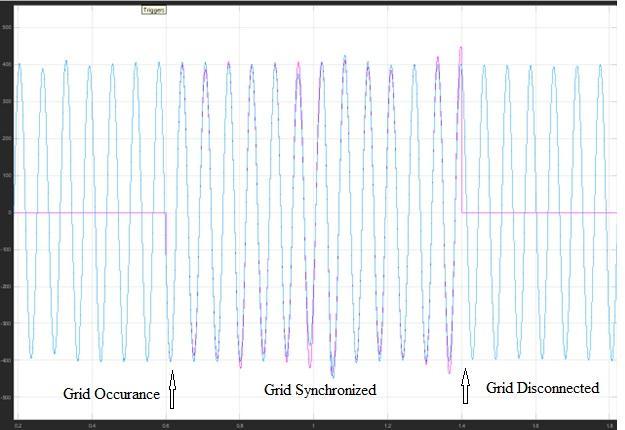
Fig11Simulatedoutputcurrentofgenerator(is)
EV charging implements PV configurations, battery storage, grids, and DG based charging stations. The results presented validate the multimode performance (island power, grid connection, and DG connection set) of a CS with onlyoneVSC.Thetestresultsalsoconfirmedthesatisfactory
© 2022, IRJET | Impact Factor value: 7.529 | ISO 9001:2008 Certified Journal | Page2169
e ISSN:2395 0056
Volume: 09 Issue: 06 | June 2022 www.irjet.net p ISSN:2395 0072
performance of the charging station under different stable and dynamic conditions resulting from changes in solar radiation,changesinthecurrentchargingEV,andchangesin load. The performance of the charging station as an independent voltage generator is guaranteed by the results presented.
[1] International Energy Agency Global EV Outlook 2018 Towards cross modal electrification. [Online] Available: https://webstore.iea.org /download/direct/1045?fileName=Global_EV_Outlook_2 018.pdf.
[2] International Energy Agency Renewables 2O18 Analysis and Forecasts to 2O23 [Online]. Available: https://webstore.iea.org/ download/summary/2312?fileName=English Renewables 2018ES.pdf.
[3] J.UgirumureraandZ.J.Haas,“OptimalCapacitySizingfor Completely Green Charging Systems for Electric Vehicles,” IEEE Trans. Transportat. Electrificat.vol. 3, no. 3,pp.565 577,Sept.2017.
[4] G. R. Chandra Mouli, J. Schijffelen, M. van den Heuvel, M. Kardolus and P. Bauer, “A 10 kW Solar Powered Bidirectional EV Charger Compatible With Chademo and COMBO,” IEEE Trans, Power Electron., vol. 34, no. 2, pp. 1082 1098,Feb.2019.
[5] V. Monteiro, J. G. Pinto and J. L. Afonso, “Experimental Validation of a Three Port Integrated Topology to Interface Electric Vehicles and Renewables With the Electrical Grid,”IEEETrans. Ind.Informat.,vol.14,no. 6, pp.2364 2374,June2018.
[6] S. A. Singh, G. Carli, N. A. Azeez and S. S. Williamson, “Modeling, Design, Control, and Implementation of a Modified Z Source Integrated PV/Grid/EV DC Charger/Inverter,”IEEETrans.Ind.Electron.,vol.65,no. 6,pp.5213 5220,June2018.
[7] K. Chaudhari, A. Ukil, K. N. Kumar, U. Manandhar and S. K. Kollimalla, “Hybrid Optimization for Economic Deployment of ESS in PV Integrated EV Charging Stations,” IEEE Trans. Ind. Informat., vol. 14, no. 1, pp. 106 116,Jan.2018.
[8] F. Kineavy and M. Duffy, “Modelling and design of electric vehicle charging systems that include on site renewableenergysources,”inIEEE5thInt.Symp.Power Electron. For Distributed Gene. Syst. (PEDG), Galway, 2014,pp.1 8.
[9] Y.Zhang,P.YouandL.Cai,“OptimalChargingScheduling by Pricing for EV Charging Station With Dual Charging Modes,”IEEETrans.IntelligentTransportat.Syst.,vol.20, no.9,pp.3386 3396,Sept.2019.
[10] Y. Yang, Q. Jia, G. Deconinck, X. Guan, Z. Qiu and Z. Hu, “Distributed Coordination of EV Charging With Renewable Energy in a Microgrid of Buildings,” IEEE Trans.SmartGrid,vol.9,no.6,pp.6253 6264,Nov.2018.
[11]N.K.Kandasamy,K.KandasamyandK.J.Tseng,“Loss of life investigation of EV batteries used as smart energy storageforcommercialbuilding basedsolarphotovoltaic systems,”IETElectricalSystemsinTransportation,vol.7, no.3,pp.223 229,92017.
[12]A. Tavakoli, M. Negnevitsky, D. T. Nguyen and K. M. Muttaqi, “Energy Exchange Between Electric Vehicle Load and Wind Generating Utilities,” IEEE Trans. Power Sys.,vol.31,no.2,pp.1248 1258,2016.
[13] Y. Shan, J. Hu, K. W. Chan, Q. Fu and J. M. Guerrero, “Model Predictive Control of Bidirectional DC DC Converters and AC/DC Interlinking Converters A New Control Method for PV Wind Battery Microgrids,” IEEE Trans.Sustain.Energy,EarlyAccess.
[14]B. Singh, A. Verma, A. Chandra and K. Al Haddad, “Implementation of Solar PV Battery and Diesel Generator Based Electric Vehicle Charging Station,” in IEEE Int. Conf. Power Electronics, Drives and Energy Systems(PEDES),Chennai,India,2018,pp.1 6.
[15] N. Saxena, B. Singh and A. L. Vyas, “Integration of solar photovoltaic with battery to single phase grid,” IET Generation, Transmission & Distribution, vol. 11, no. 8, pp.2003 2012,162017.
[16]H. Razmi and H. Doagou Mojarrad, “Comparative assessment of two different mode’s multi objective optimal power management of micro grid: grid connected and stand alone,” IET Renewable Power Generation,vol.13,no.6,pp.802 815,2019.
[17]O.Erdinc,N.G.Paterakis,T.D.P.Mendes,A.G.Bakirtzis and J. P. S. Catalão, “Smart Household Operation Considering Bi Directional EV and ESS Utilization by Real Time Pricing Based DR,” IEEE Trans. Smart Grid, vol.6,no.3,pp.1281 1291,May2015.
[18] H. Kikusato, K. Mori, S. Yoshizawa, Yu Fujimoto, H. Asano, Y. Hayashi, A. Kawashima, S. Inagaki, T. Suzuki, “Electric Vehicle Charge Discharge Management for Utilization of Photovoltaic by Coordination between Home and Grid Energy Management Systems,” IEEE Trans.SmartGrid,EarlyAccess.
© 2022, IRJET | Impact Factor value: 7.529 | ISO 9001:2008 Certified Journal | Page2170
e ISSN:2395 0056
[19]F. Hafiz, A. R. de Queiroz and I. Husain, “Coordinated Control of PEV and PV based Storages in Residential System under Generation and Load Uncertainties,” IEEE Trans.Ind.Applica.,EarlyAccess.
[20] R.W.Wies,R.A.Johnson,A.N.AgrawalandT.J.Chubb, “Simulink model for economic analysis and environmental impacts of a PV with diesel battery system for remote villages,” IEEE Trans. Power Systems, vol.20,no.2,pp.692 700,May2005.
[21]R. R. Chilipi, N. Al Sayari, A. R. Beig and K. Al Hosani, “A Multitasking Control Algorithm for Grid Connected Inverters in Distributed Generation Applications Using Adaptive Noise Cancellation Filters,” IEEE Trans. Energy Conversion,vol.31,no.2,pp.714 727,June2016
Volume: 09 Issue: 06 | June 2022 www.irjet.net p ISSN:2395 0072 © 2022, IRJET | Impact Factor value: 7.529 | ISO 9001:2008 Certified Journal | Page2171