Power Converter Configurations for Switched Reluctance Motors: A Review

Page 1

International Research Journal of Engineering and Technology (IRJET) Volume: 09 Issue: 06 | Jun 2022

www.irjet.net

e-ISSN: 2395-0056 p-ISSN: 2395-0072

Power Converter Configurations for Switched Reluctance Motors: A Review Shambhavi K N1, Dr. V Chayapathy2 1PG

Student, Dept. of Electrical and Electronics Engineering, R V College of Engineering, Karnataka, India Professor, Dept. of Electrical and Electronics Engineering, R V College of Engineering, Karnataka, India ---------------------------------------------------------------------***-------------------------------------------------------------------- The motor that converts electrical energy into Abstract - The Power Converters are an essential part of the 2Associate

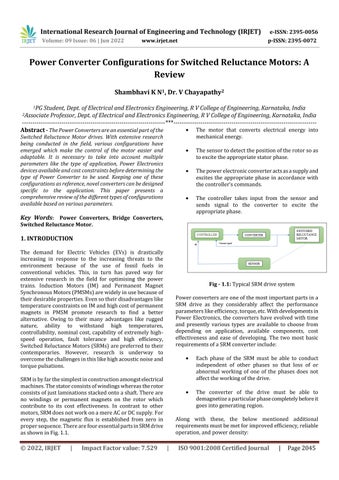
mechanical energy.

Switched Reluctance Motor drives. With extensive research being conducted in the field, various configurations have emerged which make the control of the motor easier and adaptable. It is necessary to take into account multiple parameters like the type of application, Power Electronics devices available and cost constraints before determining the type of Power Converter to be used. Keeping one of these configurations as reference, novel converters can be designed specific to the application. This paper presents a comprehensive review of the different types of configurations available based on various parameters.

The sensor to detect the position of the rotor so as to excite the appropriate stator phase.

The power electronic converter acts as a supply and excites the appropriate phase in accordance with the controller’s commands.

The controller takes input from the sensor and sends signal to the converter to excite the appropriate phase.

Key Words: Power Converters, Bridge Converters, Switched Reluctance Motor.

1. INTRODUCTION The demand for Electric Vehicles (EVs) is drastically increasing in response to the increasing threats to the environment because of the use of fossil fuels in conventional vehicles. This, in turn has paved way for extensive research in the field for optimising the power trains. Induction Motors (IM) and Permanent Magnet Synchronous Motors (PMSMs) are widely in use because of their desirable properties. Even so their disadvantages like temperature constraints on IM and high cost of permanent magnets in PMSM promote research to find a better alternative. Owing to their many advantages like rugged nature, ability to withstand high temperatures, controllability, nominal cost, capability of extremely highspeed operation, fault tolerance and high efficiency, Switched Reluctance Motors (SRMs) are preferred to their contemporaries. However, research is underway to overcome the challenges in this like high acoustic noise and torque pulsations.

Fig - 1.1: Typical SRM drive system Power converters are one of the most important parts in a SRM drive as they considerably affect the performance parameters like efficiency, torque, etc. With developments in Power Electronics, the converters have evolved with time and presently various types are available to choose from depending on application, available components, cost effectiveness and ease of developing. The two most basic requirements of a SRM converter include:

SRM is by far the simplest in construction amongst electrical machines. The stator consists of windings whereas the rotor consists of just laminations stacked onto a shaft. There are no windings or permanent magnets on the rotor which contribute to its cost effectiveness. In contrast to other motors, SRM does not work on a mere AC or DC supply. For every step, the magnetic flux is established from zero in proper sequence. There are four essential parts in SRM drive as shown in Fig. 1.1.

© 2022, IRJET

|

Impact Factor value: 7.529

Each phase of the SRM must be able to conduct independent of other phases so that loss of or abnormal working of one of the phases does not affect the working of the drive.

The converter of the drive must be able to demagnetize a particular phase completely before it goes into generating region.

Along with these, the below mentioned additional requirements must be met for improved efficiency, reliable operation, and power density:

|

ISO 9001:2008 Certified Journal

|

Page 2045


Turn static files into dynamic content formats.
Create a flipbook