International Research Journal of Engineering and Technology (IRJET) e ISSN: 2395 0056

Volume: 09 Issue: 06 | Jun 2022 www.irjet.net p ISSN: 2395 0072
International Research Journal of Engineering and Technology (IRJET) e ISSN: 2395 0056
Volume: 09 Issue: 06 | Jun 2022 www.irjet.net p ISSN: 2395 0072
Bharath D.A.1, S. Amith Nadig2 , Manjunath G.S.3
1VIII Semester, Dept. of ISE, BNMIT
2 VIII Semester, Dept. of ISE, BNMIT
3Asst. Professor, Dept. of ISE, BNMIT, Karnataka, India ***
Abstract To realise IoT promise in commercial scale applications,integratedInternetofThings(IoT)platformsare required. The key challenge is to make the solution flexible enough to fulfil the demands of specific applications. A IoT based platform for smart irrigation with a flexible design is created so that it allows developers to quickly link IoT and machine learning (ML) components to create application solutions. The design allows for a variety of customised analytical methods to precision irrigation, allowing for the advancement of machine learning techniques. Impacts on manystakeholders maybepredicted,includingIoTspecialists, whowouldbenefitfromeasiersystemsetup,andfarmers,who will benefit from lower costs and safer crop yields.
Thetypicalirrigationprocedurenecessitatesalargequantity of water use, which results in water waste. An intelligent irrigation system is desperately needed to decrease water waste during this tiresome process. Machine learning (ML) and the Internet of Things (IoT) have made it possible to develop an intelligent system that can accomplish this operation automatically and with minimum human intervention. An IoT enabled ML trained recommendation system is suggested in this paper for optimum water consumption with minimal farmer interaction. In the agriculturefield,IoTsensorsareusedtocaptureexactground andenvironmentaldata.Thecollecteddataistransferredand kept in a cloud based server that uses machine learning to evaluate the data and provide irrigation recommendations.
Key Words: IoT,ML,cloud,irrigation,water
InIndia,whereagricultureaccountsfor60 70percentofthe GDP, there is a pressing need to modernise traditional agricultural techniques in order to increase output. The groundwater table is lowering day by day as a result of uncontrolled water usage; lack of rainfall and shortage of land water also contribute to a decrease in the amount of waterontheplanet.Waterscarcityiscurrentlyoneofthe world's most pressing issues. Water is required in every sector.Waterisalsonecessaryinourdailylives.
Agricultureisoneoftheindustriesthatneedalotofwater. Waterwastageisaseriousissueinagriculture.Everytime thereisasurplusofwater,itisdistributedtothefields.
Climatechangeanditsconsequencesarewidelyexploredin academic studies on water resources and agriculture. Becauseof the potential repercussions ofglobal warming, water adaptation methods are being considered to assure wateravailabilityforfoodandhumanproductionaswellas ecosystemsustainability.Additionally,thesafetyofwaterfor humanconsumptionandreturntotheenvironmentmustbe maintained. Increased water shortages, poor quality of water, higher water and soil salinity, loss of biodiversity, increased irrigation needs, and the expense of emergency and corrective action are all possible risks from climate change. As a result of these factors, a rising number of researcharefocusingoncreatingcreativewaterutilisation in irrigation. The Internet of Things (IoT) has now progressed from a concept to being implemented in real world applications. Since then, the technological and applicationhurdleshavebeenconsiderable.
IoTplatformsenablecomplexreal timecontrolsystemsby layeringcommunicationinfrastructure,hardware,software, analytical approaches, and application knowledge. Recognizingthe expectedIoTconsequenceson systems is one of the most difficult technological issues, because IoT allowssystemstobecomeservicemashups,combiningitems asservices.Systemdevelopmentwillbecomedynamicplug and play interoperable service composition, and system logicwillbecomeserviceorchestrationasaresult.
An IoT based smart irrigation system with an effective machinelearningalgorithmisdevelopedtoassistfarmersin overcoming the uncertainty of rainfall and increasing production. This model provides a superior irrigation decision making model.Thisresearch presentsa Machine Learning(ML)strategyforsuccessfullyregulatingirrigation andenhancingagriculturalyieldasaresult.
Goldstein et al. (2017) [1] suggested a recommendation based irrigation management system that combined machinelearningwithagronomicknowledge.Accordingto the system, the best regression model with 93 percent accuracy, and the best classifier model with 95 percent accuracy,GradientBoostedRegressionTreesandBoosted Tree Classifier, provide superior irrigation prediction decisions than the linear regression model. To assist the agronomist in making better selections, the models were trainedwitheightseparatesetsoffeatures.TheInternetof
International Research Journal of Engineering and Technology (IRJET) e ISSN: 2395 0056
Volume: 09 Issue: 06 | Jun 2022 www.irjet.net p ISSN: 2395 0072
MultimediaThings(IoMT)wasproposedbyAlZu'bietal.[2] (2019),whichfocusesontheuseofmultimediasensorsin thefieldforirrigationoptimization.Digitalimageprocessing isusedtomonitorcropsandsoil.
The multimedia sensor sends the collected photos of the crops to the image processing system, which makes the choicebasedontheproportionofsoilcracks.Thismakesthe FutureNo Manirrigationmanagementsystempossible.
Accordingtothedataminingtechnique,RushikaGhadgeet al.(2018)[3]createdasystemthatemploysbothsupervised andunsupervisedML algorithms to forecastcropandsoil quality and kind of land, as well as assess the nutrients present in the soil to boost agricultural yield. This effort assistsfarmersincultivatinghealthiercropsintheproper soil to increase yield, as well as serving as a conduit for providing timely information to farmers regarding crop quality and nutrient requirements. For soil moisture estimation, a learning model based on Support Vector Regression (SVR) and K means clustering was created. Humidity,radiation,soilmoisture,air,andsoiltemperature were all captured in the field and sent into the training systemofSVRmodel.
Toincreaseaccuracyandreduceerrorrate,theSVRmodel output is sent to K means clustering. For optimal yield management,thefinaloutputfromk meansisemployedto governthewaterpumpcontroller.However,themajorityof the older prediction models had a large variance, which causes the machine learning model to perform poorly. Ensemble learning, as described by Zhao et al. (2018)[4], Catolino and Ferrucci[5] (2018), Joshi and Srivastava[6] (2014),andRenetal.[7](2016),maybeutilisedtodealwith suchsignificantvariation.Bycombiningdifferentlearning modelstopredicttheoutputofa single system, ensemble approachesimproveperformance.
Someensembleapproaches,particularlybagging,havebeen shown to decrease the problem of overfitting and underfitting of training data. The Bootstrap Aggregation approach improves single regression trees by using many models, each of which is trained using randomly selected samplesfromtheoriginaldataset.Thebaggingapproachhas a smaller prediction error than the other single models. Gonzalez et al. (2014)[8] provide a bagging method for forecasting power price that is compared to the random forest approach for both classification and regression models.
Acompleteliteraturestudywasconducted,andthepaper suggestssomeofthemostefficientfeasibletechnologiesand algorithms for the creation of a Smart Farm Monitoring Systembasedonthefindingsoftheliteratureresearchand experiments. Ersin et al.[9] suggested a microcontroller based irrigation system that is more efficient and cost effective than other traditional techniques. Liu et al. describedprecisionirrigationtechnologies.[10].Agrawalet
al.presentedasmartirrigationsystemusingRaspberryPi andArduino.[11].Koprdaetal.presentedamicrocontroller basedirrigationsolution.Ahouandjinouetal.discussfarm pestdetectionusingultrasonicsensorsintheirpaper[12]. [13].Goapetal.[14]providedafulloveralldesignforanIoT basedirrigationsystem.
Smithetal.[15]presentedmachinelearningalgorithmsfor soilcategorization.Wuetal.[16]investigatedafarmvehicle andsmartdispatchingstrategy.Ryuetal.[17]presentedan integrated method to smart farming. Kwok et al. [18] proposed utilising deep learning to recognise plants and thendeterminingtheoptimalwateringvolumedependingon planttype. Wang, Muzzammel,Raheel,andcolleagues[19] explored deep learning and an altitude based economical irrigationtechnique.AWSNtechniqueforprecisionfarming waspresentedbyMartinelletal.[20].Izquierdo etal.[21] suggestedasmartfarmingsolutionbasedoncloudandedge computing.
Bacco [22] provided a detailed smart farming method in their study effort, including all constraints, enablers, and prospects. This paper emphasises and presents a comprehensive, precise picture of the feasible answer for agricultural demands following a thorough analysis of currentlyaccessibleliteraturethatdealswithcontemporary farmingchallengesandtheirassociatedsolutions.Thepaper describes a distributed sensor network field whose prototypewascreatedforthisresearch.
Ingeneral,thereisnoautomatedirrigationmethodthatis beingusedallovertheworld.However,somestudyhasbeen done in the topic of automating the watering process. In mostexistingstudies,the followingisthebasicmethodfor Automated Irrigation: To begin, data is collected from severalsensorstodeterminethemoisturecontentofthesoil and the temperature of the surrounding environment. They're attached to a breadboard that's wired up to the Arduinoboard.TheArduinoIDEreceivesthedatafromthe board. The programming language employed executes instructionsthatextractdataandreflectit,i.e.,adecisionis madewhethertoturnthewaterpump"On"or"Not"based ontheextracteddata
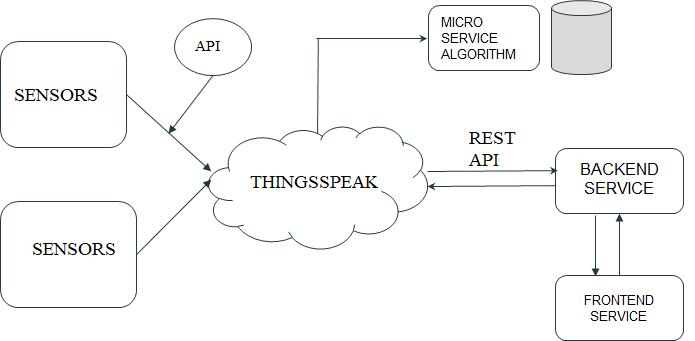
Step 1: As demonstrated in Fig. 1, irrigation can be automatedutilisingsensors,microcontrollers,Wifimodules, and the ThingSpeak platform. A controller is necessary to maintainallofthesensorsandtodrivethemotorasneeded. WeutilisedNodeMcutoaccomplishthis.TheNodeMcucan outputamaximumvoltageof5volts.Themoisturesensors moduleandDTH11sensorcanbothbepoweredby5volts, butnotthemotor.Weneedatleast7voltstorunamotor.To
International Research Journal of Engineering and Technology (IRJET) e ISSN: 2395 0056
solvethisissue,weutiliseda9vbatterytopowerthemotor. We'll need a switch to regulate the motor whenever it's needed.Weutilisedarelaymoduletoaccomplishthis.It'sa switch in the electrical system. We must deliver a strong pulsetothemoduleinordertoclosetheswitch.Thefieldis constantlymonitoredbythesoilmoisturesensor.NodeMCU isattachedtothesensors.Thesensordataissenttotheuser viawirelesstransmissionsothathecanmanageirrigation
rather than building separate specialised models and determiningtheirperformance.
When the soil moisture falls below a certain threshold, a motor will switch on. Instead of turning on the motor immediately,weexaminetheprobabilityofrainusingthe above mentioned ensemble methodologies, and if rain is likelytooccurduringthattimeperiod,wewaitawhile.From crop to crop, the threshold level will differ. If a crop need morewater,wewillincreasethehighthresholdlevelsothat the crop receives more water. Alternatively, if the crop requireslesswater,wewillspecifyalowvalue
Hardware used:
Step2:Finally,allthedataneedstobethereinThingSpeak forvisualisation.byusingwriteAPIkeys wewill sendthe sensordatatotheserver.InThingSpeakwecanvisualisethe dataofeverysensoroverthetime.
Step3: Fetching the data from ThingSpeak to our python script
1. Importallrequiredlibraries(json,urllib.request).
2. CreateanAPIusingREAD_API_KEYandCHANNEL_IDof ThingSpeak.
3. RequesttheThingSpeakwebsitebyusingurllib.request module.
4. StorethejsonresponsefromThingSpeak.
5. Retrievetemperature,Humidity,Soilmoisturevalues fromjsondata.
Step4:
1. The weather data was obtained through the Kaggle platform.
2. The performance of rainfall prediction is benchmarked usingavarietyoflearningmethodsinthiswork.Theseare thesupervisedlearningmethodsNB,C4.5,SVM,ANN,and RF.
3.AnensembleoftheabovemodelsisusedtotrainaVoting Classifier, which predicts an output (class) based on the output'shighestlikelihood.Itsimplysumsuptheresultsof eachclassifierfedintotheVotingClassifierandpredictsthe outputclasswiththemostvotes.Weproposeasinglemodel thattrainsonnumerousmodelsandpredictsoutputbased on the cumulative majority of votes for each output class,
1.NodeMcuESP8266 2.SoilMoistureSensorModule 3.SubmersibleDCmotor 4.DTH11sensor 5.Relaymodule
Software used: 1.ArduinoIDE 2.ThingSpeak 3.GoogleSites
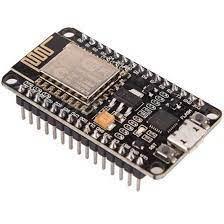
NodeMcuEsp8266:It'sanIoTgadgetthat'sopen source.It's a32 bitmicrocontrollerthatallowsWi Fi connectedgadgets tosendandreceivedata.It'salow costsemiconductorwith TCP/IPnetworkingsoftwarebuiltin.Thereare17GPIOpins on this board. It contains a Tensilica L 106 RISC CPU that usesverylittleelectricity.It'scompatiblewithADCs,power amplifiers,andcertainpowermanagementmodulesareall available. It contains 4KB of memory storage. Figure 1 depictsNodeMcuinitsmostbasicform.
SoilMoistureSensorModule:Thepurposeofasoilmoisture sensor is to determine the amount of water in the soil. It comprisesmostlyofapairofconductingprobes.Thechange inresistancebetweenthoseprobesisusedtocalculatethe moisturecontent.Thequantityofmoistureinthesoilhasan
Volume: 09 Issue: 06 | Jun 2022 www.irjet.net p ISSN: 2395 0072 © 2022, IRJET | Impact Factor value: 7.529 | ISO 9001:2008 Certified Journal | Page2110
International Research Journal of Engineering and Technology (IRJET) e ISSN: 2395 0056
Volume: 09 Issue: 06 | Jun 2022 www.irjet.net p ISSN: 2395 0072
inverserelationshipwithresistance.Ittransmitsanalogue data.
The value will vary from 0 to 1023 after feeding this into ADC. As a result, if there is no water in the soil, the value decreases. 1023 will be the number. So for changing this valueintopercentweneedmap(0,1023)to(1,100)which canbedoneusingmapfunction.
RelayModule:It'satypeofelectricalswitchthatworksby usingmagnetism.TheRelaymodule'sprimaryfunctionisto controlthemotor.TheNodeMcu'smaximumoutputvoltage is5volts,whichisinsufficienttodrivethemotor.So,todrive themotor,we'llconnecttherelaymoduletotheNodeMcu, andpowerthemodulewitha9vbattery.Wewillsendahigh tolowpulsetotherelaymoduleanytimewewanttoturnon the motor, the switch will shut, and 9v will be sent to the motor.ThesinglechannelRelaymoduleisshowninFig5as anexample
Submersible DC: motor is one that can be completely immersedinwater.Inordertopreventwaterfromentering the motor, it is hermetically sealed. It converts rotational energy into kinetic energy, which is then converted into pressure energy, which pushes water to the surface. This engine will be submerged in water, with a conduit connectingittothewater'soutput.
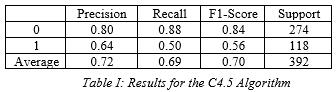
The categorization technique C4.5 is one of the most effective. C4.5 generates a decision tree, where each node divides the classes according to the information. The property with the highest normalised information gain is used to determine the splitting criteria. Humidity and temperature,forexample,areincludedinourdatacollection. The C4.5 algorithm investigates these aspects first to determinewhichisoptimalfordatasplitting(afeaturewith maximuminformationgain).Afterthat,thefeatureisutilised to partition the dataset into the following feature till it reaches the final destination. The algorithm's output is showninTable.
DTH11sensor: It'sa multi purposesensorthatmeasures temperatureandhumidityintheenvironment.Itismadeup of humidity detecting material and a temperature sensing thermistor.Ahumiditydetectingmaterialisacapacitorwith humidityasadielectricsubstancebetweenthem,causingthe capacitancetoalterasthehumiditychanges.Weunderstand howthermistorsfunction.Theresistancevaluefluctuatesas afunctionoftemperature.Itoperatesat3 5volts,whichwe canacquirefromtheNodeMcu.
Nave Bayes is a supervised machine learning model that belongstothefamilyofprobabilisticclassifiersthatapplies the Nave Bayes theory to the dataset's independence assumption. By computing the assumptions, Nave Bayes determines the probability of each feature in the dataset. Nave Bayes determines every attribute conditional probability on the class label for every known class label. The product rule is then used to calculate the joint conditionalprobabilityforthecharacteristicsofalabel.The Nave Bayes model is then used to derive the conditional probabilityfortheclasscharacteristics.Theclasswiththe highestprobabilityisprovidedafterperformingthismethod foreachclassvalue.Theresultsofthealgorithmareshown inTable.
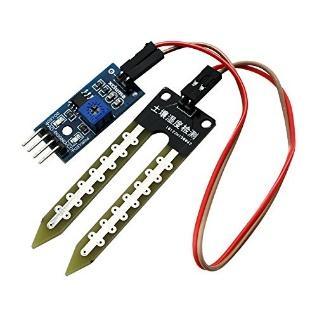
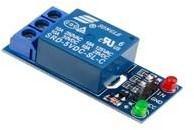
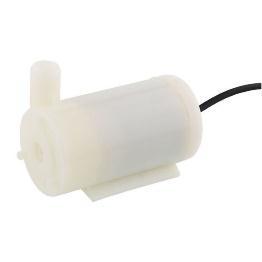
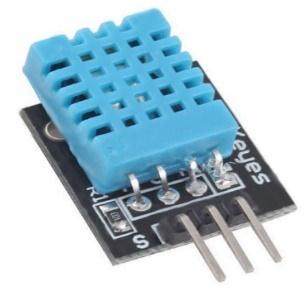
Fig - 4: DTH11Sensor
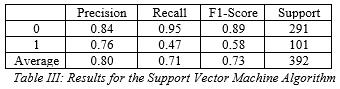
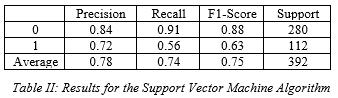
The support vector machine is a machine learning model thatusesahyperplanetopartitionadatasetintotwopieces This partitioning procedure treats each class label
International Research Journal of Engineering and Technology (IRJET) e ISSN: 2395 0056
Volume: 09 Issue: 06 | Jun 2022 www.irjet.net p ISSN: 2395 0072
separately,anditmaybedonebyclassifyingthedatainto class A and not class B, where A and B are the two class labels.CalculatingtheEuclideandistancebetweeneachdata point and the hyperplane's margin is used to classify the data.Whendatacannotbelinearlyseparatedinalowerlevel space,theSupportVectorMachinemodelemploysakernel, which is a set of scientific functions, to allow for data categorization in a complicated dimensional space. In machinelearning,manykernelfunctions,suchasradial,are availabletoregulatetheabove.
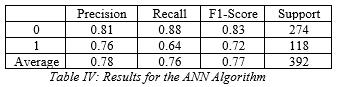
Exhibit machines that mimicked the brain's functions influencedthedevelopmentofneuralnetworks.Everybrain unitislinkedtoaslewofothers.Intermsoftheinitialstate effect of the linked neuronal units, links might be either enforcingorinhibitory.Asummingfunctionmightbeusedto unite the input values of each individual brain unit. This modelisutilisedinregressionandclassification,aswellas predictionandclustering.Therearetwoprimaryfactorsthat have a substantial impact on the performance of neural networkclassifiers.Thenumberofhiddenlayersisthefirst, andthevalueofthelearningrateisthesecond.Theresults ofthealgorithmareshowninTableIV.
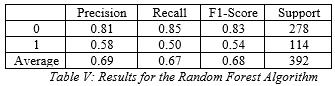
Randomforestisamachinelearningmodelthatmaybeused for prediction, regression, and classification, among other things.Thisalgorithmisanensembleofdecisiontreemodels thataimstoproduceamultiplicityofdecisiontreemodels fromthesametrainingdataandgeneratethefinalclassas the output. The number of characteristics to freely study (NumFeatures),maximumdepthofthetree(MaxDepth), andnumberoftrees(NumTree)parametersaremodifiedin the random forest classifier. The findings of the research show shows the Random Forest classifier's classification performanceimprovesasthenumberoffeatures,trees,and depthgrow.TheresultsofthealgorithmareshowninTable.
A.C4.5Algorithm
Accuracy:0.77
B.NaïveBayes
Accuracy:0.81
C.SupportVectorMachine
Accuracy:0.82
D.NeuralNetworks
Accuracy:0.77
E.RandomForest
Accuracy:0.75
Machine learning based prediction performance varies amongst algorithms, with the artificial neural network approach having a modest performance edge over other categorizationmodels.Eachmodelhascertainflaws,butthe overall outcome is always better since the error rate is reduced.Whenonemodelfails,othermodelswillstepinto help.Becausewe'reemployingensemblelearning,we'lltake intoaccountamixofmodelknowledge.amajorityofpeople Avotingmodelisconstructedthattrainsonamixtureofthe aforementionedmodelsandpredictsanoutput(class)based on the majority of the highest likelihood of each model's preferredclassastheoutput.Itsimplyaggregatestheresults ofeachmachinelearningmodelfedintoVotingClassifierand predictstheoutputclassbasedonthemostvotes.
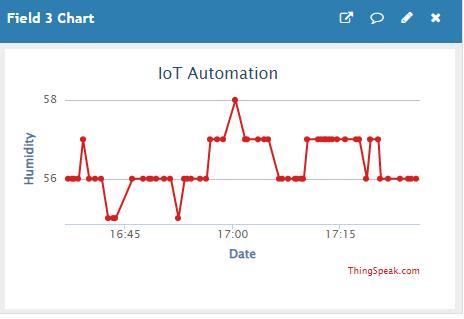
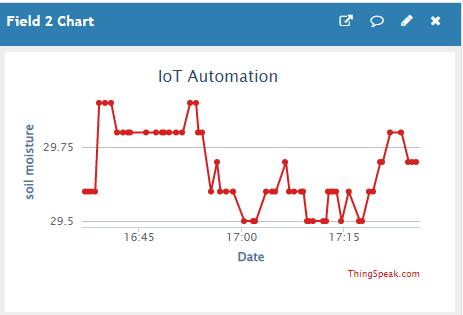
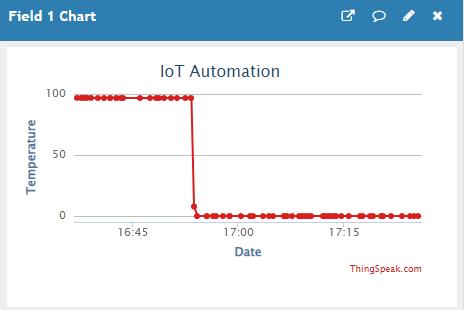
The representation of detected data via sensors in ThingSpeak is shown in Figures 11,12,13. It aids in the
International Research Journal of Engineering and Technology (IRJET) e ISSN: 2395 0056
Volume: 09 Issue: 06 | Jun 2022 www.irjet.net p ISSN: 2395 0072
interpretation of data. We may use this data to combine, transform, and create new data, and we can use built in charting algorithms to graphically grasp the relationships betweenthedata.Inthefuture,we'llbeabletocombinedata fromnumeroussourcestoprovideamorecomplexstudy.
Fig 6: FieldChart1
Regular crop updates, such as moisture, humidity, and temperature,arecriticalinagriculture.Climateforecasting data accuracy has increased dramatically as a result of technologicaladvancements,andweatherforecastingdata maynowbeutilisedtoestimaterainfallinaspecificlocation. To estimate rainfall possibilities, this study suggests an AutomatedIrrigationSystemthatusestheInternetofThings andEnsembleLearningtechniques.Thesuggestedtechnique predictsrainfallinthenearfuturebycombiningsensordata from the recent past with weather projected data. We utilised the Ensemble learning approach to forecast the likelihood of rain on that particular day. Rather than constructing separate specialised models and calculating classificationmetricesforeachofthem,themainpurposeof this technique is to develop a single model that trains numerous modelsandclassifiestheoutputbasedontheir aggregatemajorityofvotesforeachoutputclass.Forecasted rainfall possibilitiesaresuperiorin termsofaccuracyand mistake rate. A solo system prototype can also use the prediction method. The system prototype is low cost becauseitisbasedonopen sourcetechnologies.We'dliketo perform a water saving study based on the suggested techniqueinthefuture,withmorenodesandalowersystem cost.Theirrigationsystemautomationweprovidedaspart of our strategy performed wonderfully. It's also cost effective.Usingthistechnique,wecanreducethenumberof peopleneededinthefieldsforupkeep.Thisapproachwill not only irrigate the ground automatically based on the moisturelevel in the soilandthepossibility of rain, but it willalsosendthedatatotheThingspeakserver,allowingthe farmertokeeptrackoftheland'sstatus.
[1].Muhammad Ayaz, Mohammad Ammad Uddin, Zubair Sharif, Ali Mansour And El Hadi M. Aggoune (2019). “Internet Of Things (Iot) Based Smart Agriculture: TowardMakingTheFieldsTalk”.SpecialSectionOnNew TechnologiesForSmartFarming4.0.
[2].HamzaBenyezz,MounirBouhedda,SamiaRebouh(2021). “Zoningirrigationsmartsystembasedonfuzzycontrol technologyandIoTforwaterandenergysaving”.Journal of Cleaner Production Volume 302, 15 June 2021, 127001
[3].VaishaliS,SurajS,VigneshG,DhivyaSandUdhayakumar S (2017). “Mobile Integrated Smart Irrigation Management and Monitoring System Using IOT”. InternationalConferenceonCommunicationandSignal Processing,April6 8,2017,India.
[4].NurzamanAhmed,DebashisDe,andMd.IftekharHussain (2018). “Internet of Things (IoT) for Smart Precision Agriculture and Farming in Rural Areas”. IEEE
International Research Journal of Engineering and Technology (IRJET) e ISSN: 2395 0056
INTERNET OF THINGS JOURNAL, VOL. 5, NO. 6, DECEMBER2018
[5].Jhonn Pablo Rodríguez, Ana IsabelMontoya Munoz, Carlos Rodriguez Pabon, Javier Hoyos, Juan Carlos Corrales(2021).“IoT Agro:Asmartfarmingsystemto Colombiancoffeefarms”.ComputersandElectronicsin AgricultureVolume190,November2021,106442
[6].Md. Rezwan Hossain Naeem, Shadman Gawhar, Md. BelawalHoqueAdib,SanjidAhmedSakib, AbirAhmed and Nafiz Ahmed Chisty(2021). “An IoT Based Smart IrrigationSystem”.20212ndInternationalConference onRobotics,ElectricalandSignalProcessingTechniques (ICREST)
[7].H.G.C.R.Laksiri, H.A.C.Dharmagunawardhana, J.V.Wijayakulasooriya “Design and Optimization of loT BasedSmartIrrigationSysteminSriLanka”.2019IEEE 14th International Conference on Industrial and InformationSystems(ICIIS),18 20Dec.,Peradeniya,Sri Lanka
[8].Neha K.Nawandar, Vishal R.Satpute(2019). "IoT based low cost and intelligent module for smart irrigation system”. Computers and Electronics in Agriculture Volume162,July2019,Pages979 990
[9].A.Anitha,NithyaSampath,M.AshaJerlin(2020).“Smart Irrigation system using Internet of Things”. 2020 International Conference on Emerging Trends in InformationTechnologyandEngineering(ic ETITE)978 1 7281 4142 8/20/$31.00 ©2020 IEEE 10.1109/ic ETITE47903.2020.271
[10]. Thilina N. Balasooriya, Pranav Mantri, Piyumika Suriyampola(2020).“IoT BasedSmartWateringSystem Towards Improving the Efficiency of Agricultural Irrigation”. 2020 IEEE Global Conference on Artificial Intelligence and Internet of Things (GCAIoT) | 978 1 7281 8420 3/20/$31.00©2020IEEE|DOI:10.1109/ GCAIOT51063.2020.9345902
Volume: 09 Issue: 06 | Jun 2022 www.irjet.net p ISSN: 2395 0072 © 2022, IRJET | Impact Factor value: 7.529 | ISO 9001:2008 Certified Journal |