International Research Journal of Engineering and Technology (IRJET) e-ISSN: 2395-0056
Volume: 09 Issue: 06 | Jun 2022 www.irjet.net p-ISSN: 2395-0072
International Research Journal of Engineering and Technology (IRJET) e-ISSN: 2395-0056
Volume: 09 Issue: 06 | Jun 2022 www.irjet.net p-ISSN: 2395-0072
V. MADHUSUDHANA RAO1 , A. NAGARAJU2 , A. KRISHNAVENI3, S. NAGARAJU4
1Senior lecturer in Electrical and Electronics Engineering, GPT Station ghanpur 2 lecturers in Electrical and Electronics Engineering, GPW Siddipet 3 lecturers in Electrical and Electronics Engineering, GPT Warangal
4 Senior lecturers in Electrical and Electronics Engineering, GPT Bellampally ***
Abstract A significant possibility for lowering greenhouse gas emissions is the usage of electric automobiles. Electric cars not only lessen reliance on fossil fuels but alsolessenthe effects of ozone depleting compounds and encourage the widespread use of renewable energy sources. Electric vehicle production and network modelling continue to change and are limited despite extensive study on the qualities and traits of electric vehicles as well as the makeup of their charging infrastructure. The study addresses the various modelling approaches and optimization strategies used in studies of the market penetration rates of battery electric vehicles, hybrid electric vehicles, plug in hybrid electric vehicles, and electric vehicles. For a developing nation like India, the studyis unique in that it addresses crucial hurdles including insufficient charging infrastructure.
Key Words: electricvehiclesTechniqueforvehicletogrid optimizationCO2reduction
ElectricVehicles(EVs)areevolvingasapromising avenue for enhancing air quality, energy security, and economicopportunityasaresultoftherapidlyexpanding Indianautomobilemarket.TheIndiangovernmentisaware of the pressing need to investigate sustainable mobility optionstolessenrelianceonimportedenergysources,cut greenhousegasemissions,andlessenthenegativeeffectsof transportation, such as global warming. By taking preventative efforts to lessen the catastrophic climate change that threatens the life on this planet, the carbon dioxide output can be decreased. Significant efforts have been made to reduce the use of fossil fuels for energy production,transportationpropulsion,energyconsumption reduction, and carbon sequestration protection. Electric vehicles(EVs)mightbeasolutiontoreducecarbondioxide gasemissions[1].
Althoughtheuseofelectricvehicleshasbegun,peoplestill rely on fossil fuel powered vehicles. However, EVs face challengesinlifecycleanalysis(LCA),charging,andrange compared to traditional fossil fuel vehicles. The CO2 emissions of electric vehicle production are (59%) higher thantheCO2emissionsofICEV.ICEVsgenerate120g/km
of CO2 emissions on a tank to wheelbase basis, which increasesfrom170to180g/kmfromanLCAperspective. Tank to wheelEVshavenoCO2emissions,butaverageCO2 emissions are estimated to be measured throughout the vehicle's life cycle, not the entire vehicle. Lifetime CO2 emissionsvarywidelydependingontheenergysourcefrom whichthevehicleismanufacturedandoperated[2].
Harmful emissions from the transportation sector and investment from various OEMs raise concerns about producingmoreandcheaperelectricvehiclesinthecoming years. Several factors, such as technological advances, vehicle cost reductions, government support, vehicle purchasing incentives, parking benefits, and good public charginginfrastructure,canleadto theadoptionofEVsin India.EVproductionissolowthattheoverallshareofEVsin the Indian market is negligible. EVs include i) electric motorcyclessuchaselectricbicyclesandscooters(E2W),ii) three wheeledvehiclessuchaselectricbicycles,andiii)four wheeledvehiclesconsistingofelectricvehicles.RevaElectric Car,India'sfirstelectricvehiclecompanytolaunchcarsin the early 2000s, focuses on making affordable cars with advanced technology. As the only BEV manufacturer, Mahindra Electric Mobility Ltd is a leader in the Indian market.AnothermajorHEVmanufactureroperatinginthe IndianmarketisToyotaKirloskarMotorPvt.Limited,BMW AG, Volvo Car Corporation, Honda Motors Co. Ltd. Other models include Mahindra e2oPlus, Mahindra e Verito, Mahindra e KUV 100, Eddy Current Controls Love Bird, AtomMotorsStellar,andTataTiagoElectric[3].
In2014,India'stotalgreenhousegasemissionsreached322 milliontonsintermsofcarbondioxide,accountingfor6.55% of the world's greenhouse gas emissions. In India, 68% of GHG emissions come from the energy sector, followed by agriculture, manufacturing processes, land use improvement,forestryandwaste,19.6%,6.0%and3.8%of GHG emissions. It accounts for% and 1.9%. Four]. The electricvehiclecanbeusedasaflexibleloadtointegratethe gridinasignificantportionoffluctuatingrenewableenergy production[5].Electricvehicleownersdonottradeinthe electricitymarketduetothepoorperformanceofasingle transaction [6]. Some authors [7], [8], [9], [10], [11], [12] estimatecurrentsmartpoliciesthatarepre establishedand
© 2022, IRJET | Impact Factor value: 7.529 | ISO 9001:2008 Certified Journal | Page

International Research Journal of Engineering and Technology (IRJET) e ISSN: 2395 0056
Volume: 09 Issue: 06 | Jun 2022 www.irjet.net p ISSN: 2395 0072
extrinsic for changing scenarios. We are considering a generalwaytodothis.Totakefulladvantageofthepotential ofelectricvehicles,flexiblechargingandintelligentcharging strategies needtobeimplemented.Another study by[13] showedthatEVusersareorganizedtocommunicatetheir timeandenergyneedstoaggregators.Timingrequirements definetheamountoftimethatchargingmustbecompleted while the battery level supports energy requirements. Similarstudiesconductedby[14]suggestthatdecentralized frameworksandcentralinstitutionsshouldsignalEVowners who expect centralized and decentralized frameworks to overlap.
BradyandMahony,2016[15]investigatedelectricvehicle stochastic simulation techniques to generate dynamic schedules and charging profiles for powering electric vehiclesinthisrealworld.Theyconcludethatincreasingthe parkingtimedistribution conditionimprovesnotonly the overallaccuracyofthemodel,butalsotheaccuracyofthe parking time distribution. Morrissey et al. , 2016 [16] surveyedsomeEVconsumersandshowedthattheyprefer tochargetheircarsathomeduringpeakeveningelectricity demand.Foleyetal.,2013[17]investigatedtheimpactofEV charginginpeakandoff peakchargingscenariosinIreland's singlelargeelectricitymarketandfoundthatpeakcharging was at a disadvantage compared to off peak charging. Doucette and McCulloch, 2011 [1] conducted a study to determine carbon emissions for BEVs and PHEVs and compared the results with Ford Focus's CO2 emissions. Steinhilber et al. , 2013 [18] explored the basic tools and strategiesforadoptingnewtechnologiesandinnovationsby investigating the major barriers to electric vehicles in the two countries. Yu et al. , 2012 [19] introduced driving pattern recognition technology for assessing the range of electric vehicles based on driving segment sharing algorithms.Hayesetal.,2011[20]buildsvehiclemodelsfor differentdrivingconditionsandterrain.Salahetal.,2015 [21] investigated the impact of EV charging on Swiss substationsandfoundthathigherpenetranceanddynamic ratesincreasetheriskofcongestioninsomelocations.These parametersarethencomparedtoeachotherbasedonthe rangetype.Observersin[22],[23],[24],[25],and[26]non linearlyinvestigatedtheeffectsofdifferentclassificationsof electricvehiclechargingmethodsonpublicpowergridsand storage utilization. .. Estimate the torque of a permanent magnetsynchronousmotorforahybridelectricvehicle.The maximumtransferabletorquemethodisdeterminedby[27], [28], which enhances the non slip design of the torque control frame and improves the stability of the electric vehicle. Lu et al. , 2013 [29] outlined the most important aspects of lithium ion battery management for electric vehicles. Topics such as battery cell voltage, battery state estimation (battery SOC, SOH, DOD, and SOF), battery balance and uniformity, and battery failure analysis can provide motivation for research and design of battery management systems. A review of optimal management strategies, energy management systems, and modeling
approachesforelectricvehicleshasbeenreviewedby[30], [31],[32],and[33].
Wehavestudieddiverseformsofelectricpowered motors exiting at gift throughout the world. Besides this, we'vegotfoundouttheobstaclesofEVwithinsidetheIndian market.Differentformsofoptimizationstrategiesalsoare mentionedandaresuppliedinTable2.Theuniqueevaluate onElectricVehiclesbecamestudiedandissuppliedinFig.1. Thispaperisbasedintosomesegmentssuchas:Section2 describes the methodology. Section three explains the evaluate of all forms of electric powered automobile configurationaccompaniedviawayofmeansofitscharging stateofaffairsinSectionfourandthebarrierofEVinSection 5.Theoptimization method forEVand V2Gis supplied in Section6,accompaniedviawayofmeansofaendinSection 7.
Thegrailatthebackoftheelectricalcaristoupdate aninnercombustionenginewithanelectricpoweredmotor thatispoweredviawayofmeansofthepowersavedwithin sidethebatteriesviastrengthdigitaltractioninverter.The Electric motor makes use of 90 95% of enter power to strengththecar,whichmakesitacompletelygreenone.The keyadditivesofanElectricvehiclearebattery,chargingport, charger, DC/DC converter, strength electronics controller, regenerativebraking,andpressuresystem.
Themotiveoftheelectricalmotoristhatitmakes useoftheelectricpowersavedinbatteriesforpoweringthe Electric vehicle. The EVs end up environment pleasant as they'rerechargedwithdecreaseemissionstrengthsources. Thecellsarechargedfromtheelectricalgrid.Thenumber onefeatureofthebatteryistoofferstrengthtotheElectric vehicle for making it in strolling condition. Generally, EVs uselithium ionbatteriesduetothefactthey'regreatergreen than different cells because of their light weight and negligible protection. The production of those Li ion batteries is bit high priced in comparison to the nickel metallichydrideandlead acidbatteries.Dependinguponthe climaticregionandprotectionschedule,theLi ionbatteries lastaslongaseighttotwelveyears.
Thechargingportisthefactorthatletsinthecartohookup withanoutsidestrengthdelivermachinethruachargerto pricethebattery.Thecharacteristicofthechargeristotake ACdeliverfromthestrengthsupplytheusageofapriceport andconvertsitintoDCstrengthforchargingthebattery.It additionally video display units the voltage, current, temperature and state of price of the battery even as chargingit.TheDC/DCconverterconvertsexcessivevoltage DCfromthebatterytolowvoltageDCstrengthtorunthecar accessories.Thestrengthelectronicscontrollercontrolsthe velocity of the traction motor and torque with the aid of
International Research Journal of Engineering and Technology (IRJET) e ISSN: 2395 0056
Volume: 09 Issue: 06 | Jun 2022 www.irjet.net p ISSN: 2395 0072
usingdealingwiththewaftofelectricalelectricityfromthe traction battery. The regenerative braking performs an crucial function in keeping car energy and accomplishing steppedforwardelectricity.Thisbrakingtechniquemakes use of the mechanical electricity from the motor and convertskineticelectricityintoelectricelectricitytoprovide again to the battery. Regenerative braking additionally complements the variety of the EV, so it's miles broadly followed inall hybridandBEVmodels.Here the electrical motor generates ahead momentum while the auto movementsahead,andwhilethebrakeisapplied,itmaybe used to price the batteries, that's called regenerative braking. It can get better 15% of used electricity for acceleration. Being an powerful component, it's miles not abletorechargetheelectricalcarfully.
Thefunctionofthepowergadgetistogeneratemovement withtheaidofusingmovingthemechanicalelectricityinto thetractionwheel.Basedontheusageoftheadditives,the electricalautomobilehasnumerousinnerconfigurationsand does now no longer require traditional transmission. For example,afewlayoutmakesuseofmorethanonesmaller automobilesmeantforpoweringeverywheelindividually. On the opposite hand, a huge electric powered motor probable is coupled to the rear wheels the usage of differential housing. The electric powered powered automobilemakesuseoftonslessdifficultadditiveswhilst in comparison with the factors of a gas powered vehicle engine.However,electricpoweredautomobilesmightnow nolongercrosstonsquickerasagaspoweredvehiclecan.
Inthispaper,thechargingcallforofEVischaracterizedwith the aid of using numerous frameworks in one of a kind geographical locations. The framework includes Random software version, Activity primarily based totally equilibrium scheduling, Driving sample recognition, Stochastic version, Trip prediction version, Probabilistic version, Fuzzy primarily based totally version and Data mining version, Forecasting version, Distributed Optimization, Hybrid particle swarm optimization, Ant colonyoptimizationandHouseholdActivityPattern,Particle swarm optimization, linear programming, multi goal and adaptiveversionthataresummarizedbelow.Thescopeof this observe become to research the ability advantage of charging traits of all EVs. Various research carried out internationalwiththeaidofusingone of a kindauthorsfor locatingtheoptimizationapproachofElectricVehicles.
TheV2Gideachangedintofirstaddedviawayofmeansof [106]. Under this idea, the parked EV can deliver electric electricity to the grid and featurea bi directional charger, i.e.,itisabletobothsupplyelectricitytothegridormaybe
used to price the battery. In V2G and Grid to Vehicle, the effect of bidirectional charging of Li ion cells has been proposed to locate its mobileular performance [34].Overviewofusingpowergaragegenerationwithinside themakingplansandoperationofa distributiondevice is provided via way of means of [35], [36]. They studied the battery generation and coverage of V2G generation. They suppliedamethodtomanipulatebatterydegradation,which maybeusedforextendingthelifestylesofthebatteryused withinsidetheelectricpoweredvehicle.Kesteretal.,2018 [37] made a comparative examine in Nordic international locations on how masses of professionals associated with electricpoweredmobilitymirrorcoveragehintsforV2Gand EVs. Dubarry et al., 2017 [38] made an experimental examine on how the Li ion battery is degraded from the effect of V2G operation. They additionally discovered the effectofbi directionalchargingformaximizingtheearnings ofEVcustomersviawayofmeansoftheusageofindustrial Li ioncells.Anotherexaminemadeviawayofmeansof[39] usedanempiricalversiontolocatetheV2Gviabilitytaking intoaccountthepowerfeeandbatterydurabilityforbattery degradation.
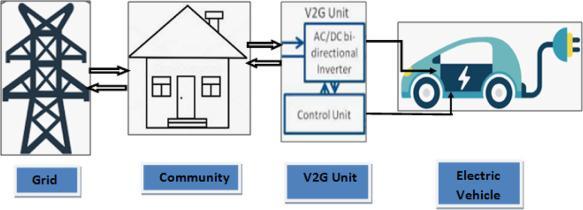
Habib etal.,2015[40] madea comparative reviewonthe chargingstrategyofanEVinadditiontoV2Gtechnologyto investigatetheirimpactonthepowerdistributionnetwork. They also stated that the charging strategy and vehicle aggressioncouldmakeV2Gtechnologyeconomicallyviable. TherearenumerousadvantagesoftheV2Gsystem,however ifweincreasethenumberofPEV,thenitmayhaveadirect impactonthedynamicsof powerdistributionsystemand performance of the system through overloading of transformers, cables, and feeders. This lessens the effectivenessaswellasrequiresextrageneratorstartsand creates voltage deviation and harmonics [41], [42]. The VehicletoGridchargingsystemisshowninFig.1
Fig. 1. Vehicle to Grid charging.
4.2.1. Application of optimization technique for V2G
Various control strategies are proposed for optimal performance of V2G. Many authors across the globe have investigated challenges to V2G and different optimization techniques. The strategy published by different authors acrosstheglobeisreviewedandpresented
Tulpule et al., 2013 [43] showed the feasibility study in a parking lot at a place of work in USA, OH, Columbus, Los
International Research Journal of Engineering and Technology (IRJET) e ISSN: 2395 0056
Volume: 09 Issue: 06 | Jun 2022 www.irjet.net p ISSN: 2395 0072
Angeles, and CA and compared it with the home charging system in terms of carbon dioxide emission and its expenditure. A similar study performed by [44] also consideredtheparkinglotinUSA,NJ,andNewJerseyand employed a simple approach for determining the driving needsthatcouldbemetbysolarpowerinsummerbutnotin winter. Many authors have considered the EV fleets at a differentcityorregionallevel.Onesuchstudymadeby[45] in Kansai Area, Japan, and combined 1 million EVs with 1 millionheatpumpsforreducingexcessofsolarpowerby3 TWhbyusingsmartchargingmethod.TheBatteriesusedin EVs do not have any significant impact on the grid due to their small size, as revealed by [46].However, V2G faces many socio technical barriers due to their large scale deployment[47].ForevaluatingV2Geconomics,Kempton andTomic,2005[48]expressedthelifetimeofthebattery energy as a function of battery capacity, battery cycle lifetime,andit'sDOD.TheenergytransferofV2Ghasalready beencarriedoutindifferentcountriestoregulatevarying, unpredicted energy demand or variation in supply availability. Ekman, 2011 [49] studied the cooperation betweenlargeEVfleetsandhighwindenergypenetrationin Denmark.V2G concept for Electric vehicle can either be hybrid,fuelcell,orpurebatteryvehicle.Thesehybridvehicle drivetrain,fuelcell,andbatteryEVshavebeenanalyzedfor various energy markets peak load, base load, spinning reserve,andregulationservices.Severalelementsmustbe met to enable V2G; these are i) the vehicle must have a connectionwiththegridfortransferofelectricalpowerii) communication either control or logical connection concerninggridoperationandiii)onboardmeteringdevice ofthevehicle.
DrudeandRuther,2014[50]expressedtheroleofbuilding integrated grid connected PV generation in a commercial buildinginawarmandsunnyclimate.Previouslyvehicles wereonlyabletochargeandwerenotabletodischarge,so supporting the grid was not possible at that time [51]. Reviews of technologies, benefits, costs, and challenges of the vehicle to grid technology have been mentioned. The optimalmanagementofV2Gsystemandaresidentialmicro gridandthefeasibilityofelectricvehiclecontributiontogrid ancillary services have been presented presented a case study in the US where the Plug in Electric vehicle is comparedwithhybridelectricvehicles,whereitisseenthat theCO2emissionsarereducedby25%intheshorttermand 50% in the long term basis by using a mix of generating powerplants.
Hybrid, Plug in Hybrid and Electric Vehicles are able to growingthegasolineeconomicsystemofmotorshowever with an growth within side the value of purchasing as comparedtostandardmotors.Intrendytheirreducedintake ofpetroleumandextendedproductivenessgivesmonetary gaintobuyers,society,automakersandpolicymakersover
the lifetime. This paper affords an in depth review of the literature,review,andsuggestionsforHEV,PHEVandBEV penetration price research into the Indian Market. The currentprojectsandnumeroussubsidiesviawayofmeans of the Indian Government will assist push the e mobility pressureinIndia.Theimprovementofabrandnewideaof Vehicle to Gridcanbothsupplyelectricitytothegridormay beusedtofeethebatterywhilenon traditionalelectricity reassertsaren'tavailable.Thisgenerationisanvitalthingof electricitysecurity,renewableelectricity,andgivingahigh qualityscopetoaddressinternationalwarmingissues.This paper affords a précis of an electric powered vehicle's obstaclesandissueswithinsidetheIndiancontextandisthe primarynoveltyofthepaper.
[1] R.T.Doucette,M.D.McCulloch,Modelingtheprospectsof plug inhybridelectricvehiclestoreduceCO2emissions, Appl.Energy88(2011)2315 2323.
[2] https:www.goldmansachs.com/insights
[3] https://en.wikipedia.org/wiki/Electric_vehicle_industry _in_India
[4] https://www.climatelinks.org/resources/greenhouse gas emissions factsheet india
[5] W. Kempton, J. Tomić, Vehicle to grid power implementation:fromstabilizingthegridtosupporting large scalerenewableenergy,J.PowerSources144(1) (2005)280 294.
[6] R.J. Bessa, M.A. Matos, Economic and technical management of an aggregation agent for electric vehicles:aliteraturesurvey,Eur.Trans.Electr.Power22 (3)(2012)334 350.
[7] N. Daina, A. Sivakumar, J.W. Polak, Modelling electric vehiclesuse:asurveyonthemethods,Renew.Sustain. EnergyRev.68(2017)447 460.
[8] F. Koyanagi, Y. Uriu, Modeling power consumption by electric vehicles and its impact on power demand, Electr.Eng.Jpn.120(4)(1997)40 47.
[9] J.E.Kang,W.W.Recker,Anactivity basedassessmentof thepotentialimpactsofplug inhybridelectricvehicles on energy and emissions using 1 day travel data, Transp.Res.PartD:Transp.Environ.14(8)(2009)541 556.
[10] J.Dong,C.Liu,Z.Lin,Charginginfrastructureplanning forpromotingbatteryelectricvehicles:anactivity based approachusingmultidaytraveldata,Transp.Res.PartC: Emerg.Technol.38(2014)44 55.
2022, IRJET | Impact Factor value: 7.529 | ISO 9001:2008 Certified Journal |
International Research Journal of Engineering and Technology (IRJET) e ISSN: 2395 0056
[11] C. Weiller, Plug in hybrid electric vehicle impacts on hourlyelectricitydemandintheUnitedStates,Energy Policy39(6)(2011)3766 3778.
[12] J.Axsen,K.S.Kurani,Anticipatingplug inhybridvehicle energy impacts in California: constructing consumer informedrechargeprofiles,Transp.Res.PartD:Transp. Environ.15(4)(2010)212 219.
[13] O.Sundström,C.Binding,Chargingserviceelementsfor an electric vehicle charging service provider, in: ProceedingsofthePowerandEnergySocietyGeneral Meeting,2011,IEEEIEEE,2011,pp.1 6.
[14] M.D.Galus,M.G.Vayá,T.Krause,G.Andersson,Therole of electric vehicles in smart grids, Wiley Interdiscip. Rev.:EnergyEnviron.2(4)(2013)384 400.
[15] J. Brady, M O’Mahony, Modelling charging profiles of electric vehicles based on real world electric vehicle chargingdata,Sustain.CitiesSoc.26(2016)203 216.
[16] P.Morrissey,P.Weldon,M.OMahony,Futurestandard andfastcharginginfrastructureplanning:ananalysisof electric vehicle charging behaviour, Energy Policy 89 (2016)257 270.
[17] A.Foley,B.Tyther,P.Calnan,B.O.Gallachoir,Impactsof electric vehicle charging under electricity market operations,Appl.Energy101(2013)93 102.
[18] S.Steinhilber,P.Wells,S.Thankappan,Socio technical inertia:understandingthebarrierstoelectricvehicles, EnergyPolicy60(2013)531 539.
[19] Y.Hai,T.Finn,M.Ryan,Drivingpatternidentificationfor EV range estimation, in: Proceedings of the IEEE InternationalElectricVehicleConference(IEVC),2012, pp.1 7.
[20] G.HayesJohn,R.P.R.Oliveirade,V.Sean,GEganMichael, Simplifiedelectricvehiclepowertrainmodelsandrange estimation,in:Proceedings oftheIEEE Vehicle Power andPropulsionConference(VPPC),2011,pp.1 5.
[21] F. Salah, J.P. Ilg, C.M. Flath, H. Basse, C. Van Dinther, Impactofelectricvehiclesondistributionsubstations:a Swisscasestudy,Appl.Energy137(2015)88 96.
[22] N. Hartmann, E.D. Ozdemir, Impact of different utilizationscenariosofelectricvehiclesontheGerman grid in 2030, J. Power Sources 196 (4) (2011) 2311 2318.
[23] F.Yang,Y.Sun,T.Shen,Nonlineartorqueestimationfor vehicular electrical machines and its application in enginespeedcontrol,in:Proceedingsofthe2007IEEE InternationalConferenceonControlApplications,IEEE, 2007,pp.1382 1387.
[24] X. Yu, T. Shen, G. Li, K. Hikiri, Regenerative braking torqueestimationandcontrolapproachesforahybrid electric truck, in: Proceedings of the 2010 American ControlConference,IEEE,2010,pp.5832 5837.
[25] X.Yu,T. Shen,G.Li, K.Hikiri,Model baseddrive shaft torque estimation and control of a hybrid electric vehicleinenergyregenerationmode,in:Proceedingsof the2009ICCAS SICE,IEEE,2009,pp.3543 3548.
[26] D.Yin,Y.Hori,AnoveltractioncontrolofEVbasedon maximumeffectivetorqueestimation,in:Proceedingsof the 2008 IEEE Vehicle Power and Propulsion Conference,IEEE,2008,pp.1 6.
[27] D.Yin,Y.Hori,AnewapproachtotractioncontrolofEV based on maximum effective torque estimation, in: Proceedingsofthe200834thAnnualConferenceofIEEE IndustrialElectronics,IEEE,2008,pp.2764 2769
[28] D. Yin, S. Oh, Y. Hori, A novel traction control for EV basedonmaximumtransmissibletorqueestimation,in: Proceedings of the IEEE Transactions on Industrial Electron,2009.
[29] L.Lu,X.Han,J.Li,J.Hua,M.Ouyang,Areviewonthekey issues for lithium ion battery management in electric vehicles, J. Power Sources 226 (2013) 272 288 ics, 56(6),2086 2094.
[30] A. Panday, H.O. Bansal, A review of optimal energy managementstrategiesforhybridelectricvehicle,Int.J. Veh.Technol.2014(2014)1 19.
[31] S.F.Tie,C.W.Tan,Areviewofenergysourcesandenergy managementsysteminelectricvehicles,Renew.Sustain. EnergyRev.20(2013)82 102.
[32] J.Y. Yong, V.K. Ramachandaramurthy, K.M. Tan, N. Mithulananthan, A review on the state of the art technologies of electric vehicle, its impacts and prospects,Renew.Sustain.EnergyRev.49(2015)365 385.
[33] D.B.Richardson,Electricvehiclesandtheelectricgrid:a reviewofmodelingapproaches,Impacts,andrenewable energy integration, Renew. Sustain. Energy Rev. 19 (2013)247 254
[34] M. Dubarry, A. Devie, K. McKenzie, Durability and reliability of electric vehicle batteries under electric utility grid operations: bidirectional charging impact analysis,J.PowerSources358(2017)39 49.
[35] M.A. Awadallah, B. Venkatesh, Energy storage in distribution system planning and operation: current statusandoutstandingchallenges,Can.J.Electr.Comput. Eng.42(1)(2019)10 19.
Volume: 09 Issue: 06 | Jun 2022 www.irjet.net p ISSN: 2395 0072 © 2022, IRJET | Impact Factor value: 7.529 | ISO 9001:2008 Certified Journal | Page2043
International Research Journal of Engineering and Technology (IRJET) e ISSN: 2395 0056
Volume: 09 Issue: 06 | Jun 2022 www.irjet.net p ISSN: 2395 0072
[36] K.Uddin,M.Dubarry,M.B.Glick,Theviabilityofvehicle to gridoperationsfromabatterytechnologyandpolicy perspective,EnergyPolicy113(2018)342 347.
[37] J. Kester, L. Noel, G.Z. de Rubens, B.K. Sovacool, PromotingVehicletoGrid(V2G)intheNordicregion: expert advice on policy mechanisms for accelerated diffusion,EnergyPolicy116(2018)422 432.
[38] M. Dubarry, A. Devie, K. McKenzie, Durability and reliability of electric vehicle batteries under electric utility grid operations: bidirectional charging impact analysis,J.PowerSources358(2017)39 49.
[39] M.Andrea,R.Marco,SauerDirkUwe.Influenceofthe vehicle togridstrategyontheagingbehavioroflithium battery electric vehicles, Appl. Energy 137 (2015) 899e912.
[40] S. Habib, M. Kamran, U. Rashid, Impact analysis of vehicle to grid technology and charging strategies of electric vehicles on distribution networks a review, J. PowerSources277(2015)205 214.
[41] E. Sortomme, M. Hindi, S. MacPherson, S. Venkata, Coordinatedchargingofplug inhybridelectricvehicles to minimize distribution system losses, IEEE Trans. SmartGrid2(1)(2011)198 205Mar..
[42] M.Bojrup,P.Karlsson,M.Alakula,B.Simonsson,Adual purpose battery charger for electric vehicles, in: Proceedings of the IEEE Power Electronics SpecificationsConference,1998,pp.565 570.
[43] P.J. Tulpule, V. Marano, S. Yurkovich, G. Rizzoni, EconomicandenvironmentalimpactsofaPVpowered workplaceparkinggaragechargingstation,Appl.Energy 108(2013)323 332.
[44] D.P.Birnie,Solar to vehicle(S2V)systemsforpowering commuters of the future, J. Power Sources 186 (2) (2009)539 542.
[45] Q. Zhang, T. Tezuka, K.N. Ishihara, B.C. Mclellan, IntegrationofPVpowerintofuturelow carbonsmart electricitysystemswithEVandHPinKansaiArea,Jpn. Renew.Energy44(2012)99 108.
[46] C. Guille, G. Gross, A conceptual framework for the vehicle to grid(V2G)implementation,EnergyPolicy37 (11)(2009)4379 4390.
[47] B.K. Sovacool, R.F. Hirsh, Beyond batteries: an examination of the benefits and barriers to plug in hybrid electric vehicles (PHEVs) and a vehicle to grid (V2G) transition, Energy Policy 37 (3) (2009) 1095 1103.
[48] W. Kempton, J. Tomic´, Vehicle to grid power fundamentals: calculating capacity and net revenue, J. PowerSources144(1)(2005)268 279.
[49] C.K. Ekman, On the synergy between large electric vehiclefleetandhighwindpenetration Ananalysisof theDanishcase,Renew.Energy36(2)(2011)546 553
[50] L.Drude,L.C.P.Junior,RRuther,Photovoltaics(PV)and electric vehicle to grid 13 S. Goel, R. Sharma and A.K. RathoreTransportationEngineering4(2021)100057 (V2G) strategies for peak demand reduction in urban regionsinBrazil ina smartgrid environment,Renew. Energy68(2014)443 451.
[51] K. Clement Nyns, E. Haesen, J. Driesen, The impact of chargingplug inhybridelectricvehiclesonaresidential distribution grid, IEEE Trans. Power Syst. 25 (2010) 371 380.
[52] K.Clement,E.Haesen,J.Driesen,Coordinatedcharging ofmultipleplug inhybridelectricvehiclesinresidential distributiongrids,in:ProceedingsofthePSCE 09,Seatle ,Washington,USA,2009.
2022, IRJET | Impact Factor value: 7.529 | ISO 9001:2008 Certified Journal