International Research Journal of Engineering and Technology (IRJET) e ISSN:2395 0056

Volume: 09 Issue: 06 | June 2022 www.irjet.net p ISSN:2395 0072
International Research Journal of Engineering and Technology (IRJET) e ISSN:2395 0056
Volume: 09 Issue: 06 | June 2022 www.irjet.net p ISSN:2395 0072
ABSTRACT: The response and damage analysis of structure subordinated to the blast lading has entered considerable interest in recent times. There has been a number of studies on the damage analysis of structures due toairblast.Designguidelinesforguardingstructuresagainst the air blast is available in several literatures. Despite the available knowledge on the subject, exploration is still continuing in this area, especially for assessing the damage caused due to the face blast. The thesis deals with the responseanddamageanalysisofthecorroboratedconcrete( RC)structuressubordinatedtothefaceblast.
The alternate part deals with the nonlinear time history analysis of the 3 D model of the four structures subordinated to the face blast. The analysis is performed with the help of SAP 2000 software. The dynamic ladings produced due to the air pressure and ground shock are dissembled using the procedure available in the literature. The parameters varied are the charge weight, standoff distance and height of the structure. The responses include the maximum top storey relegation, maximuminter storey drift rate, number of plastic hinges formed and maximum base shear. The response geste of the structure under different parametric variations is critically examined in order to assess the damages caused due to the face blast. Further, the relative impact of the air pressure and ground shockonthetotalresponsesisdelved.
Next,acompletelycoupledanalysisofthe3 Dmodelofa6 storey structure is performed in which air structure soil commercearecompletelyincluded.TheABAQUSsoftwareis used to pretend the finite element( FE) modelling of the explosive, air medium, soil medium and structure in one single model. The nonlinear time history analysis is performed for two standoff distances, two different charge weights and two different types of soil( hard soil and medium soil). Results of the analysis are compared with those of the uncoupled analysis in which the soil structure commerce(SSI)effectisn'tconsidered.
Analysis of the dynamic response of structures under blastladingisveritablycomplex,asitinvolvestheeffect of the high strain rate on the material geste , inelastic
nonlinear geste of the material and time dependent distortion(Ngoetal.,2007).Highstrainrates(102to104 s 1) produced by blast loads alter the damage medium of structural rudiments by effecting their mechanical parcels. Strength of concrete and buttressing sword significantlyincrease due to thestrain rate effect.Grote, ParkandZhou(2001)conductedtrialsandreportedthat fortheconcreteincontraction,thestrengthexaggeration factorisattainedashighas4andinpressure,it'soverto 6 for strain rates in the range 102 to 103 s 1. Dowling and Harding( 1967) conducted tensile trials on mild swordandconcludedthatthemildswordhasaveritably high strain rate perceptivity. It was set up that the high stain rates doubled the lower yield strength of mild swordandincreasedtheultimatetensilestrengthby50.
Blast cargo may produce both original and global responses of near structures. When an explosion takes place veritably near to a structural member, it causes localized flexural or shear failure of that member. The localized failure may be in the form of localized spalling and punching and, it's accompanied by fractions and debris.
Theissueofstructuralsafetyfromexplosiveblastsarose during World War II and now this concern has grown due to the increase in terrorist conditioning. A large body of literature for military operations has been developed which provides knowledge regarding the effect of the explosion on structures and design guidelines for the blast lading, which include( i) “ Structures to repel the goods of accidental explosions ”, TM5 1300(U.S.DepartmentsoftheArmy,Navy,andAir Force, 1990);( ii) “ A primer for the vaticination of blast and scrap ladings on structures ”, DOE/ TIC 11268(U.S. Department of Energy, 1992);( iii) “ Defensive constructiondesignManual”,ESL TR 87 57(AirForce Engineering and Services Center, 1989);( iv) “ Fundamentals of defensive design for conventional munitions ”, TM 5 855 1(U.S. Department of the Army, 1986);( v) “ The design and analysis of toughened structures to conventional munitions goods ”( DAHS CWE,1998)etc.NationalResearchCouncilinitsreport“
International Research Journal of Engineering and Technology (IRJET) e ISSN:2395 0056
Volume: 09 Issue: 06 | June 2022 www.irjet.net p ISSN:2395 0072
guarding structures from lemon damage Transfer of blast goods mitigation technologies from military to mercenary operations ”( National Research Council, 1995) examined the operation of the construction and design methodologies developed for military structures to the mercenary structures. It was observed that the blast design principles developed for military purposes are generally applicable for mercenary design practice. TM5 1300(1990)isextensivelyusedbytheserviceand mercenary association for blast resistant design of structures. It provides information about the blast lading, dynamic analysis principles and design of corroborated and sword structures. Guidance for the selection of security door, windows, and other factors are also handed in the primer. A report published by ASCE “ Design of Blast Resistant structures in Petrochemical installations ”( ASCE, 1997) provides general guidelines for blast resistant design of structures.
Inrecenttimes,theSSIeffectonthestructuralresponse caused due to the blast convinced vibration has been delved using different approaches like, the modal superpositionsystem,pressure impulseillustrationand using empirical equations. Ma, Quek and Ang( 2004) studied the soil structure commerce( SSI) effect on the responseofafive storeyaeroplaneframecauseddueto an underground explosion and set up that when the SSI effectisconsideredthestructuralresponsegetsreduced and an increase in the shear haste of the soil causes a reduction in the SSI effect. Huang, He and Ma( 2011a) represented that structural damage with due consideration of the SSI effect due to the blast can be fluently and directly estimated with the help of P I plates. It was shown that the exponential air pressure surge palpitation, when simplified as a triangular palpitation, overrated the structural response and for conniving P I illustration, the exponential palpitation shapeislargelyrecommended.Mahmoud(2014)delved the effect of base soil inflexibility on the dynamic responseanddamageoferectingunderairpressuredue to the blast by working governing equations of stir. It was set up that the flexible base structure was more susceptible to damage due to the blast than the fixed base structure and for a correct estimate of the structural response and damage, soil inflexibility should be considered. Liu( 2009) delved the goods of burial depth, stiffness of ground medium and weight of explosive on the response of shelter coverts under internal blast conditions by using unequivocal dynamic finiteelementsystem.
An explosion at a close distance to the structure causes severe damage to the nearest crucial factors of the structure. This original failure spreads from element to elementduetothe redivisionof loads,which causesthe collapse of an entire structure. This type of collapse of the structure is nominated as ‘ progressive collapse ’( NISTIR, 2007). General Services Administration guidelines( GSA, 2003) recommend four procedures of the progressive collapse analysis, videlicet, direct static, nonlinear static, direct dynamic and nonlinear dynamic. The selection of the analysis procedure depends upon the structural configuration( irregular or regular), size and significance of the structure. Among these four procedures, the nonlinear dynamic analysis is considered as the most complex yet dependable approach. The guidelines on progressive collapse resistance of structures promote proper connection detailing( ray column, ray ray) and redundancy of the structureinordertoinsurevacuityofthealternatecargo pathifthelossofanycrucialmemberoccurs.
Keeping in view the above mentioned areas of investigation, this study is performed to investigate the behaviourofseismicallydesignedmulti storeybuildings under the surface blast scenario, focusing mainly on the nonlinear characteristics of the building including failure. A preliminary estimate of the relative contributions of the ground shock and air pressure on the responses produced due to the surface blast is attempted using equivalent SDOF models of building frames having different heights (3 storey, 6 storey, 9 storeyand12storey).
Estimationoftherelativeeffectsofsurfaceblast generated ground shocks as compared to air pressure on RC buildings using an equivalent SDOFmodel.
To study the nonlinear response of earthquake resistant multi storey buildings under different intensities of the simulated surface blast using 3D models of the building; the parameters varied in the study include the building height, chargeweightandstandoffdistance.
International Research Journal of Engineering and Technology (IRJET) e ISSN:2395 0056
Volume: 09 Issue: 06 | June 2022 www.irjet.net p ISSN:2395 0072
reasonforcarryingoutboth typesofanalysisisthatthe buildingframecanundergoboththeelasticandinelastic excursions depending upon the charge weight, fundamental period of the building and standoff distance. Further, the initial stiffness of the idealized pushover curve utilized for the nonlinear time history analysis differs to some extent from the linear spring stiffnessusedforthelineartimehistoryanalysis.Thisis thecasebecausethelineartimehistoryanalysisusesthe fundamental frequencies of the buildings The response isobtainedasthetopfloordisplacementofthestructure. Forthelinearanalysis,topfloordisplacementisx1=11 z1.Since11issettounity x1=z1.

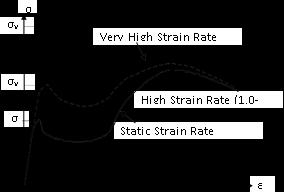
Fig1:Effectofhighstrainratesonsteelproperties
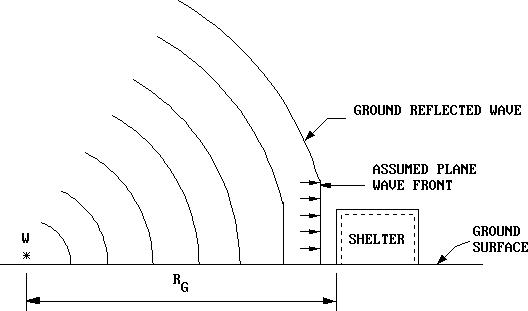
Thesurfaceblastisdifferentfromtheairblastinrespect of producing the dynamic loading on structures supported on the ground, due to both air pressure and ground vibration caused by the blast. Air pressure produces the load on the surface of the structure exposed to air pressure, which in turn causes the vibration in the frames or other elements of the structure. The ground shock provides the dynamic forces,ascausedduetothe earthquake,butwithhigher magnitude and shorter duration than earthquake. The dynamic loadings caused by the surface blast are simulated by generating the pressure time history for the air pressure and acceleration time history for the groundvibrationusingtheprocedure.


Whilethenormalmodetheorycanbeconvenientlyused to develop an SDOF model of the multi storey building vibrating only in one mode, the quantification of the effects of the total air pressure and ground shock in the SDOF model is not straight forward. For obtaining an equivalent SDOF system for the multi storey building frame subjected to the surface blast, only the first mode responseisconsidered.Thereasonforchoosingonlythe fundamental mode of vibration for developing the SDOF model is that for very short duration impulse, the maximumresponseoccursinthefreevibrationphaseof the structure after the end of the pulse (Chopra, 2007). Since the free vibration of any structure takes place in the fundamental mode, the equivalent SDOF models for the building frames are developed using only the fundamentalmodeofvibration.
Boththe linearandnonlinearanalysesofthe equivalent SDOF systems are performed using equations . The
For the nonlinear analysis, equations 3.26 and 3.27 are solved using the Newmark’s Average Acceleration method for solving the incremental equation of motion (Chopra, 2007). The algorithm duly takes into account the different loading and unloading paths. Further, it takes into account the transition points during incremental analysis by monitoring the displacement andvelocityaftereachincrementoftime.
Fig.2 Surface Burst Blast Waves.
Surface blast:- Asurfaceblastcausesboth airpressure andgroundshock effectona nearbystructure. In order
International Research Journal of Engineering and Technology (IRJET) e ISSN:2395 0056


Volume: 09 Issue: 06 | June 2022 www.irjet.net p ISSN:2395 0072


tosimulatetheeffect ofthesurfaceblast, timehistories ofthereflectedairpressureon the exposed surface of the building, and ground acceleration are generated using theequationsgivenbyWuandHao(2005).
The structure is modelled as a 3D frame. The arbor action is properly included in the model. shafts and columnsaremodelledasrayrudiments,whilethearbor is modelled using shell rudiments. The base of the structure is assumed to be fixed. The simulated time histories of the ground shock are applied at the base of thecolumnsandthoseoftheairpressureareappliedon the ray column joint bumps of the structure. The time history records are dissembled with the time pause effect,whichisincorporatedbytheappearancetimesof the ground shock surge and air pressure surge. For carrying out the nonlinear time history analysis, the dereliction plastic hinge parcels of the SAP 2000 are usedatallsectionswhereplastichingesareanticipated to form( near the ray and column ends) so that all possible types of failure modes including the pure storeyswayfailuremodecausedbytheconformationof hinges can develop. Force distortion and moment gyration gesteofthederelictionplastichingesisshown in Figure4.1. As shown in the wind, point A shows the origin. A B shows direct distortion of the element. This direct distortion occurs in the element, not in the hinge andbeyondtheyieldpoint(B)theelementgoesintothe plastic range. Beyond the point B, plastic distortion occurs in the hinge in addition to the elastic distortion being in the element. Points C, D and E represent ultimate capacity, residual strength and total failure independently.
For simulation, Rayleigh commensurable damping is espoused for the first two vibration modes by considering critical damping as 5 and Hilber Hughes Taylor direct time integration approach is used for nonlinear time history analysis with portions Gamma = 0.5andBeta=0.25.
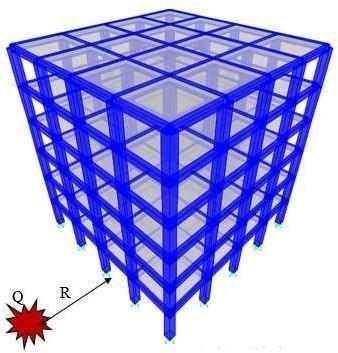
Four RC buildings having the same plan dimensions withdifferentnumberofstoreys, namely,3,6,9and12 storeys are considered for the investigation. Figure 4.2 showstheplanofthefourbuildingsand3 Dviewofthe 6 storey building. Plan dimensions of all the four buildings are 16m x 16m with four equal spans in each direction and all storey heights are 3m. Grades of concrete and steel reinforcement bars are M30 (compressive strength 30 MPa) and Fe 415 (yield strength 415 MPa) respectively. The buildings are designed for the gravity loads and earthquake load for


zone V (peak ground acceleration 0.36g with a probability of 10% exceedance in 50 years) in accordance with IS 1893 Part 1 (Bureau of Indian Standards, 2002). First three time periods (T1, T2, T3) of the buildings, sizes of the members and reinforcements(R/F)ofstructuralcomponents
5
Figure 4: 3D view of 6 storey building
4m 4m 4m
Figure 5 Plan of the four buildings
For the building frames, four response quantities of interest are evaluated, namely, the top floor displacement, inter storey drift ratio, base shear and number of plastic hinges formed. The effects of the
International Research Journal of Engineering and Technology (IRJET) e ISSN:2395 0056
Volume: 09 Issue: 06 | June 2022 www.irjet.net p ISSN:2395 0072
variation of the standoff distance, charge weight, and building height on these response quantities are evaluatedinordertoinvestigatetheeffectofthesurface blastonthebuildings.
The responses of RC buildings of different heights produced by the surface blast are investigated. For this purpose, four RC buildings with the same plan dimensions and different heights, designed for gravity and earthquake loads are considered. For the analysis, charge weights of 1000kg and 500kg of TNT and standoff distances of 5m to 60m are considered. Responses of the buildings include the peak top floor displacement, maximum inter storey drift ratio and maximum base shear. The extent of damage in the buildings is evaluated in terms of the number of plastic hinges formed.Fromthenumerical study, the following conclusionscanbedrawn:
Forlowrisebuildings(3and6storey),atsmallto medium standoff distances, the maximum top storey displacement and maximum inter storey drift ratio are more for the air pressure than the ground shock produced by the surface blast. At large standoff distances, the effect of ground shockbecomespredominant.
natureofoscillationsproducedbythegroundshockand airpressure.
For high rise buildings (9 and 12 storeys), at smallerstandoffdistances(R≤10m),theeffectof the ground shock on the displacement and drift responses is more than that of the air pressure. ForstandoffdistancesR>10m,thetwoeffectson theresponsesarenearlythesame.
For both low and high rise buildings, the base shears produced by the ground shock is more than that produced by the air pressure for all standoffdistances.
Withtheincreaseinthechargeweight,theeffect of the ground shock increases more significantly thantheairpressure.
From the above conclusions, it is apparent that the responseofabuildingproducedbythesurfaceblastisa complex phenomenon arising out of both the air pressureandgroundshockactingonthebuilding.These two effects are significantly influenced by the standoff distance,chargeweightandbuildingheight.Forlowrise buildings, the surface blast may be critical as compared tothe freeairblastatgreaterstandoffdistances(15m ≤ R≤60m).Forsmallerstandoffdistances(R≤15m),the surfaceblastmayproducelessresponsesinbuildingsas compared to the free air blast because of the opposing
‘ABAQUS Analysis User’s Manual (Vol 3): Materials’ (2010)inAbaqus6.10.DassaultSystems.
ASCE/SEI (2002) ‘Minimum Design Loads for Buildings and Other Structures’.Reston, Virginia: ASCE7 02.doi:10.1520/G0154 12A.
ASCE (1997) Design of Blast Resistant Buildings in PetrochemicalFacilities.
Attia, F., Salem, H. and Yehia, N. (2017) ‘Progressive Collapse Assessment of Multi Story Flat Slab Reinforced Concrete Structures under Gravity Loads’,StructuralConcrete,18(3),pp.409 420.doi: 10.1002/suco.201600051.Submitted.
Ballantyne, G. J. et al. (2010) ‘Air Blast Effects on Structural Shapes of Finite Width’, Journal of StructuralEngineering,136(February),pp.152 159.
Bao, X. and Li, B. (2010) ‘Residual strength of blast damagedreinforcedconcretecolumns’,International Journal of Impact Engineering. Elsevier Ltd, 37(3), pp.295 308.doi:10.1016/j.ijimpeng.2009.04.003.
Beshara, F. B. A. (1994a) ‘General Phenomenology and External Blast’, Computers and Structures, 51(5),pp.585 596.
Brode,H.L.(1955)‘Numericalsolutionsofspherical blast waves’, Journal of Applied Physics, 26(6), pp. 766 775.doi:10.1063/1.1722085.
Brunesi, E. et al. (2015) ‘Progressive collapse fragility of reinforced concrete framed structures through incremental dynamic analysis’, Engineering Structures. Elsevier Ltd, 104, pp. 65 79. doi: 10.1016/j.engstruct.2015.09.024.
Bureau of Indian Standards (2002) ‘Criteria for Earthquake Resistant Design of Structures’. New Delhi,India:IS1893 Part1,p.500.
CEN (2006) ‘Eurocode 1 Actions on structures Part 1 7: General actions Accidentalactions Eurocode’.Brussels:EN1991 1 7.
Chopra, A. K. (2007) Dynamics of structures: theory and applications to earthquake engineering. 3rd ed. PearsonPrenticeHall,NewJersey.
International Research Journal of Engineering and Technology (IRJET) e ISSN:2395 0056
Volume: 09 Issue: 06 | June 2022 www.irjet.net p ISSN:2395 0072
Clough, R. W. and Penzien, J. (1995) Dynamics of Structures. 3rd ed. Computers and Structues Inc., USA.
Dusenberry, D. O. (2010) Handbook for blast resistantdesignofbuildings,Assessment.
Edri, I. et al. (2011) ‘On Blast Pressure Analysis due toaPartiallyConfinedExplosion:
Experimental Studies’, International Journal of Protective Structures, 2(1), pp. 61 80. doi: 10.1260/2041 4196.3.1.61.