Simplified Numerical Approach for Steering System Design Parameter Selection for Off-Road Racing

Page 1

International Research Journal of Engineering and Technology (IRJET)

e-ISSN: 2395-0056

Volume: 09 Issue: 06 | Jun 2022

p-ISSN: 2395-0072

www.irjet.net

Simplified Numerical Approach for Steering System Design Parameter Selection for Off-Road Racing Suraj Prashad Sharma1, Gedala Udit Narayana2 1-2School

of Mechanical Engineering, VIT University, Vellore, Tamil Nadu, India ---------------------------------------------------------------------***---------------------------------------------------------------------

Abstract – Vehicle dynamics is considered to be one of the

Provided study aims to give an optimized and simplified numerical approach to finalize the parameters of steering system for designing and manufacturing.

most compact and complex systems to analyse. The steering system is part of the Vehicle Dynamics department and plays an important role in providing directional control to the vehicle. Physically, the steering system appears simple, but the mathematical approach to parameter selection and design is extremely complicated. The purpose of this study is to present a simplified and optimal mathematical approach for selecting steering system design parameters for Off-Road racing vehicles using a rack and pinion mechanism. The findings of this study can be applied to vehicles developed for off-road racing competitions such as mBaja, eBaja, ESI, ATVC, and many others.

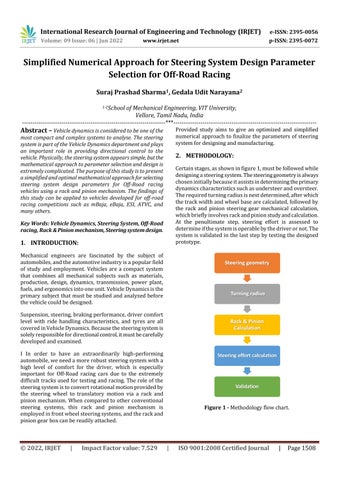
2. METHODOLOGY: Certain stages, as shown in figure 1, must be followed while designing a steering system. The steering geometry is always chosen initially because it assists in determining the primary dynamics characteristics such as understeer and oversteer. The required turning radius is next determined, after which the track width and wheel base are calculated, followed by the rack and pinion steering gear mechanical calculation, which briefly involves rack and pinion study and calculation. At the penultimate step, steering effort is assessed to determine if the system is operable by the driver or not. The system is validated in the last step by testing the designed prototype.

Key Words: Vehicle Dynamics, Steering System, Off-Road racing, Rack & Pinion mechanism, Steering system design.

1. INTRODUCTION: Mechanical engineers are fascinated by the subject of automobiles, and the automotive industry is a popular field of study and employment. Vehicles are a compact system that combines all mechanical subjects such as materials, production, design, dynamics, transmission, power plant, fuels, and ergonomics into one unit. Vehicle Dynamics is the primary subject that must be studied and analyzed before the vehicle could be designed. Suspension, steering, braking performance, driver comfort level with ride handling characteristics, and tyres are all covered in Vehicle Dynamics. Because the steering system is solely responsible for directional control, it must be carefully developed and examined. I In order to have an extraordinarily high-performing automobile, we need a more robust steering system with a high level of comfort for the driver, which is especially important for Off-Road racing cars due to the extremely difficult tracks used for testing and racing. The role of the steering system is to convert rotational motion provided by the steering wheel to translatory motion via a rack and pinion mechanism. When compared to other conventional steering systems, this rack and pinion mechanism is employed in front wheel steering systems, and the rack and pinion gear box can be readily attached.

© 2022, IRJET

|

Impact Factor value: 7.529

Figure 1 - Methodology flow chart.

|

ISO 9001:2008 Certified Journal

|

Page 1508


Turn static files into dynamic content formats.
Create a flipbook