Volume: 09 Issue: 06 | June 2022 www.irjet.net p-ISSN:2395-0072

6’APART – A STEP TO PREVENT COVID-19
Abstract The era of mobile technology opens the windows to android app development. The websites are getting overshadowed by the advancements in Native APP development. Thus, it is convenient to change from conventional websites to apps, which has become a major part of our daily routine. Considering the easy use and more preference to Android Apps, we are introducing 6’ APART APP, an android application that helps in analyzing if people are maintaining Social Distance among themselves while being in a crowded area. Due to the outbreak of Coronavirus, a lot has changed in the world. The new normal will be impossible if citizens do not take necessary precautions like wearing a face mask and maintaining a distance of 6 feet at all times but there will come times when individuals will have to go out for work, use public transport. Police personnel will be able to make sure if citizens are following the rules of Social Distancing, just with the help of this app. During these situations, 6’ APART APP would be a great tool in helping people also by letting them decide whether or not they should enter a crowded place.
Keywords ObjectDetection,CNN,YOLOv3,XML,UI
1. INTRODUCTION
Stopping the spread of pandemics, such as the present COVID 19 pandemic and those that may strike in the future, requires the practice of social distance. Social distancingisdefinedbytheUSCentersforDiseaseControl and Prevention (CDC) as keeping at least 6 feet between yourselfandotherpeopleoutsideofyourhome,refraining from gathering in groups, staying out of crowded places, andavoidingmassgatherings.
The CDC currently recommends social separation and wearingmasksasthebestwaystopreventCOVID 19from spreading, and experts believe that some type of social distancing will be required in the near future. Despite the necessity of social distancing and rules to enforce compliance, adoption has been delayed and at times insufficient in some locations. Not only for the current context of COVID 19, but also to respond to future pandemics, it is critical to understand what drives social distancing uptake and adherence, and how these drivers vary for various individuals. Social distancing and
protective actions in general are linked to a multitude of demographicandattitudinalcharacteristics,perceptionsof community standards, and structural elements including theabilitytoworkfromhome,accordingtoresearchfrom previous epidemics. For many of us, living inside our home, having all of the essential conveniences, and still beingabletoworkfromhomeisa blessing,butthisisnot the situation for our doctors, police officers, and other Corona front lines and fighters. This is the motivation for theapp.
By using the 6’APART app, Police personnel can record a video of a crowded place and understand who all are taking the respective measures to avoid the spread of the novel Coronavirus. With the advancement in finding the vaccineforcovid 19,variousgovernmentsoftheworldare ensuring certain relaxations in the rules and regulations about staying at home. With the ongoing unlock in India, people have started going out for their jobs, attending other important matters and for a change of mind too, since people have stayed at home for a long time. This leads to the risk of breaking the Social Distancing rules in public places like Railway stations, restaurants and other rejuvenation centers. This led to the thinking that there hastobeoneappthatallowsuserstounderstandwhether ornottheyshouldvisitthatplace.
2. RELATED WORK
Object Detection Apps - There are just a few object detectionapplicationsforsocialdistance,butweidentified one named "1point5"[1] that helps maintain track of social distance.Whenadeviceentersyour1.5parameterradius, the app looks for nearby mobile devices and alerts you. The phone vibrates and a notification is sent to you. It's a friendly nudge in the right direction to diffuse the issue. Family members' devices, for example, can be excluded. This program can also calculate the hazard rate. This software has the constraint that if the user switches off Bluetooth on his phone, the required output will not be received.WearewellawarethatkeepingBluetoothonour phones is not viable because it consumes a significant amount of battery power. This has the disadvantage that what if another device in the user's vicinity does not have Bluetooth connectivity? 1point5[1] also allows you to
International Research Journal of Engineering and Technology (IRJET)
e-ISSN:2395-0056
Volume: 09 Issue: 06 | June 2022 www.irjet.net p-ISSN:2395-0072
customize the notification's nature. For proximity notifications,youcantoggleonoroffsoundandvibrations. When the app is turned on, it sends notifications about nearbyobjects, butnotwhenitisclosed.Youcanalsouse the app to restrict devices that belong to family members orotherswithwhomyoushareahome.
theUser,a MachineLearningmodel anda script,frontend of the app which implements the design and backend which will handle the queries from the frontend and connectivityofthemachinelearningmodelwiththeapp.
Object Detection Models
ImageAI [2], TensorFlow, OpenCV,andTinyYOLOv3wereusedtodetectobjects.One of the methods for deep learning object detection is ImageAI. ImageAI is a Python based object detection library. With the help of ImageAI, developers may create self containeddeeplearningandcomputervisionappsand systems with a few lines of straightforward code. Almost all state of the art deep learning algorithms, such as YOLOv3 and TinyYOLOv3, may be implemented using the ImageAI package. ImageAI employs a number of offline APIs, including object detection, object location, video detection, and object tracking APIs that may be used without an internet connection. ImageAI primarily uses pre trained models and is easily customizable. With ImageAI, you can identify and recognize more than 80 distincttypesofcommonitems.
Numerouscountrieshavebeenexploringfortechnological solutions since the emergence of the COVID 19 pandemic. COVID 19 has been combated by Asian countries using a varietyoftechnology.Themostwidelyutilizedtechnology isphonelocationtracking, whichsavesCOVID 19 positive people'sdataandallowsthemtobetrackeddependingon their proximity to healthy people. Germany and Italy are utilizing anonymized location data to monitor the lockdown. The C9 corona symptom tracker [3] is a new software program from the United Kingdom that allows users to record their symptoms. Similarly, South Korea developed Corona 100m, an app that tracks infected individual’s locations and informs healthy people when theygetwithin100metersofthem.
In India, an application is developed that allows users to keepasafedistancefromsomeonewhohastestedpositive for corona. In addition, India, South Korea, and Singapore are utilizing CCTV video to track down sick patients who have recently visited COVID 19 affected areas. China is detecting people with high temperatures in crowds using AI poweredthermalcameras.Inthiscriticalsituation,such inventionsmayhelpto flattenthecurve,but theyalsoput personalinformationatrisk.
3. METHODOLOGY
Weconcludedfromtheproblemstatementthatweneedto build an android app and in order to do that, we understoodthatwerequiredagoodUIdesignthatattracts
The tools and technology used in these proposed models are a version control system so we chose to use GIT, a placetohostoursourcecodeforcollaborationsoweused GitHub, Visual Studio Code and Android Studio to create theapp.
The features included in the proposed model are a main screen where there will be the animated logo of the proposed model and a button which asks the user to captureavideo,thevideobuttonwilldirecttheusertothe camera screen. An output screen where the video will be shownafterithasbeenprocessedbytheMLmodel.
Transfer learning [4] is a machine learning technique in which a model developed for one task is seen as the foundation for the next task's model. Given the huge compute and time resources required to develop neural network models for these problems, as well as the huge jumps in skill that they provide on related problems, pre trainedmodelsareapopularapproachindeeplearningfor computervisionandnaturallanguageprocessingtasks.
Working of the app:
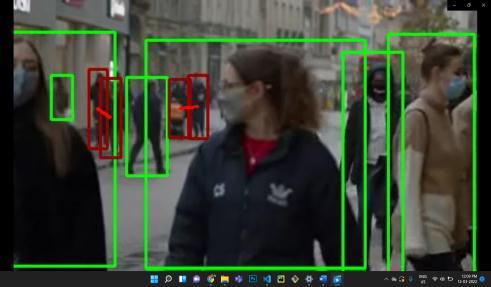
Theuserinstallstheapp.Theappwillthenasktheuserto grant permission to access storage and camera. The user can then record a video. If the user does not give permissiontoaccessstorageandcamerathentheuserwill notbeabletorecordavideo.Afterrecordingthevideo,the userwillgetthereviewofthevideo,iftheuserissatisfied with the video recorded then it gets stored in the gallery and the same video will be sent to the server or else the user can record another video. Machine learning model which is deployed on the server, will then receive the recorded video as input. All the objects in the video are detected first using a pre trained YOLOv3 model, then people are filtered out from the rest of the objects. Their centroids are calculated and then the midpoint between two centroids is checked. Dispensing on whether the midpoints are among the given range, red and green boundingboxesareassignedtoeachframe.Allframesare then grouped to form a video (mp4) format. The video is then sent to the app in a binary format as response from theserverwhichisdecoded usingbase64decoderinjava. The output video with red and green boxes will then be shownontheoutputscreenusingJavaandXML.
© 2022, IRJET | Impact Factor value: 7.529 | ISO 9001:2008 Certified Journal | Page1465
Volume: 09 Issue: 06 | June 2022 www.irjet.net p-ISSN:2395-0072
We have used the YOLOv3 model for detecting the distance between two people. Other YOLO models are YOLOv2,YOLOv4,YOLOv5,PP YOLO
1) YOLOv3 - YouOnlyLookOnce,Version 3(YOLOv3)is a real time object detection system that detects specific objects in movies, live feeds, and images [5] . YOLO employs features learned by a deep convolutionalneuralnetworktodetectanitem.
Fig 1 - YOLOv3 computer vision example
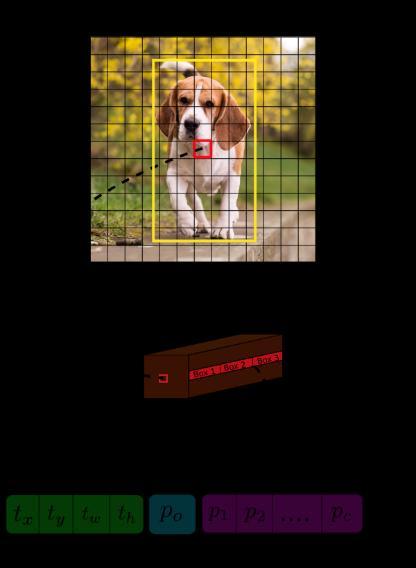
A real time object detection system is the YOLO Convolutional Neural Network (CNN). CNNs are classifier based systems that can recognize patterns in incoming images and interpret them as organized arrays of data (view image below). YOLO has the advantage of being much faster than other networks without sacrificing accuracy.Itallowsthemodeltoassessthecompleteimage at test time and generate predictions based on the overall context of the image. Regions are "rated" by YOLO and otherconvolutional neural network algorithmsdepending onhowcloselytheyresemblespecifiedcategories.
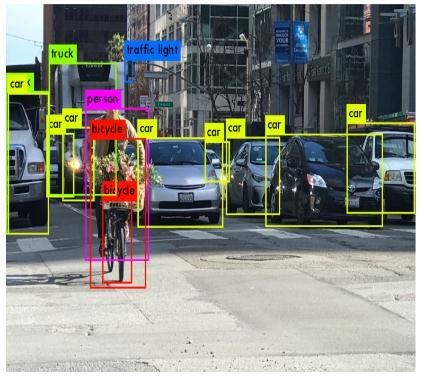
Positive detections of the class with which they most closelyidentifyarehighlightedinwideareas.Forinstance, YOLOmaybeusedtodetectdifferenttypesofcarsinalive traffic feed relying on whether parts of the video score wellincomparisontospecifiedvehicleclasses.
Fig 2 How YOLOv3 works
OtherversionsofYOLOareasfollows:
YOLOv2 In2016,RedmonproposedYOLOv2model.The primary objective is to increase recall and localization while retaining classification accuracy. Darknet 19, a new fully convolutional feature extraction network with 19 convolutional layers and 5 maximum pooling layers, is used in YOLOv2 [6]. The recall and accuracy are greatly improved by adding a batch normalization layer to the convolutional layer and reducing dropout, introducing anchor box mechanism,utilizingk meansclustering [7] on the training set bounding box, and multi scale training. However, there is still room for improvement in the detectionoftargetswithalotofoverlapandsmalltargets.
2) YOLOv4 ObjectdetectionalgorithmYOLOv4[8]isan extension of the YOLOv3 model It is twice as fast as EfficientDet with comparable performance. In addition,AP(AveragePrecision)andFPS(FramesPer Second) in YOLOv4 have increased by 10% and 12%, respectively, when compared to YOLOv3. CSPDarknet53, a spatial pyramid pooling extra module,aPANetpath aggregationneck,andaYOLOv3 head form the backbone of YOLOv4. YOLOv4 has a numberofnewfeaturesandcombinesthemtoachieve cutting edge results: At a real time rate of 65 frames per second, the Tesla V100 scored 43.5 percent AP (65.7percentAP50)fortheMSCOCOdataset.
ThefollowingarethenewfeaturesinYOLOv4
Weighted Residual Connections (WRC), Cross Stage Partial Connections (CSP), Cross mini Batch Normalization (CmBN), Self adversarial training (SAT), Mish activation, Mosaic data augmentation,
International Research Journal of Engineering and Technology (IRJET)
e-ISSN:2395-0056
Volume: 09 Issue: 06 | June 2022 www.irjet.net p-ISSN:2395-0072
DropBlock regularisation, Complete Intersection over Union loss, Self adversarial training (SAT), Mish activation, Mosaic data augmentation, DropBlock regularisation,CompleteIntersectionover(CIoUloss)
Fig 3 Features of YOLOv3
3) YOLO v5 [9] is now the most acceptable version, but YOLOv3 takes significantly less time to learn than v4 and v5. And, when all factors are considered, v4 has some good performance qualities and requires less training time than v5. We chose YOLOv3 since it requiresverylittletrainingtime.
4. RESULT & DISCUSSION
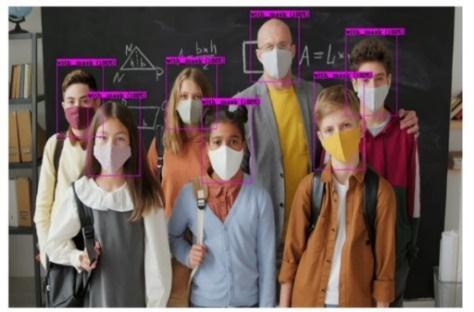
The transfer learning methodology is applied to improve the accuracy of the model (yolo v3). The model is now testedforthesampletestvideo.
Fig 4
Fig 5
Fig 6
Fig 7
Fig 8
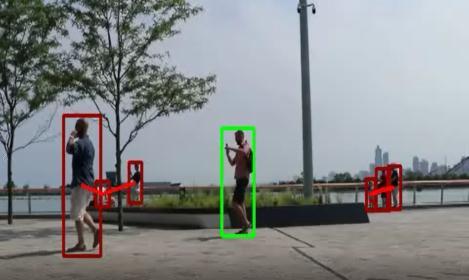
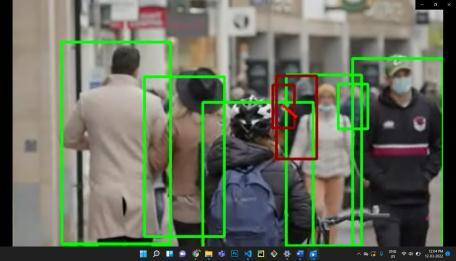
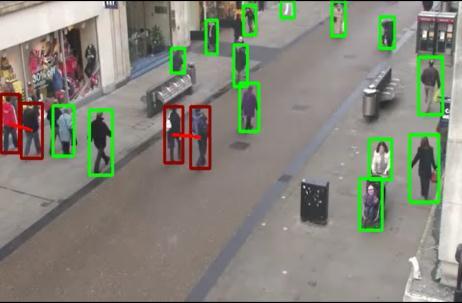
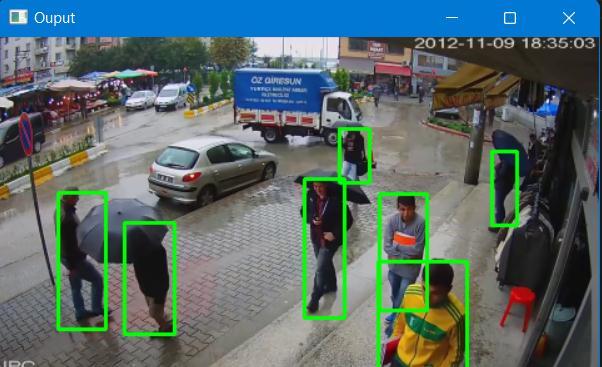
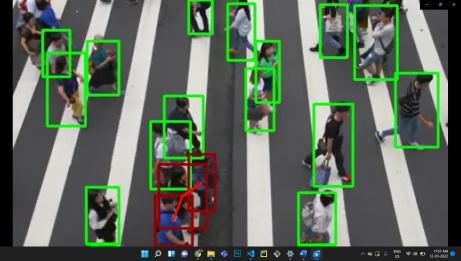
Multiplepeoplewalkingandenteringthesitearedetected and monitored in Fig. 5.0. If the persons are too close to eachother,theframeworkefficientlydetectsthebreachof socialdistancebetweenthemandmarkstheboundingbox as a red rectangle. People are bounded by green box if there is no violation of social distance. In fig. 5.0, four people are bound in red, indicating that they have broken theregulations,whereasroughlyeightpeopleareboundin green,indicatingthattheyhavefollowedtherules.Wecan alsoseethatthereisonlyonepersonwhoisnotdetected. The cause for the miss detection could be that as the pre trained model isused, anindividual'sappearance from an overhead view change, which could lead to the model beingmisled.
International Research Journal of Engineering and Technology (IRJET)
e-ISSN:2395-0056
Volume: 09 Issue: 06 | June 2022 www.irjet.net p-ISSN:2395-0072
backend application can be done using a combination of framework for API conversion, and Java for the POST and GETmethods.
6. REFERENCES
[1] 1point5App https://indianexpress.com/article/technology/tech news technology/how to maintain social distancing app download 6384726/
Fig 9
Output People in red box People in greenbox
Fig4.0 4 14
Fig5.0 0 7
Fig6.0 5 1
Fig7.0 3 15
Fig8.0 3 6 Fig9.0 4 6 Table 1
5. CONCLUSION
Java is an excellent choice for developing Android applications since it provides a large number of libraries andpackagestoaiddevelopment.Androidisa completely free and open development platform based on Linux and opensource.Withoutpayingaroyalty,handsetmakerscan utilizeandadapttheplatform.Internetmash upsinspired this component based architecture. Parts of one software can be utilized in another in ways the creator never imagined, and they can even replace built in components with their own enhanced versions. This will spark a new waveofinnovationinthemobilerealm.
Android is available to everyone: businesses, developers,andusers.
[2] ObjectDetectionUsingImageAI https://www.fireblazeaischool.in/blogs/object detection using imageai in python/
[3] G Seetharaman EB. How countries are using technologytofightcoronavirus https://economictimes.indiatimes.com/tech/softwar e/how countries are using technology to fight coronavirus/articleshow/74867177.cms
[4] A Gentle Introduction to Transfer Learning for Deep Learning https://machinelearningmastery.com/transfer learning for deep learning/
[5] WhatisYolov3? https://viso.ai/deep learning/yolov3 overview/
[6] A review of research on object detection based on deep learning. In: Jun Deng et al 2020 J. Phys.: Conf. Ser.1684012028 https://iopscience.iop.org/article/10.1088/1742 6596/1684/1/012028/pdf
[7] Understanding K means Clustering in Machine Learning https://towardsdatascience.com/understanding k means clustering in machine learning 6a6e67336aa1
Being a part of a number of successful open sourceproposalmodels
[8] Yolov4vsYolov4 tiny https://medium.com/analytics vidhya/yolov4 vs yolov4 tiny 97932b6ec8ec
Aimstobeassimpletoprogramastheweb.
Google Android is taking the mobile internet to thenextlevel.
FieldslikeMachineLearningcanbeaboonifusedwelland integration is well taken care of. Deployment of models and then using their endpoints for any frontend or
[9] How to Use Yolo v5 Object Detection Algorithm for CustomObjectDetection https://www.analyticsvidhya.com/blog/2021/12/ho w to use yolo v5 object detection algorithm for custom object detection an example use case/
© 2022, IRJET | Impact Factor value: 7.529 | ISO 9001:2008 Certified Journal | Page1468
International Research Journal of Engineering and Technology (IRJET)
e-ISSN:2395-0056
Volume: 09 Issue: 06 | June 2022 www.irjet.net p-ISSN:2395-0072
7. BIOGRAPHIES
Mihir Paghdal is studying Information Technology (B.E), currently in third year of Engineering,studentofThadomal Shahani Engineering College, UniversityofMumbai.
His primary research interest is in Data Science and Analysis,SoftwareDevelopment.


Shubh Mehta is studying Information Technology (B.E), currently in third year of Engineering, student of Thadomal Shahani Engineering college, UniversityofMumbai.
His primary research interest is in Machine Learning andArtificialIntelligence.
Parinda Pranami is studying Information Technology (B.E), currently in third year of Engineering,student of Thadomal Shahani Engineering College, UniversityofMumbai.
Her primary research interest is in Computer Vision, Object Detection, Deep Learning and Machine Learning.
Dr Shanthi Therese S is an AssociateProfessoratThadomal Shahani Engineering College with 25 years of teaching experience.
She received her H. D (Technology) in Computer Engineering from the University ofMumbai.
Her areas of specialization are Automatic Speech Recognition, Data Mining and Business Intelligence Applications,MachineLearning.
© 2022, IRJET | Impact Factor value: 7.529 | ISO 9001:2008 Certified Journal | Page1469