International Research Journal of Engineering and Technology (IRJET) e ISSN: 2395 0056

Volume: 09 Issue: 06 | Jun 2022 www.irjet.net p ISSN: 2395 0072
International Research Journal of Engineering and Technology (IRJET) e ISSN: 2395 0056
Volume: 09 Issue: 06 | Jun 2022 www.irjet.net p ISSN: 2395 0072
Shivam1 , Ankit Kumar2
2
1
Abstract ProgressiveCollapsedenotesaglobalstructural system breakdown disproportionally triggered by local structuraldeterioration.Anuncommonoccurrenceinvolving local element removal criteria due to natural forces or artificial risks. When one or more vertical load bearing elementsareremoveddueto artificial(Explosions,Vehicular Collisions) or natural dangers (Earthquake, Tsunami), the progressive collapse of reinforced concrete structures is triggered.Theweightofthebuildingistransferredtoadjacent columns in the structure, failing adjacent components and failing a portion of the entire structure system. In which the collapsing system constantly seeks other load pathways to survive.Whenoneormoreverticalload bearingelementsare removed due to artificial or natural dangers, the progressive collapse of reinforced concrete structures is triggered. The building's weight is transferred to adjacent columns and beams in the structure, failing adjacent components and failing a portion of the entire structure system. In which the collapsing system constantly seeks other load pathways to survive. Performing Linear static analysis in the G+8 storey R.C.C.buildingusingETABSSoftwareVersion16.0.According toG.S.A.regulations,thedemandcapacityratioisevaluatedin thecriticalzoneoftheR.C.partconnectedwiththeeliminated column.
Key Words: Progressive Collapse, Etabs, D.C.R. (Demand Capacity Ratio), G.S.A., Columns removal.
ProgressiveCollapseisthesubsequentbreakdownofapart oftheentirestructurecausedbythelossofaverticalload bearingelement(mostlycolumn).Failureofaprimaryload resistantmemberredistributesforcestoadjacentmembers, whichfailiftheredistributedloadexceedstheircapability. Thisprocesscontinuesinthestructure,andeventually,the buildingcollapses.Collapsesofthisnatureareofparticular interesttostructuralengineersifthereisamarkeddisparity betweentheinitiationeventandtheresultingCollapse.
The potential irregular loads that can cause the dynamic breakdownarearrangedthatway
i) PressureLoads
•Gasexplosions
•Blast
***
•Excessivepressureduetothewind.
•Extremeenvironmentalloads
ii) ImpactLoads
•Vehicularcollision
•Earthquake
Linear Static Analysis - The linear static approach establishesthepossibilityofstructuralfailurebycalculating thedemandcapacityratiosofstructuralparts(U.F.C.,2013). Iftherearenostructuralanomaliesinsidethestructure,the analysiscanbeconducted,anditisnotnecessarytocalculate the D.C.R.s. If structural anomalies occur, the analysis can onlybeundertakenifallmemberD.C.R.sarebeloworequal totwo.
Nonlinear static procedure: TheL.S.P.cannotaccurately predicthowastructurewillbehaveafterlosingaprimary member. A nonlinear method, albeit more complex, is requiredtoadvanceourunderstandingoftheperformance of a building undergoing gradual Collapse. In an NLS analysis,materialandgeometricnonlinearbehavioursmust beconsidered.
DCR=Qud/Que
Qud =Demand (Acting force) observed in member or connection(bendingmoment, axialforce,shearforceand possiblecombinedforces)
Que=Expectedultimate,unfactoredcapacityofthemember or connection (shear, moment , axial force and possible combinedforces)thepermissibleD.C.R.valuesforprimary andsecondarystructuralelementsare:
•Demandcapacity ratio (DCR)<2.0for typical structural configurations.
•Demandcapacityratio(DCR)<1.50foratypicalstructural configurations.
International Research Journal of Engineering and Technology (IRJET) e ISSN: 2395 0056
Volume: 09 Issue: 06 | Jun 2022 www.irjet.net p ISSN: 2395 0072
In this work, the Linear static method is used for the assessmentofprogressivecollapseinamulti storeybuilding. ThestructureunderInstantaneousRemovalofColumnsfrom thedifferentlocationsandcomparetheirD.C.R.valuetofind outthemostcriticalsituationinR.C.C.Multi StoreyBuilding UsingETABSSoftwareasperI.S.standards.
There are multiple methods for analyzing structures and investigating their reaction to the progressive collapse phenomenonforthisresearch,andweemployedG.S.A.for additionalrecommendations.
ThepurposeoftheseGuidelinesisto:
• Assist throughout the reduction of the possibility of progressiveCollapseinnewbuildings
• Progressive Collapse potential evaluation in existing buildings.
•Helpwiththedevelopmentoffuturefacilityenhancements, ifnecessary.
The localised failure of one or more structural elements causes progressive collapse. This failure leads to a progressionofloadtransferthatexceedsthecapacityofother surroundingfeatures,whichinturninitiatestheprogression thatultimatelyresultsinthetotalorpartialcollapseofthe structure. Progressive collapse can be caused by the structure'scompleteorpartialfailure.
ETABSisusedtocreateatypicalframemodelforthestudy. All supports are modelled as being fixed. On each of these models,linearanalysisiscarried out. We useLinearStatic Analysisinthispaper Thefirststructureisdesignedusing ETABS v16.0 using IS 1893 load combinations. Then, a separatelinearstaticanalysisisconductedforeachcolumn removalinstance.Thedemandcapacityratioforshearatall storiesiscomputedforvariousbeamfailurescenarios.The capacity of the member at any section is estimated in accordance with I.S. 456:2000 using the reinforcing data obtainedfollowinganalysisanddesign.Afterremovingthe column,theDCRisdeterminedbycalculatingtheforceofthe member for the load combination following G.S.A. requirements. ETABS 16.0 analysis findings determine the memberforces.
Locationconsiderationsforcolumnremovals
The following analysis aspects must be applied when evaluatingprogressiveCollapse
i) ExteriorColumnC3removedfromGroundFloor
ii) Exterior Columns C2 and C5 remove from Ground Floor
iii) InteriorColumnC17RemovedfromGroundFloor
Table 1:SpecificationofBuilding.
SPECIFICATION DATA
TypicalStoreyHeight 3
BaseStoreyHeight 3
ConcreteGrade M30
DensityofRCC 25KN/M3 DensityofMasonry 20KN/M3
ColumnsSize 0.30X0.30M
BeamSize 0.25X0.30M
SlabThickness 0.15M
BottomSupportCondition FixedSupport
WindSpeed 50M/Second DeadLoad 0.52KN/M2
LiveLoad 3KN/M2
SeismicZone IV SeismicZoneFactor 0.24 ImportanceFactor 1 ResponseReduction 3 SiteType II SoilType Medium DampingRatio 5%, asper IS 1893: 2002(Part 1) PoissonRatio 0.2
Table 2:GeneralData
Software
Etabs2016
BuildingConfiguration Symmetric Dimension 27.4256X8.6868M
STOREY 9 CODES IS456:2000 IS18923:2002 IS875:1987
International Research Journal of Engineering and Technology (IRJET) e ISSN: 2395 0056
Volume: 09 Issue: 06 | Jun 2022 www.irjet.net p ISSN: 2395 0072
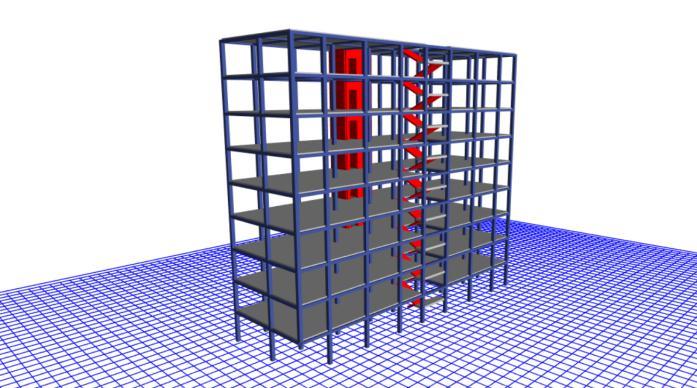
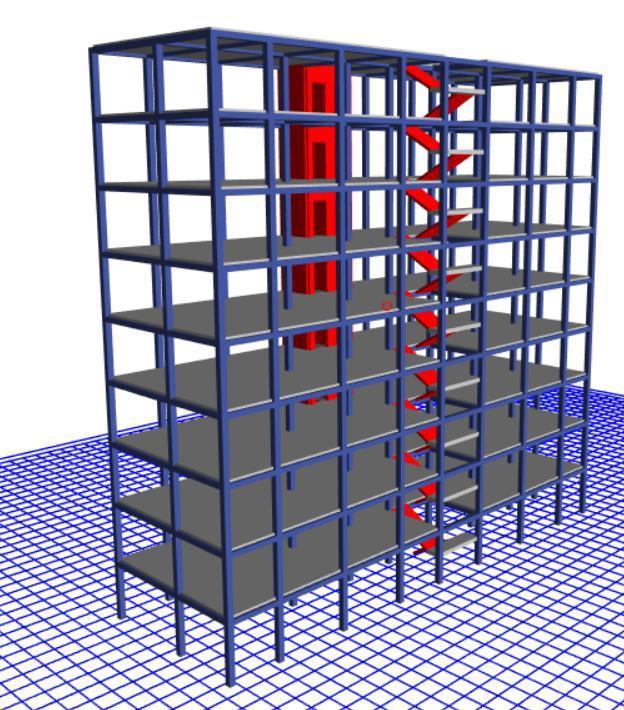
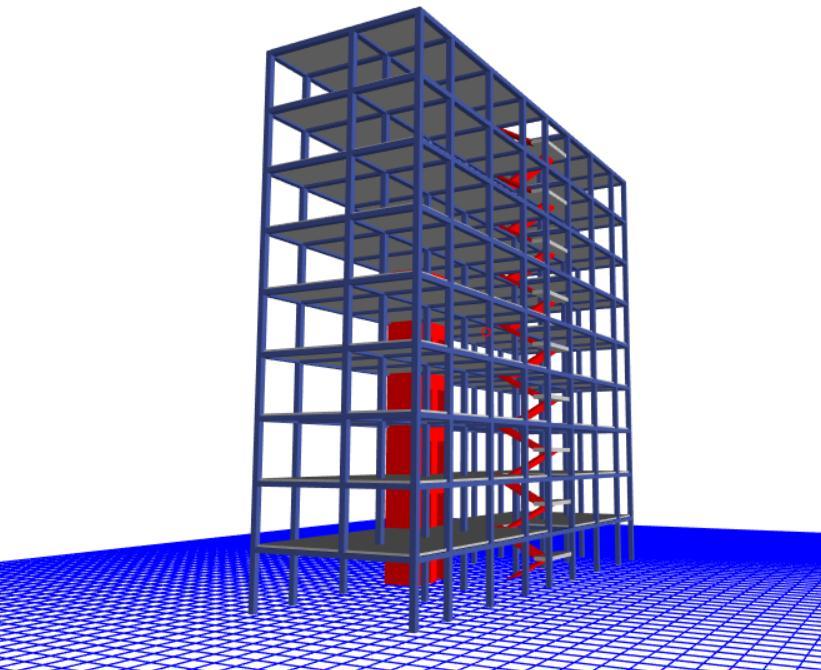
Figure 1: 3Dviewofthebuilding
The D.C.R. values acquired by the ETABS program for loadings assigned per G.S.A. are used to determine the behaviourofstiltfloormembersinthestructure.
In this chapter, the results of the analysis and the D.C.R. values for the beams of the stilt floor are shown. The susceptivity of three case studies with various column removalstoprogressiveCollapsehasbeenevaluated.Ineach frame,theD.C.R.oftheprimaryitems(beams)isspecified alongwiththeirparticulars.
D.C.R.increasesinbeamsafterremovingcolumnC3,butthe value is under the permissible limit; therefore, no progressivecollapseoccurs.
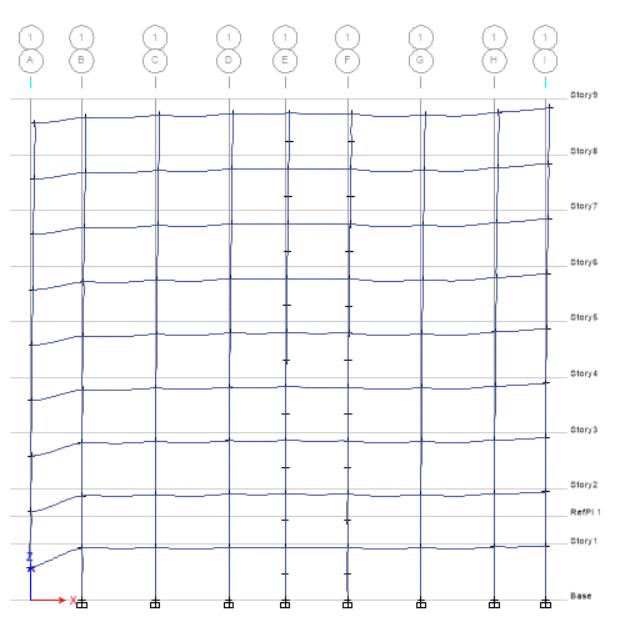
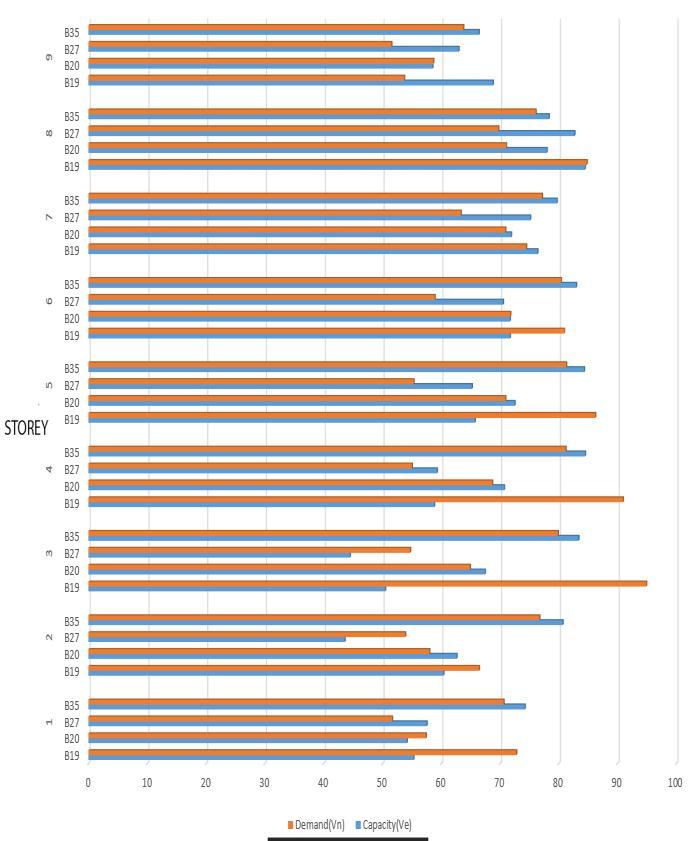
WeCalculateD.C.R.ValuesinbeamsB35,B27,B20,andB19 aftertheColumnremoval ThefollowingChartsShows the designcapacityanddemandcapacityofbeamsundershear.
Fig 2: ExteriorColumnC3removed
Chart 1: ShowsDemandandcapacityofBeamsafter removingColumnC3
International Research Journal of Engineering and Technology (IRJET) e ISSN: 2395 0056
Volume: 09 Issue: 06 | Jun 2022 www.irjet.net p ISSN: 2395 0072
Chart 2: ShowsD.C.R.ValueinBeamsafterremoving ColumnC3.
D.C.R.increasesinbeamsafterremovingcolumnC3,butthe valueisunderthepermissiblelimit;therefore,noprogressive collapseoccurs.
2) Remove Columns C2 and C5 from Ground Floor
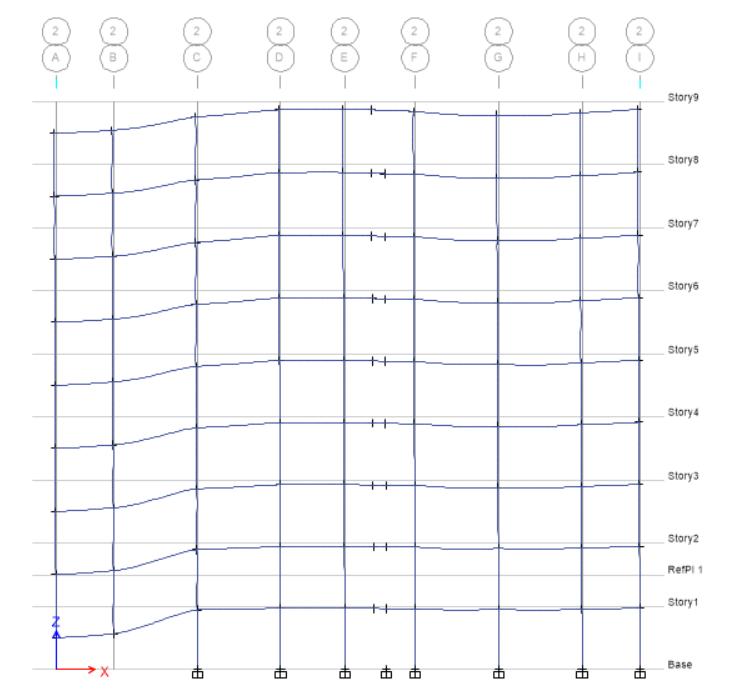
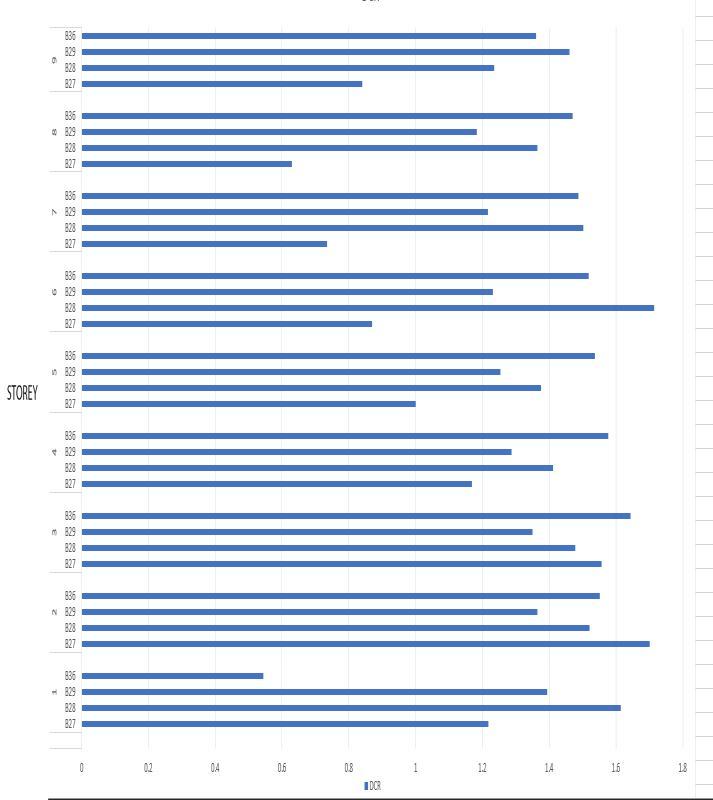
WeCalculateD.C.R.ValuesinbeamsB36,B29,B28,andB27 aftertheremovalofColumnsC2andC5.
Figure 5:DisplacementafterColumnsC2andC5Removed
ThefollowingChartsShowsthedesigncapacityand demandcapacityofbeamsundershear.
Figure 4:ColumnsC2andC5Removed
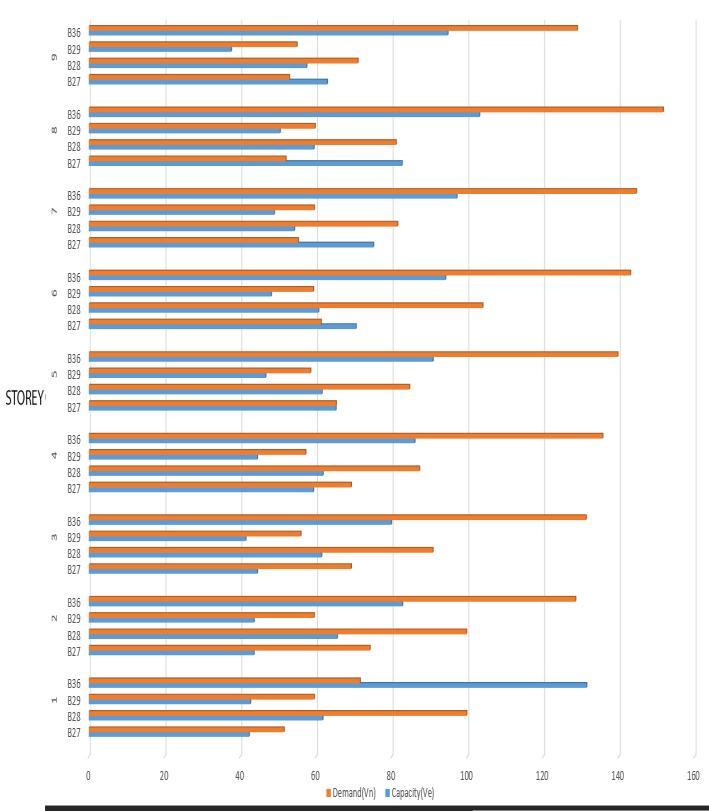
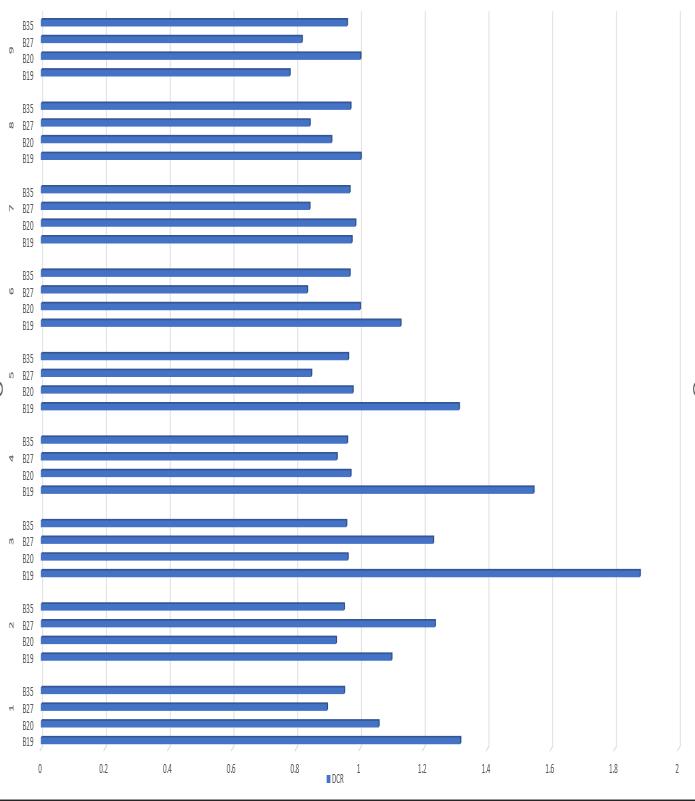
Chart 3: ShowstheDemandandcapacityofBeamsafter removingColumnsC2andC5.
International Research Journal of Engineering and Technology (IRJET) e ISSN: 2395 0056
Volume: 09 Issue: 06 | Jun 2022 www.irjet.net p ISSN: 2395 0072
Chart 4: D.C.R.ofBeamsafterremovingColumnsC2and C5.
D.C.R.increasesbeamsafterremovingcolumnsC2andC5, but the demand capacity ratio is under 2; therefore, no progressivecollapseoccurs.
WeCalculateD.C.R.ValuesinbeamsB23,B22,B32,andB31 aftertheremovalofColumnC17
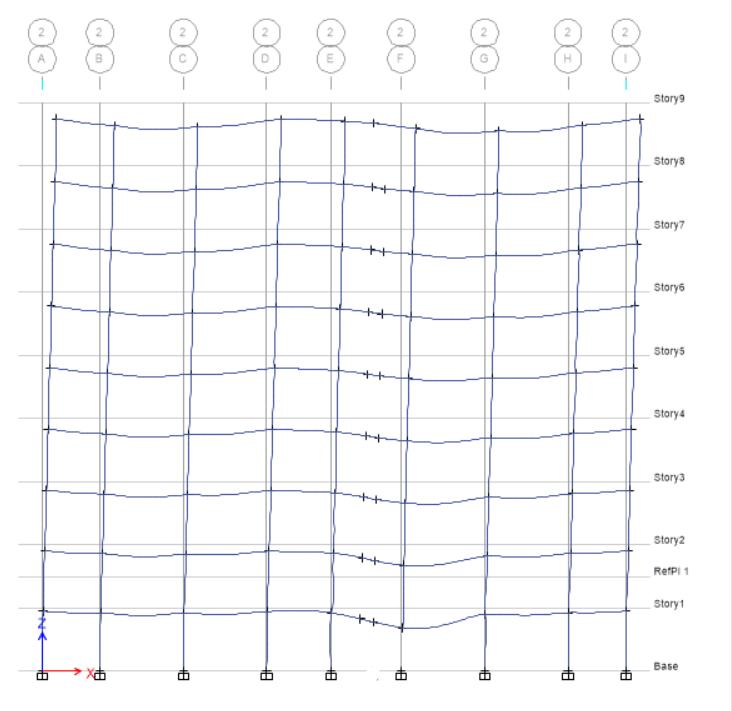
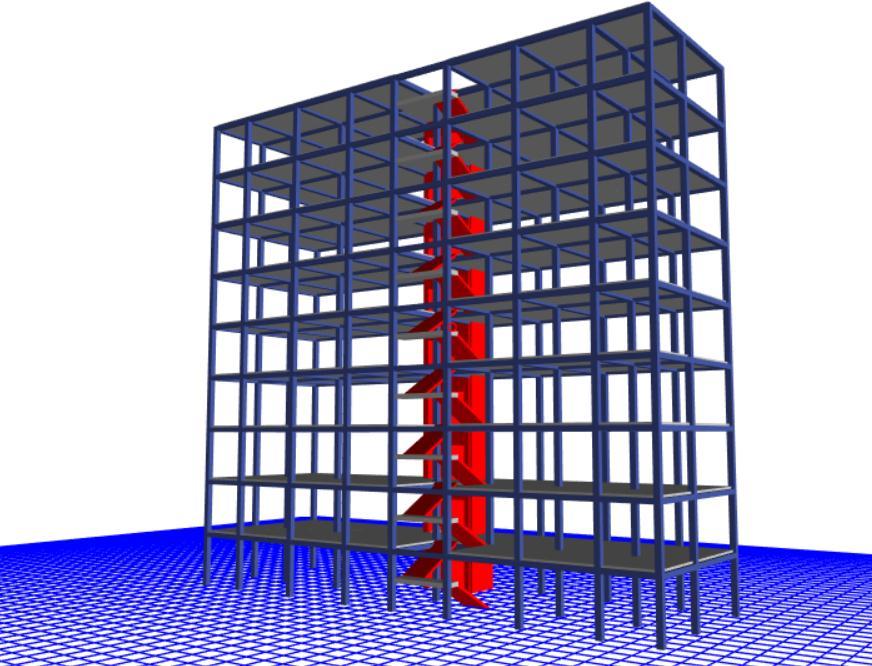
Figure 7: Displacement due to InteriorColumnC17 Removed
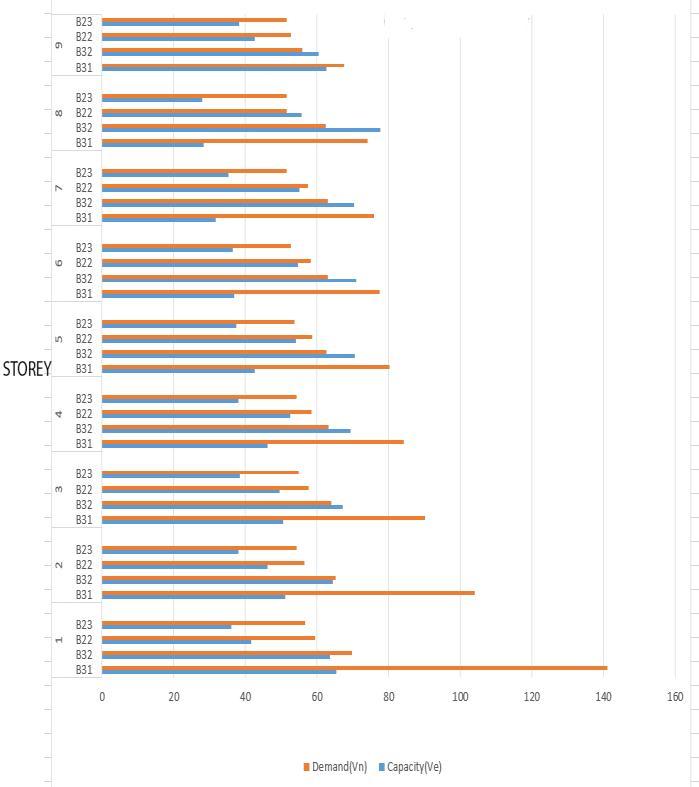
FollowingChartsShowsdesigncapacityanddemand capacityofbeamsundershear.
Chart 5: ShowsDemandandcapacityofBeamsafter removinginteriorColumnC17
Figure 6:InteriorColumnC17Removed
International Research Journal of Engineering and Technology (IRJET) e ISSN: 2395 0056
Volume: 09 Issue: 06 | Jun 2022 www.irjet.net p ISSN: 2395 0072
[1] Raghavendra, C., and Mr. Pradeep AR. "Progressive collapse analysis of reinforced concrete framed structure."InternationalJournalofCivilandStructural EngineeringResearch,ISSN(2014):2348 7607.Ganesh Kumar and P.Vasanth Sena, "Novel Artificial Neural Networks and Logistic Approach for Detecting Credit CardDeceit,"InternationalJournalofComputerScience and Network Security, Vol. 15, issue 9, Sep. 2015, pp. 222 234
[2] Ellingwood, B. R., Smilowitz, R., Dusenberry, D. O., Duthinh, D., Lew, H. S., & Carino, N. J. (2007). Best practices for reducing the potential for progressive Collapse in buildings. https://doi.org/10.6028/NIST.IR.7396
[3] Kiakojouri, F., de Biagi, V., Chiaia, B., & Sheidaii, M. R. (2020). Progressive Collapse of framed building structures:Currentknowledgeandfutureprospects.In Engineering Structures (Vol.206).ElsevierLtd.
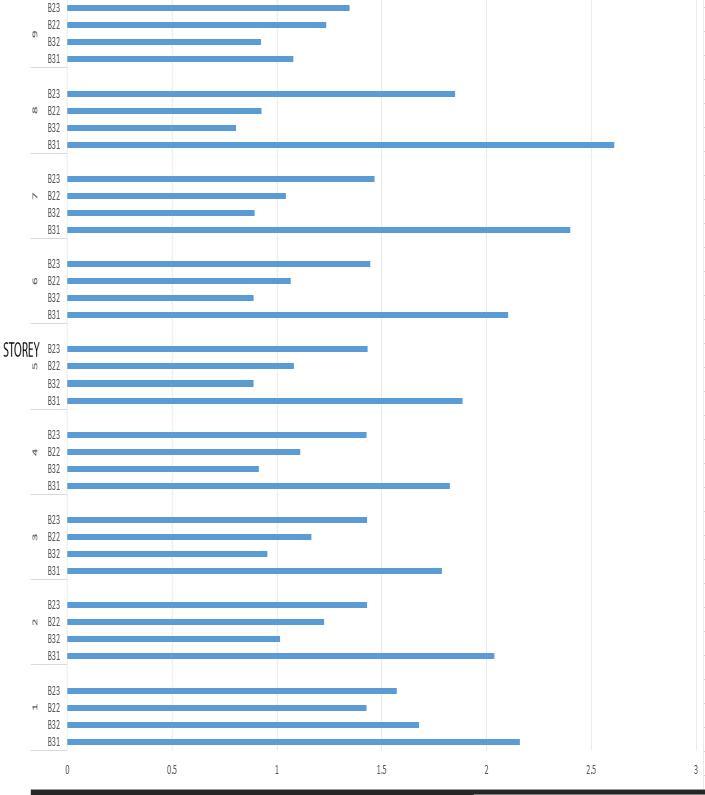
Chart 6: D.C.R.ofBeamsafterremovingColumnC17
DCRincreasesinbeamsafterremovingcolumnC17,andthe demand capacity ratio is over 2 in Beam 31 Therefore, progressiveCollapseoccurs.
i. Demand Capacity Ratios for three conditions are calculated.In two conditions,theyare lessthan 2 andexceeds2inonecase,suggestingthatinterior columnremovalcausemoredamage.
ii. Theaxialparameteriscrucialforunderstandingthe progressivecollapseprocessincolumns.
iii. Whenperipheralcolumnsareremoved,theD.C.R. valueofinnercolumnsincreases.
iv. Columnsbearlessdamagethanbeams.
v. Increasing the beam size may be more beneficial thanincreasingthecolumnsizetopreventordelay Collapse
vi. ItwasfoundthatthereisaconstantdropinD.C.R. value from the bottom Story to the top Story, implyingthatthefailureismoreatthegroundFloor storythanatthetopStory.
[4] Wang,H.,Zhang,A.,Li,Y.,&Yan,W.(2014).SendOrders forReprintstoreprints@benthamscience.netTheOpen CivilEngineeringAReviewonProgressiveCollapseof BuildingStructures.In Journal (Vol.8).
[5] Wang,H.,Zhang,A.,Li,Y.,&Yan,W.(2014).SendOrders forReprintstoreprints@benthamscience.netTheOpen CivilEngineeringAReviewonProgressiveCollapseof BuildingStructures.In Journal (Vol.8).
[6] Nassir, M., Yang, J., Nyunn, S., Azim, I., & Wang, F. L. (n.d.). Progressive Collapse Analysis of multi story building under the scenario of multi column removal https://doi.org/10.1051/e3sconf/2019136040
[7] Chidambaram, C. R., et al. "A study on progressive collapse behavior of steel structures subjected to fire loads." Indian Journal of Science and Technology 9.24 (2016).
[8] Tripathi, Shubham & Jain, A. (2019). Progressive Collapse Assessment of R.C.C. Structure under Instantaneous Removal of Columns and its Modeling Using Etabs Software. IOSR Journal of Engineering. 9. 27 36.
[9] Patel, Vishalkumar. (2018). STUDY OF PROGRESSIVE COLLAPSEONRCC15STOREYBUILDINGAsPerG.S.A. Guidelines.
[10] D. D. Joshi, P. V. Patel, and S. J. Tank, "Linear and NonlinearStaticAnalysisforAssessmentofProgressive Potential of Multistoried Building," presented at the StructuresCongress,2010.
International Research Journal of Engineering and Technology (IRJET) e ISSN: 2395 0056
Volume: 09 Issue: 06 | Jun 2022 www.irjet.net p ISSN: 2395 0072
[11] R. C and M. P. A. R, "Progressive Collapse Analysis of Reinforced Concrete Framed Structure," International JournalofCivilandStructuralEngineeringResearch,vol. 2,2014.
[12] R. Jeyanthi and S. M. Kumar, "Progressive Collapse Analysis of a Multistorey using pushover analysis," International Journal of Engineering Research & Technology,vol.5,2016.
[13] KamelSayedKandil1,EhabAbdElFattahEllobodyand Hanady Eldehemy, "Progressive Collapse of Steel FramesWorldJournalofEngineeringandTechnology", 2013,1,39 48PublishedOnlineNov2013.
[14] Miss.PreetiK.MoreyandProfS.R.Satone,"Progressive CollapseAnalysisOfBuilding",InternationalJournalof EngineeringResearchandApplications(IJERA)Vol.2, Issue4,June July2012,pp.742 745.
[15] K. Jinkoo and K. Taewan, "Assessment of progressive collapse resisting capacity of steel moment frames," Journal ofConstructional Steel Research, vol.65, no.1, pp.169 179, Mar.2008.
2022, IRJET | Impact Factor value: 7.529 | ISO 9001:2008 Certified Journal