International Research Journal of Engineering and Technology (IRJET) Volume: 09 Issue: 06 | Jun 2022
www.irjet.net
e-ISSN: 2395-0056 p-ISSN: 2395-0072
TREATMENT OF LANDFILL LEACHATE USING ALGAE Rifana Fabin1, Rana Rahman M2 1Mtech
Environmental Engineering Student, KMCT CEW Kerala, India Professor, Dept. of Civil Engineering, KMCT CEW Kerala, India ---------------------------------------------------------------------***--------------------------------------------------------------------1.1 Objectives Abstract - The study focuses on the treatment of landfill 2Assistant
leachate using Algae. The algae used is chlorella vulgaris. Generation of landfill leachate become an important problem and it should be treated thoroughly. Leachate is the highly toxic waste water which is formed due to precipitation entering landfill. The amount of Nitrate, Ammonia, TDS, Chemical Oxygen Demand etc. will be very high. Leachate not only pollutes the ground water but also it generates lot of toxic gases and also it may damage the reinforcement of the nearby buildings by corroding it. The binding strength of concrete is also affected. In this study, optimum dosage and optimum time for the algae chlorella based on their removal efficiency is main focus in this project. Key Words: Leachate, Chlorella
Specific objectives of this project can be outlined as follows:
To evaluate the feasibility of Algae in the treatment of leachate.
To determine the removal efficiency Algae in various parameters of leachate such as Chemical oxygen demand(COD), Nitrate and Ammonia nitrogen
To find out the optimum contact time and optimum dosage of algae.
1.2 Scope of the study
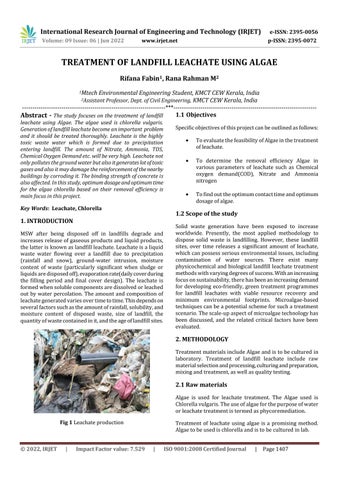
1. INTRODUCTION MSW after being disposed off in landfills degrade and increases release of gaseous products and liquid products, the latter is known as landfill leachate. Leachate is a liquid waste water flowing over a landfill due to precipitation (rainfall and snow), ground-water intrusion, moisture content of waste (particularly significant when sludge or liquids are disposed off), evaporation rate(daily cover during the filling period and final cover design). The leachate is formed when soluble components are dissolved or leached out by water percolation. The amount and composition of leachate generated varies over time to time. This depends on several factors such as the amount of rainfall, solubility, and moisture content of disposed waste, size of landfill, the quantity of waste contained in it, and the age of landfill sites.
Solid waste generation have been exposed to increase worldwide. Presently, the most applied methodology to dispose solid waste is landfilling. However, these landfill sites, over time releases a significant amount of leachate, which can possess serious environmental issues, including contamination of water sources. There exist many physicochemical and biological landfill leachate treatment methods with varying degrees of success. With an increasing focus on sustainability, there has been an increasing demand for developing eco-friendly, green treatment programmes for landfill leachates with viable resource recovery and minimum environmental footprints. Microalgae-based techniques can be a potential scheme for such a treatment scenario. The scale-up aspect of microalgae technology has been discussed, and the related critical factors have been evaluated.
2. METHODOLOGY Treatment materials include Algae and is to be cultured in laboratory. Treatment of landfill leachate include raw material selection and processing, culturing and preparation, mixing and treatment, as well as quality testing.
2.1 Raw materials Algae is used for leachate treatment. The Algae used is Chlorella vulgaris. The use of algae for the purpose of water or leachate treatment is termed as phycoremediation. Fig 1 Leachate production
© 2022, IRJET
|
Impact Factor value: 7.529
Treatment of leachate using algae is a promising method. Algae to be used is chlorella and is to be cultured in lab. |
ISO 9001:2008 Certified Journal
|
Page 1407