International Research Journal of Engineering and Technology (IRJET) e-ISSN:2395-0056

Volume:09Issue:06| June2022 www.irjet.net p-ISSN:2395-0072
International Research Journal of Engineering and Technology (IRJET) e-ISSN:2395-0056
Volume:09Issue:06| June2022 www.irjet.net p-ISSN:2395-0072
1,2,3B Tech Student, Dept. of Civil Engineering, DBATU University, Maharashtra, India 4 Assistant Professor, Dept. of Civil Engineering, DBTU University, Maharashtra, India ***
Worldwide, retrofitting is used largely to repair and re strengthen RC structural members. Retrofitting is the modification of an existing structure by adding new technologiesorfeaturestooldersystems.Thereare somany existing structures that need reconstruction, but complete replacement of structures becomes costly and time consuming. Hence, retrofitting becomes an efficient option. Retrofitting is the most commonly used technique to repair or re strengthen the structure. This paper presents an experimental study of the retrofitting and re strengthening of RC members using various fibre materials externally and a comparison between a control specimen and a retrofitted specimen for ultimate load capacity. In this experimental study, we cast RC members and tested them after retrofitting with CFRP, GFRP, and CFRP with Carbon Laminate.
Keywords: Retrofitting, RC member, CFRP, CFRP, Carbon Laminate, Ultimate Load Capacity, Strengthening.
Repairandrehabilitationareoneofthebiggestchallenges to the civil engineering field. Structures deteriorate because of natural disasters, reinforcement corrosion, poor construction quality, etc. For such conditions, retrofitting has become an efficient option for rehabilitation and repair. Existing structures also become saferasretrofittingimprovestheultimateloadcapacityof existingstructures.
FRP is nowadays widely implemented. FRP composite materials have recently been developed and studied for repair. FRP is a composite material made of a polymer matrix reinforced with fibres. There are various fibres such as CFRP, GFRP, PFRP, SFRP, COIR FIBRE SHEET etc. FRPiswidelyusedbecauseofitsproperties,asitislightin weight, corrosion resistant, high strength, easy to transportandinstall,etc.
Retrofitting using FRP materials is easy and cost effective as compared to other traditional methods of retrofitting. Beams are the critical structural members subjected to bending, torsion, and shear in all types of structures. Similarly, columns are also used as various important elements, subjected to axial load combined with/without bending,andareusedinalltypesofstructures.Therefore, extensive research work is being carried out throughout the world on the retrofitting of concrete beams and columns with externally bonded FRP composites [2].The conventional strengthening methods of reinforced concrete structures attempt to compensate for the lost strength by adding more material around the existing sections[1].
The main objective of this study is to understand the behaviour of RC structural members after being strengthened withvariousfibressuchasCFRP,GFRP,and CFRPwithCarbonLaminate.
International Research Journal of Engineering and Technology (IRJET) e ISSN:2395 0056
Volume:09Issue:06| June2022 www.irjet.net p ISSN:2395 0072
stirrups 8mmØbarsareprovidedataspacingof140mm c/c. The beam was cast for M30 grade (1:0.75:1.5). Three beams werecast,one asa control specimenand theother twoforretrofitting.Beamswerecuredfor14days
Themouldsofthecolumnhavealength of700mmwitha cross sectional dimension of 150mm x 150 mm are prepared from wooden planks. For the column two identical moulds are prepared. The column has 4 bars of 12mmØbarsandforstirrups,8mmØbarsareprovidedat a spacing of 140mm c/c. The columns were cast for the M30 grade (1:0.75:1.5). Two columns were cast, one as a control specimen and the other one for retrofitting. Columnswerecuredfor14days.
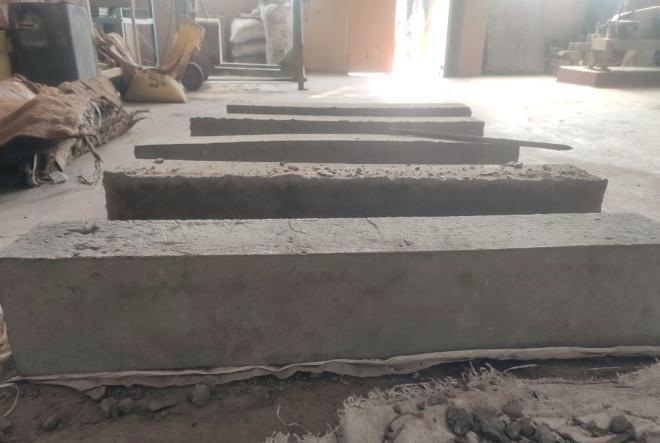
The grade of concrete used for casting RC members was M30 (1:0.75:1.5). The cement was Ordinary Portland Cement of grade 53 (JK Super Cement), crushed sand retainedon4.75 mm sieve andaggregatepassing through 12 mm sieve. The water to cement ratio was 0.5. For reinforcement, 12 mm, 10 mm and 8 mm diameter bars are used. The following materials were used in this experimentalstudy:CFRP,GFRP,andCarbonLaminate.
The moulds of the beam having a length of 1000mm with cross sectional dimension of 150mm X 150mm are preparedfromwoodenplanks.Threemouldsareprepared tohavethesamesizeasthebeam.Thebeamhas 2barsof 12mm Ø at top as a compression reinforcement, 2 bars of 10mm Ø at bottom as a tension reinforcement and for
Fig.1: CastingoftheRCmember
International Research Journal of Engineering and Technology (IRJET) e ISSN:2395 0056 Volume:09Issue:06| June2022 www.irjet.net p ISSN:2395 0072
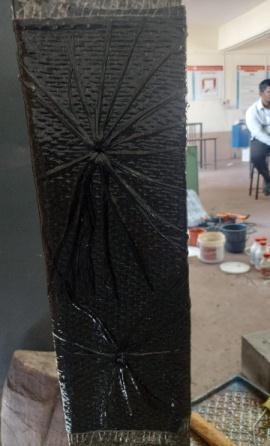
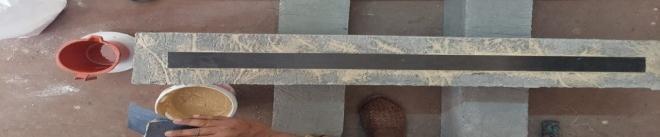
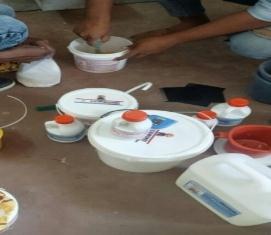
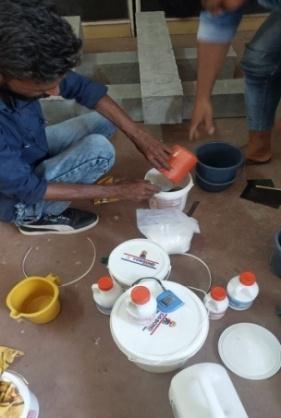
MixVCOBONDEPBL 5920partsAandBwithaproportion of1:1/2.Addhalfthebagoffillertotheabovemixtureand stir thoroughly. Apply this putty over the beam bottom to level the surface. Mix VCOBOND EPF 5910 parts A and B with a proportion of 1:1/2. Add half the bag of filler and stir thoroughly. Apply this putty over a surface to paste carbon laminate. Paste carbon laminate having a size of 900 x 50 mm over putty at the centre of the beam. Cut carbon fibre as per the required size. Mix VCOBOND EPB 5160 parts A and B with the proportion of 1:1/2. Apply this mixture to the beam bottom and sides of the beam withthehelpofarollerorbrush.Applycarbonfibretothe mixture,finelyremovingallwrinkles.Reapplythemixture to the carbon fibre. The surface should be flat with no air bubbles.
Firstly, cut carbon fibre as per the required size. Drilling two holes at a certain distance for fasteners. Mix VCOBOND EPB 5160 parts A and B with a proportion of 1:1/2. Apply this mixture on all four sides of the column. Apply carbon fibre to the mixture, finely removing all wrinkles. Reapply the mixture to the carbon fibre. Place fasteners into drilled holes to seal the overlapping joints Reapply the mixture to the fasteners. The surface should beflatwithnoairbubbles.
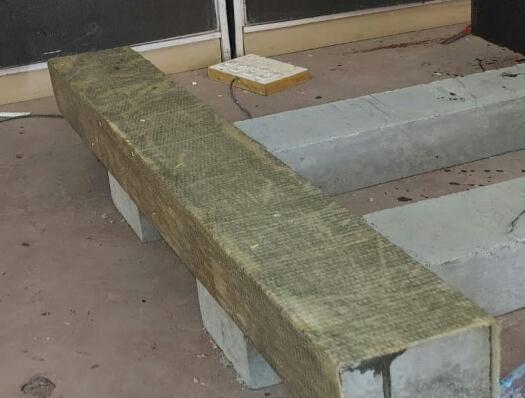
b) GFRPbeamapplicationprocedure.

Firstly, cut glass fibre as per the required size. Mix VCOBOND EPB 5160 parts A and B with a proportion of 1:1/2. Applythismixtureonthebeambottomandsidesof the beam with the help of a roller or brush. Apply glass fibre to the mixture, finely removing all wrinkles. Reapply themixturetothefibre Thesurfaceshouldbeflatwith no airbubbles.
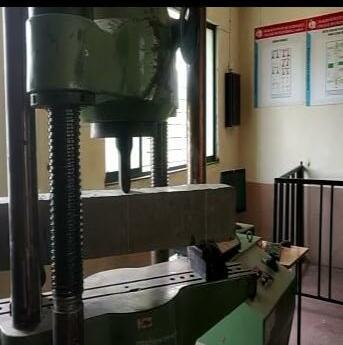
The control beams and columns as well as retrofitted beams and columns were tested for flexural strength. The UTM set up wasused for testing. A central point load was given. The control specimens were tested after curing for 14 days. And retrofitted specimens were tested 15 days afterretrofitting.
International Research Journal of Engineering and Technology (IRJET) e ISSN:2395 0056
Volume:09Issue:06| June2022 www.irjet.net p ISSN:2395 0072
The beams were supported by the roller bearings. The beams were placed, leaving 150 mm from both ends, and theremainingpartwasdividedintotwoequalparts.Then thecentral loadwasapplied by the loadcell.Theultimate load was taken at which the load on the control unit returnedback.
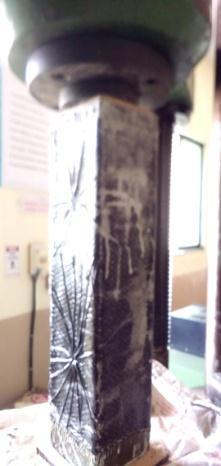
The columns were placed vertically in UTM and central point load was given by load cell. The ultimate load was takensameasthatofbeams.
Fig.5: TestingofRCmembers
The control specimen had an ultimate load capacity of 79 KN. The beam strengthened with GFRP had an ultimate load capacity of 120 KN, which increased by 51% compared to that of the control beam. The beam strengthened by using CFRP with carbon laminate had an ultimateloadcapacityof132KN,whichincreasedby67% comparedtothatofthecontrolspecimen.
The ultimate load capacity of the control specimen is 370 KN. The ultimate load capacity of a column strengthened withCFRPis448KN,whichisanincreaseof21%overthat ofthecontrolspecimen.
UL TIMATE LOA D (K N )
Control GPRP Specimen CFRP+ Laminates
Fig.6: Beamloadinggraph
Control Specimen CFRP
Fig.7: Columnloadinggraph
International Research Journal of Engineering and Technology (IRJET) e ISSN:2395 0056 Volume:09Issue:06| June2022 www.irjet.net p ISSN:2395 0072
In this experimental study, the behaviour of RC structural members retrofitted with CFRP, GFRP, and CFRP with carbon laminate is studied. From the test results and calculatedstrength values,thefollowingconclusionswere made:
• Deflection of beams minimized due to the wrapping of variousfibrematerials.
• The flexural strength and ultimate load capacity of RC members improved due to external strengthening of RC members.
• The ultimate load capacity of the beam by using CFRP withcarbonlaminateisincreasedby67%.
• The ultimate load capacity of a beam strengthened with GFRPisincreasedby51%.
• Even though the beam retrofitted by using CFRP with carbon laminate has the maximum ultimate load capacity, ithasprovedtobeuneconomical.
• Beam strengthening using GFRP is more economical thanusingCFRPasitcostsonlyRs.300/sq.mandincreases ultimateloadcapacityby51%.
• The ultimate load capacity of a column strengthened withCFRPincreasedby21%
• The strength of a column retrofitted with CFRP is increasedascomparedtoanun strengthenedcolumn.
[1] Anumol Raju et al..(2013) “Retrofitting of RC Beams UsingFRP”.
[2] Akash Rathod et al.,(2018) “Retrofitting of Reinforced Concrete Beam Using Carbon Fibre Reinforced Polymer (CFRP)Fabric”.
[3] Purnima Mishra et al.,(2020) “ Retrofitting of RC StructureUsingCarbonlaminates”.
[4] Ankit Dasgupraet al.,(2018) “Retrofitting of Concrete StructureWithFibreReinforcedPolymer”.
[5] Muktar Nuhu Danrakaet al.,(2017) “ Strengthening of ReinforcedConcreteBeamsusingFRPTechnique”.
[6] F. H. Chowdhury et al.,(2014)“Application of FRP MaterialsForStrengtheningofRCStructuralMembers”.
[7] Ahmed Farghalyet al.,(2014) “ Evaluation of Seismic Retrofitting Techniques Used In Old Reinforced Concrete Building”.
[8] A. R. Khan et al.,(2018) “Behavior Of CFRP Wrapped Reinforced Concrete Columns Under Uniaxial Compression”.
[9] Kritika Gupta et al.,(2017) “Review paper on seismic retrofittingofstructure”.
[10] Puneet Kuma et al.,(2019) “A Review Paper on SeismicRetrofittingofPureMasonryStructure”.
[11] P. Lestuzziet al.,(2004)“A Review of Conventional SeismicRetrofittingTechniquesForURM”.
[12] R. Nandini et al.,(2020)“Retrofitting of Concrete StructuresUsingFibreReinforcedPolymer(FRP)”.
[13]AhmadAbdelHamidetal.,“RetrofittingofReinforced ConcreteBeamsUsingAdvancedCompositeOverlays”.
[14] BishnuGupt Gautam et al., “Experimental Study on Retrofitting of Square RC Short Column Subjected to ConcentricAxialLoadingbyJacketing”.
[15] AlperIIkiet al.,(2004) “Low Strength Concrete MembersExternallyConfinedWithFRPSheets”.
[16] Jiangfeng Dong et al.,(2013) “Structural Behavior of RC Beams With External Flexural and Flexural Shear StrengtheningByFRPSheets”.
[17] Mr. Hrishikesh Salunkhe, View Coatings Pvt. Ltd, Kolhapur.
[18] Mr. SachinJathar, RCC Consultant, Caliber Concrete Solutions,Kolhapur.