Sustainable Design of Alternator Pulley for Locomotives

Page 1

International Research Journal of Engineering and Technology (IRJET)

e-ISSN: 2395-0056

Volume: 09 Issue: 06 | June 2022

p-ISSN: 2395-0072

www.irjet.net

Sustainable Design of Alternator Pulley for Locomotives Fyzal Badarudeen 1 Sherine Y F 2 Faculty of Mechanical Engineering, Higher Colleges of Technology, Al Ain Men’s Campus, Al Ain, Abu Dhabi, U.A.E. Former Assistant Professor, Department of Mechanical Engineering, Younus College of Engineering & Technology, Kollam, Kerala, India. 2 Former Associate Professor, Department of Electrical & Electronics Engineering, Younus College of Engineering & Technology, Kollam, Kerala, India. ---------------------------------------------------------------------***--------------------------------------------------------------------SolidWorks Sustainability tool measures the following Abstract – Sustainable Design represents the application 1

parameters to analyse the environmental impact of the product which can happen during the various stages of product life cycle during the design and product development stage itself 4:

of Sustainability principles to the field of engineering and design. In this study, the Sustainable Design of an Alternator Pulley for Locomotives has been analyzed using the Sustainability Tool in SolidWorks Software to review the life cycle of the design and the impact of the design on the environment. Life Cycle Assessment was carried out on the design and the environmental impact was calculated using an impact assessment methodology. Accordingly, the SolidWorks Sustainability Tool measured the environmental impact of the design across the product life cycle including the effect of material, manufacturing, transportation, product use and disposal.

a. Air Acidification - It is the impact of acidic emissions like Sulphur dioxide, nitrous oxides released into air, which increases the acidity of rainwater, which in turn will adversely acidify land and water bodies. These acids will leave a toxic effect on plants, trees, vegetation and aquatic life, which depends on soil and water bodies to grow. Air acidification also leads to acid rain, which in turn can damage buildings and monuments in the long term. The impact of air acidification on the environment is measured in terms of kg Sulphur dioxide equivalent units or in moles H+ equivalent units. Solidworks Sustainability tool uses kg Sulphur dioxide equivalent units to evaluate the impact of air acidification on the environment due to the product design.

Key Words: Sustainable Design, Sustainability, Life Cycle Assessment, Impact Assessment Methodology, etc.

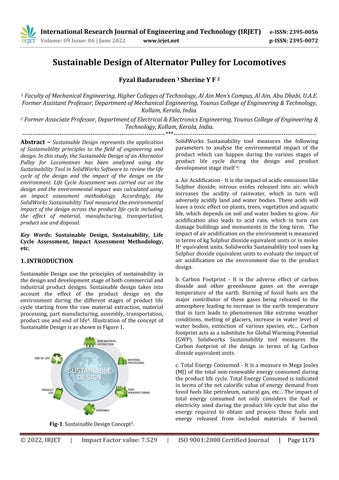
1. INTRODUCTION Sustainable Design use the principles of sustainability in the design and development stage of both commercial and industrial product designs. Sustainable design takes into account the effect of the product design on the environment during the different stages of product life cycle starting from the raw material extraction, material processing, part manufacturing, assembly, transportation, product use and end of life4. Illustration of the concept of Sustainable Design is as shown in Figure 1.

b. Carbon Footprint - It is the adverse effect of carbon dioxide and other greenhouse gases on the average temperature of the earth. Burning of fossil fuels are the major contributor of these gases being released to the atmosphere leading to increase in the earth temperature that in turn leads to phenomenon like extreme weather conditions, melting of glaciers, increase in water level of water bodies, extinction of various species, etc... Carbon footprint acts as a substitute for Global Warming Potential (GWP). Solidworks Sustainability tool measures the Carbon footprint of the design in terms of kg Carbon dioxide equivalent units. c. Total Energy Consumed - It is a measure in Mega Joules (MJ) of the total non-renewable energy consumed during the product life cycle. Total Energy Consumed is indicated in terms of the net calorific value of energy demand from fossil fuels like petroleum, natural gas, etc... The impact of total energy consumed not only considers the fuel or electricity used during the product life cycle but also the energy required to obtain and process these fuels and energy released from included materials if burned.

Fig-1. Sustainable Design Concept5.

© 2022, IRJET

|

Impact Factor value: 7.529

|

ISO 9001:2008 Certified Journal

|

Page 1173


Turn static files into dynamic content formats.
Create a flipbook