International Research Journal of Engineering and Technology (IRJET) e ISSN: 2395 0056

Volume: 09 Issue: 06 | Jun 2022 www.irjet.net p ISSN: 2395 0072
International Research Journal of Engineering and Technology (IRJET) e ISSN: 2395 0056
Volume: 09 Issue: 06 | Jun 2022 www.irjet.net p ISSN: 2395 0072
1,2,3Department of Computer Science, Chandigarh University, Punjab, India ***
Abstract License Plate Recognition has been ingrained in our daily life, and it is expected tocontinue to evolve and combine with newtransportationtechnologyin the future. The notion of license plate recognition (LPR) offers a variety of solutions to transportation related issues. It also eliminates human intervention. License platerecognitionhelps in the problems related to traffic, car theft, crimes, and also it can be used for modernlaw enforcement. It can be installed in areas difficult to reach and in rural areas where technology is scarce. The LPR system is frequently employed in traffic applications such as traffic surveillanceandparkinglot access management as a basic technology for security. It solves all these problems. The vehicle's license plate is identified using a computer vision algorithm. It uses different algorithms to extract the number plate and uses optical character recognition to read the licenseplate. We have used the canny algorithm for edge detection and sorted algorithm to select the most relevant contour to localize the number plate. Localization of the number plate can greatly enhance the speed and accuracy of the LPR. We have tried to cover the existing methodology in the survey paper and try to come up with a simple output using our knowledge that we gathered during the research of the project.
Key Words: LicensePlateRecognition(LPR),OCR(optical character recognition), Edge detection, gray scale, canny Algorithm,noisereduction,contour.
AutomaticLicensePlateRecognition(ANPR),alsoknown asLicensePlateRecognition,haslong beenapartofour livesandwillcontinuetobe inthefutureaslongasitis compatible with future transportation technology. The notion of autonomous vehicles opens up a plethora of possibilitiesfortransformingfundamentaltransportation networks. By removing the need for human interaction, LPRtechnologyisalreadyassistinginthedevelopmentof intelligenttransportationnetworks.It'snolongeronlythe roadside or parking fence cameras. It originally became mobileinautomobilesovertime,butwiththeevolutionof smartphone technology, many license plate recognition systemshavenowbecomeportableaswell.Becauseofits inexpensiveacquisition costs, LPR is widely employed in thetoll and parking businesses. LPR is a frequent choicefortollandparkingbusiness.
Licenseplatedetectionisbasedoncomputervisionmethod or technique to identify the number plate of the cars. In
recentyears,ithasbeenusedwidelyasamajortechnology in the field of security or traffic application such as surveillanceinparkinglotandparkinglotaccesscontroland information management. Modern LPR cameras not only scan license plates, but can also provide vital extra informationsuchascounting, heading,vehiclegroupsand speed. Because of its ability to detect and read large numbersoffast movingcars,technologyhasenteredmany elements of today's digital scene. While LPR technology comes in various packages, they all share the same primarypurpose:tocomeupwithaerrorlessmechanismto scanavehiclenumberplatewithoutanyhumanintervention. Itisusedinawidevarietyofapplications,includingaccess control, parking management, toll, user billing, delivery tracking,trafficmanagement,policingandsecurity,customer
assistanceandinstructions,redlightandlaneenforcement, queuelengthestimation,andothers.Formanyyears,license plate recognition techniques have been created. The precision of LPR system has improved much extent as hardware and software have improved. This technology couldbe improved in the future and used to help solve crimes. With improvements, this license platerecognition systemcanbebuiltatareasonablecostanditseffectiveness willbeavailableinallareas.
Currently, there are many studies in the numberplate detectionfieldandthedetectionoflicenseplateisprimarily dividedintofivestages:inputimage,imagepreprocessing, locatingthenumberplate,andthenidentifyingthecharacter.
Grayscale images and Density Transform images are commonlyusedinthefirsttwosegments.Thepurposeofthe first two steps is to aid in a more precise search for the licenseplate.Thesearchforanddetectionofthelicenseplate is the first and most important stage in an automobile licenseplaterecognitionsystem.Thespeedandaccuracyof automatic license plate recognition systems can be considerably impacted by this detecting phase. The most commontechniqueinpriorresearchwastipstatistics,which wasbasedonthepremisethatbrightnessvariationsinthe plate region are more pronounced and frequent than elsewhere. However, because of their sensitivity to undesirable edges,they are rarely used on complicated pictures.Inordertoeliminateundesirededgesfromphotos thathavebeenprocessed,S.WangandH.Lee[2]integrated edge statistics with morphological procedures. Some approachesmakeuseofcolorproperties.
International Research Journal of Engineering and Technology (IRJET) e ISSN: 2395 0056
Volume: 09 Issue: 06 | Jun 2022 www.irjet.net p ISSN: 2395 0072
LinLuo[1]designs anewandsuccessfulmethodforfinding plates. This proposedalgorithm includesthreemainparts listedbelow.Tobeginwith,theverticaledgesoftheimage areextracted usingSobeloperator.Onbothyellowandnon yellowplates,theHSVcolorspaceandintegratedpictureare then utilized to discover possibilities. Final step is component analysis that pinpoints the location of the number plate. Similarly, Yao quan [7] uses a color based technique, but the color information in the color image is wellexploitedtosignificantlyreducetheedgepoints.This procedure also eliminates the area that resembles the number plate,but does not match the actual color of the numberplate.
With the two described subsystems: the automobile detection subsystem and the license plate removal subsystem, Hsiao Chen [6] created an altogether new methodtolicenseplatedetection.Theautomobiledetection subsystem employs the Minimum Movement Amount DecisionRule and theNearest Distance DecisionRule for dynamicphotos to locate cars on the screen. The license plate extraction subsystem employs license plate characteristicsandalicenseplatesearchalgorithmtoextract a license plate. We feel, however, that thistechnique is inefficientwhenitcomestodetectinglicenseplates.Because thedetectingtechniquecontainsnumerouslayers,eachlevel iseasilydisordered.
Characterrecognitionisanothercrucialstageinthelicense plateidentificationsystem.Thisisamoredifficultstepthat needs a great deal of computation.The system accuracy dependsontheidentificationstep.Recognizingthelplate wasextremelydifficultwhenviewingthevehicle'slicense plateinthedark,intherain,orinotheradverselighting conditions.Asaresult,wemustdefinetheCharacterusing thetechnique.
IntheH.Ching Tang[2]article,theycalibratetheLicense Platefirst, usingthegrayscalelevel valuetomodulatethe light, and then apply the Black top hat approach for characterseparationandintegralitycorrectiontoeliminate theshadowandproduceanidealdisplay.Intheend,they recognizedeachcharacterusingaback propagationneural network.
In the license plate character identification section of Q. Xiwen[3],itintroducesamethodthatusesanenhancedBP NeuralNetworkforcharacteridentification.Thisproposed design works on three layers: an input layer, a concealed layer,andanoutputlayer.Forthesystemtorecognize the Englishcharactertheoutputlayerneuronnumbershouldbe 5.Thisstrategyhasthepotentialtoimproveaccuracyand training speed. Another significant advantage is the avoidanceofmunicipalminimumpoints.
ApatternmatchingmethodisdescribedbyY.Chenpu[4].A single database must exist. For example, the database contains 26 letters and 10digital letters for English and
digitalletterrecognition.Thecomputationwasthenusedto matchthetemplateanddetermineifitdid.Italsopioneered a comparable method for identifying Chinese characters. AccordingtoSlimanietal.[5]proposedatwo stepprocess for removing plates. Otsu's Threshold Path, an effective techniqueforadaptivethresholdingprocedures,isusedin thefirststeptodeal withvariablelightingconditions.The CCAapproachisthenusedtofindrectangularstructuresin thebinaryimage.Toensurethatthecreatedimageisaplate, thesecondstepistoperformedgedetectionontheresulting plate, followed by the closed curve method. This method was used to evaluate more than 2,500 Moroccan format photosfromvideosequenceswitha96percentsuccessrate. 96.6 percent was the successful extraction rate on a low qualityvideowhileusingthecomponentanalysistechnique. Inbinaryimages,contourdetectionalgorithmsareusedto find associated objects. Plate like geometric elements are selected for further processing. However, if the resulting imageisofpoorquality,thistechniquemaycausedistortion problems.
A license plate detection system for cars in Tamil Nadu (India)wasproposedbyP.anishiyaandprof.S.MaryJoans [8]. This technology uses digital photos and is simple to integrate into commercial parking systems, for recording, parking service access, securing parking homes and preventing automobiletheft.Theproposed technique for plate localization combinesmorphologicalprocessingwith fieldcriteriontesting.
D.Jiang,T.M.Mekonnen,T.E.MerkebuandAGebrehiwot. [9]Thearticleunderdiscussion isaboutanautomobile license plate recognition system. Explains the design algorithmanditspotentialapplication.Thesystemaccepts thecolorimageinputsofthecarsandgivestheregistration number of the cars. In order to obtain the necessary information, the system goes through three main processes. The localization of the number plate, the charactersegmentationwrittenonthelicenseplate and then recognizing the character. The number of plates is first calculated from the original image, followed by the isolationofthecharacters,andthentherecognitionofeach character.Asetoftrainingphotoswasusedtobuildthe algorithms.
Z. Xu, H. Zhu.[10] proposed a solid method for the localizationofthenumberplate.Theapproachusesplate edgeinformationaswellasrichcornerinformationinthe platearea.Itcanhandlemorechallenginglocationissues suchaslicenseplatesonacomplexbackground.
Todetectthenumberplateandextractthenumber formtheimage.
ToGreyscaletheimageandreduce thenoiseso thepicturebecomemoreevidenttoread.
International Research Journal of Engineering and Technology (IRJET)
e ISSN: 2395 0056
Volume: 09 Issue: 06 | Jun 2022 www.irjet.net p ISSN: 2395 0072
To accurately detect the number plate using different algorithm to detect edges such as the Vertical Edge Detection Technique which is believed to be the most reliablealgorithm for detecting edges another method is Canny algorithmwhichisalsousedtodetecttheedgesin aneasyway.
UsingContourDetectiontodetectthepolygonor shape inside the image. The geometrical feature having similarities with the number plate is chosen.
Lastly, we need to render the result that is to recognize the character written on the number plate.
Itiscommonforsecurityforcesandauthoritiestoencounter difficultieswhenpursuingacarorattemptingtoapprehenda vehicle that has violated traffic laws. On a busy day, authoritiesfinditdifficulttomanually log car numbers in a parking lot.So,inordertoeliminatethehumaninteraction withthesystemandtomaketheentireprocessautonomous, wemayinstallthissystemthatwillautomaticallyrecognize thecarthatviolatestrafficlaws,snapapictureofit,andsave thelicenseplatenumberinthedatabaseinordertofinethe owner later. The technique can be used in parking to photographvehiclesandrecordtheirlicenseplatenumbersin adatabase(orthecloud,ifconnectedtotheinternet).This technologyeliminatestheneedforfranticmanuallaboron eachbusyday, saveslaborcosts,andissignificantlymore efficientthanhumans.Onceretrievedastext,thenumberof anycarcanbe displayed,savedinthedatabase,orsearched for details across the entire database. This project is so adaptablethatitmaybeutilizedasawholeapplicationonce converted to software or asa component of any larger project. There has also been increase in contemporary national road networks over the past decade. These circumstances has revealed the need for efficacious monitoringandmanagementofroadtraffic.Theaimofthis projectistocreateamodelthatcanproperlyrecognizeand identifythelicenseplatefromitsimage.
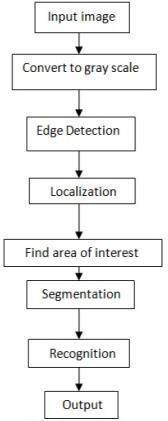
Thedetectionofnumberplateismainly dividedintotwo parts.Thecorrespondingpositionoftheplateinthetest imageisfound inthefirst blocks. The characters onthe platemustthenberemovedandenteredinthesecondary blocks.Eachblockhasmorespecificsteps.Theapplication willbepresentedstepbystepinthenextsection.
Fig-5.1 Stepsfor LPR.
Thefirstandforemoststepinnumber plate
detectionisto
find the location of the number plate. This procedure is important as it has a direct impact on the recognition results. If the position of the plateis incorrect, the next stepswillbeinvalid.
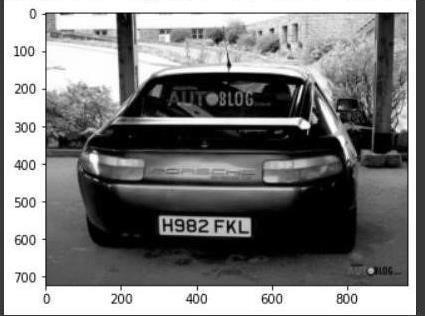
Ingeneral,itisverydifficulttodetectatargetfroma color image. Image processing often uses atechnique known as grayscale to make it easier torecognize the outline of a target.Inmostcases,the numberplatesectionareainthe image is brighterthan the rest of the elements present inside the image. If we try to remove the plate immediately,the contrast between the number plate and thesurroundingitemsmaynotalwaysbesharp,limitingthe identification accuracy. As a result, the level of the grayscale can be stretched so as to improve the distinction of the output image. In this manner, the problemcan beefficientlysolved.
Fig-5.1.1 Grayscaledimage
International Research Journal of Engineering and Technology (IRJET) e ISSN: 2395 0056
Volume: 09 Issue: 06 | Jun 2022 www.irjet.net p ISSN: 2395 0072
Itistheconversionofagrayscaleimagetoablackandwhite image.Agrayscaleimageconsistsofseveralgrayscalevalues ranging from 0 to 255. In order to make the image more relevant to read, the image is processed several times to make the binary image more useful. In the binarization process,thegrayscalethresholdvalueofanimageiscritical sinceitdecideswhethergrayscalepixelsaretransformedto blackorwhite.
After applying the grayscale, we need to apply the edge detectionandapplyfilter.Thisdetectingphasemayhavea significantimpactontheoverallspeedandaccuracyofLPR system. Vertical Edge Detection Algorithm or Canny Algorithm can beused for detecting the edges which will make the image more evident, easy for us to detect the number plate. Bilateral filter will minimize the noiseand make the image more suitable to read. The image will be startingtolooklikethis.
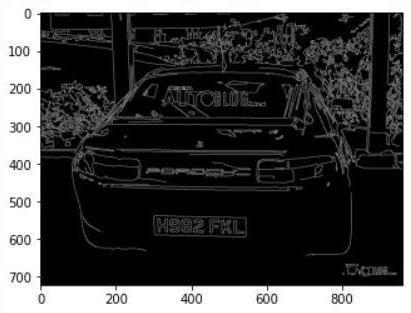
Fig 5.4.1 Afterapplyingthemaskandcroppingthe numberplatefromtheimage.
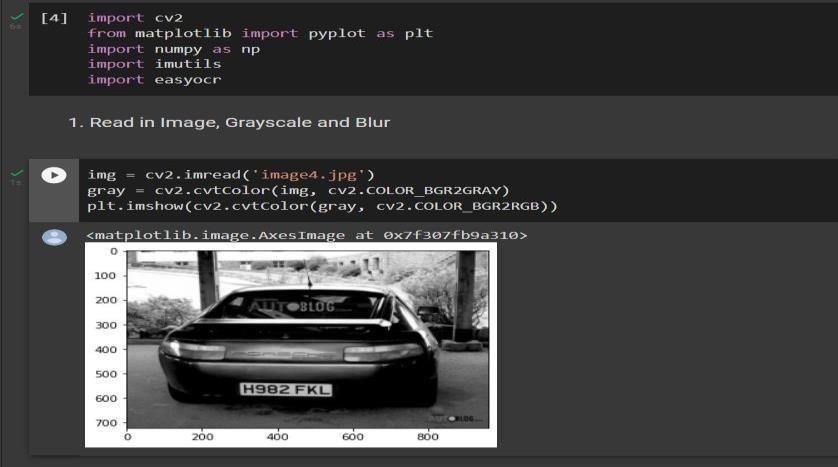
We used the python to show the outcome of the research paper. We installed and imported all of the Python dependencies,includingeasyocr,apythonlibrarythatallows developer using computer vision method to optically recognize the character withease. With OpenCV, we used imutils tomakefundamental imageprocessingoperations like translation, scaling, and displaying images easier. OpenCVisusedsowecanprocessimageandvideotoidentify object,faceorevenwrittentext.
Fig 5.3.1 Noisereductionandedgedetectionusing contourdetection.
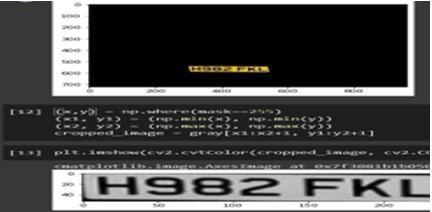
ContourDetectiondetectsthepolygonorashapeinsidean image.Inourcasethepolygonwillhavefourpointsandit willresembletheshapeofnumberplatethatisapolygon withfourpoints.Incontourdetectionmanycontourswill beselected afterwhichwewillselectthemostrelevant contourusingsortedalgorithmoranyotheralgorithm.
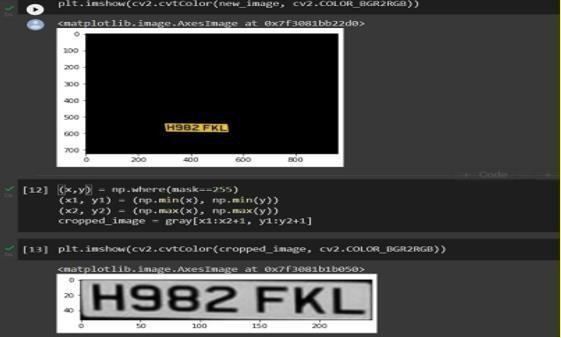
Thenwecanrendertheoutput,andforthenumberplate extraction,wemayuseamaskthatcoverstheentireimage exceptforthelicenseplateorcontourthatwehavepicked. Wecancroptheimageafterapplyingthemask,thenshow the number plate part,and use OCR (optical character recognition) to read the number plate and present the results.
Fig-6.1 Readinimageandthengrayscaleitusing cvtColouranddisplayeditbyusingmatplot
Volume: 09 Issue: 06 | Jun 2022 www.irjet.net p ISSN: 2395 0072
imagewillbecoveredinblackexceptforthenumberplate, which we easily clippedaway,leavingonlythenumber plate.TheOCRwasthenusedtointerpretthetextprinted ontheimageandhighlightthenumberplatewithagreen box before rendering the result just below the number plate.
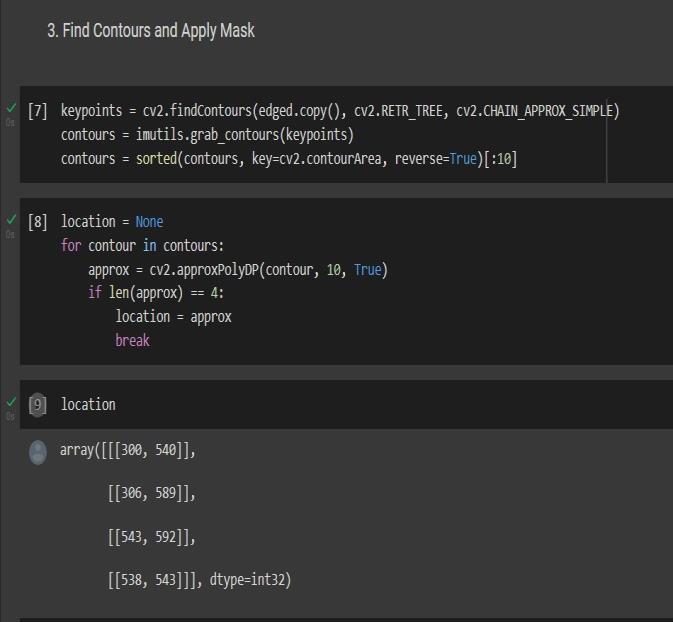
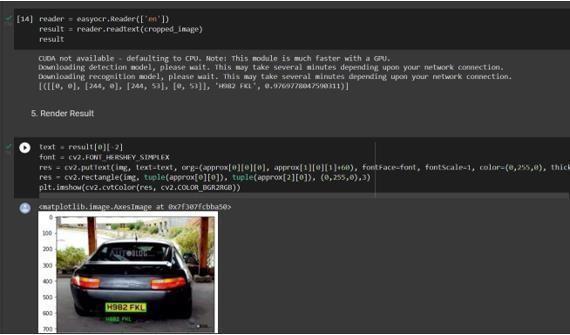
Fig-6.2 Usebilateralfiltertoreducethenoiseandthen cannyalgorithmtodetectedges.
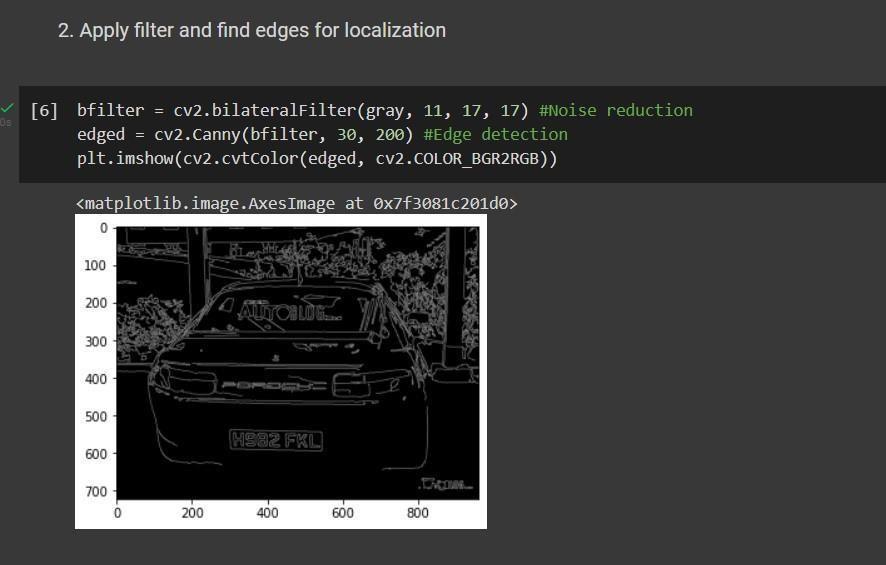
NowweusedOpenCVfordetectingpolygonorshapeinside theimage.Inspecificwewillbelooking for contour with four point and then choosing the top 10 contour using sorted.WeusedthePolyDPtomaketheselection.Higher theDPvaluethemoreshapewillbetaken.Thelocationof thenumberplateorthefourpointsofthenumberplatewill bedisplayedinoutputandwillbeusedinnextstepthatis toapplymaskandthencroptheimage.
Fig-6.3 Contour detection and selecting mostrelevant
contour.
Wewereabletodeterminetheimage'slocationinFigure 6.3.Nowwe'llpassthelocationsothatthemaskisapplied to the image except for the given points of the contour/numberplate.Afterapplyingthemask,theentire
Fig-6.4 Applied the mask and cropped thenumber plate rendering the result
Fig-6.5 Readthetextonlicenseplateand
International Research Journal of Engineering and Technology (IRJET) e ISSN: 2395 0056
In general, an LPR has four phases of processing. The resolution and shutter speed of the camera must be consideredattheimageacquisitionstep.Then comesthe extractionstagewhereweneedtoreduce thenoiseand hange RGB to grayscale. After this we need to find the edgesalsoknownasedgedetection.Inthesegmentation stageweneedtolocalizetheplateandextractit.
Finally, in the character recognition process, characters are detected using optical characterrecognition. LPR is challengingduetothenumerousplateformsandvarying ambientcircumstances.ManyLPRapproacheshavebeen presented in recent years. There are many sections on kernel processing procedure, experimental database, processing time and recognition rate. However, the authorsof[11]notedthatitisnotappropriatetoreacha conclusion because there is no universaltechnique for evaluating which method produces the most accurate resultsandbestperformance.
ExistingLPRtechnologyhasanumberofflaws,including erroneousfindingswheretheimagedoesnothavesmooth texture, such as when the image is blurred or contains curved plates. As a consequence, the existing algorithm may be tweaked to produce more accurate results Furthermore, there are restrictions to identifying the character,suchasthenumberofcharactersthatchangeby location, which requires the developmentof a global algorithm.
According to review of various papers we came to know about various techniques accessible for recognizing car numberplates,includingtheSobeledgedetection,Automatic licenseplaterecognition,Novel method used for detecting edge,differentalgorithmforcontourdetection,categorize features in each stage, and identifying & recognizing car licenseplate.Asaresult,wearecurrentlyusinganimproved character segmentation method to lower the amount of effortnecessarytorecognizeavehiclelicensenumberplate.
In the end I want to conclude the review with “Cost and imagination are the only constraints on technological advancement.Ifyoucanconceiveit,youcanachieveit.”
We'veallcollaboratedonthisproject,but itwouldn'thave been possible without the wonderful support and help of manyothers.Wethankourinstituteforenablingustowork on this project, as well as our project supervisor, mam Kumud Sachdeva, for her constant guidance and support, andourfacultymember,NehaSingla,forherhelp.Weare
excitedtobeapartofthisinitiative,andweappreciatetheir helpandencouragementduringthedevelopmentprocess. We'd want to express our gratitude to everyone who contributedtothesystem'sdevelopment,whetherdirectly orindirectly.
[1]. L. Luo, H. Sun, W. Zhou and L. Luo, “An Efficient MethodofLicensePlateLocation”InformationScienceand Engineering(ICISE),20091stInternationalConferenceon. Page:770.26 28Dec.2009.
[2]. S. Wang and H. Lee, “Detection and recognition of license plate characters with differentappearances,” IEEE IntelligentTransportationSystems,vol.2,2003.
[3]. X. Qin , Z. Tao , X. Wang, X. Dong, “LicensePlate Recognition Based on Improved BP Neural Network”, Computer, Mechatronics, Control and Electronic Engineering (CMCE), 2010 International Conference on,Page:171,IssueDate:24 26Aug.2010.
[4].C.Yu , M. Xiand J. Qi ,“A Novel SystemDesign of License Plate Recognition”Computational Intelligence and Design, 2008. ISCID '08. International Symposium on,Page:114,IssueDate:17 18Oct.2008.
[5].Slimani,I.;Zaarane,A.;Hamdoun,A.;Atouf,I.Vehicle License Plate Localization and Recognition System for Intelligent Transportation Applications.InProceedingsof the 2019 6th International Conference on Control, Decision and InformationTechnologies (CoDIT), Paris, France,23 26April2019;pp.1592 1597.
[6]. H. Kuo, J. Lee, S. Kao, “An Autonomous License Plate Detection Method” Intelligent Information Hiding andMultimediaSignalProcessing,2009.IIH MSP'09.Fifth InternationalConferenceon,Page:110,IssueDate:12 14 Sept.2009.
[7].Y.Yang,J.Bai,R.Tian,N.Liu,“A vehiclelicenseplate recognition system based on fixed color collocation,” MachineLearningandCybernetics,2005.Proceedingsof 2005InternationalConferenceon,Page:5394,IssueDate: 18 21Aug.2005.
[8]. P.Anishiya, Prof. S. Mary Joans,” Number Plate RecognitionforIndianCarsUsingMorphologicalDilation and Erosion with the Aid of Ocrs.” International Conference on Information and Network Technology, Vol.4,2011.
[9].D.Jiang,T.M.Mekonnen,T.E.Merkebu,AGebrehiwot,“ Car Plate Recognition System.” Fifth International ConferenceonIntelligentNetworkandIntelligentSystem 2012.
Volume: 09 Issue: 06 | Jun 2022 www.irjet.net p ISSN: 2395 0072 © 2022, IRJET | Impact Factor value: 7.529 | ISO 9001:2008 Certified Journal
International Research Journal of Engineering and Technology (IRJET) e ISSN: 2395 0056
[10]. Zhigang Xu, Honglei Zhu, “An Efficient Method of LocatingVehicleLicensePlate”,IEEE2007.
[11]. S. H. Kasaei .,S. M. Kasaei, " Extraction and RecognitionoftheVehicleLicensePlateforPassingUnder OutsideEnvironment."IEEE2011
Volume: 09 Issue: 06 | Jun 2022 www.irjet.net p ISSN: 2395 0072 © 2022, IRJET | Impact Factor value: 7.529 | ISO 9001:2008 Certified Journal