International Research Journal of Engineering and Technology (IRJET) e ISSN: 2395 0056

Volume: 09 Issue: 06 | June 2022 www.irjet.net p ISSN: 2395 0072
International Research Journal of Engineering and Technology (IRJET) e ISSN: 2395 0056
Volume: 09 Issue: 06 | June 2022 www.irjet.net p ISSN: 2395 0072
1M. Tech Student, Structural and Construction Engineering Department, Ballarpur Institute of Technology, Maharashtra, India
2Assitant Professor, Structural and Construction Engineering Department, Ballarpur Institute of Technology, Maharashtra, India ***
Abstract The conventional bricks are the main building materials that are used broadly in the construction and building industry. Autoclaved Aerated Concrete blocks are recently one of the a new adopted building materials. The Autoclaved aerated concrete (AAC) is a creation of fly ash whichismixedwithlime,cement,andwaterandanaerating agent. The AAC is mainly produced as cuboid blocks and manufactured panels. The Autoclaved aerated is a type of concrete that is manufactured to contain lots of closed air voids.TheAACblocksarestrong,lessthick,andlightweight. Itismanufacturedbyaddingup foamingadditivetoconcrete in different sizes of molds as per requirement, then wire cuttingtheseblocksorpanelsfromresulting‘cakelump’and ‘heating them with steam. This process is called as Autoclaving. It has been observed that this material is an environmentalbuildingmaterialthatisbeingmanufactured from industrial waste and is composed of non toxic ingredients.
This research work is comparison of seismic analysis and design of (G+8) and (G+12) building using AAC (Autoclave Aerated Concrete) block and conventional bricks.(G+8) building previously design for conventional brick and we wanttoexpandto(G+12).Ifpossibleornotiresearchinthis project. The performance of the building is analyzed for differentpositionofinfillwallwiththehelpofAACblockand conventional brick. The study consist of understanding the mainconsiderationfactorthatleadsthestructuretoperform badlyduringearthquakeinordertoachievetheirapproaches behavior under future earthquakes. As a result to this attemptismadetoanalyzeanddesignamultistoriedbuilding byusingaSoftware“STAADPRO”.Inthis softwaremethodof analysisisusedfora(G+8)and(G+12)Residentialbuilding withAACblockandconventionalbrickslocatedinallzones.
The analytical result of the multistoried building will be compared Analyzed and Design. We will obtained are Displacement , Story drift, Peak story, Absolute bending moment,Maximum shearforceandstructuralpropertiesare optimizedformosteconomicaldimensions.
Key Words: AACBlock,ConventionalBrick,BaseShear, STAADPro,Displacement.
Bricksareusefor thebuildingofthewall.Thestrengthand toughness of the wall, eventually of the whole building depends upon the bricks. Red bricks are the oldest and the mostregulartypeofbrickused.Thepopularityofredbricks canbetoitseasyavailability,durability,lowcost,convenience. AAC blocks are manufactured from the combination of fly ash,cement,lime,gypsumandanaerationagent.Conventional red bricks are made from a combination of clay (alumina), sand,Lime,ironoxideandMagnesia.AACblocksareveryeasy tohandleandnormal toolscanbeusedforcutting.AACblocks are available in huge sizes and hence less number of joints. This finally results in faster construction on site and less consumption of eithercement mortaror chemical and also increasing the strength of wall. Earthquake forces are proportionaltotheweightofbuilding.Duetolightweightof AACblocks,therewillbedecreaseindeadloadofthebuilding. HenceAACblocksarefavourinhighseismiczones.Also,very littleamountof steelwillberequiredincaseofRCCstructure. UtilizingofAACblocksinthemulti storeybuildingcanreduce theconsumptionofsteelandconcrete.Thisreducesthedead load on the structure and increase thecarpet area. Drop in deadload on the structurecan greatly reduce the size of structural elements which means that it will increase the floor/carpetarea.Easyto movetoupperfloors.Employ the use of AAC blocks can significantly reduce the construction timeof the project. Time savingis possible due to the large sizeofblocksandlesscuringrequiredprevioustoplaster.AAC blocksreduceinteriortemperaturevariationmaintainingnice and healthy temperature for habitant. minimum wastage of AAC blocks. The early making cost of AAC blocks are more; however, as we discussed above, it can be reduce the consumptionofSteel,Cement,Concreteandlabour.Therefore, thewholeprojectcostgetsreduced AACblockcomesinhuge size.The drydensityofAACblockvariesfrom451kg/m3to 1000kg/m3.hereihave takendrydensity666.67kg/m3.Dry density of red clay bricks varies from 1600 kg/m3to 2000 kg/m3. We taken dry density 2000kg/m3 with Mortar. Generally,theweightofAACblocks16 18kg.Generally,the weightofredbricks/claybricksvariesfrom2.5to7.5kg.The compressive strength of AAC blocks 5.54 N/mm2. The compressivestrengthofclaybricksvariesbetween2.5to3.5 N/mm2. AAC Blocks are suggested for high rise buildings
International Research Journal of Engineering and Technology (IRJET) e ISSN: 2395 0056
Volume: 09 Issue: 06 | June 2022 www.irjet.net p ISSN: 2395 0072
because it considerably decreases total dead load of the building.
This research paper is study to effect of design change of earthquakeperformance Researchpaperisabouttofindout thepercentageofeconomyascomparedtotheconventional brickandAACBlock Thevarioustechniqueareusedtofind out the objectives involves the comparison of various parameters for different objective such as axial force, displacement,Peak story,Baseshear,Shearforce,Maximum bending moment The analysis and designing part of these projectworkwasdonebyusingSTADDPROV8isoftware.The resultofSTAADinvestigationwerevalidatedwiththeresults ofManualanalysis
(G+8)buildingearlierdesignforconventionalbrick andnowwewanttoextend(G+12).
(G+8) building design for conventional brick and i have take the sizes (Beam, Column) as per earthquakezoneVfinalizedand theyarecheckedby furtherzones.
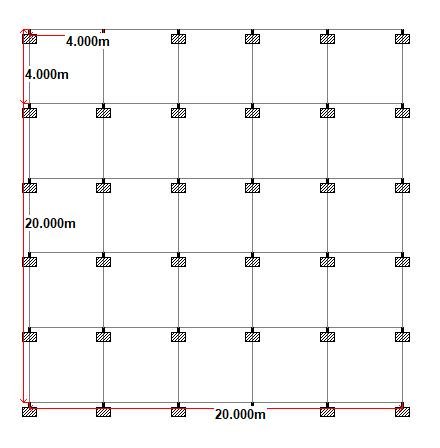
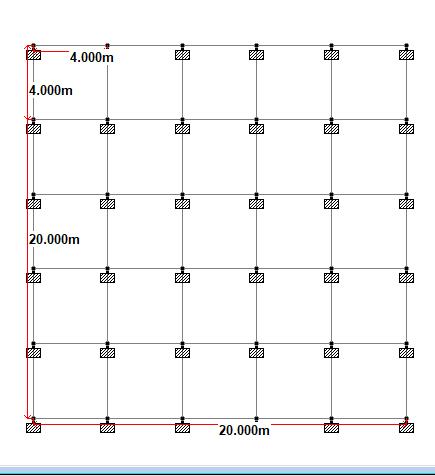
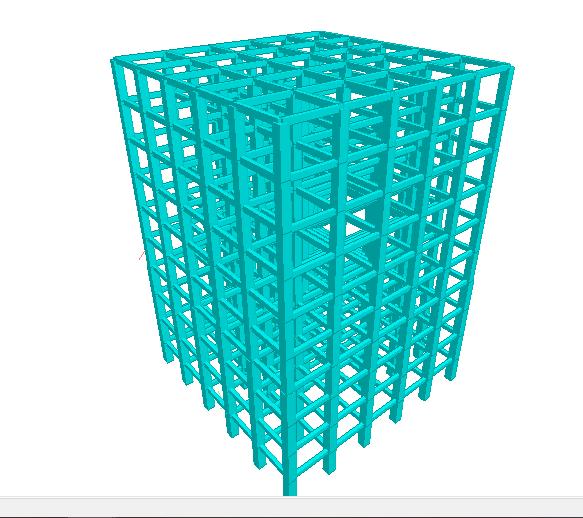
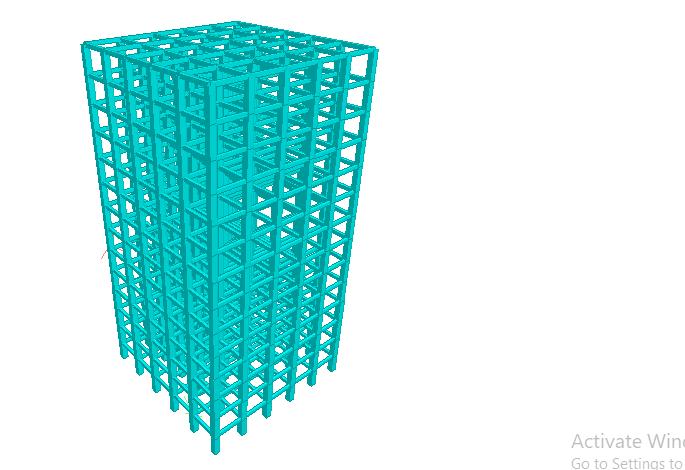
Modelsizeis20mX20m.and5bayof4m and 3m heightofeachfloor.
Use of light weight brick in all zones (G+8) and (G+12) regular building compare lateral Displacement, Story drift, Peak story, Maximum bendingmoment,Maximumshearforce,Baseshear, Timehistory,Naturalfrequency.
1. ToobservetheeffectofAACblockandConvectional Brickontheseismicbehaviorofthebuildinginall zones.
2. TocompareBaseShear,StoryDrift,PeakStoryon thebuilding.
3. TostudytheeffectonAACandConvectionalbricks inthestructurevariousparameterssuchaslateral displacement,MaximumBendingMoment, MaximumShearforce,arestudied.
4. Analysisanddesignofmulti storiedbuildingusing “STAADPRO”software
5. Toanalyzethesignificanceoflightweightblock infillwallinamulti storeybuildingbystatic analysisanddynamicanalysis.
6. ToanalyzethecomparisonforDeadloadfor conventionalbrickandAACblock.
Inthepresentstudytwotypesofmaterialsconventionalbrick andlightweightbrickistakenintoconsideration.Thebuilding modelswithtwotypesofbricksmaterialsanditismodeled andanalyzedbyusingtheSTAADPro.Softwareanditsresults arecompared.
Primary Data Model1: (G+8) Model2: (G+12) Model3: (G+12) Model4: (G+12) PlanArea (m2) 20m× 20m 20m× 20m 20m× 20m 20m× 20m Storey Height(m) 3m 3m 3m 3m Beam Size(mm) 300×400 mm 300×400 mm 300×400 mm 300×400 mm Column Size(mm) (G.F 3rd Floor) 700x700 mm (4th +8th Floor) 600x600 mm
(G.F 3rd Floor) 700x700 mm (4th +12th Floor) 600x600 mm
(G.F 3rd Floor) 700x700 mm (4th +12th Floor) 600x600 mm
(G.F 3rd Floor) 700x700 mm (4th +12th Floor) 600x600 mm
120mm 120mm 120mm 120mm LiveLoad (kN/m2) 2 2 2 2 Rooflive load (kN/m2)
Thickness ofSlab (mm)
1.5 1.5 1.5 1.5 Floor Finish (kN/m)
1.25 1.25 1.25 1.25 Deadload (kN/m2) 4.25 4.25 4.25 4.25 Response Reduction Factor
3 3 3 3 Importanc eFactor 1 1 1 1 Typeof Soil Medium Soil
© 2021, IRJET | Impact Factor value: 7.529 | ISO 9001:2008 Certified Journal | Page749
International Research Journal of Engineering and Technology (IRJET) e ISSN: 2395 0056
Volume: 09 Issue: 06 | June 2022 www.irjet.net p ISSN: 2395 0072
Gradeofconcrete:M20Mpa
GradeofSteel:500Mpa
DensityofConcrete:25kN/m3
DensityofConventionalBricks:20kN/m3
DensityofAACBricks:6.78kN/m3
Forseismicperformanceevaluation,astructuralanalysisof the mathematical model of the structure is required to determine force and displacement demands in various components of the structure. Several analysis methods are availabletopredicttheseismicperformanceofthestructures. Followingaresomeoftheseismicanalysismethodsareused forseismicevaluation.
Elasticmethodsofanalysis
A. Linearstaticanalysis B. Lineardynamicanalysis
I. WallLoadForConventionalBricks:
• DensityofConventionalbricks=20KN/m3. Thicknessofwall=0.23m Height=3m
• Wallload=Densityofbricks×width×height=20× 0.23×3=14KN/m
• Parapet Calculation: =0.9×0.23×20=4.14KN/m
II. WallLoadforAACblocks:
• DensityofAACblocks=6.78KN/m3.
• Thicknessofwall=0.23m
• Height=3m
• Wallload=Densityofbricks×width×height=6.78× 0.23×3=5KN/m
• Parapet Calculation: =0.9×0.23×6.78=1.403KN/m
International Research Journal of Engineering and Technology (IRJET) e ISSN: 2395 0056
FromISCODE: 456:2000,PageNo.68,TableNo.18,Clause 18.2.3.1,36.4.1andB 4.3
• 1(DL+LL)
• 1(DL+ELX)
• 1(DL ELX)
• 1(DL+ELZ)
• 1(DL ELZ)
• 1(DL+0.8LL+0.8ELX)
• 1(DL+0.8LL 0.8ELX)
• 1(DL+0.8LL+0.8ELZ)
• 1(DL+0.8LL 0.8ELZ)
FromISCODE:1893:2016,PageNo.8,Clause6.3.2.2
• 1.5(DL+LL)
• 1.2[DL+IL+(ELX+0.3ELZ)]
• 1.2[DL+IL (ELX 0.3ELZ)]
• 1.2[DL+IL+(ELZ+0.3ELX)]
• 1.2[DL+IL (ELZ 0.3ELX)]
• 1.5[DL+(ELX+0.3ELZ)]
• 1.5[DL (ELX 0.3ELZ)]
• 1.5[DL+(ELZ+0.3ELX)]
• 1.5[DL (ELZ 0.3ELX)]
• 0.9DL+1.5(ELX+0.3ELZ)
• 0.9DL 1.5(ELX 0.3ELZ)
• 0.9DL+1.5(ELZ+0.3ELX)
• 0.9DL 1.5(ELZ 0.3ELX) Here, DL Deadload,LL Liveload, ELX EarthquakeloadinX direction, ELZ EarthquakeloadinZ direction 4. Results and Discussion:
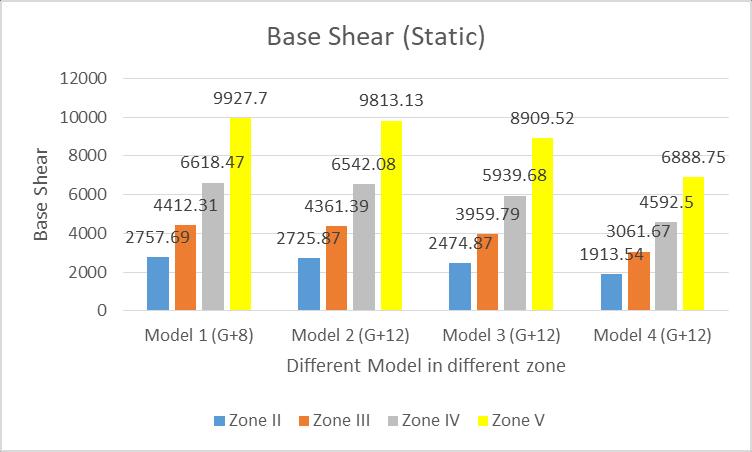
Table No 2:. Comparison of Base shear (Static)
BASE SHEAR
STATIC Model1 (G+8) Model2 (G+12) Model3 (G+12) Model4 (G+12)
ZoneII 2757.69 2725.87 2474.87 1913.54 ZoneIII 4412.31 4361.39 3959.79 3061.67 ZoneIV 6618.47 6542.08 5939.68 4592.50 ZoneV 9927.70 9813.13 8909.52 6888.75
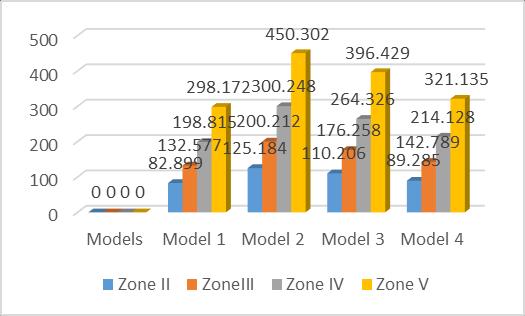
STATIC ZoneII ZoneIII ZoneIV ZoneV Models X(mm) X(mm) X(mm) X(mm) Model1 82.899 132.577 198.815 298.172 Model2 125.184 200.212 300.248 450.302 Model3 110.206 176.258 264.326 396.429 Model4 89.285 142.789 214.128 321.135
Fig3:DisplacementindifferentzonesalongX Direction
Table No. 4: Comparison of Maximum Shear Force(Fy)
STATIC Model1 (G+8) Model2 (G+12) Model3 (G+12) Model4 (G+12)
ZoneII 169.568 176.230 166.117 119.783 Zone III 223.347 232.173 216.355 159.121 Zone IV 323.206 326.453 295.540 229.345 ZoneV 484.111 489.572 443.219 343.957
Volume: 09 Issue: 06 | June 2022 www.irjet.net p ISSN: 2395 0072 © 2021, IRJET | Impact Factor value: 7.529 | ISO 9001:2008 Certified Journal | Page751
International Research Journal of Engineering and Technology (IRJET) e ISSN: 2395 0056
Fig4:ShearForceForallModels
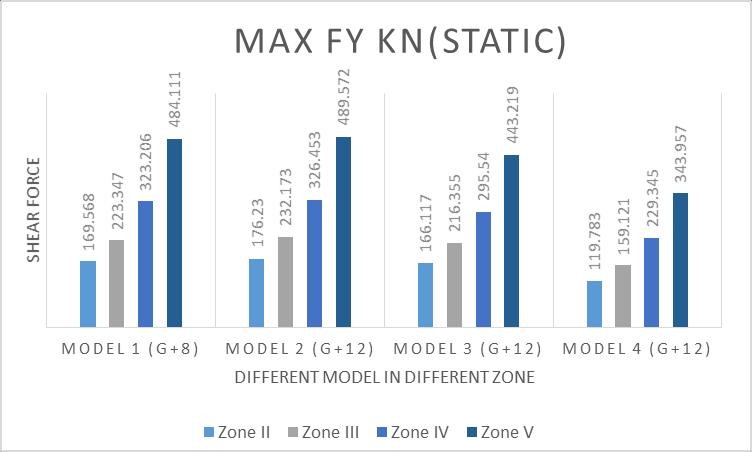
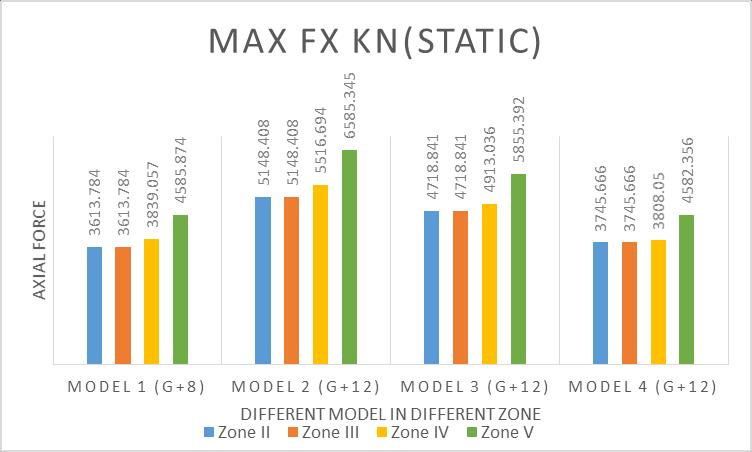
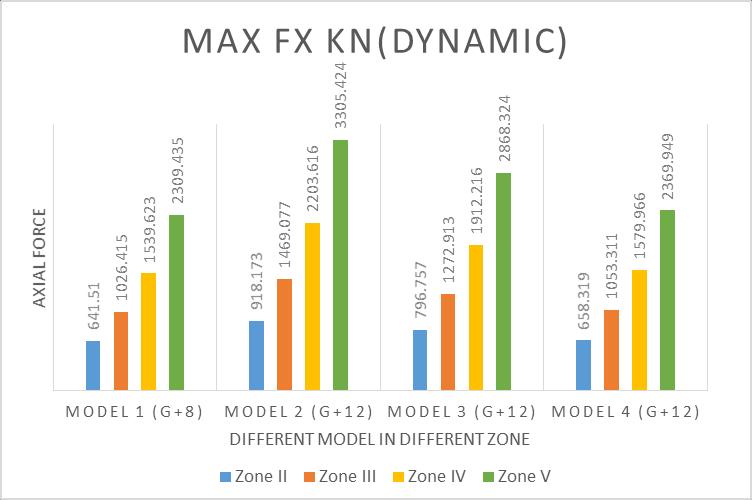
Table No. 5: Comparison of Maximum Axial Force(Fx)
STATIC Model1 (G+8) Model2 (G+12) Model3 (G+12) Model4 (G+12)
ZoneII 3613.784 5148.408 4718.841 3745.666
ZoneIII 3613.784 5148.408 4718.841 3745.666
ZoneIV 3839.057 5516.694 4913.036 3808.050 ZoneV 4585.874 6585.345 5855.392 4582.356
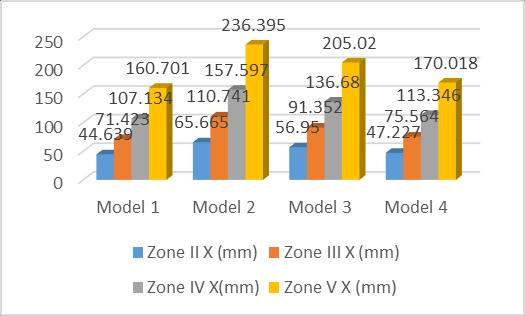
DYNAMIC ZoneII ZoneIII ZoneIV ZoneV
Model X(mm) X(mm) X(mm) X(mm)
Model1 44.639 71.423 107.134 160.701 Model2 65.665 110.741 157.597 236.395 Model3 56.950 91.352 136.680 205.020 Model4 47.227 75.564 113.346 170.018
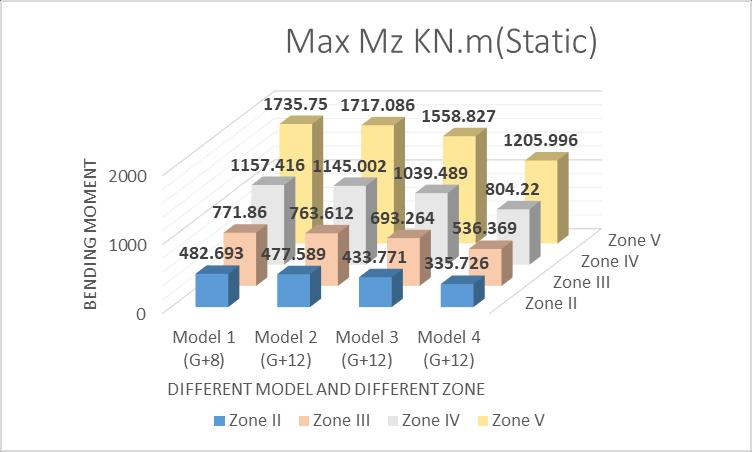
Fig5:AxialForceForallModels
Table No. 6: Comparison of Maximum Bending moment (kNm)
STATIC Model1 (G+8) Model2 (G+12) Model3 (G+12) Model4 (G+12)
ZoneII 482.693 477.589 433.771 335.726 ZoneIII 771.860 763.612 693.264 536.369 ZoneIV 1157.416 1145.002 1039.489 804.220 ZoneV 1735.750 1717.086 1558.827 1205.996
DYNAMIC
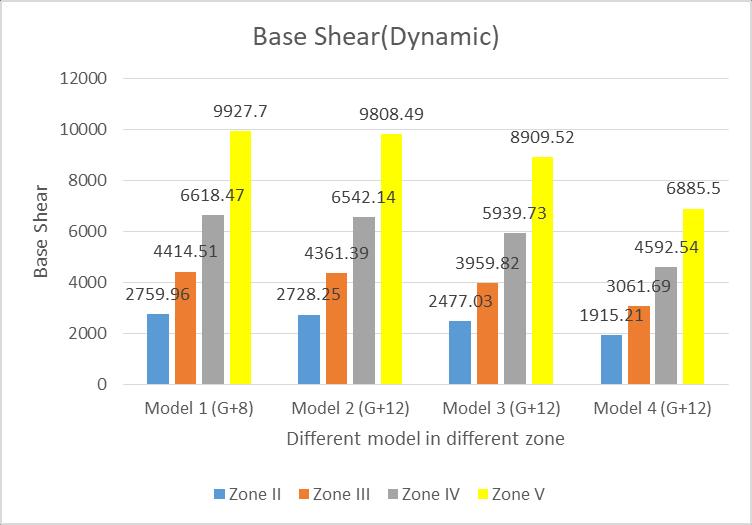
BASESHEAR
Model1 (G+8) Model2 (G+12) Model3 (G+12) Model4 (G+12)
ZoneII 2759.96 2728.25 2477.03 1915.21
ZoneIII 4414.51 4361.39 3959.82 3061.69 ZoneIV 6618.47 6542.14 5939.73 4592.54 ZoneV 9927.70 9808.49 8909.52 6885.50
Volume: 09 Issue: 06 | June 2022 www.irjet.net p ISSN: 2395 0072 © 2021, IRJET | Impact Factor value: 7.529 | ISO 9001:2008 Certified Journal | Page752
International Research Journal of Engineering and Technology (IRJET) e ISSN: 2395 0056
Volume: 09 Issue: 06 | June 2022 www.irjet.net p ISSN: 2395 0072
Figure8: BaseShearinallZone
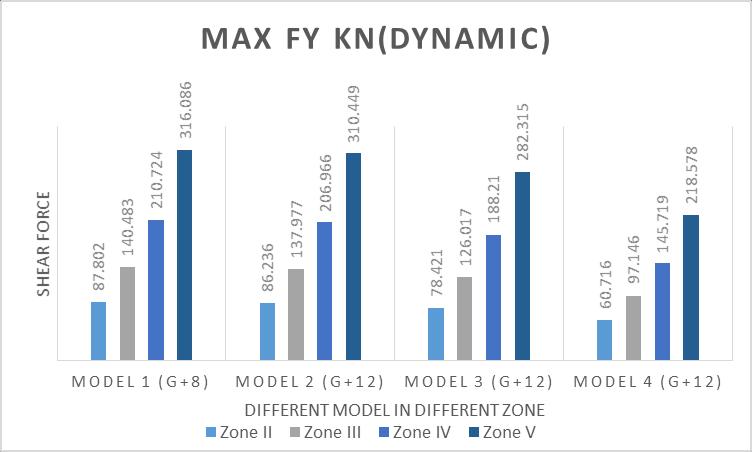
DYNAMIC Model1 (G+8) Model2 (G+12) Model3 (G+12) Model4 (G+12)
ZoneII 87.802 86.236 78.421 60.716
ZoneIII 140.483 137.977 126.017 97.146
ZoneIV 210.724 206.966 188.210 145.719
ZoneV 316.086 310.449 282.315 218.578
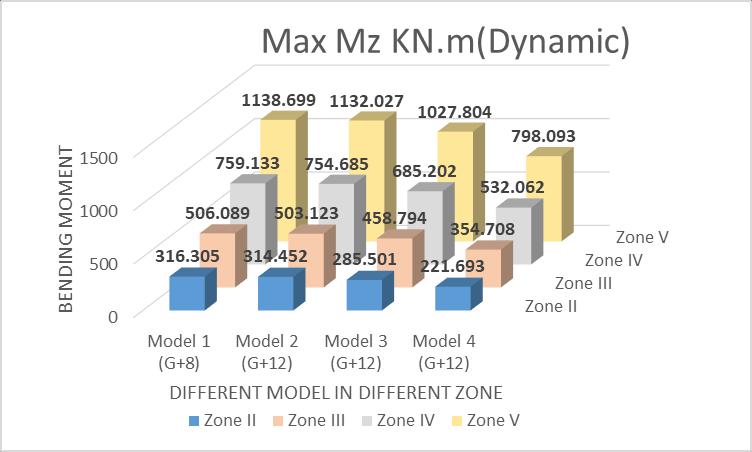
Table No. 11: Comparison of Max Bending Moment (kNm)
DYNAMIC
Model1 (G+8) Model2 (G+12) Model3 (G+12) Model4 (G+12)
ZoneII 316.305 314.452 285.501 221.693
ZoneIII 506.089 503.123 458.794 354.708
ZoneIV 759.133 754.685 685.202 532.062
ZoneV 1138.699 1132.027 1027.804 798.093
DYNAMIC Model1 (G+8) Model2 (G+12) Model3 (G+12) Model4 (G+12)
ZoneII 641.510 918.173 796.757 658.319
ZoneIII 1026.415 1469.077 1272.913 1053.311
ZoneIV 1539.623 2203.616 1912.216 1579.966
ZoneV 2309.435 3305.424 2868.324 2369.949
Four different models are studied in this present research. Model1 (G+8)actualbuildingdesignforconventionalbricks. Model 2 (G+8)actual building butincreasing4 floor using conventional brick. Model 3 (G+8) is real building but increasing4floorusingAACblock.Model4 (G+12)building designforAACblock andall these modelsare madeinall 4 zonesi.e.zone2,zone3,zone4zone5.STADDProsoftwareis
2021, IRJET | Impact Factor value: 7.529 | ISO 9001:2008 Certified Journal | Page753
International Research Journal of Engineering and Technology (IRJET) e ISSN: 2395 0056
Volume: 09 Issue: 06 | June 2022 www.irjet.net p ISSN: 2395 0072
usedforanalysisandtheresultsobtained weresatisfactory and following are the concluded remarks that can be establishedfromtheresults.
Responsespectrummethodallowsaclearunderstandingof the contributions of different modes of vibration. It is also useful for approximate evaluation of seismic reliability of structures.
1. ComparingtheMaximumDisplacementforModel1as Compare all Model the maximum is obtained for Model2inZoneVinStaticaswellasinDynamic.
2. Comparing the maximum base shear for Model1 as CompareallModelthemaximumshearisobtained forModel1inZoneVinStaticaswellasinDynamic.
3. Comparing the Maximum Axial Force Compare all ModelthemaximumisobtainedforModel2inZone V inbothDirectioninStaticaswellasinDynamic.
4. Comparing the Maximum Shear Force Compare all ModelthemaximumisobtainedforModel1inZone V inbothDirectioninStaticaswellasinDynamic.
5. Comparing the Maximum Bending Moment for Model1 as Compare all Model the maximum is obtainedforModel2inZoneVinZ Direct.
TheBuildingresultscanbeanalyzesbyusing PushoverAnalysisMethod.
Thanktoallforhisconstantsupportandguidancethroughout thework.
1) R.R. Sarode, Gulam Rizwan Gulam Firoz, Prakash Sureshwaghode,“ComparativeAnalysisofG+10RCC BuildingwithAACBlocksandConventionalBlocks”, International Research Journal of Engineering and Technology(IRJET),Volume:06Issue:04,pp2430 2435,Apr2009.
2) Dr.S.G.Makarande,AbhilashDilipraoJachak,Prof.A. B. Dehane, “Seismic Analysis of G+5 Building with AAC blocks and Conventional Bricks for different Zones by using Staad Pro”, Journal of Emerging Technologies and Innovative Research (JETIR), Volume8,Issue6,ppd683 d691,June2021.
3) Laxmikant Vairagade, Ajay Patre,“Comparative Analysis and Design of High Rise Structure Using LightWeightInfillBlocksandConventionalBricks”, International Journal of Trend in Research and Development,Volume3(4),pp4 6,Aug2016.
4) Ahsan Rabbani, Ashish Kurweti, Ruchi Chandrakar, “Comparativeanalysisonaac,clcandflyashconcrete blocks”, International Journal of Engineering Development and Research, Volume 5, Issue 2, pp1924 1931,2017.
5) Vidhya P. Namboothiri “Seismic Evaluation of RC buildingwithAACBlockInfillwall”,Volume5,Issue7 juily2016,ISSN:2319 7064.
Thebuildingisanalyzedinsoilmediumi.etypeof soil,furtheritcanbeanalyzedforthesoftaswellas hardsoilasperISCodeProvisionalOutcomescan becompared.
6) Dr.S.Needhidasan,BrajeshkumarTandon.“Seismic Analysis of Multi Storied Bilding in Different Zones”Vol 2Ius 2,JAN FEB2018,ISSN2456 6470.
TheRCBuildingcanbeanalyzedbyvaryingthe parameter.
The Author(s) wish to express their special thanks and gratitudetoProf.DeepakIrkullawarSir,AssistantProfessor, StructuralandConstructionEngineering,BallarpurInstituteof Technology.Iwouldalsogivespecialcredittoallthefaculty member of Structural and Construction Engineering Department:
1}Prof.NeerajBais(HOD)
2}Prof.GaneshMahalle(AssistantProfessor)
3}Prof.KirtiPadmawar(AssitantProfessor)
4)Prof.NandkishorSinha(AssistantProfessor)
5}Prof.ShilpaSamrutwar(AssistantProfessor)
7) PrashantB.Bhaganagare,RavikantS.Sathe,SonaliP. Patil “ Comparative Study of RC Structure with Different Infill Material”, Vol 6, Iss 11, Nov 2019 ISSN 2395 0056.
8) Abhishek S. Shinde “Comparative Study between ConventionalBrickandAACblock”,Volume7,Issue 4,sept.2020(IJIRT)ISSN:2349:6002.
9) Ms Kajal Goel “Seismic Analysis of Symmetric RC FramewithAACandMasonaryInfillUsingResponse SpectrumMethod”Volume 2,Issue06,sept 2015.
10)ShailenderPalSingh,Prof.OmprakashNetula “StudyandComparisonofStructureHaving DifferentInfillMaterialUsingE Tab”Volume4, Issue12,Dec2017.
© 2021, IRJET | Impact Factor value: 7.529 | ISO 9001:2008 Certified Journal | Page754
International Research Journal of Engineering and Technology (IRJET) e ISSN: 2395 0056
Volume: 09 Issue: 06 | June 2022 www.irjet.net p ISSN: 2395 0072
11)AditiH.Deshmukh,SyedRaheelAhmed“Comparative Analysis and Design of Framed Structure with DifferentTypeofInfillWall”Volume5,Issue32019.
12)Hrituraj Singh Rathore, Dr. Savita Maru “Seismic EvaluationofAACBlockandbrickWallFullyInfilled BuildingandBuildingHavingSoftStoryatDifferent Floor as per IS 1893 2016” Volume 4, Issue 4, April2018.
13)PreetPatelandDr.DharaShah“ComparativeStudyof Brick Infill Wall and Autoclaved Aerated Concrete (AAC) Block Using Response Spectrum Analysis” Volume8,Issue 5,May2021.
14)Ashwin Hardiya, Mr. Harsh Thakar “Comparative StudyofAACBlockandBrickInfillBuildingwithSoft StoryAtDifferentFloor”Volume11,Issue 3,2022.
15)Ritesh J.Raut, Gulshan V. Patil, Vibha P. Borade “Comparative Study of Seismic Analysis of Building with Lightweight and Conventional Material” InternationalJournalforResearchinAppliedScience &EngineeringTechnology(IJRASET),PageNo:1367 1372,Vol:7IssueV,May2019,ISSN:2321 9653

16)G. Ranganayagi and J. Premalatha (2021), “Seismic Performance ofMultistorey RCFramewith Various Masonary Infill Bricks”, International Journal of Advanced Research in Science, Communication and Technology(IJARSCT),PageNo.644 649,Vol:5,Issue 2,May2021,ISSN(Online)2581 9429.
17)K.Srividhya,P.KodandaRamaRao“ResponseofHigh Rise Building with Conventional Brick and Light WeightBrickwithSeismicLoad”Volume8,Issue 9, July2019(IJITEE).
18)Miss. Prajakta Dinesh Bulkade, Prof. Ganesh Deshmukh “Study on Comparative Analysis of Building with AAC block and Conventional brick” Volume5,Issue09,2017.
19)Mr. Jasdeep Singh Rehal, Dr. G. D Awchat (2016), “Review Paper On Comparative Study of Seismic Analysis of G+15 RCC Building Frames With And WithoutMasonryInfillWalls”,InternationalJournal ofScientificDevelopmentandResearch(IJSDR),Page No:19 25,Volume:1,Issue7,ISSN:2455 2631
20)PrakashANayakar(2018),“AComparativeStudyof theeffectofInfillmaterialsonSeismicPerformanceof ReinforcedConcreteBuildings”,InternationalJournal of Current Engineering and Scientific Research
(IJCESR), Page No.35 44, Volume 5, Issue 1, ISSN (PRINT):2393 8374,(ONLINE):2394 0697.
21)IS:1893(Part1)2016,“IndianStandardforEarthquake ResistantDesignofStructures(6threvision)”,Bureau ofIndianStandards,NewDelhi,India.
Trupti N. Khanke1,(M Tech2nd Year Student), Structural and Construction Engineering Department, Ballarpur InstituteofTechnology.

Prof. Deepak Irkullawar2,(Assistant Professor), Structural and ConstructionEngineeringDepartment, BallarpurinstituteofTechnology.
© 2021, IRJET | Impact Factor value: 7.529 | ISO 9001:2008 Certified Journal | Page755