International Research Journal of Engineering and Technology (IRJET) e ISSN:2395 0056
Volume: 09 Issue: 06 | Jun 2022 www.irjet.net p ISSN:2395 0072
International Research Journal of Engineering and Technology (IRJET) e ISSN:2395 0056
Volume: 09 Issue: 06 | Jun 2022 www.irjet.net p ISSN:2395 0072
Guide: Smt. Smitha Padshetty, Authors: Saurav P Singh, Rashmi R Patil, Shakti Patil
Smitha Padshetty, Asst Professor, Dept of Computer Science & Engineering, Poojya Doddappa Appa College, Kalaburagi, Karnataka. Saurav P Singh, Dept of Computer Science & Engineering, Poojya Doddappa Appa College, Kalaburagi, Karnataka. Rashmi R Patil, Dept of Computer Science & Engineering, Poojya Doddappa Appa College, Kalaburagi, Karnataka. Shakti Patil, Dept of Computer Science & Engineering, Poojya Doddappa Appa College, Kalaburagi, Karnataka. ***
Abstract Plants play an essential role in climate change, the agriculture industry and a country’s economy. Thereby taking care of plants is very crucial. Just like humans, plants are affected by several diseases caused by bacteria, fungi and viruses. Identification of these diseases timely and curing them is essential to prevent the whole plant from destruction. This project describes leaf disease detection using image processing that can recognize problems in crops from images, based on color, texture and shape to automatically detect diseases and give fast and accurate solutions to the farmer using CNN (Convolution Neural Network) & ANN (Artificial Neural Network). Different classifiers are used to classify such as SVM (Support Vector Machine), K nearest neighbor classifiers, Fuzzy Logic, etc. This project imparts a representation of leaf disease detection employing image processing that can identify drawbacks in plants from images, based on color, bound and texture to give brisk and reliable results to the farmer.
Key Words: CNN (Convolution Neural Network) & ANN (Artificial Neural Network), SVM (Support Vector Machine),RGB(RedGreenBlue),
In India, about 70% of the population depends on agriculture. Due to production losses, many farmers attempt to commit suicide, which is a painful problem. This problem can be controlled to some extent by using new technologies that will help farmers improve the harvest. Many farmers want to adopt modern agriculture, buttheycannotduetoanumberofreasonssuchaslackof awareness of latest technology, high cost of technology, etc. It has been repeatedly observed that foliar diseases are difficult to control because populations change with environmental conditions. Plants are often affected by various diseases such as leaf spot, drought, color change, etc.andsomecandestroy entireculturesifnotdiagnosed and treated promptly. This can lead to huge losses for farmers and can also lead to lower yields of staple crops leading to higher prices and burden on the economy. The majorchallengesofsustainabledevelopmentarereducing the use of pesticides, preserving the environment and increasingquality.
Our work mainly focuses on critical analysis of various plant disease segmentation techniques using an image processing based deep learning model known as a crop diseasedetector.
•Detectsomeplantdiseasesusingpicturesoftheirleaves.
•Classificationofleafdiseasesusingstructuralfeatures.
•Codingusedtoanalyzeleafinfection.
The ability to diagnose plant diseases is limited by humanvisualabilitybecausemostoftheinitialsymptoms aremicroscopic.
•Thisprocessistediousandtimeconsuming.Thereisa need for a system designed to automatically recognize, classify and detect symptoms of crop diseases. In plant disease, disease is referred to as any alteration of the normal physiological function of plants, producing characteristicsymptoms.
• Automated foliar disease detection is important as it can be useful in monitoring large crop fields, and thus automaticallydetectingdiseasefromsymptomsappearing on the leaves of plants. Here, image processing plays an importantrole.Thesystemprovidestheabilitytocapture images, process and receive results through image processing.
Byusingdifferentnewtechnologiesandmethods,weneed to make the application faster and more efficient for the users
• The system presented in this project should be able to function correctly, based on the development of an automated and accurate model used to detect leaf diseases.
2022, IRJET | Impact Factor value: 7.529 | ISO 9001:2008 Certified Journal |

International Research Journal of Engineering and Technology (IRJET) e ISSN:2395 0056
Volume: 09 Issue: 06 | Jun 2022 www.irjet.net p ISSN:2395 0072
•Workcouldbeextendedtodevelopinganartificialvision system that automatically recognizes, classifies and detectssymptomsofleafdisease.
Mrunalini R. Badnakhe and Prashant R. Deshmukh by using the automated agricultural inspection, Farmer can give potentially better and accurate productivity. The different products can be yield with better quality. The primary need for the agriculture to predict which the infected crop is. With the help of this work we are indirectly contributing for the Improvement of the Crop Quality.Itisa Machinelearning basedrecognitionsystem whichwillgoingtohelpintheIndianEconomy.Thepaper will propose the technique to classify and identify the different disease affected plant. Digital Analysis of crop color is the important. Now it’s becoming popular day by day. It is also of the cost effective method. Because changedinthecolorareavaluableindicatorofcrophealth and efficiency and survaibility. Then it can be measured withvisualscalesandinexpensivecropcolor.
S.Raj Kumar , S.Sowrirajan The proposed decision makingsystemutilizesimagecontentcharacterizationand supervisedclassifierBackPropagationwithFeedForward neural network (BPN FF). At the preprocessing stage, the resizing of image to 256x256 pixels, color space conversion and region of interest selection is performed onaninputimage.Color,textureandgeometricfeaturesof the image are extracted by the HSV conversion, GLCM, Lloyd’s clustering respectively. The proposed method incorporatesallthehybridfeatureswiththeaidofLloyd’s Clustering and BPN FF classifier will be used for classification based on learning with the training samples andtherebyprovidingtheinformation.
Vidyashanakara and Kumar, 2018[3] classify leaves using the Gray Level Co Occurrence Matrix (GLCM) to extract features based on the leaves and the Support VectorMachine(SVM)areusedtoimprovetheaccuracyof the leaf classification. Muchtar and Cahyani,2018[4], researched the classification of leaves using image processing.
Huntley, B. (1991). How plants respond to climate change: migration rates, individualism and the consequences for plant communities. Annals of Botany, 15 22. The magnitude of climate changes forecast for the next century is comparable to the magnitude of warming during the last deglaciation. No climate change of similar magnitude has occurred since that event. The palaeoecological evidence of the response, especially of plants, to past climate change indicates that evolutionary adaptationhasplayednomorethanaminorroleandthat migration is the usual response of organisms to climate change. The individualism of response has important implications with respect to changes in the nature of
vegetation and ecosystems. The maximum realized rates of migratory response by trees, although perhaps matching the maximum potential rates, are close to the maximumthatitisbelievedcanbeachievedbysuchlong livedsessileorganisms.
Fang, Y., & Ramasamy, R. P. (2015). Current and prospective methods for plant disease detection. Biosensors, 5(3), 537 561.Food losses due to crop infections from pathogens such as bacteria, viruses and fungi are persistent issues in agriculture for centuries acrosstheglobe.Inordertominimizethediseaseinduced damage in crops during growth, harvest and postharvest processing,aswellastomaximizeproductivityandensure agriculturalsustainability,advanceddiseasedetectionand preventionincropsareimperative.Thispaperreviewsthe direct and indirect disease identification methods currently used in agriculture. Laboratory based techniques such as polymerase chain reaction (PCR), immunofluorescence (IF), fluorescence in situ hybridization (FISH), enzyme linked immunosorbent assay (ELISA), flow cytometry (FCM) and gas chromatography mass spectrometry (GC MS) are some of the direct detection methods. Indirect methods include thermography, fluorescence imaging and hyperspectral techniques. Finally, the review also provides a comprehensive overview of biosensors based on highly selective bio recognition elements such as enzyme, antibody, DNA/RNA and bacteriophage as a new tool for theearlyidentificationofcropdiseases.
Plant diseases are of great concern to today's farmers. Farmers often do not know which pesticide is needed to treat a crop witha particulardisease becausethey do not know the nature of the disease. This causes the wrong pesticides to be applied, damaging the crop and affecting theyieldofthecrop.Tosolvethisproblem,wehavefound a solution to develop a system that can easily identify commondiseasesthatoccurinplants
Theseillnessesare: •Earlyrot •Bacterialspots •TYLCV
Using image processing and machine learning algorithms toclassifysuchdiseasesandcreatemodelsthatprovidean easyandaccuratewaytodetermineplantdiseases. Image of leaves of affected plants. This system is beneficial for farmers as it not only saves crops, but also saves money simply by purchasing the right type of pesticide for the treatment of the disease at hand. The system works without heavy machinery or heavy usage of electricity, so
2022, IRJET | Impact Factor value: 7.529 | ISO 9001:2008 Certified Journal |
International Research Journal of Engineering and Technology (IRJET) e ISSN:2395 0056
Volume: 09 Issue: 06 | Jun 2022 www.irjet.net p ISSN:2395 0072
ithasproventobeanenvironmentallyfriendlysolutionas wellascost effective.
Withtherightpesticidesandremedies,wecanreducepest attacks. We can use appropriate resizing techniques to reduce the size of the image so that the quality does not deteriorate excessively. The project mentioned above can also be extended to show cures for illnesses from the system. The main goal is to use image processing to identify plant diseases. Also, after identifying the disease, the name of the pesticide to be used is suggested. It also identifies the insects and pests that cause the epidemic. Complete each process one at a time and reach each output.
Therefore,themaingoalsare:
1) Develop a system that can accurately detect plant diseasesandpests.
2) Creating a database of pesticides for each pest and disease.
3)Createacureforthediagnosedillness.
B. Design ofModel.
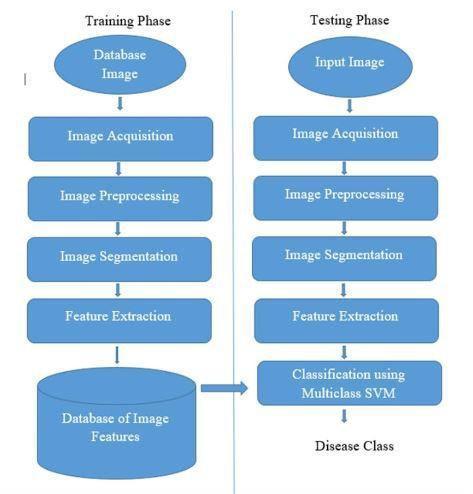
In order to build a machine learning model the figure consists of two phase namely testing and training phase where the model is first trained and an input is given to test the model which is called the test data. The model consists of several image processing steps such as image acquisition, image pre processing, segmentation, feature extractionandSVMclassifiertoclassifythediseases.
1.CaptureimagesinRGBformat.
2.Creationofcolorconversionstructure
3.Convert color values to designated rooms in this structurefromRGB.
4.ApplyingKmeansclusteringofimagesegmentation.
5.MaskingGreenPixel(MaskingGreenChannel).
6.Eliminatemaskedcellspresentattheendoftheinfected cluster.
7.ConvertinfectedclustersfromRGBtoHIS.
8.GenerationofSGDMMatrixforHandS
9.CallingtheGLCMfunctiontocalculateitscharacteristics.
Detection of diseases using the K clustering method. This algorithmprovidesthenecessarystepsrequiredforimage recognitionoftheplantsheet.Inthefirststep,RGBimages ofallleavesareusuallyrecordedatthecamera.Instep2,a colorconversionstructureisformed,andthencolorspace conversion is applied in step 3. These two steps are expected to perform step 4. In this step, the received image is processed for segmentation using the K Means clustering technique. These four steps fall into Phase 1 where infected objects are detected and determined. In step 5, the green pixel is detected. Next, the masking of greenpixelsisdoneasfollows:Ifthegreencolorvalueofa pixelislessthanthethresholdalreadycalculated,thered, green,andbluecomponentvaluesofthosepixelsarezero. This happens because this is the unaffected part. That's why their values are made zero, which also leads to a reduction of calculations. In addition, the time consumed by the system to render the final result will be greatly reduced.Instep6,pixelswithnovaluesforred,green,and blue, and pixels at the edges of infected clusters, are completely discarded. Stage 2 includes step five and step number six and these results with good detectability and good performance, as well as the overall required computation time should be reduced to its minimum value.Instep7,theinfectedclusterisconvertedfromRGB toHSIformat.Then,anSGDMmatrixisgeneratedforeach pixelintheimage.ButthisisonlydoneforHandSframes and not for I frames. SGDM actually measures the probability that a given pixel at a particular gray level occursata distanceandangulardirectiond.thananother pixel, but that pixel has a special second gray level for it. FromtheSGDMmatrix,thegenerationoftexturestatistics for each image is performed. Briefly, features are calculatedforpixelsinsidetheedgeoftheinfectedpartof the leaf. This means that the unaffected part within the boundary of the infected part will not participate. Steps seventhroughtenbelongtostagethree.Duringthisphase,
International Research Journal of Engineering and Technology (IRJET) e ISSN:2395 0056
Volume: 09 Issue: 06 | Jun 2022 www.irjet.net p ISSN:2395 0072
the texture related features of the segmented objects are calculated. Finally, the accreditation process of the fourth phase has been implemented. For each image wecapture, the steps of the algorithm are repeated each time. The result is then transferred to the GSM module. By using a goodsystem,theresultsareemailedandalsodisplayedon thescreen.
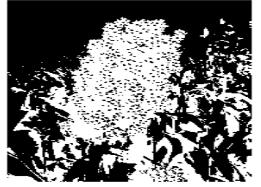
We need to extract features from the input image. To do this, instead of selecting the entire set of pixels, we can selectonlythosepixelsthatarenecessaryandsufficientto describe the entire segment. Affected areas are revealed. Thepercentageofareaoccupiedbythissegmentindicates thequalityoftheresult.Ahistogramofanobjectorimage providesinformationaboutthefrequencyofoccurrenceof a particular value in any data/image. It is an important toolforfrequencyanalysis.Coincidencetakesthisanalysis to the next level. Here the matrix shows the intensity matches of two pixels together, making coincidences a great tool for analysis. Features such as contrast, correlation, energy, and homogeneity are extracted from theGray co matrix
Ram :512Mb
2) SOFTWARE:
Operatingsystem:WindowsXP/Windows7orMore SoftwareTool :OpenCV. CodingLanguage:Python. Toolbox:Imageprocessingtoolbox.
3)
TheSoftwaremustbeabletodetectdiseaseinleaf. Itshouldbeabletoextracttexturefeaturesoftheleaves.
Itshoulddisplaydiseasename
ItshoulddisplayRemedyName
DetectionofDiseasemustbeaccurate. The detection process should be done effectively and efficiently.
Thesoftwareshouldneverfailinmiddleoftheoperation
Support vector machines are part of supervised learning models in machine learning. SVM is mainly used for classification and regression analysis. To get the output, weneedtoassociatetheSVMwiththelearning algorithm. SVMperformsbetterforclassificationandregressionthan otherprocesses.The
training kit is divided into two categories. The SVM learning algorithm creates a model that assigns new examples to one category or another, making it a non stochastic binary linear classifier. The example occurs because views in SVM show and also display points in space,separatedbythewidestpossiblespacing
1) HARDWARE:
System :PentiumIV2.4GHz.
HardDisk :40GB.
Monitor :15VGAColour. Mouse :Logitech.
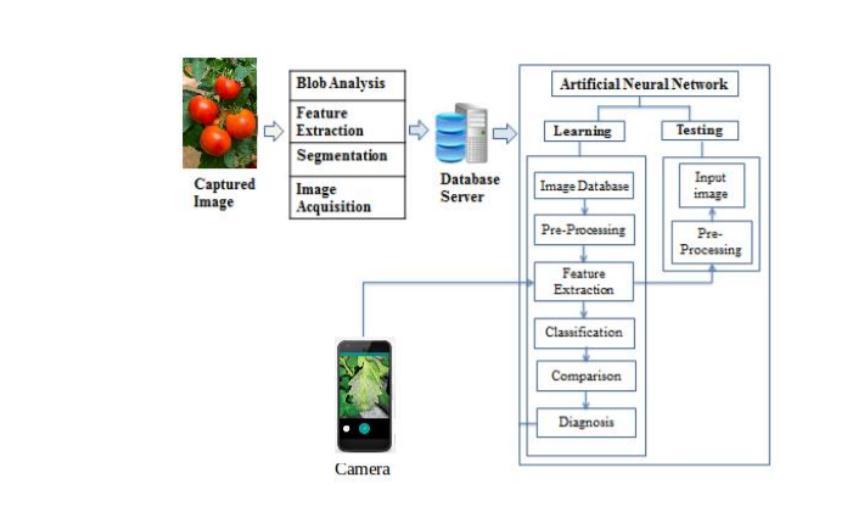
Thisarchitectureshowshowsystemsinteractandcontrol the flow from one point to another in a cycle. System hardware control flow from image capture to disease detection and display. The figure below shows the hardwareandsoftwarecontrolflowoftheentiresystem.
International Research Journal of Engineering and Technology (IRJET) e ISSN:2395 0056
Volume: 09 Issue: 06 | Jun 2022 www.irjet.net p ISSN:2395 0072
Leafimagesofdiseasedplantsarecapturedusingamobile or digital camera. The captured image is then sent to the system, followed by a process that includes image processing steps. The resulting image serves as input to thissoftwaresystem.Theseimagesconstitutethetestdata that determines the accuracy of the system. Before we actually test it on our machine learning model, we first resize the image, then we use a variety of techniques to repaintandfitit.Thisimageisreadytobetested.
The dataset is a huge collection of raw data that must be trained to extract useful information. The dataset used in oursystemisasetofleafimagesofvariousplantsthatfall intoeitherhealthyordiseasedcategories.
with an image dataset in the back end. Results are generatedintheuserinterfaceandtheuserdoesnothave tonavigatebetweenthetrainingandtestingphasesofthe system.Theinterfaceprovidesasimpleandseamlessflow of control and users do not need to know the entire mechanismbehindtheplantdiseaseidentificationsystem.
This project uses classification of leaf images to identify the diseases of the sheet by combining texture and color functions.Initially,farmerssendadigitalimageofpatients with leaves of plants, and this image is read from Python andisautomaticallyprocessed based on SVM.The results aredisplayed.
Resultsofthisproject Findtheappropriatefeaturesthat can identify the disease of leaves of specific commonly generated plant diseases. The proposed approach is a valuableapproachtosupportingtheexactdetectionofthe leaf disease in a small amount of computing efforts by supporting vector classifiers for increasing the reference speedofthefinalclassificationprocess.
Further,onlytheamountofpesticideneededtoeffectively manufacture agricultural production system costs using severityandnumberofdiseasespresentincrops.
To ensure that our disease identification model is as accurate and accurate as possible, the database must be huge. A total of 200 leaf images are required. 50 each for Health, Premature Decay, Bacterial Spot, and TYLCV. All these images need to be scaled and corrected to one specific quality and size to have a single data set. This datasetformsthetrainingdatathatcontrolstheplatform, startingwiththedigitalimagingpart.
This is an overall large mechanism consisting of various steps and algorithms. Looking at the whole process as a whole,thefunctionsofthisstageare:
1. Perform training on images pre configured and collectedandsavedasdatasets.
2. Test the photos of the plant leaves we got to see if the leavesarediseasedornot.Thecollecteddatasetformsthe trainingdatatrainedbytheimageprocessingmodel.Then savethismodelanduseittochecktheimagescapturedby thecamera.
The web UI is needed when the user needs to upload capturedimagestothefront endandtheUIispre trained
1. Mrunalini R. Badnakhe and Prashant R. Deshmukh An application of K means clustering and artificial intelligence inputted recognition for cropdiseases2011.
2. S.Raj Kumar, S.Sowrinajan," Automatic Leaf Disease Detection and Classification using Hybrid Features and Supervised Classifier", International Journal of Advanced Research in Electrical, Electronics and Instrumentation Engineering, vol. 5, Issue6,2016.
3. Vidyashanakara and Kumar, 2018[3] classify leaves using the Gray Level Co Occurrence Matrix (GLCM)
4. Huntley, B. (1991). How plants respond to climate change: migration rates, individualism and the consequences for plant communities. Annals of Botany,15 22.
5. T. Van der Zwer, "Present worldwide distribution offireblight,"inProceedingsofthe9thInternational Workshop on Fire Blight, vol. 590, Napier, New Zealand,October2001.
6. Fang, Y., & Ramasamy, R. P. (2015). Currentand prospective methods for plant disease detection. Biosensors,5(3),537 561
International Research Journal of Engineering and Technology (IRJET) e ISSN:2395 0056
Volume: 09 Issue: 06 | Jun 2022 www.irjet.net p ISSN:2395 0072
7. Steinwart and A. Christmann, Support Vector Machines, Springer Science & Business Media, NewYork,NY,USA,2008ViewatMathSciNet
8. P. R. Reddy, S. N. Divya, and R. Vijayalakshmi, "Plant disease detection technique tools theoretical approach," International Journal Innovative Technology and Research, pp.91 93, 2015. View at GoogleScholar
© 2022, IRJET | Impact Factor value: 7.529 | ISO 9001:2008 Certified Journal |