International Research Journal of Engineering and Technology (IRJET) e ISSN: 2395 0056

Volume: 09 Issue: 06 | June 2022 www.irjet.net p ISSN: 2395 0072
International Research Journal of Engineering and Technology (IRJET) e ISSN: 2395 0056
Volume: 09 Issue: 06 | June 2022 www.irjet.net p ISSN: 2395 0072
Department of Refrigeration and Air Conditioning Technology, Faculty of Technology and Education, Helwan University, 11282, Cairo, Egypt
*Email: aly_wael@techedu.helwan.eg; aly_wael@yahoo.com, ***
Abstract The total heat transfer coefficient and friction coefficient of the heat exchanger were estimated using antifreeze (Ethylene glycol) as an experimental coolant. An Ethylene glycol/water mixture (50%:50 % (by volume was used as the base liquid. Purified and mixture at temperatures 6°C, 8°C, 10°C and 12°C, and air v6elocities (1.30 m/s 2.30 m/s 3.54 m/s) with a 20liter tank. Theresultsshowedthatthe thermal heat transfer coefficient increases when ethylene glycol is added to water and the mass flow rate. It was found that the excess heat transfer coefficient increases with the increase in temperature, as it is at a temperature of 12° C and a flow rate of 0.016 kg / s and the highest is 100 % when it was The air velocity was 3.45 m. /s. The fluid pressure drops increases with respect to adding ethylene glycol to water in a ratio of (50:50) by volume, at 10 degrees Celsius, the coefficient of friction improved to 17% and an air velocity of 1.30 m/s. In all cases of ethylene glycol, it shows a higher thermal conductivity compared to the base liquid under the same weight and temperature concentration
Key Words: Enhancementofheattransfer,Heatexchanger, ethyleneglycol/waterMixture
Energytransmissionplaysavitalrolegloballyandoccupies a dominant position in a very large area in various fields such as mechanical, electrical, chemical, transportation, nuclearandpetroleumindustries. Whenfluidisaddedin the heat exchanger, the coil and tube heat exchanger is a pressurized heat exchanger that is widely used in many industrial applications, because it can satisfy a large heat transfer area in a small space with high heat transfer coefficientsand narrow residencetime distributions, they flowintotubeswithalimitedflowarea.Theconductivityof these conventional fluids can be improved by seeding nanoparticles with high thermal conductivity in various shapes.[1 2] Ahmedetal. [3] synthesisofethyleneglycol treatedGrapheneNanoplateletswithone pot,microwave assisted functionalization for use as a high performance engine coolant ,Water and ethylene glycol were used to improve the thermal, physical and rheological properties, and the evaluation was measured for the thermal performance ،The results showed an increase in the
pressuredropatdifferenttemperaturesandconcentrations, andthepumpingforceincreased,andtheperformanceindex became greater than 1.The energy efficiency ratio of the shroudedfinswashigherthanthatofthecoolingandflatcoil by9%and17.4%
Bhanvas et al. [4 studied the effect of the solid volume fraction,the NanofluidFlowrateandinlettemperatureon theheattransferperformanceofnanofluid.TheAmaximum enhancement of 105% is observed in the heat transfer coefficientoftheNanoliquidwiththe solidthesizeofthe fracture is 0.5. Naddaf et al. [5] studied the heat transfer performance and pressure drop of Nano fluids using graphene and multi walled carbon nanotubes based on dieseloil.Herisetal. [6] investigateNanofluidscontaining CuOandAl2O3oxidenanoparticlesinwaterasbaseliquidat different concentrations and convective heat transfer of laminarflowthroughacirculartubewithtwo wallconstant temperature.Sathishetal. [7] experimentalinvestigationof heat transfer coefficient by convection on the mixture of nanoparticlesusedinautomobileradiatorsonthemassflow rate Selvam et al. [8] study the overall heat transfer coefficient improvement of an automobile radiator with graphene based suspensions. Amir et al. [9] awards improvingengineperformancebyusingaqueousgraphene ethyleneglycol coatednitrogencoolant.
Bhanvase et al] .10[ intensification of convective heat transfer in water/ethylene glycol based Nano fluids containingTiO2 Nano particles. Subhea et al [ . 11] experimental investigation of overall heat transfer coefficientofAl2O3/Water MonoEthyleneGlycolNanofluids inanAutomotiveRadiator.Pandeletal.[12]reductioninthe surface area of the coolant investigate performance of cooling effect on automobile radiator using CU TiO2nanofluid ,Studying the performance of the cooling effectonthecarcoolantusingcopper TiO2nanofluidisthe mainobjectiveofthestudy. Hoet al. [13] presentanatural convectionheattransferofaluminaaqueousNanoliquidsin verticalsquarecontainers. kumaretal. [14] experimentally investigatetheincreaseofheattransferinacarradiatorthat works with a nano liquid (water magnesium oxide). Hameedetal. Derive [15] anexperimentalstudytoenhance heattransferinacarradiatorusingAl2O3/Water Ethylene GlycolNanocoolant.
International Research Journal of Engineering and Technology (IRJET) e ISSN: 2395 0056
Volume: 09 Issue: 06 | June 2022 www.irjet.net p ISSN: 2395 0072
Nambeesan et al. [16] showed the heat transfer and hydrodynamic properties using different metal oxide nanostructures in horizontal concentric annular tube. Alawiat et al. [17] present an experimental study for heat transferenhancementofGraphenenanoribbonnanofluidın anautomobileradiator ,Kilinceetal. [18] improvethecar radiatorperformancebyusingTiO2 waternanofluid,Ahmed et al. Investigate the [19] viscosity of low volume concentrationsofmagneticFe3O4nanoparticlesdispersed inethyleneglycolandwatermixture ,ThisLetterrevealsan experimental investigation of rheological properties of Fe3O4 nanoparticles dispersed in 60:40%, 40:60% and 20:80%(byweight)ethyleneglycolandwatermixtureThe results indicate that the 60:40% EG/W based nanofluid is 2.94timesmoreviscouscomparedtotheotherbasefluids. Sundar et al. [22] experimental study of the effect of diameter on temperature Conductivity and dynamic viscosityofiron/waterNanofluidsthestudyisbasedonthe development of different Nano fluids by mixing a Water basedliquidwithmagneticnanoparticles.
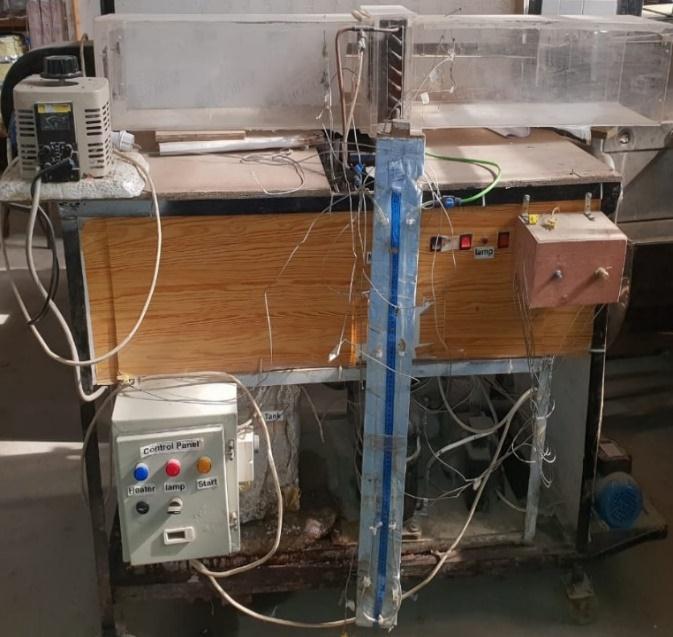
Toinvestigatetheheattransferpotentialofthenanofluidas acoolant,Includespressurecoolingcircuitandacentrifugal pumpthatworkstopumpcoldwatertotheheatexchanger andawaterflowratemeter,andthepumpiscontrolledbya manualvalve,andthereisanothermanualvalvethatactsas apassage,heatdetectorstorecordthetemperatureofthe inletandoutlettemperatureoftheheatexchangercooling, airgaugestorecordairspeed,thermocouplesfromTypeK, To record the temperature before and after the heat exchangerandtheentryandexitofwater Thespecifications ofthecoolantusedforresearchare:TheyarelistedinTable 1 Acentrifugalfanwithapowerof0.37kWisused.witha Varic(tochangetheinputvoltage.Thefanwasinstalledat thebeginningoftheductofthetestsectionandinthisway the flow of air and the cooled liquid have an indirect connectionwiththetangentialflowandasaresulttheheat exchange occurs between the flow of coolant in the low temperatureheatexchangerandthehotairpassingoverthe tubes.Theinletairtemperaturewasabout30°C+ 0.10°Cat full search. Thermal centrifugal: a pump giving a constant flowrateof30L/minusedtochangetheflowrateusinga manualvalve.Inthetestapparatus,coolantisstoredina50 litertank(0.4mx0.3mx.5m).Adeviceisusedtocontrol the flow rate of the water and so the total volume of the coolant is constant in the experiment. Two thermometers areusedtorecordtheinlet andoutlettemperatureofthe coolant Mercury manometer is used to measure the pressuredifferencebetweenwaterandair.Beforeinstalling thethermocouples,allthermocouplesarecalibratedovera widetemperaturerange(0 100°C).
In order to evaluate heat transfer coefficients in the radiator,theFollowingequationsforthecoolantwereused () w wwoutwin w QmCpTT (1)
The heat transfer rate of air from the coolant side can be estimatedas: () a aainaout a QmCpTT (2)
The actual average heat transfer rate is used for Eq. (14) whichcalculatedas[1,2] 0.5() avaw QQQ (3)
The overall heat transfer coefficient (Uo) in Eq. (15) is estimatedby: av o s
Q U AFLMTD (4)
Where(F=1)correctionfactorfor crossflowin thecase of unmixed/unmixedheatexchangerflowconfiguration. The coolant side non dimensional parameters were calculatedas: , .. Re winw w w
Vd
Theairsidenondimensionalparameterswerecalculated as:
International Research Journal of Engineering and Technology (IRJET) e ISSN: 2395 0056 Volume: 09 Issue: 06 | June 2022 www.irjet.net p ISSN: 2395 0072
with the different data in open literature, in addition, to comparetheresultstheoreticallywith Well knowndifferent empirical correlations by taking into account The appropriateness of the empirical equations of the applied boundaries with the current research One of the famous empiricalequationsisusedtocomparetheresultsWiththe presentdatawhichsuggestedbyHerisandEtemad[6].
Where(Dhy)isthehydraulicdiameteroftheradiator tubes,whichthefollowingequationisobtainedas: 4 () sff hy s
LA D A (11)
TheDarcyfrictionfactorforradiatortubesis calculatedbyDarcy Weisbachequationas: 2
Pd f WNLV
2.. () why w tuTuw
(12) Wherethepressuredropofthewatersideisgivenby: (13) Theeffectivenessofcrossflowunmixed/unmixedcompact heatexchangersispresentedby
Figure2showsthefrictionfactorvalidationofdistilledand Reynoldswaterwithanairspeedof3.54m/sandawater inlet temperature of 6°C and 8°C. Comparison of results showsgoodagreement. Itis clearfromthe figure thatthe friction factor of the heat exchanger decreases when the Reynoldsnumberincreasesinallcases.Increasingthefluid velocity through the exchanger tubes leads to a random increaseinthemovementofthefluidparticlesovertime,as well as the irregular velocity fluctuations and thus the pressuredropinthewrinklesacrossthecoolanttube,and the friction factor is also reduced. The reason for the inconsistencyintheresultsisduetothelackofinsulationof thetubesItcanbeseenfromtheReynoldsnumber2500that the friction factor in the current study was less than the reference[4]by4%,9%at6°C،8°C.
0.07
0.06
V a =3.45m/s
TheNusseltnumberinsinglephasefluidscanbecalculated bycorrelationsforthelaminarflowthroughpipes[4]and for the flow in the compact heat exchanger at 550Re1850 w as: 1 3 .14 Re.Pr 1.86() () s h
Nu L D (14)
Where, Re representstube sideReynoldsnumberwhichis based on tube hydraulic diameter whereas Pr is Prandtl number.
Although, we used a high Reynolds number as an input parameter, experimental results were compared by using theequationsforfriction(Eq.(26)). 64 w w f Re (15)
5.1.Validationoftheexperimentalresults.

In order to check the reliability and accuracy of the experimentalSet up,oneoftheresultsshouldbevalidated
0.05
0.04
0.03
0.02
0.01
presentstudy(6oC) 64/Re(6oC) presentstudy(8oC) 64/Re(8oC) f w Rew
1000 1500 200025003000 0.00
Fig 2 comparison between the measured f and Re and the predicted values for distilled water at6°C and 8°C.
Figure3showstheNusseltnumberforthecurrentstudyof distilled water against Reynolds number and the relationship between Sidr and Tate [20], and the current study at an air speed of 3.54 m/s and a water inlet temperatureof6oCdegreesand8oC.Itcanbeseenfromthe
International Research Journal of Engineering and Technology (IRJET) e ISSN: 2395 0056
Volume: 09 Issue: 06 | June 2022 www.irjet.net p ISSN: 2395 0072
figureatReynoldsnumberof2000thatthenusseltnumber in the current study is lowerthan the sider andtate [22] corrlactions by22%and 19%.Thiscan bereferredtothe lackofinsulationofthepipes.
Figure 4 shows the relationship between Nusselt number versusReynoldsnumberfordifferenttypesofpurewater
1000 1500
Fig 3 comparison between the measured Nusselt Number and Reynolds number and the predicted values for distilled water at 6°C and 8°C
Wa-EG12oC Wa-EG10oC Wa-EG8oC Wa-EG6oC Wa12oC Wa10oC Wa8oC Wa6oC
increaseswithanincreaseintheReynoldsnumberwhenthe temperaturechanges,asanincreaseinthetemperatureof the working fluid increases the Reynolds number for all typesoffluids.Thisisduetothechangeintheviscosityand density of the fluids used as a result of the temperature change,whiletheReynoldsnumberdirectlydependsonthe thermo physical properties of density and viscosity and therefore the Reynolds number is affected by changes in temperature,theretoincreasethetemperatureofthefluid increasestheNusseltnumberforallcasesandvalues.The figure also shows the relationship between the Reynolds numberandtheNusseltnumberatdifferenttemperatures whenthemixture(waterandethyleneglycol)is(50:50)% byvolumeandatanairspeedof1.30m/s.Thetemperature andthatthewatertemperatureat12oC degreesCelsius is morethanitwasat6oC,andtheNusseltnumberat2000is higherthan6oC,8oCand10oCby200%,50%and36.6%.Itis also clear from the figure that the Reynolds number increases with an increase in the Nusselt number when adding ethyleneglycol to waterata ratio of(50:50)% by volume concentration. It may be related to the thermal expansionoftheliquidandthereforetheReynoldsnumber increases with Nusselt when ethylene glycol is added to waterandthattheReynoldsnumberat12°Cismorethanit was at 6°C For water and ethylene glycol،Thermal conductivity of water increases with increasing temperature ،And at 12°C water showed a significant improvementover6°C,8°Cand10°CatReynolds2200by 200%,114.2%and15.3%,respectively.WhenEGwasadded to water in a ratio (50:50) by volume at different temperatures, it showed a temperature improvement. At 12°CandtheReynolds2200isbetterthan6°C,8°Cand10°C was66% ،50%and20%respectively.Itisalsoclearfromthe figure that at a temperature of 12 oC for the mixture and Reynoldsnumber2200itwasbetterthandistilledwaterby percentage122%andat10oCforthemixturewasbetterthan distilledwaterbypercentage67%andat8oCforthemixture wasbetterthandistilledwaterbypercentage110%andat6 oC for the mixture showed an improvement Marked percentage200%fordistilledwater.
Fig .4 Comparison shows the relationship between Nusselt number versus Reynolds number for different temperature
(H2O EG) at different entering temperatures of 6°C, 8°C, 12°C. It is clear from the figure that the Nusselt number
Figure 5 shows the relationship between overall heat transfercoefficientandmassflowratefordifferenttypesof purewater(H2O EG)atdifferentinlettemperaturesof6°C, 8°C,12°C.Itisclearfromthefigurethatthemassflowrate increases with an increase in the overall heat transfer coefficientwhenthetemperaturechanges,thisisduetothe change in that when ethylene glycol is added to water, it improvesheattransferandhasalargeheatcapacity.Ascan beseenfromthefigure,theoverallheattransfercoefficient increases with increasing mass flow rate at different temperatureswhenthemixture(waterandethyleneglycol) is(50:50)%byvolumeandatanairspeedof3.54m/s.And thatthetotalheattransfercoefficientofpurifiedwaterat12 °Cisbetterthanwhatitwasat10°C,8°Cand8°Cby25%, %,67%and 150%. When the mass impact rate is 0.018
International Research Journal of Engineering and Technology (IRJET) e ISSN: 2395 0056
Volume: 09 Issue: 06 | June 2022 www.irjet.net p ISSN: 2395 0072
kg/sec It is also clear from the figure that the total heat transfercoefficientofthemixtureincreasedwithanincrease in the mass flow rate when ethylene glycol was added to water at a ratio of (50:50)% in terms of volume concentration,andthatthetotalheattransfercoefficientat 12 ° C is more than it was at 6 °C for water and ethylene glycol,thethermalconductivityofwaterincreaseswiththe increase in temperature, and at 12 °C water showed significantimprovementover6°C,8°Cand10°Cat0.018°C massflowrateof67% ،46%and11%respectively.Asitcan beseenfromthefigurethatatatemperatureof12°Cforthe
Fig.5. Effect of the heat transfer coefficient rate on mass flow when the temperature changes.
mixtureandamassflowratewasbetterthandistilledwater by122%andat10°Cforthemixtureitwasbetterthanthe distilled water by 89% and at 8 ° C for the mixture. The mixturewasbetterthandistilledwaterby152%andat6°C the mixture showed improvement of 222% for distilled water. Figure 6 shows the flow rate versus logarithmic temperature difference (LMTD) of different types of pure water(H2O EG)atdifferenttemperaturesof6°C,8°C,10°C and12°C.Itisalsoevidentfromthefigurethatthemassflow rate increases with the increase of the logarithmic temperature difference ،The logarithmic difference in temperature improves at higher temperatures and when ethyleneglycolisaddedtowaterataratioof(50:50) %by volumeandatanairspeedof3.54m/s.itshowedat12cwas beter than 10oC ،8oC and 6oC by percentage 93% ،45%.،26%Whenthemassimpactrateis0.018kg/sec Asit can be seen from the figure that the total heat transfer coefficientofthemixtureincreaseswiththeincreaseinthe massflowratewhenethyleneglycolisaddedtowaterata ratioof(50:50)%intermsofvolumeconcentration,andthat thetotalheattransfercoefficientat12°Cismorethanitwas at6degreesCelsiusforwaterandethyleneglycol,andthe thermal conductivity of water increases with increasing temperature, and at 12 degrees Celsius water showed significantimprovementabove6°C,8°Cand10°Cat0.018 °Cmassflowrate56%and25%and11%respectively.Asit canbeseenfromthefigurethatatatemperatureof12°C forthemixture,themassflowratewasbetterthanthatof distilledwaterby72%,andat10°Cforthemixtureitwas betterthanthatofdistilledwaterby28%,andat8°Cforthe mixture ،The mixture was better than distilled water by 122%andat6°Cthemixtureshowedimprovementof 94% relativetodistilledwater.whentheairvelocityincreases, andthustherateofheattransferincreases.Thereasonfor this is that ethylene glycol has a low viscosity and low molecularweightthatwasn’teffectsofthepumpingprocess, asithasalargeheatcapacityandgoodthermalconductivity. ItisalsoevidentfromthefigurethatatReynoldsNumber 2000,therateofheattransferat3.45m/swasbetterthanat 1.30m/sand2.30m/sby43%and12%fordistilledwater.It isalsoevidentfromthefigurethatinReynoldsNumber2000 theheattransferrateofthemixtureataspeedof3.45m/sis betterthanthatof2.30m/s,1.30by43% ، 17.6 % Itisalso evidentfromthefigurethatinReynoldsNumber2000,the heattransferrateofthemixtureat3.45m/sisbetterthan thatof3.45m/sofdistilledwaterat100%,andat2.30m/s isbetterthatof2.30m/sofdistilledwaterby113% andat 1.30m/sisbetterthatof1.30m/sofdistilledwaterby117%.
Fig.6. Effect of the logarithmic temperature difference mass flow rate on when the temperature changes

Figure7showstheoverallheattransfercoefficientandmass flowrateofwater,(water ethyleneglycol).Itisclearfrom thefigurethattheoverallheattransfercoefficientincreases withthemassflowofwaterandthemixturewhentheair velocityincreases,andthustheheattransferrateincreases.

International Research Journal of Engineering and Technology (IRJET) e ISSN: 2395 0056
Volume: 09 Issue: 06 | June 2022 www.irjet.net p ISSN: 2395 0072
The reason for this is that ethylene glycol has a low viscosityandlowmolecularweightthatwasnotaneffect forthepumpingprocess,asithasalargeheatcapacityand goodthermalconductivity.Asshowninthefigureatamass flowrateof0.016kg/sec,thetotalheattransfercoefficient at3.45m/swasbetterthan1.30m/sand2.30m/sat150% and 50% for distilled water. It is also evident from the figurethatataflowrateofMassat0.016kg/s,theoverall heattransfercoefficientofthemixture )wa EG)at3.45m/s wasbetterthantheheattransferrateofthemixture2.30 m/s,1.30m/s,20%.,50%respectively.Itisalsoclearfrom thefigurethatthemassflowrateat0.016kg/sec,andthe totalheattransfercoefficientat3.45m/secforthemixture (WA EG) is 3.45 m/s better than that of distilled water at122%,andat2.30m/sisbetterthan2.30m/s.ofdistilled wateratarateof 152% andat1.30m/s
isbetterthan1.30m/sofdistilledwaterat186%.Figure8 showsthemassflowrateofwater(water ethyleneglycol) versusLogarithmictemperaturedifference(LMTD).Itisclear fromthefigurethatthelogarithmictemperaturedifference (LMTD)increaseswiththeflowofthemassofwaterandthe mixture(wa EG)whentheairvelocityincreases,andthusthe heat transfer and the logarithmic heat transfer coefficient increase.Thereasonforthisisthatwithincreasingspeed,the logarithmic temperature difference (LMTD) increases as ethylene glycol hasa large heatcapacityand goodthermal conductivity.Itisalsoclearfromthefigurethatatamassflow rate of 0.016 kg/s, the logarithmic temperature difference (LMTD)at3.45m/swasbetterthan1.30m/sand2.30m/s at122%and34%fordistilledwater.Itisalsoevidentfrom the figure that at a mass flow rate of 0.016 kg/s, the logarithmictemperaturedifference(ofthemixture)WA EG) at 3.45 m/s was better than the heat transfer rate of the mixture2.30m/s,1.30m/s,11%and20%respectively.Itis alsoevidentfromthefigurethatthemassflowrateat0.016 kg/s,andthelogarithmictemperaturedifferenceat3.45m/s for the mixture (WA EG) is 3.45 m/s better than that of distilledwaterby50%andat2.30m/sbetterthan2.30m/s. ofdistilledwateratarateof80%andataspeedof1.30m/s isbetterthan1.30m/sofdistilledwateratarateof150%.
Fig. 7 The difference between the Nusselt numbers versus the Reynolds number for Different distilled water and( wa EG) at different speed.
Twi.(EG)/w(50;50)3.54m/s
Twi.(EG)/w(50;50)2.30m/s

Twi.(EG)/w(50;50)1.30m/s
Twi3.54m/s
Twi2.30m/s
Anexperimental studywasperformedontheoverall heat transfer coefficient of (EG H2O) in heat exchanger for varyingmassflowrate,andnanofluidinlettemperatureand air velocity. The Using of EG as a base fluid tremendously enhancestheconvectiveheattransfercoefficient.Studyon enhancingheattransferingeneral Themixtureof(EG H2O) theexperimentalinvestigationresultsshowedfortheheat exchangerusedthelowestconcentrationof0.33%of(EG H2O)has Significant effectontheconvectiveheattransfer coefficient with respect to mass flow rate. When the temperatureofentryofthestationaryEGintothemassflow isincreased.Therateofincreaseinthethermalheattransfer coefficientvalues thevolumepercentageofthemixtureof EG WATER is directly proportional to the coefficient of thermalheattransfer .ThemassflowrateoftheEG WATER mixture is also directly proportional to the coefficient of thermal heattransfer size96%ata massflow rate of1.2 L/min It produced the highest convective heat transfer values.
Fig. 8 Effect of mass flow rate on the excess heat transfer coefficient when air velocity changes.
1. C. Selvam, D. Mohan lal, Sivasankaran harish, “Enhancedheattransferperformanceofanautomobile radiator with graphene based suspensions”, Applied ThermalEngineering,vol123(2017)50 60
International Research Journal of Engineering and Technology (IRJET) e ISSN: 2395 0056
Volume: 09 Issue: 06 | June 2022 www.irjet.net p ISSN: 2395 0072
2. AbdallaGomaa,GamalAbdElAziz,MomenRadwan," performance characteristics of wet air conditioning coolingcoilswithdifferentfinpatterns",Scienceand TechnologyfortheBuiltEnvironment,February2015 DOI:10.1080/10789669.2014.975092.
3. Ahmad Amiri, Rad Sadri, Mehdi Shanbedi, Goodarz Ahmadi,S.N.Kazi.Chew,MohdNashrulMohdZubir, "Synthesis of ethylene glycol treated Graphene nano platelets with one pot, microwave assisted functionalizationforuseasahighperformanceengine coolant", energy conversion and management ,vol. 101,1September2015,pages767 777.
4. E B.A. Bhanvasea, M.R. Sarodec, l.A. Putterwar, Abdullah k., M.P. Deosarkar, S.H. Sonawane, " Intensification of convective heat transfer in water/ethylene glycol based nano fluids containing TiO2 nanoparticles", chemical engineering and processing, process intensification vol. 82, August 2014,pages123 131.
5. AtiyehNaddaf,SaeedZeinaliHerisandBabakPouladi," Anexperimentalstudyonheattransferperformance andpressuredrop ofnanofluidsusinggrapheneand multi walledcarbon nanotubes based on diesel oil", powdertechnology,vol,352(2019)369 380
6. S. Zeinali Heris, S.GH. Etemad Nasr Esfahany, "Experimental investigation of oxide nano fluids laminarflowconvectiveheattransfer",international communications in heat and mass transfer ,vol. 33 (2006) 529 535( .T. Sathish, R.V. Sabariraj , K. Muthukumar , S. Karthick, " Experimental investigationofconvectiveheattransfercoefficienton nano particles mixture used in automobile radiator based on mass flow rate. https://doi.org/10.1016/j.matpr.2019.12.016
7. C. Selvam , R. Solaimalai Raja , D. Mohan lal , SivasankaranHarish, "Overallheattransfercoefficient improvementofanautomobileradiatorwithgraphene basedsuspensions",InternationalJournalofHeatand MassTransfer,vol.115(2017)580 588.
8. AhmadAmiri,MehdiShanebedi,B.T.Chew ,S.N.Kazi, k.H.Solangi," Towardimprovedengineperformance withcrumpledNitrogen dopedgraphenebased water ethyleneglycolcoolant",ChemicalEngineeringJournal ,Journal (2015), doi: http://dx.doi.org/10.1016/j.cej.2015.12.083.
9. B.A.Bhanvasea,M.R.Sarodec,l.A.Putterwar,Abdullah k.A.,M.P.Deosarkar,S.H.Sonawane,"Intensificationof convective heat transfer in water/ethylene glycol basednanofluidscontainingTiO2 nanoparticles",vol. 82,August2014,pages123 131.
10. Dattatraya. Subhedar, Bharat M. Ramani, Akhilesh Gupta Chandubhai S patel institute of technology, Charusat Changa, " Experimental investigation of overallheattransfercoefficientofAl2O3/water mono ethyleneglycolnanofluidsinanautomotiveradiator", HeatTransfer AsianResearch,00(0),2016
11. RahulD.Pande,Prof.S.S.Jawre,Prof.A.A.Kanaskar, "Investigate performance of cooling effect on automobileradiatorusingCU TiO2 nanofluid",vol.4 issue 12018ijariie issn 2395 4396
12. C.j. Ho, W.k. Liu, Y.S. Chang, C.C. Lin, " Natural convectionheattransferofalumina waternanofluidin vertical square enclosures: an experimental study " international journal of thermal sciences,49 (2010) 1345e1353.
13. Dr.P.T.SaraVanakumar,M.Surya,D.vijayandG.santhos Hkumar, " Improving performance in engine cooling system using nano fluids" , International Research JournalofEngineeringandTechnology(IRJET)e ISSN: 2395 0056Volume:04Issue:09|Sep 2017
14. Hameed K. Hamzah ,Qusay Rasheed and Al Ami, " Experimental investigation to heat transfer augmentationinacarradiatorworkedwith(water magnesium oxide) nanofluid",Journal of babylon university/engineering sciences/ no.(4)/ vol.(25): 2017
15. R k.p. Vasudevan Nambeesan, R. Parthiban, K. Ram kumar, U.R. Athul, M. Vivek and S. Thirumalini, " Experimental study of heat transfer enhancement in automobile radiator using AL2O3 /water ethylene glycol nanofluid coolants" , science direct materials today:proceedings24(2020)1525 1532.
16. OmerAlawi,Ali.Abdelrazek,MohammedSuleman Aldlemy ,WaqarAhmed,OmarA.Hussein,Sukaina TuamaGhafel,KhaledMohamedKhedher,Miklas ScholzandZaherMundheryaseen , "Heattransfer andhydrodynamicpropertiesusingdifferentmetal oxidenanostructuresinhorizontalconcentric annulartube", anoptimizationstudy ,nanomaterials 2021,11,1979.
17. F. Kilinc, Buyruk, Karabulut ,"An experimental study for heat transfer enhancement of graphene nano ribbon nanofluid ın an automobile radiator " at: https://www.researchgate.net/publication/32705128 6
18. Siraj Ali Ahmed , Mehmet Ozkaymak , Adnan Sözen , Tayfun Menlik , Abdulkarim Fahed , " Improving car radiatorperformancebyusingTiO2 waternanofluid",
International Research Journal of Engineering and Technology (IRJET) e ISSN: 2395 0056
Volume: 09 Issue: 06 | June 2022 www.irjet.net p ISSN: 2395 0072
engineeringscienceandtechnology",aninternational journal(2018).
19. l.SyamSundar,Venkataramana,M.K.Singh,A.C.M.De Sousa ," Viscosity of low volume concentrations of magnetic Fe3O4 nanoparticles dispersed in ethylene glycolandwatermixture",chemicalphysicsletters , vol.554(2012)236 242
20. Mohammad Hemmat Esfe ,Seyfolah Saedodin ,Somchai wongwises , Davood to ghraie, "An experimental study on the effect of diameter on thermal conductivity and dynamic viscosity of Fe /water nano fluids " j therm anal calorim (2015) 119:1817 1824
21. DevireddySandhya,Mekala Chandra Sekhara Reddy, Veeredhi Vasudeva rao, “Improving the cooling performance of automobile radiator with ethylene glycol water based TiO2 nano fluids" , international communicationsinheatandmasstransfer78(2016) 121 126
22. Yee Ho Chai , Suzana yusup , Vui Soon Chok , Sonny Irawan , Jespal Singh Deol Balbir singh and cho ," Equations were used for the estimation of density, viscosity, specific heat and thermal conductivity and theequationsarepresentedbelowapplied" ,thermal engineering,vol,122(2017)794 805.
23. Antonios. Zggrafos, william. Martin andJ. Edward Sunderland,"Equationsofpropertiesasafunctionof temperature for Seven fluids", computer methods in appliedmechanicsandengineering,vol61(1987)177 187north holland.
Wael Aly,isaprofessorandtheheadof theRefrigerationandAir Conditioning Technology Department, Faculty of Technology and Education, Helwan University,Cairo,Egypt.Heobtainedhis B.Sc. (1994) in Mechanical Power Engineering from Benha University, EgyptandM.Sc.(1997)fromEindhoven University of Technology, the Netherlands.HeobtainedalsothePhD (2007)fromOkayamaUniversity,Japan. Heistheauthorandco authorofthan 40papersinthefieldsofThermofluids, RHVAC,andCFD.
E mailaddress: aly_wael@techedu.helwan.edu.eg


MahmoudMohammedAbdelmagied,is a Lecturer at the Department of Refrigeration and Air Conditioning Technology, Faculty of Industrial Education, Helwan University, Cairo Egypt He obtained his B.Sc. (2007) in industrial Education from Helwan University,EgyptandM.Sc.(2012)from SuezUniversity,Egypt.Heobtainedalso the Ph.D. (2017) from Helwan University, Egypt. He has about 13 research papers in the fields of Thermofluid,RHVAC,andCFD.
E.Mailadress:
mahmoudabdelmagied@techedu.helw an.edu.eg
AmanyTayelisanassociatedprofessor ofengineeringphysics,sheearnedher PH.D.fromEgyptAinShamsUniversity in 2013. Her main research interest is material science and engineering application “Graphene, nanomaterial, composite materials, and polymer compositewithnanomaterial.
AyaSonpolisapostgraduatestudentin refrigerationandairconditioningdpt., faculty of Technology and Education, HelwanUniversity.