International Research Journal of Engineering and Technology (IRJET)
e-ISSN: 2395-0056
Volume: 09 Issue: 05 | May 2022
p-ISSN: 2395-0072
www.irjet.net
A REVIEW ON DESIGN AND 3D PRINTING OF A ROTOR BLADE OF LIGHT HELICOPTER N.Yadagiri1, V.Ajith Kumar2, V.Rajesh3, R.Ravi Nayak4 Assistant Professor, Department of Mechanical Engineering, Guru Nanak Institute of Technology, Ibrahimpatnam, R.R. Dist-501506, India 2,3,4 UG Student, Department of Mechanical Engineering, Guru Nanak Institute of Technology, Ibrahimpatnam, R.R. Dist-501506, India 1
---------------------------------------------------------------------***---------------------------------------------------------------------
Abstract -3D printing is an added substance fabricating
computerized file.3D printing is an added substance process by which layers of material are moved toward empower a 3D part. This is the go against of subtractive assembling processes, where a last plan is cut from a bigger square of material. Accordingly, 3D printing empowers less material wastage. The making of a 3D printed object is accomplished utilizing the added substance process.
process that can assemble protests straightforwardly from a computational model. Not in the smallest degree like standard social event methods, for example, dealing with and adornment, 3D printing can manufacture models of selfassured multifaceted nature in to some degree speedy time frames. It is an essential resource for envisioning complex human or animal life frameworks and can be used for cautious arrangement, specialist and patient tutoring, activity planning, clinical contraption prototyping, and redid clinical contraption fabricating.3D printing advancement is rapidly creating with advances in materials, objective, and speed hence making more noteworthy authenticity and higher exactness; this thusly empowers new clinical applications. Helicopters are cutting edge flying wonders that utilizes huge rotating cutting edges to produce pushes. This push is utilized to lift the airplane in air and moves it in both forward and in reverse headings. Since every one of the significant capacities are accomplished with the principal rotor of the helicopter, so surveying the variable of wellbeing of the blade is required. From the start aviation enterprises are giving more significance to the designs. Since the design ought to be of incredibly low weight and it's ready to endure the huge number of burden cases. This paper presents the underlying examination of fundamental rotor sharp edge of a helicopter. To plan the rotor sharp edge with the contort point (0Ëš, 7Ëš, 8Ëš,9Ëš) .since the Angle of wind is assuming indispensable part if there should be an occurrence of strength and to builds the exhibition and to analyze the properties of composite materials like carbon/epoxy and glass/epoxy. To recreate the mechanical properties limited component strategy was utilized.
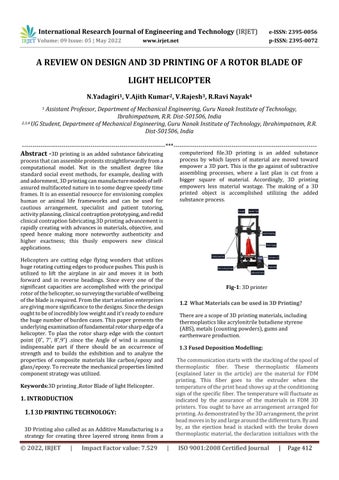
Fig-1: 3D printer 1.2 What Materials can be used in 3D Printing? There are a scope of 3D printing materials, including thermoplastics like acrylonitrile butadiene styrene (ABS), metals (counting powders), gums and earthenware production. 1.3 Fused Deposition Modelling: The communication starts with the stacking of the spool of thermoplastic fiber. These thermoplastic filaments (explained later in the article) are the material for FDM printing. This fiber goes to the extruder when the temperature of the print head shows up at the conditioning sign of the specific fiber. The temperature will fluctuate as indicated by the assurance of the materials in FDM 3D printers. You ought to have an arrangement arranged for printing. As demonstrated by the 3D arrangement, the print head moves in by and large around the different turn. By and by, as the ejection head is stacked with the broke down thermoplastic material, the declaration initializes with the
Keywords:3D printing ,Rotor Blade of light Helicopter.
1. INTRODUCTION
1.1 3D PRINTING TECHNOLOGY: 3D Printing also called as an Additive Manufacturing is a strategy for creating three layered strong items from a
© 2022, IRJET
|
Impact Factor value: 7.529
|
ISO 9001:2008 Certified Journal
|
Page 412