International Research Journal of Engineering and Technology (IRJET) e ISSN: 2395 0056

Volume: 09 Issue: 05 | May 2022 www.irjet.net p ISSN: 2395 0072
International Research Journal of Engineering and Technology (IRJET) e ISSN: 2395 0056
Volume: 09 Issue: 05 | May 2022 www.irjet.net p ISSN: 2395 0072
1,2,7,8
3,4,5,6
Abstract - This work is concerned with the analysis of building structure for the purpose of safety. Wind and earthquake both create dynamic action in the high rise buildings. But, the calculation for wind force and seismic force are distinctly different. The present paper considered three building models of G+10, G+15, and G+ 20 with the same plan area. Each building is subjected to different seismic zones and variations in soil type. The parameters selected are nodal displacement and bending moment. Results were traced in tabular format for all parameters value and observed against selected zone like V, IV, III and II with varying soil type. We know earthquake is a disaster causing event but wind may be more in some cases. This work is also concerned with the zone depending on the height of the building; where wind is more devastating than the earthquake
Key Words: High rise building, Static analysis, Seismic analysis, Nodal displacement, Bending moment, Wind analysis, STAAD PRO.
Humans are always fascinated with skyscraper or tall building. The tower of babel is the oldest mention of such multistoreybuilding.Theromanswerethefirsttobuildthe multistorey building but they are different enough from today’sconstruction andinsula in romanarchitecturewas suchaconstruction.WiththecompletionoftheLICBuilding inChennaiin1959,theeraofskyscrapersinIndiabegan.It wasthefirstskyscraperwith12floorsinitiallyinthecountry andremainedtallestinthecountryuntil1961whenitwas surpassedbythe25 storiedUshaKiranbuildinginMumbai. Inmoderncities,high risebuildingplaysveryimportantrole. Firstofall,tallbuildingmeetstherequirementofthemodern societyandsolvetheproblemoflimitationofconstruction siteresources.Toanalyzethehigh risebuildingsomeuseful software’slikeSTAADPro,ETABSetc.arewidelyusedbythe designers and researchers in this field. In traditional calculation of model of high rise building, the following factors affecting the earthquake design of structures are different seismic zones, damping factor of the structure, importanceofthebuilding,typeofsoil,naturalfrequencyof thebuilding,differentseismiczones,etc.
***
A. Purohit.et.al (2017) conducted a study on seismic analysisofg+12multistoreybuildingvaryingzoneandsoil type, where they have analyzed the behavior of a G+12 structure by STAAD pro software. They have conducted various test regarding Zone II and Zone V for soft and mediumsoilcases.A.Bhaskar.et.al(2020)conductedastudy onSeismicdesignandanalysisof(g+6)residentialbuildingin zone3&4usingSTAADPro.andultimatelycostestimationof thebuildinghasbeenchecked.Theywantedtoestimatesome parameters like steel percentage, maximum shear force, maximum bending moment, maximum deflection for different seismic zone. After the analysis they came to a conclusionthat(a)thestructureissafeinloadinglikedead load, wind load and seismic load. (b) member dimension (beam,column,slab,footing)arechangedbycalculatingthe loadtypeanditsquantityappliedonit.(c)theyfoundthatifa buildingisconvertingfromzone3tozone4thenifwetake 12.5%moresteelthebuildingwillalsobemaintainedinzone 4.(d)wefoundthatthereisa13.875%variationincostdue to change in the quantity of steel. V.Nagaraju.et.al (2016) conducted a study on Analysis and design of multistorey buildingunderdifferentloadcombination.Theyconcluded that, design and evaluation of the reinforced concrete buildingstructureforpreciseresultswithvariousloadsisa wideandcomplexproblemandproperdesignofstructure with valid results leads to better life and performance of structure under various load combinations. A.A. Wadekar.et.al. (2020) conducted a study on analysis and designofamultistoreybuildingbyusingSTAADproandthey concludedthatforthecalculationofdesignofreinforcement fortheconcretesection,STAADProplaysaneffectiverole. A.K.KADHUM.et.al(2018)hascarriedoutanevaluationon effect of seismic load on reinforced concrete multistorey buildingfromeconomicalpointofview,theyhaveconcluded thatwhenabuildingistakeninearthquakeconsiderationthe cost of building gradually increases. P. Singh.et.al (2017) performedastudyondesignandcomparisonofmultistoried building inall seismic zones. theyhave concluded that the baseshearobtainedbyresponsespectrumanalysisandalso comparisonofcosteffectivenessinallzones.Staticanalysisis not sufficient for high rise buildings and it’s necessary to providedynamicanalysis.
In this paper, analysis of G+10, G+15 and G+20 storey buildingsagainstseismicloadandwindloadasperIS:875 part(III)andIS1893part(I) 2002usingSTAADProhasbeen
International Research Journal of Engineering and Technology (IRJET) e ISSN: 2395 0056
Volume: 09 Issue: 05 | May 2022 www.irjet.net p ISSN: 2395 0072
conductedtocomparethemaximumnodaldisplacementand maximumbending momentofthestructures.Also,toevaluatethedominating nature of earthquake load and wind load according to the heightofthebuilding.Theplandimensionremainssamefor allthemodelsi.e.,15mX20m.Seismiczoneandsoiltypeof the structures was varied for each model. In the seismic
zoningmapgivenintheearthquakeresistantdesigncodeIS 1893(Part1)2002]assignsfourlevelsofseismicityforIndia intermsofzonefactors. Accordingtothat,hereweconsider four cities Visakhapatnam (Zone II), Kolkata (Zone III), Jamnagar(Zone IV),Shillong(Zone V)withaconstantwind speedof50m/s.Themodelsaresubjectedtodeadloads,live load, seismic load and wind load. The member forces are calculatedusingloadcombinationsasperIS456:2000.
Table 1: Descriptionofstructuralitemsrequiredforthedesignofmodels
Sl.no. Description StructuralProperties
1. Numberofstorey G+10 G+15 G+20
Floortofloorheight 3m 3m 3m
Plinthheight 0.6m 0.6m 0.6m
Sizeofcolumn FromGL to33.6m (0.4X0.5)m (0.6X0.65)m (0.7X0.8)m
From33.6to48.6m (0.25X0.35)m (0.3x0.5)m
From48.6to63.6m (0.3x0.4)m
International Research Journal of Engineering and Technology (IRJET) e ISSN: 2395 0056
Volume: 09 Issue: 05 | May 2022 www.irjet.net p ISSN: 2395 0072
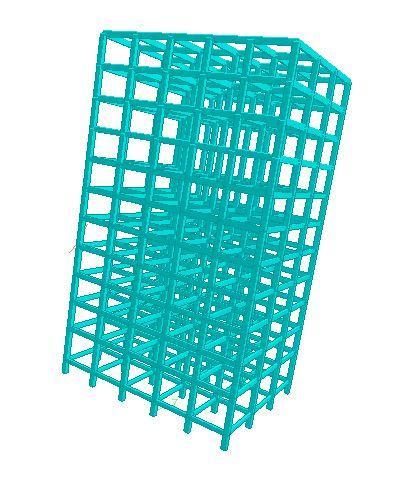
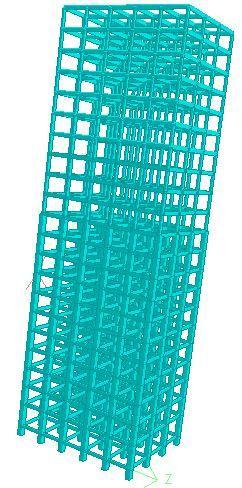
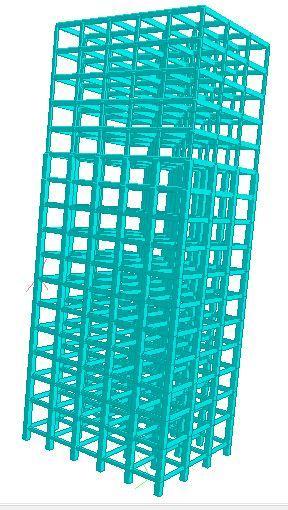
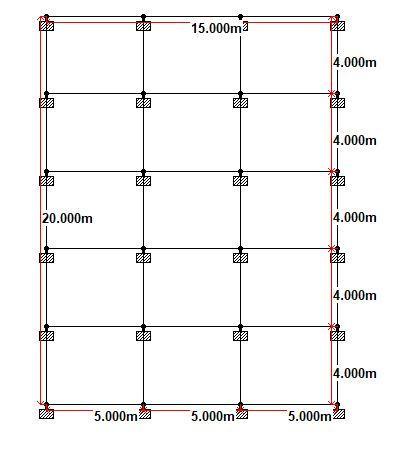
The plan and models for G+10, G+15 and G+20 storey buildingsbyusingSTAADProhasbeenshowninFigs.(1 4). Fig 1:Planofthemodels Fig 2:G+10structure
Fig -3:G+15structure Fig 4:G+20structure
International Research Journal of Engineering and Technology (IRJET) e ISSN: 2395 0056
Volume: 09 Issue: 05 | May 2022 www.irjet.net p ISSN: 2395 0072
4.1. Check for maximum nodal deflection under different soil condition
The details of the variation of nodal deflection with different storey for different load conditions and for differentseismiczoneshasbeentabulatedinTable5and Chart1respectively
Table 5 Variationofmaximumnodaldisplacement andloadconditionsfordifferentstoreyandzones
Zone Storey Max.Nodal displacement(mm) Load combination
II G+10 4599 15(DL+WL)
G+15 82.15 1.5(DL+WL)
G+20 12182 15(DL+WL)
III G+10 6128 15(DL+EL) G+15 9582 15(DL+EL)
G+20 12182 15(DL+WL)
IV G+10 9139 15(DL+EL)
G+15 14307 15(DL+EL)
G+20 165.80 1.5(DL+EL)
V G+10 13673 15(DL+EL) G+15 21417 15(DL+EL) G+20 24797 15(DL+EL)
The details of the variation of nodal deflection with different storey for different load conditions and for differentseismiczoneshasbeentabulatedinTable6and Chart2respectively.
Table 6 Variationofmaximumnodaldisplacement andloadconditionsfordifferentstoreyandzones
Zone Storey Max.Nodal displacement (mm)
Load combination
II G+10 5229 15(DL+EL)
G+15 8215 15(DL+WL)
G+20 121.82 1.5(DL+WL)
III G+10 8294 15(DL+EL)
G+15 129.82 1.5(DL+EL)
G+20 15050 15(DL+EL)
IV G+10 12402 15(DL+EL)
G+15 19425 15(DL+EL)
G+20 22493 15(DL+EL)
V G+10 185.77 1.5(DL+EL)
G+15 29108 15(DL+EL)
G+20 33693 15(DL+EL)
Chart 1:Variationofmaximumnodaldisplacements withseismiczonesfordifferentstorey
Case II: MediumSoilConditions
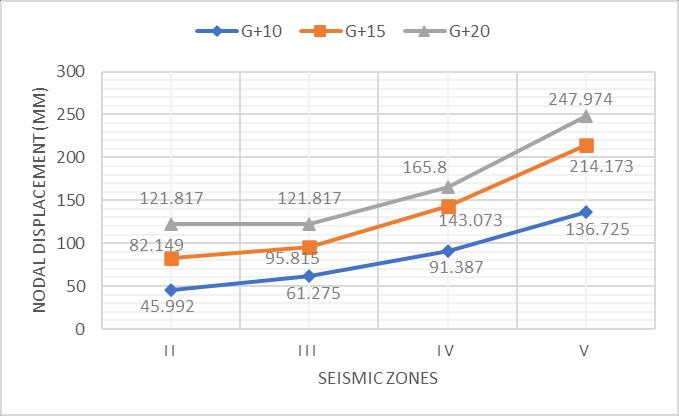
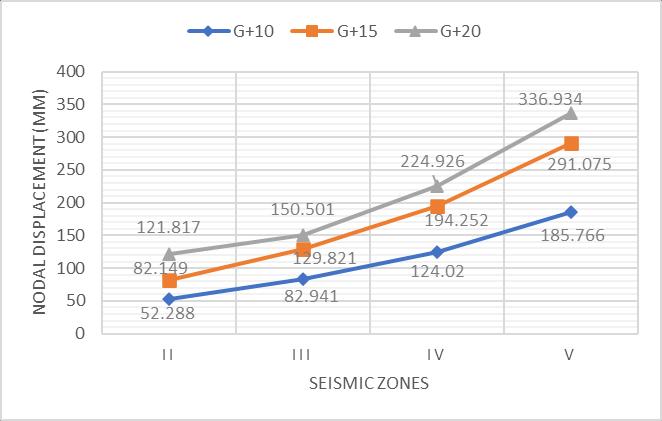
Chart 2:Variationofmaximumnodaldisplacements withseismiczonesfordifferentstorey
Case III: SoftSoilConditions
The details of the variation of nodal deflection with different storey for different load conditions and for differentseismiczoneshasbeentabulatedinTable7and Chart3respectively.
International Research Journal of Engineering and Technology (IRJET) e ISSN: 2395 0056
Volume: 09 Issue: 05 | May 2022 www.irjet.net p ISSN: 2395 0072
Table 7 Variationofmaximumnodaldisplacement andloadconditionsfordifferentstoreyandzones
Zone Storey Max.Nodal displacement (mm)
Loadcombination
II G+10 63.90 1.5(DL+EL)
G+15 9994 15(DL+EL)
G+20 12182 15(DL+WL)
III G+10 10165 15(DL+EL)
G+15 15918 15(DL+EL)
G+20 18440 15(DL+EL)
IV G+10 15216 15(DL+EL)
G+15 238.37 1.5(DL+EL)
G+20 27597 15(DL+EL)
V G+10 22804 15(DL+EL)
G+15 35734 15(DL+EL)
G+20 41357 15(DL+EL)
4.2. Check for maximum Bending Moment under different soil condition
Case IV: HardSoilConditions
The details of the variation of bending moment with different storey for different load conditions and for differentseismiczoneshasbeentabulatedinTable8and Chart4respectively.
Table 8 VariationofmaximumBendingmomentand loadconditionsfordifferentstoreyandzones
Zone Storey Max.Bending moment (KN m)
Loadcombination
II G+10 173.1 1.5(DL+WL)
G+15 238.7 1.5(DL+WL)
G+20 472.1 1.5(DL+WL)
III G+10 173.1 1.5(DL+WL)
G+15 238.7 1.5(DL+WL)
G+20 472.1 1.5(DL+WL)
IV G+10 209.5 1.2(DL+LL+EL)
G+15 280.7 1.5(DL+EL)
G+20 472.1 1.5(DL+WL)
V G+10 289.6 1.5(DL+EL)
G+15 420.8 1.5(DL+EL)
G+20 683.2 1.5(DL+EL)
Chart 3:Variationofmaximumnodaldisplacements withseismiczonesfordifferentstorey
FromtheaboveTables(5 7)&Charts(1 3),itisobserved that for different soil conditions with the increase of seismiczonesandtheheightofbuilding,maximumnodal displacementincreases.Itisalsoobservedthattherateof increase of nodal displacement for G+20 structure from seismic zone II to seismic zone III is linear and beyond seismiczoneIII,therateofincreaseofnodaldisplacement increases and for G+10 & G+15 the nodal displacement increases rapidly irrespective of zones for hard soil conditionsandforothertwoconditions(mediumandsoft) the rate of increase of nodal displacement increases rapidlyforG+10,G+15&G+20buildings.
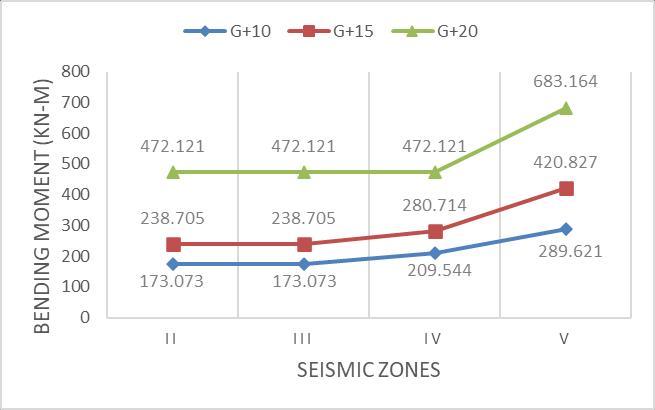
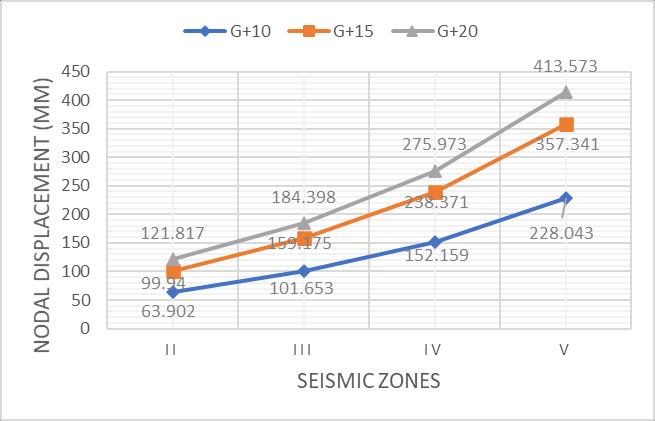
Chart 4:Variationofmaximumnodaldisplacements withseismiczonesfordifferentstorey
Case V: MediumSoilConditions
The details of the variation of bending moment with different storey for different load conditions and for
International Research Journal of Engineering and Technology (IRJET) e ISSN: 2395 0056
Volume: 09 Issue: 05 | May 2022 www.irjet.net p ISSN: 2395 0072
differentseismiczoneshasbeentabulatedinTable9and Chart5respectively.
Table 9 VariationofmaximumBendingmomentand loadconditionsfordifferentstoreyandzones
Zone Storey Max.Bending moment (KN m)
Loadcombination
II G+10 173.1 1.5(DL+WL)
G+15 238.7 1.5(DL+WL)
G+20 472.1 1.5(DL+WL)
III G+10 198.7 1.2(DL+LL+EL)
G+15 254.6 1.5(DL+EL)
G+20 472.1 1.5(DL+WL)
IV G+10 266.6 1.5(DL+EL)
G+15 381.6 1.5(DL+EL)
G+20 619.5 1.5(DL+EL)
V G+10 378.6 1.5(DL+EL)
G+15 572. 1.5(DL+EL)
G+20 928.7 1.5(DL+EL)
Zone Storey Max.Bending moment (KN m)
Loadcombination
II G+10 175.0 1.2(DL+LL+EL)
G+15 238.7 1.5(DL+WL)
G+20 472.1 1.5(DL+WL)
III G+10 198.7 1.2(DL+LL+EL)
G+15 254.6 1.5(DL+EL)
G+20 472.1 1.5(DL+WL)
IV G+10 317.7 1.5(DL+EL)
G+15 468.5 1.5(DL+EL)
G+20 760.5 1.5(DL+EL)
V G+10 455.2 1.5(DL+EL)
G+15 702.5 1.5(DL+EL)
G+20 1140.1 1.5(DL+EL)
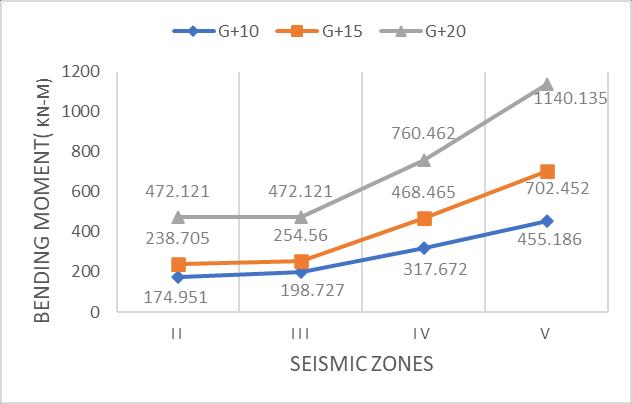
Chart 5:Variationofmaximumnodaldisplacements withseismiczonesfordifferentstorey
Case V
The details of the variation of bending moment with different storey for different load conditions and for differentseismiczoneshasbeentabulatedinTable10and Chart6respectively.
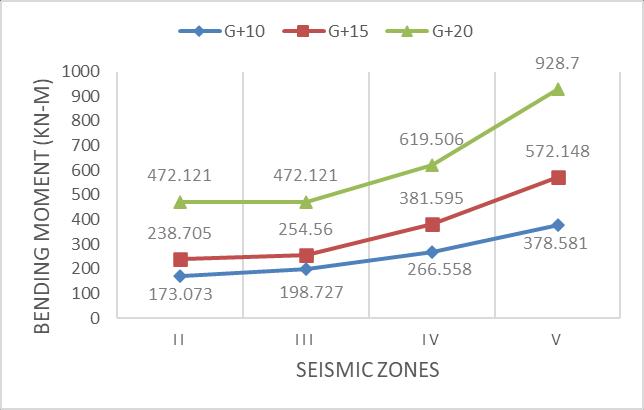
Fromtheabovetables&figures(8to10),itisobserved that for different soil conditions with the increase of seismic zones and the height of building, maximum bendingmomentincreases.Itisalsoobservedthattherate ofincreaseofbendingmomentforG+15,G+10buildings remainsconstantuptozoneIIIandbeyondthattherateof increase of bending moment increases rapidly and for G+20 building the rate of increase of bending moment remainconstantuptozoneIVandbeyondthattherateof increaseofbendingmomentincreasesrapidlyforhardsoil conditionsandforothertwoconditions(mediumandsoft) forG+20building therateofincreaseofbendingmoment remainconstantuptozoneIIIandbeyondthattherateof increase of bending moment increases rapidly and for G+10, G+15 buildings the rate of increase of bending momentincreasesrapidlywiththeincreaseofzones.
International Research Journal of Engineering and Technology (IRJET) e ISSN: 2395 0056
Volume: 09 Issue: 05 | May 2022 www.irjet.net p ISSN: 2395 0072
In this study, analysis of G+10, G+15 and G+20 storey buildingsagainstseismicloadandwindloadasperIS:875 part(III)andIS1893part(I) 2002usingSTAADProhas beenconductedtocomparethenodaldisplacementand bending moment of the structures. Also, to evaluate the dominating nature of earthquake load and wind load accordingtotheheightofthebuilding.
The conclusion drawn from the study of multistorey building under seismic & wind that one of the reasons behindthefailureisnodaldisplacement.Itisobservedthat the dominating factor load combination for zone II (Visakhapatnam) is wind not the seismic for a constant wind speed of 50 m/s. But for zone III (Kolkata), IV (Jamnagar)&V(Shilong)thedominatingfactorisseismic notthewindforthesamewindspeedi.e.,50m/s.Anditis also observed that if the soil type changes from hard, medium to soft, the maximum nodal deflection and bendingmomentalsochangescorrespondingtotheheight of building. There are few cases where for maximum bending moment is occurring due to wind but the maximum deflection occurs due to seismic. Generally, always we go for the seismic analysis but wind is also importantfortheR.C.Cbuilding.
[1] Ankit Purohit (2017): "Seismic Analysis of G+12 Multistory Building Varying Zone and Soil Type" Volume 4,Issue 6.
[2] AnkitBhaskar(2020)“Seismicdesignandanalysisof (G+6) residential building in zone 3&4 using STAAD proandit’scostestimation”Volume 7,Issue 6.
[3] V. Nagaraju (2016): “Analysis and design of multi storey building under load combination” Volume 5, Issue 3.
[4] AdhirajA.Wadekar(2020):“Analysisanddesignofa multi storeybuildingbyusingSTAADpro”Volume 8, Issue 4.
[5] Ali Kifah Kadhum (2018): “Effect of seismic load on reinforced concrete multistory building from economicalpointofview”Volume 9,Issue 11.
[6] Preeti Singh (2017): “Design and comparison of multistoriedbuildinginallseismiczones”Volume 5, Issue 4.
[7] IS:456 2000:Indianstandardcodeofpracticeforplain andreinforcedconcrete.
[8] IS:875(part1)1987:codeofpracticeforDesignloads (otherthanearthquake)Forbuildingsandstructures Part1deadloads unitweightsofbuildingmaterials andStoredmaterials(secondrevision).
[9] IS: 875 (part 2) 1987: Code of practice (other than earthquake)part2:imposedloads(Secondrevision)
[10]IS:875(part3) 2015:CodeofpracticeforDesignloads (otherthanearthquake)Forbuildingsandstructures Part3Windloads(Thirdrevision)
2022, IRJET | Impact Factor value: 7.529 | ISO 9001:2008 Certified