
Partial Replacement of Cement with brick Dust in concrete

Page 1

International Research Journal of Engineering and Technology (IRJET)

e-ISSN: 2395-0056

Volume: 09 Issue: 05 | May 2022

p-ISSN: 2395-0072

www.irjet.net

Partial Replacement of Cement with brick Dust in concrete Mohd Azam1 , Mohd Tayyab2, Shadab Ali3 , Naim 4, RK Jain5 B Tech Students, 5Professor, Department of Civil Engineering, Teerthanker Mahaveer University, Moradabad ---------------------------------------------------------------------***--------------------------------------------------------------------2.1 CONCRETE Abstract - Construction is the key for the development of 1.2.3.4

any Nation. Cement is the most widely used construction material on the earth after water. The production of one thousand Kg of cement releases approximately 870Kg of CO 2 in the atmosphere. This further pollutes the environment .It contributes about 4% of global total CO 2 emissions from fuel use and industrial activities6 Some of the pozzolonic materials viz. fly–ash, brick powder, marble dust etc. are found to be possessing cementitious properties, hence the use of these waste materials can replace the cement by some percentage without compromising the strength and workability of cement. The reduction in the quantity of cement will reduce CO 2 content in the atmosphere, thereby saving the environment and our mother earth. The aim of this research is to investigate the feasibility of using Waste brick powder (WBP) 4 successfully in concrete as a substitute of cement. The replacement levels were kept at 5%, 10% and 15%, compared to the reference concrete. The tests on concrete include slump and compressive strength tests. Results show an increase in workability and decrease in compressive strength after certain percentage of brick dust

Freshly mixed concrete can be moulded into any shape. The various ingredients of concrete are the cement, water aggregate mixed together in a particular proportion to control the properties of concrete in the wet as dry state. The obtained result is a hardened mass with filler and pores

2.2 CEMENT: Cement in general sense is a cohesive as

well as adhesive material which binds together particles of solid matter into a compact durable mass. For our project work, 43-grade Ordinary Portland Cement (OPC) was used.

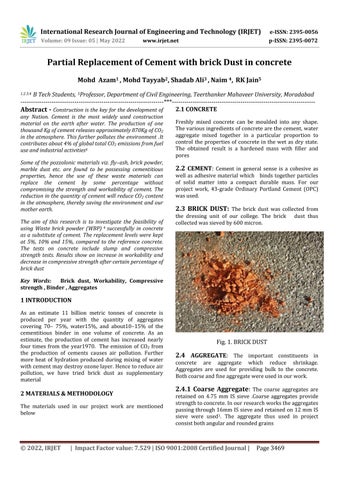
2.3 BRICK DUST: The brick dust was collected from the dressing unit of our college. The brick collected was sieved by 600 micron.

dust thus

Key Words: Brick dust, Workability, Compressive strength , Binder , Aggregates

1 INTRODUCTION As an estimate 11 billion metric tonnes of concrete is produced per year with the quantity of aggregates covering 70– 75%, water15%, and about10–15% of the cementitious binder in one volume of concrete. As an estimate, the production of cement has increased nearly four times from the year1970. The emission of CO2 from the production of cements causes air pollution. Further more heat of hydration produced during mixing of water with cement may destroy ozone layer. Hence to reduce air pollution, we have tried brick dust as supplementary material

2 MATERIALS & METHODOLOGY The materials used in our project work are mentioned below

© 2022, IRJET

Fig. 1. BRICK DUST

2.4 AGGREGATE: The important constituents in concrete are aggregate which reduce shrinkage. Aggregates are used for providing bulk to the concrete. Both coarse and fine aggregate were used in our work.

2.4.1 Coarse Aggregate: The coarse aggregates are

retained on 4.75 mm IS sieve .Coarse aggregates provide strength to concrete. In our research works the aggregates passing through 16mm IS sieve and retained on 12 mm IS sieve were used1. The aggregate thus used in project consist both angular and rounded grains

| Impact Factor value: 7.529 | ISO 9001:2008 Certified Journal |

Page 3469


Turn static files into dynamic content formats.
Create a flipbook