
Assessment of Urban void space – A case of the west zone, Surat city

Page 1

International Research Journal of Engineering and Technology (IRJET)

e-ISSN: 2395-0056

Volume: 09 Issue: 05 | May 2022

p-ISSN: 2395-0072

www.irjet.net

Assessment of Urban void space – A case of the west zone, Surat city Raj G. Patel1, Zarana H.Gandhi2 1Pursuing

M.E. in Town and Country Planning, Sarvajanik College of Engineering and Technology, Surat, India Assistant Professor, Sarvajanik College of Engineering and Technology, Surat, India ---------------------------------------------------------------------***--------------------------------------------------------------------2. CRITERIA FOR SELECTING VOID SPACE Abstract - Many cities have recently experienced urban 2Ad-hoc

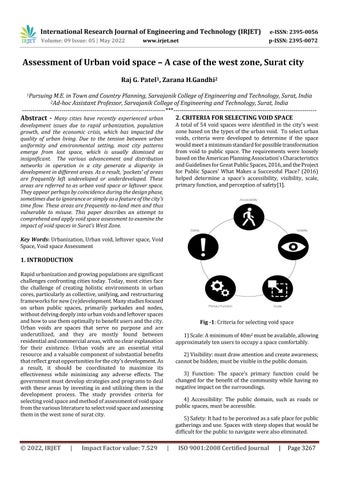
A total of 54 void spaces were identified in the city's west zone based on the types of the urban void. To select urban voids, criteria were developed to determine if the space would meet a minimum standard for possible transformation from void to public space. The requirements were loosely based on the American Planning Association's Characteristics and Guidelines for Great Public Spaces, 2016, and the Project for Public Spaces' What Makes a Successful Place? (2016) helped determine a space's accessibility, visibility, scale, primary function, and perception of safety[1].

development issues due to rapid urbanization, population growth, and the economic crisis, which has impacted the quality of urban living. Due to the tension between urban uniformity and environmental setting, most city patterns emerge from lost space, which is usually dismissed as insignificant. The various advancement and distribution networks in operation in a city generate a disparity in development in different areas. As a result, 'pockets' of areas are frequently left undeveloped or underdeveloped. These areas are referred to as urban void space or leftover space. They appear perhaps by coincidence during the design phase, sometimes due to ignorance or simply as a feature of the city's time flow. These areas are frequently no-land men and thus vulnerable to misuse. This paper describes an attempt to comprehend and apply void space assessment to examine the impact of void spaces in Surat's West Zone. Key Words: Urbanization, Urban void, leftover space, Void Space, Void space Assessment

1. INTRODUCTION Rapid urbanization and growing populations are significant challenges confronting cities today. Today, most cities face the challenge of creating holistic environments in urban cores, particularly as collective, unifying, and restructuring frameworks for new (re)development. Many studies focused on urban public spaces, primarily parkades and nodes, without delving deeply into urban voids and leftover spaces and how to use them optimally to benefit users and the city. Urban voids are spaces that serve no purpose and are underutilized, and they are mostly found between residential and commercial areas, with no clear explanation for their existence. Urban voids are an essential vital resource and a valuable component of substantial benefits that reflect great opportunities for the city's development. As a result, it should be coordinated to maximize its effectiveness while minimizing any adverse effects. The government must develop strategies and programs to deal with these areas by investing in and utilizing them in the development process. The study provides criteria for selecting void space and method of assessment of void space from the various literature to select void space and assessing them in the west zone of surat city.

© 2022, IRJET

|

Impact Factor value: 7.529

Fig -1: Criteria for selecting void space 1) Scale: A minimum of 40m2 must be available, allowing approximately ten users to occupy a space comfortably. 2) Visibility: must draw attention and create awareness; cannot be hidden; must be visible in the public domain. 3) Function: The space's primary function could be changed for the benefit of the community while having no negative impact on the surroundings. 4) Accessibility: The public domain, such as roads or public spaces, must be accessible. 5) Safety: It had to be perceived as a safe place for public gatherings and use. Spaces with steep slopes that would be difficult for the public to navigate were also eliminated.

|

ISO 9001:2008 Certified Journal

|

Page 3267


Turn static files into dynamic content formats.
Create a flipbook