International Research Journal of Engineering and Technology (IRJET) e ISSN: 2395 0056

Volume: 09 Issue: 05 | May 2022 www.irjet.net p ISSN: 2395 0072
International Research Journal of Engineering and Technology (IRJET) e ISSN: 2395 0056
Volume: 09 Issue: 05 | May 2022 www.irjet.net p ISSN: 2395 0072
1Post graduate student Department of Civil Engineering, KJ College of Engineering & Management Research, Pune 411048, India
2Associate Professor Department of civil engineering, KJ College of Engineering & Management Research, Pune 411048, India ***
Abstract Manysteelstructures are made ofstandardsteel sections designed and built in the traditional way. It leads to complex and expensive structures. Tubular steel sections are the best choice ofconventionaloneswithusefulpropertiesand relatively good. In this study analysis and design of 13 story industrial steel structure with conventional sections and tubular sections. A irregular floor plan at each floor is considered For modellingandanalysis ofstructuralmembers STAAD PRO V8i software is used. All structural members are designed as per IS code considering all load combinations. Static analysis and Time history analysis considered for seismic analysis and design of the structure. Comparison of analysis results on the basis of base shear, top story displacement, weight of structure. From the above study of analysis of conventional and tubular structure. It is understandable that tubular section is highly effective than conventional section that are subjected to lateral loading, to resist overall displacement and overall economy around 12 15% is achieved.
Key Words: Tall steel building, Time history analysis, Static analysis, Conventional section, Tube section, STAAD Pro V8i
Population growth in urban societies and the continued constantpressureoflandhaveledtotheemergenceofvery high risebuildings.Tallbuildingsareconsideredasymbolof civilization. From a structural point of view, these are structures where their height will be affected by lateral forcesduetowindloadsandearthquakesuntilsuchpower willplayamajorroleinthedesignmethod.Theconstruction of high quality buildings is a challenging undertaking by professionals and engineers. In order to build a tall structure,onehastothinkaboutaprojecttobuilditsown design based entirely on limited design and analytical analysis.
As high rise buildings have greater prestige around the world, their impact on society and the economy is felt worldwide.Overtime,newbarrierstohigh riseconstruction are accompanied by growing demands for efficiency, efficiency,andeconomicstructure.Designersareconcerned aboutchoosingconstructionplansthatcancarryextraloads
as well as the availability of service and comfort requirements. The economic life of tall buildings depends largelyontheusabilityandeaseoflivingasarequirement. Typically, tall buildings are constructed to withstand extremely strong winds over a long period of time. The chancesofcatastrophicfailureareslim;however,studiesof wind movement and effects on high rise buildings are important from a service and economic perspective. The performance of tall buildings under wind is usually measured by the amount of side displacement and acceleration.Excesslateralremovalcancausestructuraland non structuraldamage,whileexcessiveaccelerationcanlead toimproperpostureofoccupants.
Common methods of construction have been found in the past,whichrestrictedbuildingstouptofivestoreys.These smallstructuresareoftenconsideredtobetheirstrengthto withstand horizontal loads and are designed for gravity. However, in tall buildings the gravitational load system cannotwithstandhorizontalforceeffectively.Therewasa needforsuchatypeofstructuralsystemthatcouldmeetthe requirements to withstand all types of liability from an economicpointofview.
TheconventionalsteelsectionsinIndiaareverycommonin industrialconstruction.Conventionalbuildingsarebuildings thatarebuiltusingthestandardmethodsofconstruction.It involvestraditionalconstructionmaterialsandstayswithin aparticularsetofparameters.Conventionalsteelstructure areoftenfabricatedonsite.Conventionalsteelstructuresare averycommonindustrialconstruction.Hotrolledsections are used as primary members, twist and buckling is less likely to occur for a well designed structure. Due to this structures have simple connections which makes steel structuredesigneasy.Hotrolledsectionsinmanysegments are much heavier than what is actually required as per design.Costishigherduetohigherconsumptionofsteel.
Thetubeisthenamegiventothesystemswhereinorderto resist lateral loads like wind, seismic, etc. A building is designedtoathree dimensionaltube,perpendiculartothe
International Research Journal of Engineering and Technology (IRJET) e ISSN: 2395 0056
ground.FazlurRahmanKhanintroducedthissystem.Tube frame construction was first used in the DeWitt Chestnut Apartment Building, designed by Khan and completed in Chicagoin1963.Thesystemcanbeconstructedusingsteel, concrete, or both steel and concrete (composite construction).Itcanbeusedforoffice,apartmentandmixed usebuildings.
The aim of this paper is to improve the structural performance and cost effectiveness in design of tall steel building
The dissertation work is done to achieve the following objectives
1. ModelingtwotallbuildingusingStaadProsoftware.
a) Byusingconvictionalsections.
b) Byusingtubesections.
2. Studythestructuralbehaviorofsteelbuildingunder differentloadconditionlikegravityload,windload andseismicloadasperIS 875(2015)part1to4and IS 1893(2016)part1&4.
3. Study the influence of lateral loads on the performanceoftallbuilding.
4. Resultcomparisonofbuilding.
In this present study, (G+13) story Steel Industrial Tall Building.ThemodelingworkisdoneinSTAADPROV8i.The building is situated in Seismic Zone II with the following seismic, sectional and material properties. The model consists of various elements such as beams, columns, for checkingtheperformanceagainsttheacceptancecriteria.
Heightofbuilding 37.4m
Typeofstructure Steel Lengthofstructure 10m Widthofstructure 8.4m No.ofcolumn 9
Location Koppal,KA
Seismiczone II Zonefactor 0.1
Importancefactor 1.5 Response reductionfactor 4 %Damping 2% Windspeed 39m/s
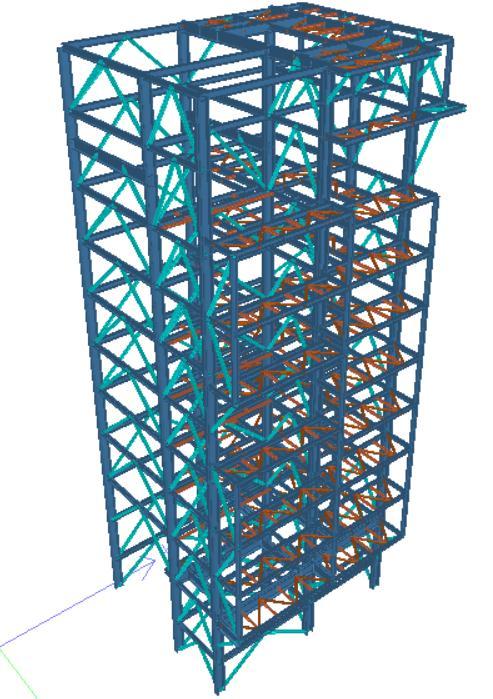
Fig 1:3Dviewofstructure
Theanalysisanddesignof13storyindustrialsteelstructure withconventionalsectionsandtubularsections.Airregular floorplanateachfloorisconsidered. TheSTAADPROV8i software is used to model and analyze structural components. All members of the structure are designed according to IS 800: 2007 consider all load combinations. Time history analysis and static analysis considered for
Volume: 09 Issue: 05 | May 2022 www.irjet.net p ISSN: 2395 0072 © 2022, IRJET | Impact Factor value: 7.529 | ISO 9001:2008 Certified Journal | Page2972
International Research Journal of Engineering and Technology (IRJET) e ISSN: 2395 0056
Volume: 09 Issue: 05 | May 2022 www.irjet.net p ISSN: 2395 0072
seismicanalysisanddesignofthestructure.Comparisonof analysis results on the basis of base shear, top story displacement,weightofstructure.
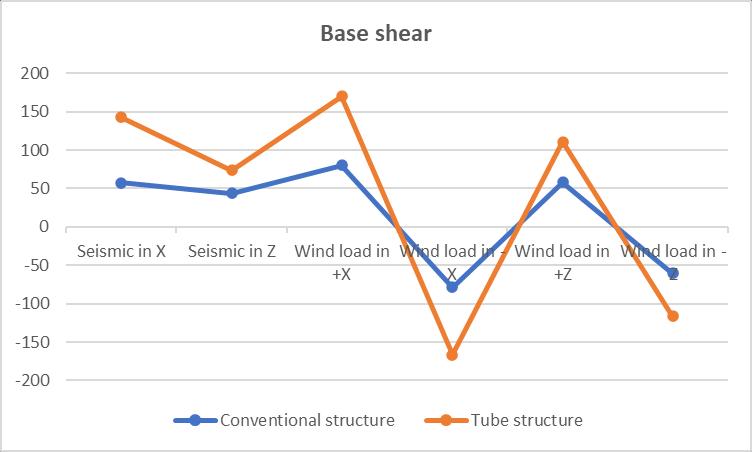
BaseShear(KN)
Sr. No. Loadcase Conventional structure Tube structure
1 SeismicinX 47.469 51.144 2 SeismicinZ 28.632 25.716 3 Windloadin+X 80.26 89.776 4 Windloadin X 78.661 88.176 5 Windloadin+Z 57.716 52.946 6 Windloadin Z 60.332 56.229
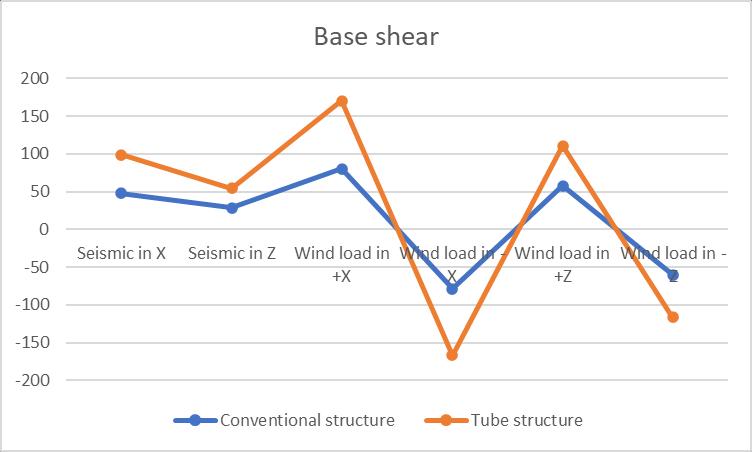
Table 3: BaseShearValues DynamicTimeHistory 4.3 Maximum Story Displacement Static Analysis
BaseShear(KN)
Sr. No. Loadcase Conventional structure Tube structure 1 SeismicinX 57.281 85.562 2 SeismicinZ 43.451 29.862 3 Windloadin+X 80.26 89.776 4 Windloadin X 78.661 88.176 5 Windloadin+Z 57.716 52.946 6 Windloadin Z 60.332 56.229
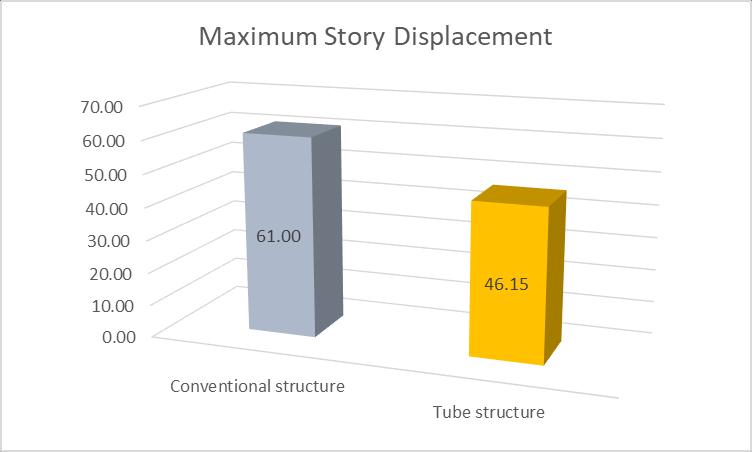
Chart 3:MaximumStoryDisplacement StaticAnalysis
PeakDisplacementValues(mm) Sr.No. Permissible limit Conventional structure Tube structure 1 99.08 61.00 46.15
Table 4: Maximum Story Displacement Values Static Analysis
4.4 Maximum Story Displacement Dynamic Time History
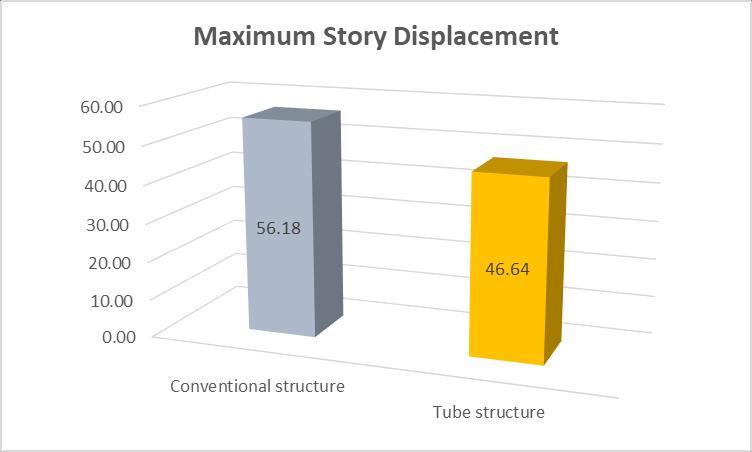
Chart -4:MaximumStoryDisplacement DynamicTime History
International Research Journal of Engineering and Technology (IRJET) e ISSN: 2395 0056
PeakDisplacementValues(mm)
Sr.No. Permissible limit Conventional structure Tube structure
1 99.08 56.18 46.64
Table -5: MaximumStoryDisplacementValues Dynamic TimeHistory
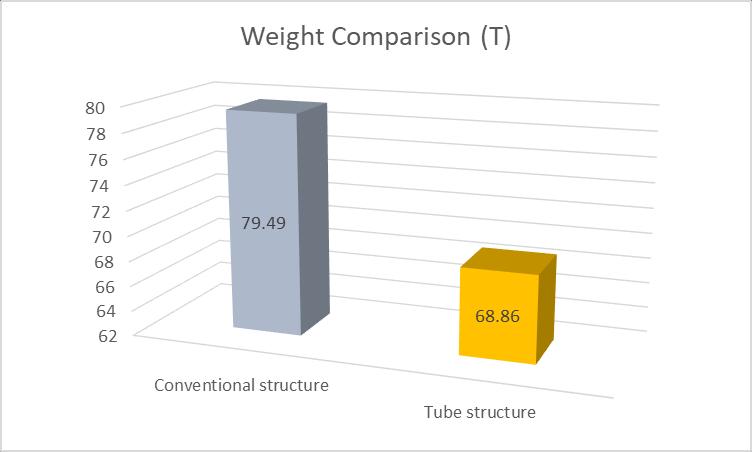
4.5 Weight Comparison in Tons
Chart 5:WeightComparison
WeightComparison(T)
Sr.No. Conventionalstructure Tubestructure
1 79.49 68.86
Table -6: WeightComparisonValues
From the above mentioned analysis of conventional and tubular structure. It is understandable that the tubular systemishighlyeffectivethanconventionalsystemthatare subjectedtolateralloadings.Thefollowingdiscussionhas beenmadefromthepresentstudy.
Fromthemodularinvestigationitcanbeinferredthat,steel tube structures are more adaptable than regular conventionalsteelstructure.
The tubular system is effective to resist the overall displacementthanconventionalsystem.
Above study reveals that tubular sections prove to be economical. Total saving of almost 12 15 % in cost is achieved. Tubular phase performance can be verified in differentpartsofthesystem.Membersofalargerstructure that are unsupported can be assigned to tubular sections thatwillbenefittheentireeconomy.
The authors acknowledge Dr Atul B. Pujari associate professorincivilengineeringdepartment,KJ’seducational institute, KJ college of engineering and management research, Pune, Maharashtra for providing the necessary facilitiesforthecompletionofthisresearchwork.
[1] RakeshR.Nora,UmarfarukhD.Masud,MaskeRaviG. “Comparison between Conventional (Angular) Steel Section and Tubular Steel Section", "International Research Journal of Engineering", Volume No.4, Issue No.10, pp : 539 541, ISSN:2319 6890)(online),2347 5013(print) 01 Oct. 2015 M. Young, The Technical Writer’sHandbook.MillValley,CA:UniversityScience, 1989.
[2] M.G.Kalyanshetti, G.S. Mirajkar “Comparison Between Conventional Steel Structures And Tubular Steel Structures", " International Journal of Engineering Research and Applications (IJERA)", Vol. 2, Issue 6, November December2012,pp.1460 1464ISSN:2248 9622
[3] Sourabh Dhiman1, Nirbhay Thakur2, Nitish Kumar Sharma3“AReviewonBehaviourofColumnsof Steel Framed Structure with Various Steel Sections", "International Research Journal of Engineering and Technology(IRJET)",Volume:06Issue:03|Mar2019 ISSN:2395 0056p ISSN:2395 0072
[4] MananD.Maisuri1,HiteshK.Dhameliya2,HitenL.Kheni3 “Review Of Comparison Between Conventional Steel And Tubular Steel Section For Multi Span Industrial Shed With Truss And Portal Frame", "international Journal of Advance Engineering and Research Development",Volume1,Issue12,December 2014e ISSN(O):2348 4470p ISSN(P):2348 6406
[5] JagadishJ.S[1],TejasD.Doshi[2],“AStudyOnBracing SystemsOnHighRiseSteelStructures","International JournalofEngineeringResearch&Technology(IJERT)", Vol.2Issue7,July 2013ISSN:2278 0181
[6] DhrubajyotiBorthakur1,Dr.(Mrs)NayanmoniChetia2, “A Study on the Effectiveness of Bracing System for Lateral loading", International Journal of Advanced Engineering Research and Science (IJAERS)", [Vol 3, Issue 4,Apr 2016]ISSN:2349 6495
[7] Farhat Aziz Sheen1 , Dr. Md. Monjur Hossain2 , Asma Ferdous1andArifurRahman1,“ComparativeStudyfor Different Bracing Systems of an Irregular Steel Structure.", International Conference on Structural
Volume: 09 Issue: 05 | May 2022 www.irjet.net p ISSN: 2395 0072 © 2022, IRJET | Impact Factor value: 7.529 | ISO 9001:2008 Certified Journal | Page2974
International Research Journal of Engineering and Technology (IRJET) e ISSN: 2395 0056
Volume: 09 Issue: 05 | May 2022 www.irjet.net p ISSN: 2395 0072
Engineering Research (iCSER2019) 19 22 Jan 2019, Dhaka,BangladeshISBN:978 0 6482681 2 3
[8] Md. Ahasan ul Haque 1 , Md. Atik Masum2 , Md. Muhtadi Ratul3 , Zasiah Tafheem, “Effect Of Different BracingSystemsOnTheStructuralPerformanceOfSteel Building",InternationalConferenceonCivilEngineering for Sustainable Development (ICCESD 2018), 9~11 February2018,KUET,Khulna,Bangladesh(ISBN 978 984 34 3502 6)
[9] Tahmina Tasnim Nahar1 , Md. Motiur Rahman2, “Performance of Different Bracing System on DisplacementofFirstSoftStoriedSteelBuildingunder SeismicLoad",InternationalJournalforReseaArchin Applied Science & Engineering Technology (IJRASET) ISSN: 2321 9653; IC Value: 45.98; SJ Impact Factor:6.887Volume5IssueIX,September2017
[10] NicolaLongarini,1LuigiCabras,2MarcoZucca,1Suvash Chapain,3 and Aly Mousaad Aly3, “Structural Improvements for Tall Buildings under Wind Loads: Comparative Study", Hindawi Shock and Vibration Volume2017,ArticleID2031248.
[11] IS875(PartI) 1987:DeadLoads.Codeforpracticeof designloads(otherthanearthquake)forbuildingsand structures.
[12] IS875(PartII) 1987:LiveLoads.Codeofpracticefor designloads(otherthanearthquake)ofbuildingsand structures.
[13] IS875(PartIII) 1987:WindLoads.Codeofpracticefor design loads (other than earthquake) of the buildings andstructures.
[14] IS 800:2007 Code of Practice (Third Revision) for GeneralConstructioninSteel.
Saurabh Rajendra More Post graduate student Department of Civil Engineering, KJ College of Engineering & Management Research,Pune411048

Dr Atul B. Pujari Associate Professor Department of civil engineering, KJ College of Engineering & Management Research,Pune411048

© 2022, IRJET | Impact Factor value: 7.529 | ISO 9001:2008 Certified Journal |