International Research Journal of Engineering and Technology (IRJET) e ISSN: 2395 0056
Volume: 09 Issue: 05 | May 2022 www.irjet.net p ISSN: 2395 0072
International Research Journal of Engineering and Technology (IRJET) e ISSN: 2395 0056
Volume: 09 Issue: 05 | May 2022 www.irjet.net p ISSN: 2395 0072
Raina1, Pratik Savale2 , Sonali Hankar3 , Shital Wanave4 , Prof. Soniya Dhotre5
1,2,3,4 Student, Dept. of Information Technology, Jayawantrao Sawant College of Engineering, Hadapsar Pune, Maharashtra 411028, India
5Assistant Professor, Dept. of Information Technology, Jayawantrao Sawant College of Engineering, Hadapsar Pune, Maharashtra, India. ***
Abstract Covid 19, an infectious illness that first emerged in Wuhan, China, in December 2019, has claimed the lives of a large number of individuals throughout the world by hurting their mental and physical health. It has shaken the global economy adding to being harmful to public health. Given the virus's fast transmission, an effective and timely way of detecting and diagnosing the illness is required. Radiology is another discipline of medicine that aids in the diagnosis of individuals with coronavirus symptoms. Our work intends to carry out the task of diagnosing the disease using radiography pictures of the human chest, with inspiration and understanding from numerous studies. The purpose of this work was to show how deep learning can be used to achieve great accuracy. COVID 19 detection utilising X ray images of the chest. The research comprised the training of deep learning and machine learning classifiers using publicly accessible X ray pictures (1583 healthy, 4292 pneumonia, and 225 verified COVID 19).
Coronavirus disease (COVID 19) is a newly found viral infectious disease. Many people all across the world have beenaffectedbyit.Itis basicallydividedinto3phases. In very first phase people have symptoms of fever accompanied with the body pain,fatigueanda dry cough. In second phase they might have loss of taste or smell, a sore throat, diarrhea, types of skin rashes. In third phase they will have breathshortness,a loss of appetite,a chest painbesideshighfevertoo.Themajorityofthoseinfected with the COVID 19 virus will develop mild to severe respiratory illness and recover without any additional treatment.Diseasesthatmightcauseasevereillnessinthe elderly and individuals with underlying health problems such as chronic respiratory disease, diabetes, and heart disease. It affects in different ways to different people. Many people can recover from mild to moderate sickness without any treatment. There have been manycompanies who tried to takeout many possible solutions to test corona virus affected persons but as the most of the solutions were manual it took 2 3 days time to take out theresults.Thencompaniestriedtousedigitalmethodsto
detect the corona virus. As the number of corona virus patientshadbeenincreasingdaybyday,weneededafast and an efficient method to diagnose a patient and where ArtificialIntelligenceisthebestsolutionfordiagnosis.ML isuseful itcangivea setof imagestogetherandthe more accurateresultstoo.Onlyonceweneedtotrainourmodel on a dataset and we can then use it for corona virus classification. Many people across the globe have developed many models for corona virus detection using machinelearninganddeeplearningalgorithms.Theyhave achieved a good accuracy too. But the main focus of our modelistodevelopaCNNmodelwhichiscomputationally efficientandgivesagoodaccuracyonsmallerdatasettoo. It was difficult earlier to find a dataset of Chest X Ray images of COVID 19 patients. With the help of this model, we would be able to detect the corona virus even if we have a smaller number of datasets. CNN is complicated, and its only flaw is that it requires a large number of datasets for training, yet it is excellent at classification. CNN is complicated, and its only flaw is that it requires a large number of datasets for training, yet it is excellent at classification. Each trained neural network learns about the task under consideration. While the basic goal of artificial neural networks is to mimic human behaviour and intellect, transfer learning allows them to apply the accumulated knowledge of one task to another. Deep learning for image recognition applications can learn millions of photos, and various large models with diverse architectureshavebeentrained.
Tulin et al. [1] developed an automatic model for COVID 19 detection by using Chest X ay images. Under this model they did two types of classification i.e., Binary classification (contained images of COVID and No Findings) and Multi class classification (contained images of COVID, Pneumonia and No Findings).They employed a DarkNet model as a classifier for "You Only Look Once" (YOLO), a real time object identification system, in their research. They used 17 layers of convolutional. They achieved accuracy about 98.08% for binary classification and87.02%formulti classclassification.
2022, IRJET | Impact Factor value: 7.529 | ISO 9001:2008 Certified Journal

International Research Journal of Engineering and Technology (IRJET) e ISSN: 2395 0056
Volume: 09 Issue: 05 | May 2022 www.irjet.net p ISSN: 2395 0072
Khan et al. [2] in his paper proposed a model named "CoroNet," which is a CNN model for COVID 19 diagnosis usingradiographyimagesofchest.Thesolutionproposed is based on the "Xception Architecture," which is a pre trainedmodel usingtheImageNetdataset.Itistrainedon adatasetthathasbeengatheredfromthevariouspublicly accessible databases for the research purpose. The averagemodelresultratehasbeen89.6%.The recalland precision rate of COVID 19 cases is as follows: 93% and 98.2% for 4 classes (normal vs COVID vs. pneumonia bacterial vs. pneumonia viral). For the 3 class classification (COVID vs. Pneumonia vs. normal), classificationperformanceachievedis95%.
Alazabetal.[3]inhispapertriedtofindCOVID19with thehelpofCOVID19X Rayimages.TheyusedChestX Ray images because they are easily available at a low price. Short term Memory Neural Network (LSTM), Autoregressive Integrated Moving Average (ARIMA) model, and The Prophet Algorithm were employed for detection(PA).Theyweresuccessfullyabletoachieve95 99% F Score. The PA gave the overall best performance. For COVID19 confirmation and recoveries they achieved 99.94% and 90.29% respectively. Shelke et al. [4] in her paper did the classification on chest X ray’s images and designedaclassificationmodelwhichfocusedonaccurate diagnosis of COVID 19. Their dataset contained the chest X ray’s images that were divided into 4 classes, are as follows:Tuberculosis (TB), Pneumonia,COVID 19andthe Normal. They used VGG16 model which achieved the precisionof95.9%.
Asif et al [5] in her paper tried the detection of COVID19 pneumonia automatically in the patients using chest x ray imaging while improving the accuracy in detection using deep convolutional neural networks (DCNN). The dataset contained images Normal Chest X ray, Viral Pneumonia and COVID 19 pictures as follows: 864 of the COVID19, 1345 of the Viral Pneumonia and 1341ofNormalchestx rayimages.Inthistheyhaveused deep convolutional neural networks based model that is, Inception V3 with the transfer learning for the detection. And they achieved a classification accuracy of more than 98%(wherethetrainingaccuracywas97%andvalidation accuracywas93%).
Artificial intelligence (AI) is a wide ranging branch of computer science concerned with building smart machines capable of performing tasks thatrequire the human intelligence. AI is an interdisciplinary science with the multiple approaches. The advancements inmachine learningand the deep learningare creating a paradigm shift, virtually in every sector of thetech industry.
Four different approaches that have historically defined thefieldofAIare:
● Thinkinghumanly
● Thinkingrationally
● Actinghumanly
● Actingrationally
Convolutional Neural Network:
Recently, CNNs are the most studied machine learning (ML) algorithms for the medical lesions diagnosis using images. The justification behind this is that CNNs retain complex features while scanning input images. As stated above, spatial relationships are of primary importance in radiology,suchashowthebonejoinsthemuscle,orwhere thestandardlungtissueinterfaceswithinfectedcells.
Sr. No. Title Methodology Pros & Cons
1. Automated Detectionof Covid 19 Cases using Deep Neural Networks with X Rays Images.
This paper aims to apply deep learning algorithms technique on dataset developed by cohen JP. CNN algorithms with Naïve Bayes classifier for the performance improvement is used in presence of YOLO technique
Pros: 1) Easy to use. 2)Easy to implement Cons: Large Non public dataset required.
2. Covid 19 Detection and Diagnosis Using a Deep Neural Network from Chest X Ray and Diagnosisof Covid 19
In this paper they propose CoroNet, a deep convolution neural network model to automatically detect COVID 19 infection from chest X
Pros: Pre trained network.
Cons: Take time to train.
International Research Journal of Engineering and Technology (IRJET)
e ISSN: 2395 0056
from Chest X Ray. Raysimages.
3. COVID 19 Prediction and Detection using Deep Learning.
An artificial intelligence technique based on a deep convolutional neural network to detect COVID 19 patients using real world datasets.
Pros: Pre trained network.
Cons: Large memory is required.
Step I:ImageDatasetExploration.
Step II:ImportingPretrainedModel.
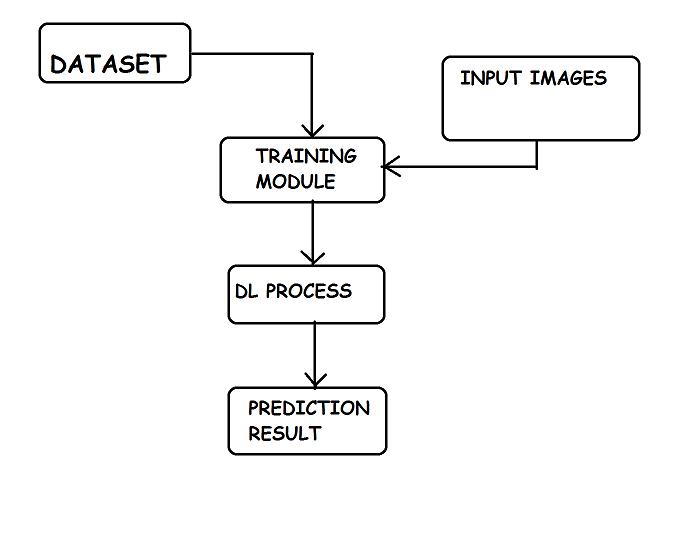
Step III:Splittingdatasetintotesting&trainingdataset to findaccuracyofthemodel.
Step IV:Actualimageinputforanalysis.
Step V:Testing&debugging.
Step 1: A publicly available chest x ray images dataset is takenforthedevelopmentofthesystem.
Step 2: Steps like exploration and feature extraction are performedtomakethedatasetsuitablefortheuse.
Step 3: Oncethedatasetisready,wewillsplititintotrain andtestdataset.
Step 4: PretrainedMLmodelwillbeusedfortrainingand testingandaccuracywillbedetermined.
Step 5: Onceeverythingisdonethentheusercanprovide actualtestdataforCOVID19Prediction.
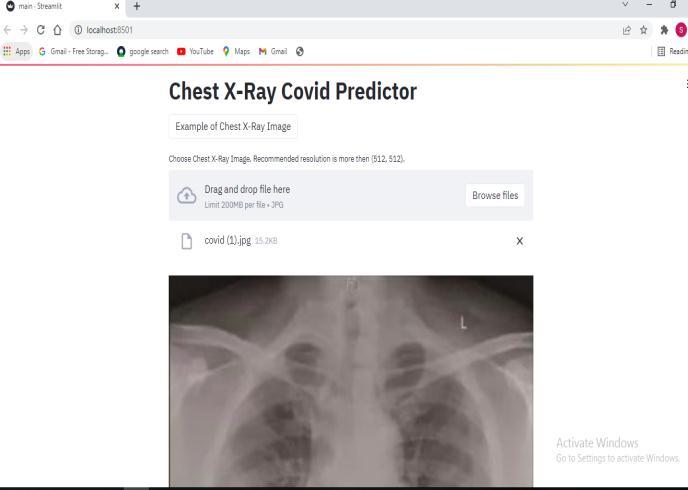
Step 6: User Interface is provided using Streamlit Python Module.
1) Inproposedsystem weare usingdataset ofchestx rayswithcovidpositiveandnonpositivelabelled.
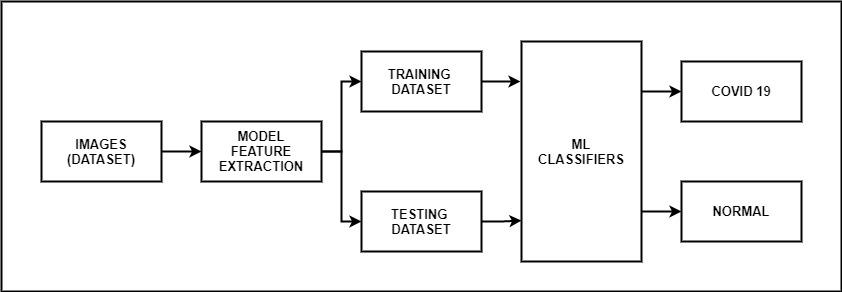
2) Proposedsystemisabletotakeinputfromuser. 3) Proposed system is able to do Deep learning operation by splitting it into training and testing data.
4) Proposed system is able to compare the extracted featurefromusersinputx rayimagewithpreviously traineddatasethavingbunchoffeatures.
5) Finally proposed system returns the compared resultwith94%accuracyofdeeplearningmodel.
Volume: 09 Issue: 05 | May 2022 www.irjet.net p ISSN: 2395 0072 © 2022, IRJET | Impact Factor value: 7.529 | ISO 9001:2008 Certified Journal | Page2932
International Research Journal of Engineering and Technology (IRJET) e ISSN: 2395 0056
Volume: 09 Issue: 05 | May 2022 www.irjet.net p ISSN: 2395 0072
Deep learning is the current trend and most prolific AI technique used for classification problems. It has been successfully used in a variety of applications, particularly inthemedicalindustry.
Hereweconsidertwodeeplearningmodel foroursystem HDF5,2DsequentialCNNmodelandResnet 50.
Thismodelisatypeoffeedforwardneuralnetworkthat's beendiscoveredtobeparticularlyeffectiveatinterpreting multidimensional data (e.g., images). In comparison to multilayer perceptrons, CNNs save memory by sharing parameters and using sparse connections. The input imagesareturnedintoamatrixbeforebeingprocessedby thevariousCNNparts.Themodelismadeupofnumerous alternatinglayersofconvolutionandpooling.
The features of the various patterns in the input are determined by the convolutional layer. It is made up of a series of dot products (convolutions) that are applied to the input matrix. This stage produces a feature map by creating an image processing kernel with a number of filters (i.e., motifs). The input is separated into receptive fields, which are convolved with the kernel using a set of weights.Inthispaper2Dconvolutionlayerwasused.
This down sampling layer minimises the spatial dimensions of the output volume by lowering the amount of feature mappings and network parameters. Furthermore,poolingimprovesthemodel'sgeneralisation by lowering overfitting. This step produces a set of featuresinvarianttotranslationalshiftsanddistortions.
Overfittingisacommonprobleminneuralnetworks.Asa result, dropout is used to introduce regularisation inside the network, which increases generalisation. It works by ignoring some visible and hidden units at random. Due to this, the network is trained to handle numerous independentinternalrepresentations.









This layer takes the feature map as input and uses an activation function to provide nonlinear altered output. This is a global operation that uses features from all phases to generate a set of nonlinear classification features.Inthisstage,therectifiedlinearunit(ReLU) was usedtohelpovercomethevanishinggradientproblem
ResNet 50
ResNet 50 is a 50 layer deep convolutional neural network. We can use the ImageNet database to load a pretrainedversionofthenetworkthathasbeentrainedon over a million photos. The network has been trained to categorisephotosinto1000differentobjectcategories.As a result, the network is able to learn rich feature representations for a variety of images. The network has animageinputsizeof225 by 225.
These models were implemented and evaluated using the Keras high level application program interface (API) of TensorFlow2.
BASIC DETAILS OF IMPLEMENTATION:
1. Hardware Interface ● System: Pentium IV 2.4 GHz and above recommended ● HardDiskSpace:Approx.4GB 2. Software Interface:
Operating System: Windows 7/8/8.1/10/11 or LinuxorMacOS
CodingLanguage:Python
Dataset: Image Dataset of Covid & Normal Patients
IDE:PythonIDLE/Spyder
International Research Journal of Engineering and Technology (IRJET) e ISSN: 2395 0056
Volume: 09 Issue: 05 | May 2022 www.irjet.net p ISSN: 2395 0072
This section describes the implementation and scan resultsof X rayimagespredictingcovid 19.Inthissection a user has to input the chest X ray image, the predicator then predicts whether the patients is covid19 positive or covid19 negative. This predictor is also capable of classifying the chest x ray images along with the percentage.
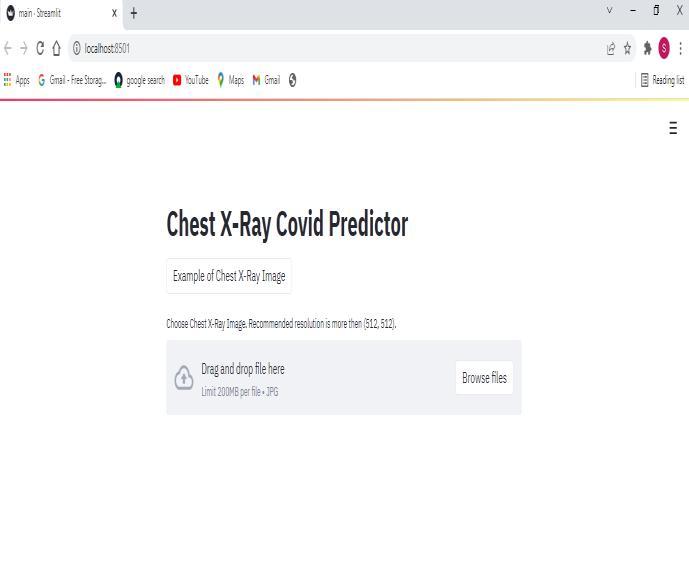
It consumes less time compared to the currenttestingmethod.
Sinceit’sasoftwareimplementationhenceno costisinvolved.
Itgives94%ofaccuracy.
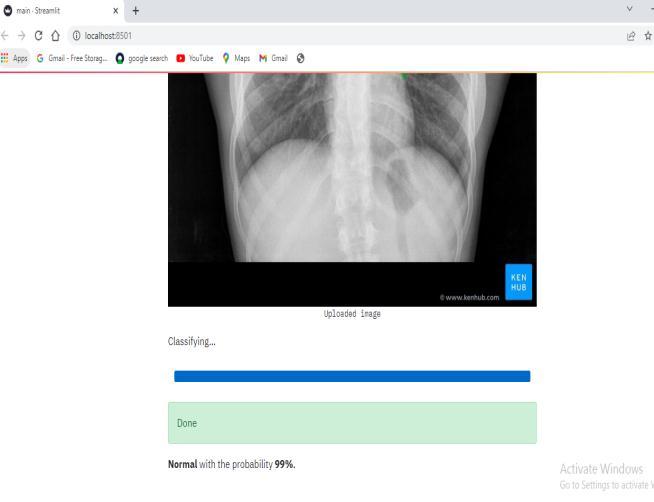
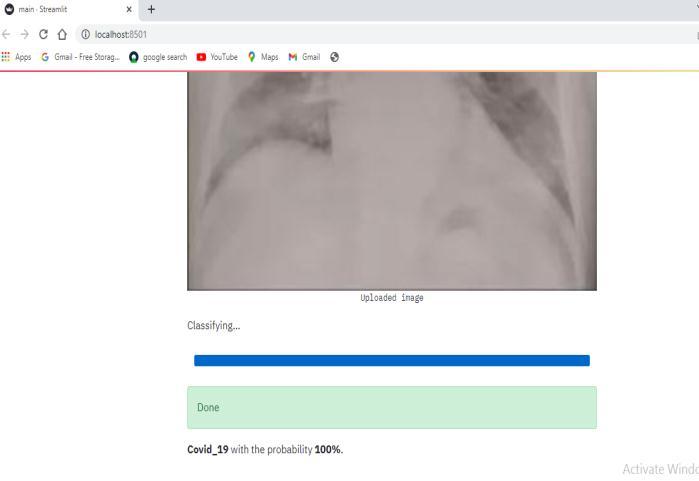
This paper has preferred a model to detect COVID 19 cases from the chest X Ray images. COVID 19 detection playsanimportantroletohaltingthespreadofthisglobal pandemic.Giventhescaleofthepubliclyavailabledataset, theresultsappearpromising.Throughthedataset,weget the F1 Score. We can acquire the best outcome if we improve further with a multi class classification and the availability of a large dataset. Finally, the system has excellent success in detecting COVID 19 with minimal time, resource and cost. Such a high accuracy will playan essential role in detecting COVID 19 patients, very fast. This will thus reduce the testing time and the cost for the generalpublic.
Futureworkcanincludeassessmentof additional models probably with an exhaustive search of optimum classification parameters, increasing datasetsize,numberofepochsfortrainingetc.
ItenhancestheefficiencyofCovidtestprocedures onroutinebasis.
Can be useful in predicting any other diseases by trainingthemachineaccordingly.
International Research Journal of Engineering and Technology (IRJET) e ISSN: 2395 0056 Volume: 09 Issue: 05 | May 2022 www.irjet.net p ISSN: 2395 0072
1) Tulin Ozturk, Muhammed Talo, Eylul Azra Yildirim, Ulas Baran Baloglu, Ozal Yildirim, U. Rajendra Acharya , “Automated detection of COVID 19 cases using deep neural networks with X ray images” ,Comput Biol Med. 2020 Jun; 121: 103792.Publishedonline2020Apr284.
2) Asif Iqbal Khan, Junaid Latief Shah, Mohammad MudasirBhat,CoroNet:Adeepneuralnetworkfor detectionanddiagnosisofCOVID 19fromchestx ray images,Computer Methods and Programs in Biomedicine, Volume 196,2020,105581,ISSN 0169 2607
3) Alazab, Moutaz & Awajan, Albara & Mesleh, Abdelwadood&Abraham,Ajith&Jatana,Vansh& Alhyari, Salah. (2020). COVID 19 Prediction and Detection Using Deep Learning. International Journal of Computer Information Systems and IndustrialManagementApplications.12.168 181.
4) Chest X ray classification using Deep learning for automated COVID 19 screening,Ankita Shelke, Madhura Inamdar, Vruddhi Shah, Amanshu Tiwari, Aafiya Hussain, Talha Cha fekar, Ninad Mehendale(doi:https://doi.org/10.1101/2020.06. 21.20136598)
5) Classification of COVID 19 from Chest X ray images using Deep Convolutional Neural NetworksSohaibAsif,YiWenhui*,HouJin,YiTao, SiJinhai.
6) T. Ozturk, M. Talo, E. A. Yildirim, U. B. Baloglu, O. Yildirim, and U. Rajendra Acharya, “Automated detection of COVID 19 cases using deep neural networks with X ray images,” Computers in Biology and Medicine,vol.121,p.103792,2020.
7) A. Borghesi and R. Maroldi, “COVID 19 outbreak in Italy: experimental chest X ray scoring system for quantifying and monitoring disease progression,”La Radiologia Medical, vol. 125, no. 5,pp.509 513,2020.
8) K. Elasnaoui and Y. Chawki, “Using X ray images and deep learning for automated detection of coronavirus disease,” Journal of Biomolecular Structure and Dynamics,pp.1 2,2020.
9) D. M. Powers, “Evaluation: from precision, recall andF measuretoROC,informedness,markedness andcorrelation,”2020,
10) L. Wang, Z. Q. Lin, and A. Wong, “Covid net: a tailored deep convolutional neural network
design for detection of covid 19 cases from chest X rayimages,” Scientific Reports,vol.10,no.1,pp. 1 12,2020.
11) Suk H. I., Shen D., Deep learning based feature representation for AD/MCI classification, in: International Conference on Medical Image Computing and Computer Assisted Intervention, Springer(2013),pp.583 590.
12) Cheng J. Z., Ni D., Chou Y. H., Qin J., Tiu C. M., Chang Y. C., Huang C. S., Shen D., Chen C. M., Computer aided diagnosis with deep learning architecture: applications to breast lesions in US images and pulmonary nodules in CT scans, ScientificReports6(1)(2016)
13) Mormont R., Geurts P., Marée R., Comparison of deep transfer learning strategies for digital pathology,in:ProceedingsoftheIEEEConference on Computer Vision and Pattern Recognition Workshops(2018),pp.2262.
2022, IRJET | Impact Factor value: 7.529 | ISO 9001:2008 Certified Journal