International Research Journal of Engineering and Technology (IRJET) e ISSN:2395 0056

Volume: 09 Issue: 05 | May 2022 www.irjet.net p ISSN:2395 0072
International Research Journal of Engineering and Technology (IRJET) e ISSN:2395 0056
Volume: 09 Issue: 05 | May 2022 www.irjet.net p ISSN:2395 0072
1. Research Scholar, Register number: 19121172031002, Department of Chemistry, Rani Anna Government College for Women, Affiliated to Manonmaniam Sundaranar University, Abishekapatti, Tirunelveli 627 012, Tamilnadu, India
2. Assistant Professor in Chemistry, Department of Chemistry, Rani Anna Government College for Women, Affiliated to Manonmaniam Sundaranar University, Abishekapatti, Tirunelveli 627 012, Tamilnadu, India
3. Associate Professor in Chemistry, Department of Chemistry, M.R Government Arts College, Rajaji Nagar, Mannargudi, Tamilnadu 614 001, India
4,5 Research Scholar, Department of Chemistry, Rani Anna Government College for Women, Affiliated to Manonmaniam Sundaranar University, Abishekapatti, Tirunelveli 627 012, Tamilnadu, India ***
An assessment was taken to study the impact on seed germination of Amaranthus dubius (red spinach) under fluoride ion. High concentration of fluoride ion in water suppresses the seed germination.[1,2] 0, 1, 2, 5, 25 and 50 mg/L (ppm) sodium fluoride solutions were used for this experiment. Fluoride reduced the number of seeds to germinate. It was noted by measuring the germination during the experiment. 25 and 50 ppm fluoride solutions suppressed the Amaranthus dubius germination by 30% and 40% respectively.
Key words: Germination, ppm, seed, fluoride, concentration
Fluoride is commonly found in the environment and its percentage availability in the Earth’s crust is 0.077 by volume [3] It is an extremely reactive element. It is not available in nature as free form [4] It readily reacts with other elementstoformcompounds Italsoformscompoundswithnoblegases. Highfluoridecontentisreportedinmostofthe waterinthemiddleEast,EastandcentralAsiaandAfrica(above1.5 mg/L),whichistheresultofleachingfromfluorine richminerals.[5,6]
Fluorideisoftenmentionedasoneofthepollutants.Fluoridecompoundscreatepollutionintheenvironment.Itis ranked fifth in the environmental poisons [7] Fluoride presents in soil, water, air and plants. It is not considered as an essentialelementforthenormalgrowthofplants [8] Theproblemofenvironmentalpollutionwithfluoridecompoundshas been noticed recently and is mainly related to industrial activity, production of fertilizers (super phosphates) and the emissionoffluoridecompoundsintotheatmosphereintheformofdustandgasfromaluminiumsmelters [9]
Fluoride is one of the most toxic elements for plants Fluoride inhibits germination, causes ultra structure malformations,reducesphotosyntheticcapacities,altersmembranepermeability,reducesproductivity,decreasesbiomass and inflict other physiological and biochemical disorders in plants [10] Moreover, Fluoride toxicity may have important consequencessuchasreductioningrowthoryield. [11] Fluoridereducesagriculturalharvestsbyupto50percentbecause most plants are highly sensitive to fluoride. Fluoridecompounds have been shown to be highly toxic to cereals and spinaches [12,13]
Theredspinach(Amaranthus dubius)isoneofthemostwidelyeatenspinachvarieties.Italsoplaysanimportantrole inTamilcuisine,nativetothemiddleEastandcultivatedinmanypartsoftheworldtoday.ItisalsowidelyeateninAfrica. Amaranthus dubius isusedinSiddhamedicineatTamilnadu.Spinachisgivenasanimportantfoodtopostpartumwomen asitgivesheattothebody.Inaddition,itgivesstrengthandstaminatothebodybyrelievingthebodyweightcausedby childbirth.
International Research Journal of Engineering and Technology (IRJET) e ISSN:2395 0056
Volume: 09 Issue: 05 | May 2022 www.irjet.net p ISSN:2395 0072
The aim of the present study is to examine the impact of Amaranthus dubius for 10 days treatment with sodium fluoride(NaF),inconcentrationsof0(control),1,2,5,10,25and50mg/Lonthegerminationpercentage,rootandstem length,vigorindex,andtranslocationfactor.
The experiment was carried out in natural climates and soil bed condition with cultivars of Red Lettuce seeds of Amaranthus dubius.TheseedswerecollectedfromAgriculturedepartment,GovernmentofTamilnadu,Tirunelveli.Astock solutionof1000mg/LwaspreparedbydissolvingNaFcrystalsindistilledwater.
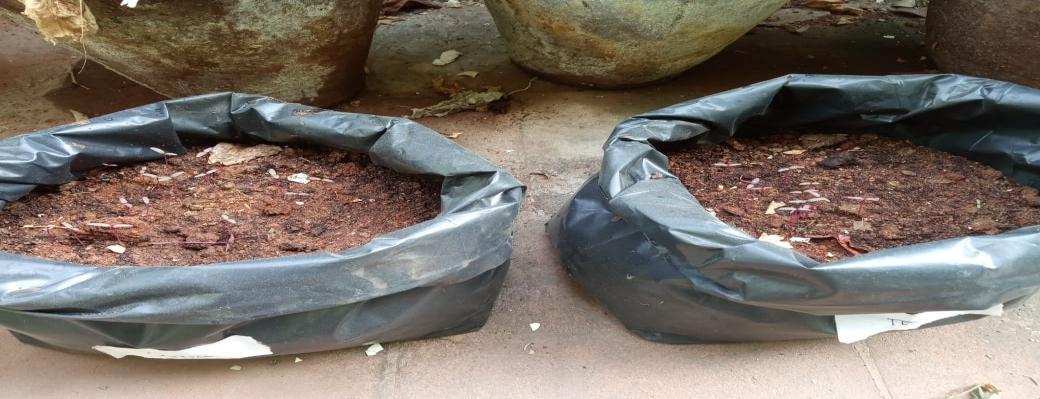
Seven potswereselected, eachonehas 4kgofsoil andmixeduniformlywith 0.5kgofcowdung,keptit for3days. The Amaranthus dubius seedswerewettedwithdistilledwaterfor2hoursand20seedsweresowingwithadequatespace betweentheminthesoilofeachpot.Controlwaswateringwithdistilledwaterandotherswerewateringwith1,2,5,10, 25 and 50 mg/L sodium fluoride solution. 50ml distilled water and 50ml 1, 2, 5 , 10, 25, and 50 ppm sodium fluoride solution were used to watering at early morning every day for control and treated respectively. After 10 days the germinationwascompletedandtheexperimentterminated.Theobservationofnumberofseedsgerminatedincontrol,1, 2,5,10,25and50ppmNaFtreatedwererecordedseparatelyfromthirdday.
2.1.1.
Germination percentage (G.P) was calculated using the formula framed by international seed testing association methods.[14]
2.1.2.
Rootlengthandstemlengthweremeasuredwitharulerafter10days.
2.1.3.
VigorindexwascalculatedforNaFtreatedbythefollowingequation [15]
VigorIndex=(Stemlength+Rootlength)×GerminationPercentage
2.1.4.
Fig1a)Control(0mg/LNaF) b)Treated(10mg/LNaF)
The stems and roots of seedlings were separated and dissolved separately in 0.1 M per chloric acid. Water extractable fluoride from stems and roots of seedlings were determined by ion selective electrode. The translocation factor(TF)ofFinthisseedlingswerecalculatedbythefollowingequation.[16]
International Research Journal of Engineering and Technology (IRJET) e ISSN:2395 0056
Volume: 09 Issue: 05 | May 2022 www.irjet.net p ISSN:2395 0072
TF=(CStem/CRoot)
Where CStem=concentrationoffluorideinplant’sstem(mg/kg)and CRoot =concentrationoffluorideinplant’sroot(mg/kg)
Theeffectsobservedin1,2,5,10,25and50ppmsodiumfluorideonseedgermination,fluorideuptake,stemt length,rootlengthandtranslocationfactorof Amaranthus dubius aregivenintablesfrom1 3,Fig1andchart 1
Fluoride is not an important element for the growth of plants. Previous studies show that fluoride affects a wide range plant processes such as respiration, starch synthesis, cell wall formation and enzyme activities.[17] Fluoride toxicities were resulted from the uptake of large doses of fluoride compounds. The adverse effects depend upon the irritatingpropertiesandtheamountofthefluoridethathasbeentakenup.[18]
Table1showsthatgerminationpercentagewasreducedas95%,90%,80%,70%and60%with2,5,10,25 and50ppmsodiumfluoridetreatmentovercontrolrespectively.Thesefindingsaresimilartoobservationingermination of Cicer arietinum L and Hordeum vulgare L,[19] in germination of Raphanus sativus L and Abelmoschus esculentus L[11] and ingerminationof Triticum aestivum L [20]
Chart 1 shows that 100% germination in control (upper graph) while 60% germination in 50 ppm NaF treated(lowergraph).
Fluoride reduced root elongation and stem elongation due to unbalanced nutrient uptake by seedlings.[21] Table 2 shows that uptake of fluoride was reduced the elongation of average root length as 34% with NaF treated over control. Average stem length decreased as 17% with NaF treated over control. Such a reduction in elongation of root lengthandstemlengthwerereportedinpulsecrop Cicer aritinum L.[14]
Analysingdata Control 1ppm 2ppm 5ppm 10ppm 25ppm 50ppm Germination% 100 100 95 90 80 70 60 Vigorindex(VI) 1030 950 922 828 640 791 390 VI%reduction 7.77 10.49 19.62 37.87 25.21 62.14
Table 2. RootandStemlengths(cm)andpercentreductionof Amaranthus dubius seedlings
Analysingdata Control 1ppm 2ppm 5ppm 10ppm 25ppm 50ppm Rootlength(cm) 2.8 3 2.2 2.2 2 2.8 1 %reduction +7.14 21.42 21.42 28.57 0 64.28 Stemlength(cm) 7.5 6.5 7.5 7 6 8.5 5.5 %reduction 13.33 0 6.66 20 +13.33 26.66
Table 3 Concentrationoffluorideinrootandstem(mg/Kg)of Amaranthus dubius seedlings
Analysingdata Control 1ppm 2ppm 5ppm 10ppm 25ppm 50ppm Root(Fmg/Kg) NA 4.141 4.918 5.516 6.476 8.826 11206 Stem(Fmg/Kg) NA 2031 2.482 3344 4.139 6.124 8.568 Translocation factor 0.4904 0.5046 0.6062 0.6391 0.6915 0.7645
NA Notapplicable
Table 3 shows that the fluoride uptake in the Amaranthus dubius increased with increasing NaF concentrations.Inroot part itrangesfrom 4.141 mg/kg andstem partit rangesfrom2.031 mg/kg. TranslocationFactor (TF) is little high (0.4904) for Amaranthus dubius indicating that the stem tissues have less capability to hold F. Similar effectwasalsoreportedin Abelmoschus esculentus.[16]
International Research Journal of Engineering and Technology (IRJET) e ISSN:2395 0056
Volume: 09 Issue: 05 | May 2022 www.irjet.net p ISSN:2395 0072
The difference in uptake of fluoride by the plants between light and dark conditions was reported. Such a studyhasbeen reported in Acacia georqinae todeterminetheconcentration offluoroacetate.[14] Itis18ppmin theroots and9ppminthestempartsafter5days.Largerfluoridewaspresentgenerallyintherootparts.Moreamountsoffluoride weretakenupbytherootswhenhighertheconcentrationoffluoridedosage150to250ppm.
Table1showsthatvigorindexwasdecreased62.14%,25.21%,37.87%,19.62%,10.49%and7.77%with50, 25,10,5,2and1ppmconcentrationof fluoridetreatmentovercontrolrespectively.Similarreductioninvigorindexhas alsobeenreportedin Triticumaestivum [1]
20
15
10
5
Number of seeds germinated Day
25 3 4 5 6 7 8 9 10 11
Control 1ppm 2ppm 10ppm 25ppm 50ppm 5ppm
0
Chart - 1 Showsnumberof Amaranthus dubius seedsgerminated
Insolutionsof1,2,5,10,25and50ppmsodiumfluoridewasfoundtocauseinhibitionofseed germination. Fluoride uptake reduced the growth and yield of plants. Varieties of plants of a species shown difference in fluoride uptake, growth and its yield.[22] Seeds treated to solutions of hydrogen fluoride or sodium fluoride during germination shows inhibiting effects Weight of fresh seedlings decreased with increasing fluoride concentration due to reduction of metabolicactivity.[23] Fluorideactsasametabolicinhibitorforgermination.[24]
In the present study 1, 2, 5, 10, 25 and 50 ppm NaF concentrations adversely affects the seed germination and seedlings growth of Amaranthus dubius Germination percentage and vigor index decreased from 100% to 60% was also reported. The root length, stem length and dry weight were also affected by increased NaF concentration. The fluoride accumulation in the plant parts is indicated by translocation factor. Fluoride accumulation is an additional stress and affects plants growth This knowledge is very helpful for farmers to avoiding excessive usage of fluoride containing fertilizersandirrigationofcropswithfluoridecontaminatedwatertoincreasecropproductivity.
[1] F.B.Abdallah, I. Mezghani I, A. Rhouma,M. Boukhris and S. Tunisia,“Effectoffluorideonalmondseedlingin culturesolution,”Fluoride.2005,38,pp.193 198.
[2] J. Anderson and B.A.S. Abdul, “Vigor determination in soya bean seeds by multiple criteria,” Crop Science. 1973,3,pp.630 633.
[3] H.Cai,Y. Dong,C.Peng,Y.Li,W. Xu,D.LiandX. Wan,“Fluoride inducedresponsesinthechlorophyllcontentand theantioxidantsystemintealeaves(Camelliasinensis),”Fluoride2017,50,pp.59 78.
[4] M. Vithanage and P. Bhattacharya, “Fluoride in the environment: Sources, distribution and defluoridation,” Environ.Chem.Lett.2015,13,pp.131 147.
International Research Journal of Engineering and Technology (IRJET) e ISSN:2395 0056 Volume: 09 Issue: 05 | May 2022 www.irjet.net p ISSN:2395 0072
[5] S.J.Cronin,V.Manoharan,M.HedleyandP.Loganathan,“Fluoride:Areviewofitsfate,bioavailability,andrisksof fluorosisingrazed pasturesystemsinNewZealand.N.Z.J,”Agric.Res.2000,43,pp.295 321.
[6] B.R.Gadi,V.Poojaand A.Ram,“InfluenceofNaFonseedgermination,membranestabilityandsomebiochemical contentinVignaseedlings,”J.Chem.Biol.Phys.Sci.2012,2,pp.1371 1378.
[7] T. Dutkiewicz, “Forms of human exposure to environmental factors,” In Environment and health; J.B. Karski, J. PawlakandEds,“Centerforhealthorganizationandeconomics,”Warsaw,Poland,1995,pp.107 113.
[8] R.K.Sarkar,A.BanerjeeandS.Mukherji,Biol.Plant.,1982,24(1),pp.34 38.
[9] R.Gautamand N.Bhardawaj,“Bioaccumulation of fluoridein different plantsparts ofHordeum vulgare (Barley) var.RD 2683formirrigationwater,”Fluoride2010,43,pp.57 60.
[10] R. Gautam, N. Bhardwaj and Y. Saini, “Fluoride accumulation by vegetables and crops grown in NawaTehesil of Nagpurdistrict(Rajasthan,India),”JournalofPhytology,2010,2(2),pp.80 85
[11] S. Singh, J. Singh and N. Singh, “Studies on the impact of fluoride toxicity on growth parameters of RaphanussativusL,”IndianJournalofScientificResearch,2013,4(1):61 63.
[12] T.S. Kumar, K.P. Dhakaand and A. Singh, “Effect of fluoride toxicity on the growth and yield of wheat (Triticum aestivumL.),”Int.J.Forest.CropImpr.2013,4,pp.59 62.
[13] S.Choudhary,M.Rani,O.SDevika,A.Patra,R.K.SinghandS.K.Prasad,“Impactoffluorideonagriculture:Areview onitssources,toxicityinplantsandmitigationstrategies,”Int.J.Chem.Stud.2019,7,pp.1675 1680.
[14] R.SreedeviandT.Damodharam,“ExterminateconsequenceofNaFonseedgerminationandsomemorphological changesofmajorpulsecropCiceraritinumL.Cv.Anuradha(Bengalgram)”,AsianJ.PlantSci.Res.,2013,3(2),pp. 38 41
[15] Jo.Anderson,A.S.Abdul Baki,CropScience.1973,3,pp.630 633.
[16] Arshi Iram and T.I. Khan, “Effect of Sodium Fluoride on Seed Germination, Seedling Growth and Biochemistry of Abelmoschusesculentus”,JPlantBiochemPhysiol,2016,4(2),pp.170.
[17] L.H.Weinstein,“Fluorideandplantlife”, Journalofoccupationalmedicine,1977,19,pp 49 77
[18] J.M. Filho, “Seed vigor testing: An overview of the past, present and future perspective,” Sci. Agric.2015, 72, pp. 363 374.
[19] P.Sachan,andN.Lal,“Effectofsodiumfluorideongermination,seedlinggrowthandphotosyntheticpigmentsin CicerarietinumLandHordeumvulgareL”,MOJEcoEnvironSci.2018,3(4),pp.300‒304
[20] Trivender kumar, T.S. Dhaka and K.P. Singh Ary, “Effect of fluoride toxicity on germination of seeds of wheat (TriticumaestivumL)”,Adv.Res.J.CropImprov,2013,4(2),pp.136 138.
[21] D. Sabal, T.I. Khan and R. Saxena, Journal of Stress Physiology & Biochemistry, 2006, 39 (3), pp. 228 230, Vol. 8 No.1201.
[22] J.AndersonandB.A.S.Abdul,“Vigordeterminationinsoyabeanseedsbymultiplecriteria,” CropScience.1973,3, pp630 633.
[23] S. Gupta, S. Banerjee and S. Mondal, “Phytotoxicity of fluoride in the germination of paddy (Oryzasativa) and its effectsonthephysiologyandbiochemistryofgerminatingseedlings,”Fluoride.2009,42,pp.142 146.
[24] J. Kaur and C. Duffus, “The effect of sodium fluoride on cereal seed germination and seedling growth,” Plant Cell andEnvironment.1989,12,pp.155 161.