
LOW ILLUMINATION VIDEO-IMAGE ENHANCEMENT

Page 1

International Research Journal of Engineering and Technology (IRJET)

e-ISSN: 2395-0056

Volume: 09 Issue: 05 | May 2022

p-ISSN: 2395-0072

www.irjet.net

LOW ILLUMINATION VIDEO-IMAGE ENHANCEMENT Munaf S, Harshavardan K, Aravind S, Maanashaswaruban M Department of Electronics & Communication Engineering, Sri Ramakrishna Institute of Technology, Pachapalayam, Coimbatore, India. ---------------------------------------------------------------------***--------------------------------------------------------------------diminished after image processing, storage, transmission, and Abstract - Due to their low visibility, low-light images are not other procedures.

suited to human observation or computer vision algorithms. Despite the fact that several image enhancement approaches have been developed to address this issue, present methods invariably introduce contrast under- and over augmentation. Low brightness, low contrast, a narrow grey range, and color distortion, as well as significant noise, are common characteristics of images captured under poor lighting conditions, all of which have a significant impact on the subjective visual effect on human eyes and severely limit the performance of various machine vision systems. The goal of low-light image enhancement is to improve the visual effect of such photos so that they may be processed more efficiently. A deep learning-based approach for low-light image enhancement is presented. The difficulties in handling multiple parameters concurrently, including as brightness, contrast, artefacts, and noise, makes this task tough. The main concept is to extract rich features at various levels so that we can apply enhancement via many subnets and then construct the output image via multi-branch fusion. In this way, image quality is increased in a variety of ways.

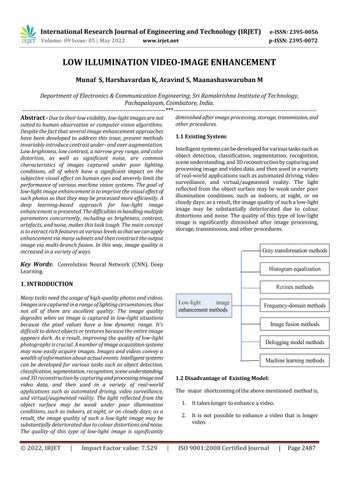
1.1 Existing System: Intelligent systems can be developed for various tasks such as object detection, classification, segmentation, recognition, scene understanding, and 3D reconstruction by capturing and processing image and video data, and then used in a variety of real-world applications such as automated driving, video surveillance, and virtual/augmented reality. The light reflected from the object surface may be weak under poor illumination conditions, such as indoors, at night, or on cloudy days; as a result, the image quality of such a low-light image may be substantially deteriorated due to colour distortions and noise. The quality of this type of low-light image is significantly diminished after image processing, storage, transmission, and other procedures.

Key Words: Convolution Neural Network (CNN), Deep Learning.

1. INTRODUCTION Many tasks need the usage of high-quality photos and videos. Images are captured in a range of lighting circumstances, thus not all of them are excellent quality. The image quality degrades when an image is captured in low-light situations because the pixel values have a low dynamic range. It's difficult to detect objects or textures because the entire image appears dark. As a result, improving the quality of low-light photographs is crucial. A number of image acquisition systems may now easily acquire images. Images and videos convey a wealth of information about actual events. Intelligent systems can be developed for various tasks such as object detection, classification, segmentation, recognition, scene understanding, and 3D reconstruction by capturing and processing image and video data, and then used in a variety of real-world applications such as automated driving, video surveillance, and virtual/augmented reality. The light reflected from the object surface may be weak under poor illumination conditions, such as indoors, at night, or on cloudy days; as a result, the image quality of such a low-light image may be substantially deteriorated due to colour distortions and noise. The quality of this type of low-light image is significantly

© 2022, IRJET

|

Impact Factor value: 7.529

1.2 Disadvantage of Existing Model: The major shortcoming of the above mentioned method is,

|

1.

It takes longer to enhance a video.

2.

It is not possible to enhance a video that is longer video.

ISO 9001:2008 Certified Journal

|

Page 2487


Turn static files into dynamic content formats.
Create a flipbook
LOW ILLUMINATION VIDEO-IMAGE ENHANCEMENT by IRJET Journal - Issuu