International Research Journal of Engineering and Technology (IRJET)
e-ISSN: 2395-0056
Volume: 09 Issue: 05 | May 2022
p-ISSN: 2395-0072
www.irjet.net
AIRLINE FARE PRICE PREDICTION Kartik Rathi1, Anubhav Kumar2, Manish Yadav3 1,2,3 Students,
Computer science and Engineering department, MIET Meerut,Uttar Pradesh,India ---------------------------------------------------------------------***---------------------------------------------------------------------
Abstract The price of airline ticket changes frequently
nowadays and there's plenty of difference. Price change keeps happening within few hours for the identical flight. The shoppers want to induce the most cost-effective possible price while the airline companies want the utmost profit and revenue possible. To unravel this problem, researchers introduce different models to avoid wasting consumers money- minimum price predicting model and models that tell us an optimal time to shop for a ticket while airlines use techniques like demand prediction and price discrimination to maximize their revenue
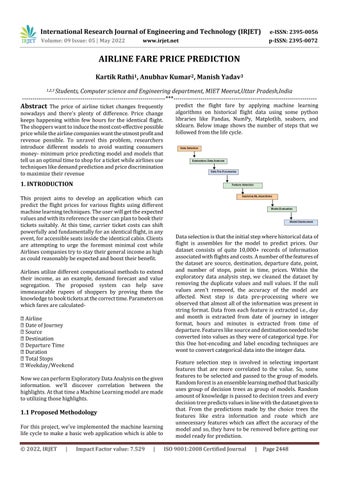
predict the flight fare by applying machine learning algorithms on historical flight data using some python libraries like Pandas, NumPy, Matplotlib, seaborn, and sklearn. Below image shows the number of steps that we followed from the life cycle.
1. INTRODUCTION This project aims to develop an application which can predict the flight prices for various flights using different machine learning techniques. The user will get the expected values and with its reference the user can plan to book their tickets suitably. At this time, carrier ticket costs can shift powerfully and fundamentally for an identical flight, in any event, for accessible seats inside the identical cabin. Clients are attempting to urge the foremost minimal cost while Airlines companies try to stay their general income as high as could reasonably be expected and boost their benefit. Airlines utilize different computational methods to extend their income, as an example, demand forecast and value segregation. The proposed system can help save immeasurable rupees of shoppers by proving them the knowledge to book tickets at the correct time. Parameters on which fares are calculated-
Now we can perform Exploratory Data Analysis on the given information. we'll discover correlation between the highlights. At that time a Machine Learning model are made to utilizing those highlights.
1.1 Proposed Methodology For this project, we've implemented the machine learning life cycle to make a basic web application which is able to
© 2022, IRJET
|
Impact Factor value: 7.529
|
Data selection is that the initial step where historical data of flight is assembles for the model to predict prices. Our dataset consists of quite 10,000+ records of information associated with flights and costs. A number of the features of the dataset are source, destination, departure date, point, and number of stops, point in time, prices. Within the exploratory data analysis step, we cleaned the dataset by removing the duplicate values and null values. If the null values aren't removed, the accuracy of the model are affected. Next step is data pre-processing where we observed that almost all of the information was present in string format. Data from each feature is extracted i.e., day and month is extracted from date of journey in integer format, hours and minutes is extracted from time of departure. Features like source and destination needed to be converted into values as they were of categorical type. For this One hot-encoding and label encoding techniques are wont to convert categorical data into the integer data. Feature selection step is involved in selecting important features that are more correlated to the value. So, some features to be selected and passed to the group of models. Random forest is an ensemble learning method that basically uses group of decision trees as group of models. Random amount of knowledge is passed to decision trees and every decision tree predicts values in line with the dataset given to that. From the predictions made by the choice trees the features like extra information and route which are unnecessary features which can affect the accuracy of the model and so, they have to be removed before getting our model ready for prediction.
ISO 9001:2008 Certified Journal
|
Page 2448