International Research Journal of Engineering and Technology (IRJET) Volume: 09 Issue: 05 | May 2022
www.irjet.net
e-ISSN: 2395-0056 p-ISSN: 2395-0072
Milk Analyser Display using 7-segment LEDs Pradnya Anil Kamble1, Utkarsha Uday Haldankar2, Astha Sandip Shaha3, Rani Arun Bhendigeri4, Eknath Chandar Patil5 1, 2, 3,4 UG
Students, Department of Electronics and Telecommunication Engineering, KIT’s College of Engineering, Kolhapur, India 5Assistant professor, Electronics and Telecommunication Engineering, KIT’s College of Engineering, Kolhapur, India ---------------------------------------------------------------------***--------------------------------------------------------------------longer distances. So, this limitation can be overcome by Abstract The task of taking readings of milk analyser parameters on in-built LCD is quite challenging because of its bright background and small size. It creates difficulties while taking reading from longer distances. And hence leads to inaccuracies. This paper presents how this obstacle of taking readings can be overcome by using common 7 segment displays. The parameters such as water, SNF, temperature, fat is displayed on the 7 segment displays. The system described in the paper consists of RS232 through which parameter data can be given to the 8051 microcontroller and data can be displayed on the common cathode 7 segment LEDs using assembly programming. As common cathode 7 segment LEDs are used data is visible over longer distances and parameter readings can be easily noted. And it can also lead to increase in accuracy while taking the readings.
using 7 segment LEDs. This paper presents a system in which common cathode 7 segment LEDs are used because of which data is visible over longer distances (at least up to 15ft). It eradicates the errors/hindrances caused while taking readings on in-built LCD.
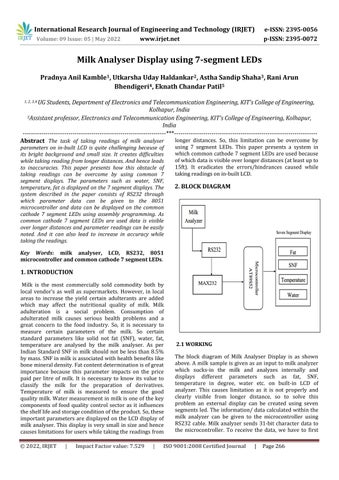
2. BLOCK DIAGRAM
Key Words: milk analyser, LCD, RS232, 8051 microcontroller and common cathode 7 segment LEDs.
1. INTRODUCTION Milk is the most commercially sold commodity both by local vendor’s as well as supermarkets. However, in local areas to increase the yield certain adulterants are added which may affect the nutritional quality of milk. Milk adulteration is a social problem. Consumption of adulterated milk causes serious health problems and a great concern to the food industry. So, it is necessary to measure certain parameters of the milk. So certain standard parameters like solid not fat (SNF), water, fat, temperature are analysed by the milk analyser. As per Indian Standard SNF in milk should not be less than 8.5% by mass. SNF in milk is associated with health benefits like bone mineral density. Fat content determination is of great importance because this parameter impacts on the price paid per litre of milk. It is necessary to know its value to classify the milk for the preparation of derivatives. Temperature of milk is measured to ensure the good quality milk. Water measurement in milk is one of the key components of food quality control sector as it influences the shelf life and storage condition of the product. So, these important parameters are displayed on the LCD display of milk analyser. This display is very small in size and hence causes limitations for users while taking the readings from © 2022, IRJET
|
Impact Factor value: 7.529
|
2.1 WORKING The block diagram of Milk Analyser Display is as shown above. A milk sample is given as an input to milk analyzer which sucks-in the milk and analyzes internally and displays different parameters such as fat, SNF, temperature in degree, water etc. on built-in LCD of analyzer. This causes limitation as it is not properly and clearly visible from longer distance, so to solve this problem an external display can be created using seven segments led. The information/ data calculated within the milk analyzer can be given to the microcontroller using RS232 cable. Milk analyzer sends 31-bit character data to the microcontroller. To receive the data, we have to first
ISO 9001:2008 Certified Journal
|
Page 266