
“A STUDY ON STRENGTH AND DURABILITY PROPERTIES OF BACILLUS SUBTILIS BACTERIAL CONCRETE”

Page 1

International Research Journal of Engineering and Technology (IRJET)

e-ISSN: 2395-0056

Volume: 09 Issue: 05 | May 2022

p-ISSN: 2395-0072

www.irjet.net

“A STUDY ON STRENGTH AND DURABILITY PROPERTIES OF BACILLUS SUBTILIS BACTERIAL CONCRETE” Kavya KP1, Mr. Adanagouda2 1PG student, Department civil engineering RYM engineering college ballari, karnataka, India. Assistant professor Department of civil engineering RYM Engineering collage, ballari, karnataka, India ---------------------------------------------------------------------***--------------------------------------------------------------------1.1 Chemical process of self-healing or bacterial Abstract - The activity life span of concrete sharply concrete decreases with the formation of cracks on its surface which 2

leads to corrosion of concrete. This leads to the failure of the structure, to remediate this type of failure due to cracks and fissures an approach of using biomineralization in concrete has evolved in recent years in this method the performance of concrete, the calcite precipitating spore-forming bacteria is introduced into the concrete. When water enters through the cracks, it reacts with bacteria and forms precipitates of calcium carbonate as a byproduct which fills the cracks and makes cracks free of concrete. This type of concrete prepared with bacteria is called bacterial concrete.

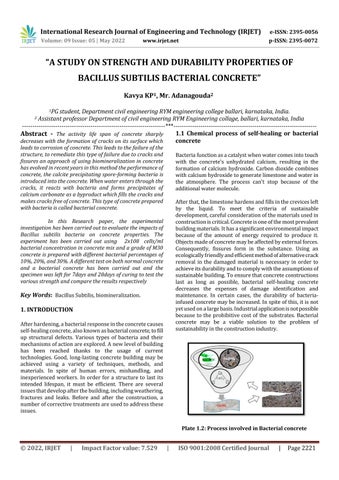
Bacteria function as a catalyst when water comes into touch with the concrete's unhydrated calcium, resulting in the formation of calcium hydroxide. Carbon dioxide combines with calcium hydroxide to generate limestone and water in the atmosphere. The process can't stop because of the additional water molecule. After that, the limestone hardens and fills in the crevices left by the liquid. To meet the criteria of sustainable development, careful consideration of the materials used in construction is critical. Concrete is one of the most prevalent building materials. It has a significant environmental impact because of the amount of energy required to produce it. Objects made of concrete may be affected by external forces. Consequently, fissures form in the substance. Using an ecologically friendly and efficient method of alternative crack removal in the damaged material is necessary in order to achieve its durability and to comply with the assumptions of sustainable building. To ensure that concrete constructions last as long as possible, bacterial self-healing concrete decreases the expenses of damage identification and maintenance. In certain cases, the durability of bacteriainfused concrete may be increased. In spite of this, it is not yet used on a large basis. Industrial application is not possible because to the prohibitive cost of the substrates. Bacterial concrete may be a viable solution to the problem of sustainability in the construction industry.

In this Research paper, the experimental investigation has been carried out to evaluate the impacts of Bacillus subtilis bacteria on concrete properties. The experiment has been carried out using 2x10⁸ cells/ml bacterial concentration in concrete mix and a grade of M30 concrete is prepared with different bacterial percentages of 10%, 20%, and 30%. A different test on both normal concrete and a bacterial concrete has been carried out and the specimen was left for 7days and 28days of curing to test the various strength and compare the results respectively

Key Words: Bacillus Subtilis, biomineralization. 1. INTRODUCTION After hardening, a bacterial response in the concrete causes self-healing concrete, also known as bacterial concrete, to fill up structural defects. Various types of bacteria and their mechanisms of action are explored. A new level of building has been reached thanks to the usage of current technologies. Good, long-lasting concrete building may be achieved using a variety of techniques, methods, and materials. In spite of human errors, mishandling, and inexperienced workers. In order for a structure to last its intended lifespan, it must be efficient. There are several issues that develop after the building, including weathering, fractures and leaks. Before and after the construction, a number of corrective treatments are used to address these issues.

Plate 1.2: Process involved in Bacterial concrete

© 2022, IRJET

|

Impact Factor value: 7.529

|

ISO 9001:2008 Certified Journal

|

Page 2221


Turn static files into dynamic content formats.
Create a flipbook