
SolidCAM iMachining technology positive effects on cutting tool life during machining AISI 304 steel

Page 1

International Research Journal of Engineering and Technology (IRJET)

e-ISSN: 2395-0056

Volume: 09 Issue: 05 | May 2022

p-ISSN: 2395-0072

www.irjet.net

SolidCAM iMachining technology positive effects on cutting tool life during machining AISI 304 steel Tarik Gazić 1, Edin Begović2, Sabahudin Ekinović2, Ibrahim Plančić2 1B.Sc.

in Mechanical Engineering, Faculty of Mechanical Engineering, Zenica, Bosnia and Herzegovina in Mechanical Engineering, Faculty of Mechanical Engineering, Zenica, Bosnia and Herzegovina ---------------------------------------------------------------------***--------------------------------------------------------------------by up to 70% while extending the life of the tool by Abstract – In this paper, the effect of the use of SolidCAM 2Ph.D.

applying iMachining technology [2]. One such saving has just been described in this paper. Namely, the tool with an estimated lifespan of up to 300 working minutes, using iMachining technology lasted almost 1000 minutes. The aim of this paper is to determine whether this increase in tool life affected the dimensions of the final piece, i.e. whether the dimensions of the workpiece remained within the tolerance limits provided by the drawing.

iMachining technology on tool wear during machining of the stainless steel AISI 304 is analyzed. Detection of the tool wear is done indirectly through the measuring appropriate dimensions of the machined parts after machining each of the last 20 items in a raw of 50 items with same machining settings. G-code generated by iMachining technology run on a five-axis milling machine DMU60 MonoBLOCK. Cutting tools used in the operations were 16mm and 4 mm endmills, produced by SARTORIUS and designated as SARA, VHM 35/38, with AlTiN+ coating system. Expected tool life for these tools are about 200-300 min. By performing simple measuring of three characteristic linear dimensions (k1, k2 and k3) there have not been detected significant deviation in measure not even after approximately 1000 min of the machining time. Cutting process flows smoothly and without noise increase. Measuring’s were performed by TS642 Heidenhain IR Touch probe and standard caliper tools. MahrSurf TS50 non-contact surface microscope was used to check cutting edge conditions. Dimensional variation is presented in MS Excel using graphs. Also, snapshots of tool wear are presented at the end of the paper.

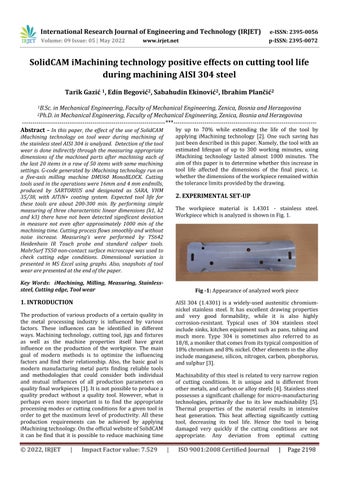
2. EXPERIMENTAL SET-UP The workpiece material is 1.4301 - stainless steel. Workpiece which is analyzed is shown in Fig. 1.

Key Words: iMachining, Milling, Measuring, Stainlesssteel, Cutting edge, Tool wear

Fig -1: Appearance of analyzed work piece

1. INTRODUCTION

AISI 304 (1.4301) is a widely-used austenitic chromiumnickel stainless steel. It has excellent drawing properties and very good formability, while it is also highly corrosion-resistant. Typical uses of 304 stainless steel include sinks, kitchen equipment such as pans, tubing and much more. Type 304 is sometimes also referred to as 18/8, a moniker that comes from its typical composition of 18% chromium and 8% nickel. Other elements in the alloy include manganese, silicon, nitrogen, carbon, phosphorus, and sulphur [3].

The production of various products of a certain quality in the metal processing industry is influenced by various factors. These influences can be identified in different ways. Machining technology, cutting tool, jigs and fixtures as well as the machine properties itself have great influence on the production of the workpiece. The main goal of modern methods is to optimize the influencing factors and find their relationship. Also, the basic goal is modern manufacturing metal parts finding reliable tools and methodologies that could consider both individual and mutual influences of all production parameters on quality final workpieces [1]. It is not possible to produce a quality product without a quality tool. However, what is perhaps even more important is to find the appropriate processing modes or cutting conditions for a given tool in order to get the maximum level of productivity. All these production requirements can be achieved by applying iMachining technology. On the official website of SolidCAM it can be find that it is possible to reduce machining time

© 2022, IRJET

|

Impact Factor value: 7.529

Machinability of this steel is related to very narrow region of cutting conditions. It is unique and is different from other metals, and carbon or alloy steels [4]. Stainless steel possesses a significant challenge for micro-manufacturing technologies, primarily due to its low machinability [5]. Thermal properties of the material results in intensive heat generation. This heat affecting significantly cutting tool, decreasing its tool life. Hence the tool is being damaged very quickly if the cutting conditions are not appropriate. Any deviation from optimal cutting

|

ISO 9001:2008 Certified Journal

|

Page 2198


Turn static files into dynamic content formats.
Create a flipbook
SolidCAM iMachining technology positive effects on cutting tool life during machining AISI 304 steel by IRJET Journal - Issuu