International Research Journal of Engineering and Technology (IRJET) e-ISSN: 2395-0056

Volume: 09 Issue: 05 | May 2022 www.irjet.net p-ISSN: 2395-0072

International Research Journal of Engineering and Technology (IRJET) e-ISSN: 2395-0056
Volume: 09 Issue: 05 | May 2022 www.irjet.net p-ISSN: 2395-0072
1PG Student, Department of Civil Engineering, JSPM’s Imperial College of Engineering& Research Wagholi, Pune, India
2Assistant professor, Department of Civil Engineering, JSPM’s Imperial College of Engineering& Research Wagholi, Pune, India.
Abstract- Retrofitting can be defined as changing, modifying certain parts, aspects of a structure with new or better parts which will prove to be beneficial for the user of the building & building itself. In a similar sense, Green Retrofit can be done by changing certain parts of building that damage the environment and changing it with sustainable alternatives which will increase the life of the building and reduce the life cycle cost of the same. This can also be achieved by undertaking many practices which not only enable conservation the natural resources but also enable us to enhance the environment and contribute towards adopting & encouraging sustainable construction practices.
Keywords: Green retrofit, environment, conservation, natural resources. Etc
Green Buildings will benefit greatly, both directly and indirectly. The main physical benefits are reduction in water consumption and energy consumption starting from the first day of ownership. Power efficiency would vary from 20 to 30%andwaterconservationfrom30to50%.Theimpalpableadvantagesofgreeninnovativebuildingsincludebetterair quality, wonderful sunshine, health & comfort of tenants, safety benefits and the preservation of country's limited resources. Other advantages of retrofitting existing buildings include; long term cost savings through minimizing power andwaterusagethroughintegratingnewtechnology,facilitiesormachinery;enhancingtheheightofcomfortinbuildings by upgrading the façade and interior to increase end user performance & efficiency by illuminating indoor thermal comfort; depressed greenhouse discharge and improving the water use in structures; Future proof constructions,which ensures that the structure will be used and can sustain for several years as it is fitted with modern automation; and maintainingthecultural andtraditionvalueofprevailingstructuresbyupdatingtheoutdoorandinteriorarchitectureof buildingstomeetpresentrequirementsandplandependingontherequirementsofendcustomers.
1.Tounderstandimportantaspectofretrofittingthroughstudydoneonresearchpapers.
2.Tostudyplanningrequiredforgreenretrofitting.
3.Toanalysecosteffectivenessofgreenretrofittingofinstitutionalbuilding
4.Toapplytheconceptandparametersofgreenretrofittingwhicharefoundsuitableand feasible.
International Research Journal of Engineering and Technology (IRJET) e-ISSN: 2395-0056
Volume: 09 Issue: 05 | May 2022 www.irjet.net p-ISSN: 2395-0072
Mohd. Ahmed & Mohd Abul Hasan et al., (2018) statedthecomparisonbetweentheworldgreenbuildingratingsystems and presents an insight into green building rating systems aspects and motives. To qualify the building green or sustainable,thedevelopedanddevelopingcountrieshavetheirownratingsystemsandcertificationmethods.
Stefano Cascone (2018) statesthattoimprovetheenergyperformanceofexistingbuildings,theretrofitwithgreenroof isaneffectivesolution.Thisstudythroughactivethermalsimulationestimatestheextentofenergysavingsoriginatingby theuseoftwodifferenttypesofgreenroofsappliedontheflatroofofamulti storeyresidentialbuilding.
Alok Thacker and Deepa Joshi (2018) carriedoutgreenauditinexistingeducationalcomplexandprovidedsuggestions for green retrofitting using LEED rating system. Cost analysis has been carried out for application of proposed measures forthegreenretrofittingmeasures.Therepaymenttimeoftheinvestmentshasbeenevaluated.
Nushrat and Saad Bin (2017) stated the economic and social benefit of green building. Aspects of green building were studied and SWOT analysiswas done. In financial analysis, thetotaleconomiccostandnon monetarycostarecalculated. The excess cost for construction of green building was calculated. It is theoretically possible to calculate the relative benefitsofgreenbuilding.
Muhammad Khairi et al., (2017) stated the importance of retrofitting the existing building to greenbuildingtoreduce thedependencyonconstructingnewbuildings.Theydiscussedthe application, benefits and disadvantages of retrofitting anexistingbuilding.Retrofittingisoneofthemostenvironmentallyfriendlyandeffectivesolutionstoimprovetheenergy performanceofbuilding.
Binoy and Sharadindu (2017) stated the sustainable development implies fulfilling the needs of the present without negotiating the ability of the future needs. They studied the amount of electricity generated by renewable energy. This papersuggestsusthevariousalternativesbywhichwecanretrofittheexistingbuildingsconsideringcostparameters.
• ChosenCaseStudy: SchoolBuilding
• Area: Jambe,Hinjewadi,Pune
• Developer: KoltePatilDevelopers
• TownshipName: LifeRepublicTownship
• Architect: SpaceDesignersSyndicate
• SchoolName: ANISHAGLOBAL
• SchoolPlayground: 18322.39SQM
• SchoolArea: 19441.71SQM
• No.ofClassrooms: 44
International Research Journal of Engineering and Technology (IRJET) e-ISSN: 2395-0056
Volume: 09 Issue: 05 | May 2022 www.irjet.net p-ISSN: 2395-0072
Selection of Feasible Parameters:
Selection of parameters is one of the important tasks after thoroughly studying all the general parameters. Out of all the parametersstudied,weabletofindmostfeasibleparametersforourstudy.
1.PhotovoltaicSolarPanels2.Energyefficientwindows3.LightEmittingDiodes
4.BrushlessDirectcurrentFans
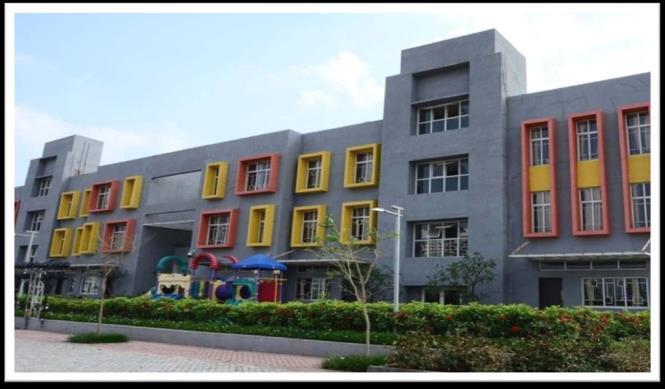
Fig1SchoolBuilding
Analysis of Existing Data:
Fromelectricalconsumptiondatagiveninelectricitybillwecametoconclusionthataveragepermonthbillingcyclecost Rs.90,231.00andtheaverageunitsconsumedis7646.7units
Total energy consumed (Tubelights,CFLlightings,fansandothermiscellaneoussources,withsuperbuiltuparea amenities)=7646.70kWh
Costof1unit=11.80INR,11.80x7646.7 =90231.06 Rs (Monthly Electricity Bill)
Table no. 1 Total consumption of Energy Consumptio n Number s Powe r W Consumptio n W per hour kW Duratio n Hrs. Total Consumptio n kWh
Fan 168 28 4704 4.704 7 88.15 Lighting 90+116 40+45 3600+5220 3.6+5.22 7 61.74 Miscellaneous 15000 15.00 7 105.00
TotalconsumptioninkWhperday 254.89
TotalconsumptioninkWhpermonth 7646.7
BLDCfanssaveupto60%oftheenergyusedbystandardfans,withlargersweepwidths,betterairdeliveryandrotation persecondavailable.
International Research Journal of Engineering and Technology (IRJET) e-ISSN: 2395-0056
Volume: 09 Issue: 05 | May 2022 www.irjet.net p-ISSN: 2395-0072
Table no. 2 Energy Consumption by Regular Fans
Numbers Fan type Wattage W Usage Duration Hrs.
Wattage consumption per day Wh
Consumption in kWh
G. Floor 62 Regular 75 7 32550 32.5 Floor 2 58 Regular 75 7 30450 30.45 Floor 1 48 Regular 75 7 25200 25.20
TotalconsumptioninadaykWh 88.15 kWh
Table no. 3 Energy Consumption by BLDC Fans
Numbers Fan type Wattage W Usage Duration Hrs.
Wattage consumption per day Wh
Consumption in kWh
G. Floor 62 BLDC 30 7 13020 13.02 Floor 2 58 BLDC 30 7 12180 12.18 Floor 1 48 BLDC 30 7 10080 10.08
TotalconsumptioninadaykWh 35.28 kWh
Table no. 4 Energy Reduction
Wattage Hourly Electricity Consumption
Daily Electricity Consumption Yearly Electricity Consumption
Yearly Costs (assuming Rs 6 per unit)
Regular Fans 75Watts 0.075units 1.125units 410.625units Rs.2463.75
BLDC Fans 30Watts 0.030units 0.45units 164.25units Rs.985.5
EnergysavingperdaykWhafterretrofitting88.15 35.28=52.87kWh
CostSavingjustbyusingBLDCFan=52.87×30×11.8=18,715.28Rs.
Thelight emittingdiode(LED)isactuallyoneoftoday'smostenergy efficientandrapidlygrowingautomationof lighting.Comparedtootherformsoflighting,qualityLEDlightbulbsarelong lasting,moreresistant,andprovide equalorbetterlightquality.
LessheatisemittedbyLEDs.Incontrast,asheat,incandescentbulbsrelease90%oftheirpowerandCFLsrelease about80%oftheirenergyasheat.
Table no.5 Total Number of CFL Fixtures Ground Floor 1st Floor 2nd Floor
Wall light points 18 17 18 Ceiling light points 22 20 21
International Research Journal of Engineering and Technology (IRJET) e-ISSN: 2395-0056
Volume: 09 Issue: 05 | May 2022 www.irjet.net p-ISSN: 2395-0072
Table no.6 Cost Comparison of CFL and LED lighting
Items Quantity & Power Price
CFLbulbpower No.116/45w Rs.250each
TotalCFLlights 5220wpower 29,000.00
LEDbulbpower No.116/12w Rs.100each
TotalLEDbulb 1392wpower Rs. 11,600.00
EquivalentLEDLights No.90/25w Rs. 500 each
TotalLEDTube light 2250w 40,000.00
Energysavingsbeforeretrofitting=8.820kW
Afterretrofitting=3.642kWSo,=8.820 3.642=5.18kW
Assumingthedailyuseofbulbsis7hours,Therefore7x5.18=36.26kWhenergysavedperday
Cost Incurred=51,600INR.
Capital Cost saving achieved by Selecting LED instead of CFL 29,000 11,600= 17,400.00 INR
Electricity Cost Saving per month just by using LED Lights = 36.26 × 30 × 11.8 = 12,836.00 Rs
Photovoltaic Panels
Studyoftheenergyandcostssavedaftertheplannedimprovementshavebeenimplemented: Totalenergyconsumed,afternewlightingFixtures(LEDTubelights,LEDlightings,BLDCfansandother miscellaneoussources,withsuperbuiltupareaamenities)=4974.00kWhpermonth
Costof1unit=11.80₹,11.80x4974.00 =₹58693.20 - (New Monthly Electricity Bill)
On Grid Solar PV system:
Ongridpanelsaretobeusedhavingpowergenerationcapacityof15kW, Numberofhourspowergeneratedpermonth=6hrs. (Sun hours are 5.5 but we have assumed 6)
Cost reduction: Approximatepowerproductionby15kWpanelsystemsis9000units,consideringefficiencyfactoras0.7
Totalunitsproducedpermonth=6300units
Therefore,6300units’ofenergycanbeharnessedbysolarPVsystempermonth
Thebuildingcanbemadeself sufficientifwegobycalculations,butasweareusingOn Gridsystem,wedon’thave energystorage,sowewillbedependentonMainpowergridforhighloadconsumptionandweathercontingencies.
Remainingsolarenergy=(6300 4974)kWh=1326kWhpermonth
Whereas,1kWh=5.5₹ (For sales to main grid) (50%ofpurchaserate)
TotalCostofenergysoldbysolarpower=5.5×1326kWh= 7293.00 Rs
Totalcostsaved/month= 58693.20 ₹ - (100% saving)
ExtraGainduetosalestomainpowergrid= 7293.00 ₹ / monthProfit annually = 87,516.00 ₹
International Research Journal of Engineering and Technology (IRJET) e-ISSN: 2395-0056
Volume: 09 Issue: 05 | May 2022 www.irjet.net p-ISSN: 2395-0072
Total solar system price = 7, 50,000.00 ₹ PaybackperiodofSolargirdsystemthroughprofitsonly(wehavenottakenthesavingsonbillingcycleinto consideration) = 8 years 6 months
Institutesusea significantamount of water everydayandneed waterinwashrooms,drinking waterfaucets,locker rooms,cafeteria,classrooms,andoutdoorplaygroundsandforlawnsandfortheirheatingandcoolingsystems. Inthewashrooms,wewilladdlowflowratefixturesandaterracerainwaterharvestingsetup.Waterwouldthusbe largelypreserved,therebyleadingtotheconversionofinstitutionalbuildingstogreenbuildings.
Table no. 7 Water Requirement for boys Fixture Ex. Flow rate
Duration Usage Lit. No. of usage/boy/day Usage/boy/day (lit) Total usage of school


WC(LPF) 6 1flush 6 1 6 4566 Urinals (LPF) 4 1flush 4 2 8 6088 WHBTaps (LPM) 6 15sec 1.5 4 6 4566 HF (LPM) 6 15sec 1.5 1 1.5 1141.5
International Research Journal of Engineering and Technology (IRJET) e-ISSN: 2395-0056
Volume: 09 Issue: 05 | May 2022 www.irjet.net p-ISSN: 2395-0072
(LPF)
WHB Taps (LPM)
6 15sec 1.5 4 6 4566 HF (LPM) 6 15sec 1.5 1 1.5 1141.5
Table no. 9 Water Usage after Retrofitting
3 Star Flow rate Usage Lit. Usage/boy/day (lit) Total usage 4 4 4 3044 1 1 2 1522 3 0.75 3 2283 2 0.68 0.68 517.48
3 Star Flow rate Usage Lit. Usage/girl/day (lit) Total usage 4 4 4 761 2 2 4 3044 3 0.75 3 2283 2 0.68 1.36 1034.96
Table no. 10 Water Savings in %
Totalwaterconsumptionof boys/day(litres) 16361.5 Liters
TotalwaterusageAfterRTF 7366.48 Liters WaterSaving 8995.02 54%
Totalwaterconsumptionof Girls/day(litres) 14839.5 Liters
TotalwaterusageAfterRTF 7122.96 Liters WaterSaving 7716.54 52%
Similarly, afterRTF WaterConsumptionforTeachers/janitors(Male) 572 260 l/d WaterConsumptionforTeachers/janitors(Female) 640 305 l/d
Totalwaterconsumptionperday(Male) 16933.5 l/d Percapita/day 21.51652 l/d
TotalwaterConsumptionperday(Female) 15479.5 l/d Percapita/day 19.52018 l/d
PercapitaSavingMale 11 l/d PercapitaSavingFemale 10 l/d
International Research Journal of Engineering and Technology (IRJET) e-ISSN: 2395-0056
Volume: 09 Issue: 05 | May 2022 www.irjet.net p-ISSN: 2395-0072
Summary
WaterconsumptionBefore 32413 l/d WaterconsumptionAfter 15054.44 l/d PercentageSaving 53.55431 %l/d
RainfallDataofLast5Years(2014 2018)
2014=1007.3mm, 2015=803.9mm, 2016=1214.9mm, 2017=997mm 2018=1066.5mm
AVERAGE RAINFALL = 1017.92 mm
Permonthaveragecalculationtillnow=763mm
Step 1: averagerainfallinPune= 1017.92 mm
Step 2: surfaceareaofroof: 832 sq.m
Step 3: runoffcoefficientaccordingtotypeofroof
Rooftype:concreteroof(flatslab),Runoffcoefficient: 0.70
Totalharvestablerainwaterinayear: 1017.92*832*0.70 = 592836 litres
Total: 763*832*0.70= 444371 litres
Cost of Rainwater Harvesting:
CapacityofExistingUndergroundwaterTank: 1, 23,135 liters
EstimatedRainfallharvest: 4 lakh liters approximatelyinentireyear
Materialrequiredstoringtheharvestedwaterandusingitaccordinglyandsaveitfromtimetotime. Table no. 11 Cost of Rainwater Harvesting Name/ Description Quantity Cost/Unit(Rs) Amount (Rs)
Syntax/Plastowatertank(10,000 liters) 4 6/lit 2,40,000
90mmPVCdownpipe(20feetpipe) 11 400 4400 RainwaterFilter 4 3850 15,400 PVCElbow 12 76 80 1000 PVCElbowwithDoor 4 100 400 PVCPipeCoupling 10 20 200 Miscellaneous 1600 Total 2,63,000 Low U Factor UPVC Double Panel Windows
Inthewinteritiswarm,Energycostsavings,&Coolinthesummer,Safety,Lesscondensation,lessnoise.
International Research Journal of Engineering and Technology (IRJET) e-ISSN: 2395-0056 Volume: 09 Issue: 05 | May 2022 www.irjet.net p-ISSN: 2395-0072

International Research Journal of Engineering and Technology (IRJET) e-ISSN: 2395-0056 Volume: 09 Issue: 05 | May 2022 www.irjet.net p-ISSN: 2395-0072
Thedata&costbenefitanalysisisdoneintheprojectclearlystatesthataround Rs.1,00,000/ canbesavedeveryyearifweimplementthegreenretrofitmethodsstatedaboveintheproject.Also,thelife of the building will increase with the increase in the building efficiency. This green retrofit can be implemented in every re developmentproject&itwillmakehugeprofitstotheownerwithapaybackperiodofsolar panelsystemis8.5years. Environmental benefits of green buildings are well recognized. The report is talking about green building economic benefits.
Whileworkingonthispapertoitsfinalformation,Iwouldliketothankwhocontributesinthisresearch.Itisapleasure to conveymygratitudetoallofthem.Iamindebtedtomyguide Prof. R. A. Binayake andHeadoftheDepartment Dr. N. V. Khadke who have motivated me to doing his research and also I would like thanks to PG Coordinator Prof. Abhijit Bhirud.Itisquitedifficulttoexpressmygratitudeinfewwords.Lastbutnottheleast;IamthankfultoallmyProfessors and non teaching staff members in the department whose help provided to be an advantage in completing the project. Also, I would like to acknowledge the moral support of my parents and friends. I am thanks again to all peoples who helpedmeduringthispaperwork.
1. Shabrin,N.,&Kashem,S.B.(2017,June).Acomprehensivecostbenefitanalysisofgreenbuilding.In Proceedings of 94th IIER International Conference
2. Stoyke, G., & Assefa, G. A method to determine life cycle CO2e of green building retrofit options, incorporating remainingembodiedCO2eofextantsystems.
3. Favi, C., Di Giuseppe, E., D’Orazio, M., Rossi, M., & Germani, M. (2018). Building retrofit measures and design: A probabilisticapproachforLCA.Sustainability,10(10),3655.
4. Khairi, M., Jaapar, A., & Yahya, Z. (2017, November). The application, benefits and challenges of retrofitting the existingbuildings.InIOPConferenceSeries:MaterialsScienceandEngineering(Vol.271,No.1,p.012030).
5. Gabay, H., Meir, I. A., Schwartz, M., & Werzberger, E. (2014). Cost benefit analysis of greenbuildings:AnIsraeli officebuildingscasestudy.Energyandbuildings,76,558 564.
6. CompendiumofenergyefficiencyandrenewableenergybestpracticesinleadingIndiancorporates
7. Savingmoneyandenergy:CasestudyoftheEnergy efficientretrofitofthegodrejbhavanbuildinginMumbai
8. RetrofittingMahindraTowers:HowaninnovativeESCOmodellowersenergybillswithnoupfrontcost
9. Mitrica,E.(2019). Financingthe GreenBuildingRetrofitting Investments:A CaseStudyfor a RomanianSeaside Hotel.InRetrofittingforOptimalEnergyPerformance(pp.50 72).IGIGlobal.
10. Naphade,A.,Sharma,A.,Chani,P.S.,&Garg,P.(2013).GreenBuildingRetrofitfortheLibraryofIndianInstitute Technology,Roorkee.JournaloftheInstitutionofEngineers(India):SeriesA,94(1),35 42.
11. Majumdar, S. B., & Choudhury, B. K. (2017). Greening Buildings: Action Based on Identification of Retrofitted Parameters.InternationalJournalofInnovativeResearchinAdvancedEngineering(IJIRAE),ISSN,2349 2163.
12. Thacker, A. V., & Joshi, D. A. (2018). Green Retrofitting of Educational Complex. Indian Journal of Science and
International Research Journal of Engineering and Technology (IRJET) e-ISSN: 2395-0056 Volume: 09 Issue: 05 | May 2022 www.irjet.net p-ISSN: 2395-0072
Technology,11,16.
13. IGBCgreennewbuildingsratingsystemversion3.0
14. Kavani,N.,&Pathak,F.(2014).RetrofittingofanExistingBuildingintoaGreenBuilding.InternationalJournalof ResearchesinEngineeringandTechnology,3(6),339 341.
15. Greenratingforintegratedhabitatassessment:Nationalratingsystemforgreenbuildings
16. Ahmed,M.,Hasan,M.A.,&Mallick,J.(2013).WorldGreenBuildingRatingSystems:AComparativeStudy.
17. Cascone, S., Catania, F., Gagliano, A., & Sciuto, G. (2018). A comprehensive study on green roof performance for retrofittingexistingbuildings.BuildingandEnvironment,136,227 239.
18. Mandel, S. (2010). towards a green economics approach to cost benefit analysis. International Journal of Green Economics,4(4),380 392.
19. Pisello, A. L., & Asdrubali, F. (2014). Human based energy retrofits in residential buildings: A cost effective alternativetotraditionalphysicalstrategies.AppliedEnergy,133,224 235.
20. Zakaria, R. B., Foo, K. S., Zin, R. M., Yang, J., & Zolfagharian, S. (2012). Potential retrofitting of existing campus buildingstogreenbuildings.InAppliedMechanicsand Materials(Vol.178,pp.42 45).TransTechPublications Ltd.
21. Kats, G., Alevantis, L., Berman, A., Mills, E., & Perlman, J. (2003). The costs and financial benefits of green buildings:areporttoCalifornia'ssustainablebuildingtaskforce.
22. Nangare,P.,&Warudkar,A.CostAnalysisofGreenBuilding.
23. Fan,K.,Chan,E.H.,&Chau,C.K.(2018).Costsandbenefitsofimplementinggreenbuildingeconomicincentives: casestudyofagrossfloorareaconcessionschemeinHongKong.Sustainability,10(8),2814.
24. Yu, S. M., Tu, Y., & Luo, C. (2011). Green retrofitting costs and benefits: A new research agenda. Institute Real EstateStudiesWorkingPaperSeries,theDepartmentofRealEstate,NationalUniversityofSingapore,Singapore.
25. Dixon, T., McNamara, P., Miller, E., & Buys, L.(2008). Retrofitting commercial office buildings for sustainability: tenants'perspectives.JournalofPropertyInvestment&Finance.
26. Kok,N.,Miller,N.,&Morris,P.(2012).Theeconomicsofgreenretrofits.JournalofSustainableRealEstate,4(1), 4 22.
27. Jagarajan, R., Asmoni, M. N. A. M., Mohammed, A. H., Jaafar, M. N., Mei, J. L. Y., & Baba, M. (2017). Green retrofitting A review of current status, implementations and challenges. Renewable and Sustainable Energy Reviews,67,1360 1368.