International Research Journal of Engineering and Technology (IRJET)
e-ISSN: 2395-0056
Volume: 09 Issue: 05 | May 2022
p-ISSN: 2395-0072
www.irjet.net
Hybrid Power Generation System – A Review Rushabh Patel1, Aarya Panchal2, Akshit Panchal3, Shubham Kamble4 and Dr. Satish Silaskar5 1,2,34 UG
Students, 5 Head of Department Department of Mechanical Engineering, NHITM, Maharashtra, India ---------------------------------------------------------------------***---------------------------------------------------------------------
Abstract – In this paper we have studied Solar and
control, we need to find better solutions that will eliminate the uncertainty and will provide fairly constant power output during any time of the day.
Wind energy which will be used for the development of electricity. This paper provides a review on the hybrid power generation i.e. combination of two or more energy sources. The hybrid power generation system will in turn be used for the charging of batteries. The hybrid system is more economical and sustainable source of energy generation. The power generation capacity of hybrid system is more than the power generation capacity of the individual system.
The hybrid Solar and Wind Power Plant will try to eliminate the very problems. The output from the solar energy keeps changing throughout the day. This can be affected by multiple reasons such as cloud weather for a long time, monsoon season can ruin generation plans for pretty much the entire day. The wind speed, direction can also be predicted only upto a certain extent. Same goes with the hydro power plant. The next problem is finding a suitable geographical location which suits the power plant both in terms of energy generation and financially.
Key Words: Renewable energy, Hybrid system, Solar energy, Wind energy
But in order to shift the entire world energy consumption towards a cleaner and sustainable source of energy generation, every single city, town and village must be included under the plan. But, majority of the cities and villages do not have an appropriate location for any of the three individual power generation. This is the problem that is tackled by installing a hybrid power generation system. Installing a full-fledged power plant will cost a lot with lot less gains at these locations due to a number of reasons.
1. INTRODUCTION The world is eager to find new solutions for the increasing energy demand as the majority of this need is being fullfilled by burning coal in thermal power plants. In order to keep this world running and the nature in order, we need to find more sustainable ways of energy generation.
2. POWER POTENTIAL Hybrid power systems constitutes of variety of storage components and power generators. It is designed to meet the energy demand of rural area. To fit the local geographic conditions and other specifications, small hydro plants wind generators, PV generators and other sources of electricity are added. For developing a hybrid system for a specific location, it is essential to know the particular energy demand and the resources available for that place location. So, for a particular site location the energy planners must study the potential available resources on solar, wind and hydro energy.
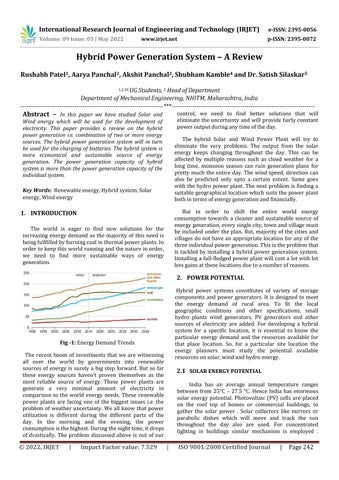
Fig -1: Energy Demand Trends The recent boom of investments that we are witnessing all over the world by governments into renewable sources of energy is surely a big step forward. But so far these energy sources haven't proven themselves as the most reliable source of energy. These power plants are generate a very minimal amount of electricity in comparison to the world energy needs. These renewable power plants are facing one of the biggest issues i.e. the problem of weather uncertainty. We all know that power utilization is different during the different parts of the day. In the morning and the evening, the power consumption is the highest. During the night time, it drops of drastically. The problem discussed above is out of our
© 2022, IRJET
|
Impact Factor value: 7.529
2.1 SOLAR ENERGY POTENTIAL India has an average annual temperature ranges between from 25°C – 27.5 °C. Hence India has enormous solar energy potential. Photovoltaic (PV) cells are placed on the roof top of homes or commercial buildings, to gather the solar power . Solar collectors like mirrors or parabolic dishes which will move and track the sun throughout the day also are used. For concentrated lighting in buildings similar mechanism is employed .
|
ISO 9001:2008 Certified Journal
|
Page 242