
COMPARATIVE STUDY ON THE SEISMIC ANALYSIS OF MULTISTOREY RC STRUCTURE WITH VARIOUS PERCENTAGE OF DIA

Page 1

International Research Journal of Engineering and Technology (IRJET)

e-ISSN: 2395-0056

Volume: 09 Issue: 05 | May 2022

p-ISSN: 2395-0072

www.irjet.net

COMPARATIVE STUDY ON THE SEISMIC ANALYSIS OF MULTISTOREY RC STRUCTURE WITH VARIOUS PERCENTAGE OF DIAPHGRAM DISCONTINUITY. Momin Mohmmed Iliyas1, Aakash suthar2 1Post

Graduate Scholar, Post Graduate Department L.J Institute of Engineering and Technology L.J University, Ahmedabad, India. 2Aakash Rajesh Kumar Suthar, Assistance Professor, L.J Institute of Engineering and Technology L.J University, Ahmedabad, India. ---------------------------------------------------------------------***---------------------------------------------------------------------

Abstract - For the present study, 36 types of buildings have

been selected to determine the effects of diaphragm discontinuity. Model I is taken as a regular building without opening in the slab as shown in figure 5.1 Model II has a central opening of 6.25% as shown in figure 5.4, and Model III is having 9.35 % opening, model 4 has 12% opening, model 5 has 14% opening, model 6 has 18.7% opening, model 7 has 23.4% opening, model 8 has 25% opening model 9 has 31% opening respectively. The prototype buildings are G+12 storied reinforced concrete buildings consisting of eight bays in both the directions. The spacing along X and Y directions is 5m and the storey height is kept as 3m throughout. Hence, the overall plan dimensions are 40m x 40m. Initially, the beam sizes are kept as 300mm x750mm and column dimensions as 800mm x 800mm. Slab thickness is kept as 100,125,150,175mm. Key Words: Diaphgram discontinuity, slab thickness, storey displacement, base shear, storey drift

To study the behaviour of slab thickness in building on seismic response of the structure.

To compare base shear, time period, storey displacement, storey drift in building with and without opening.

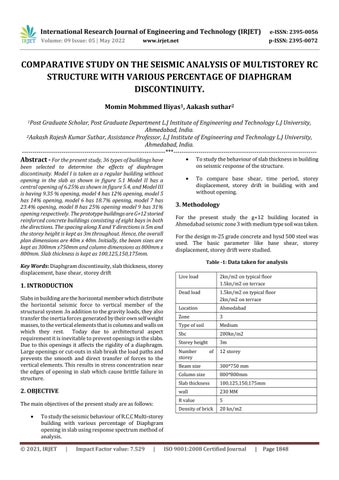
3. Methodology For the present study the g+12 building located in Ahmedabad seismic zone 3 with medium type soil was taken. For the design m-25 grade concrete and hysd 500 steel was used. The basic parameter like base shear, storey displacement, storey drift were studied. Table -1: Data taken for analysis Live load

2kn/m2 on typical floor 1.5kn/m2 on terrace

Dead load

1.5kn/m2 on typical floor 2kn/m2 on terrace

Location

Ahmedabad

Zone

3

Type of soil

Medium

Sbc

200kn/m2

1. INTRODUCTION Slabs in building are the horizontal member which distribute the horizontal seismic force to vertical member of the structural system .In addition to the gravity loads, they also transfer the inertia forces generated by their own self weight masses, to the vertical elements that is columns and walls on which they rest. Today due to architectural aspect requirement it is inevitable to prevent openings in the slabs. Due to this openings it affects the rigidity of a diaphragm. Large openings or cut-outs in slab break the load paths and prevents the smooth and direct transfer of forces to the vertical elements. This results in stress concentration near the edges of opening in slab which cause brittle failure in structure.

2. OBJECTIVE The main objectives of the present study are as follows: 

Storey height Number storey

3m of

12 storey

Beam size

300*750 mm

Column size

800*800mm

Slab thickness

100,125,150,175mm

wall

230 MM

R value

5

Density of brick

20 kn/m2

To study the seismic behaviour of R.C.C Multi-storey building with various percentage of Diaphgram opening in slab using response spectrum method of analysis.

© 2021, IRJET

|

Impact Factor value: 7.529

|

ISO 9001:2008 Certified Journal

|

Page 1848


Turn static files into dynamic content formats.
Create a flipbook