
Recent advances in Spark Plug design and Technology – A Systematic Review

Page 1

International Research Journal of Engineering and Technology (IRJET) Volume: 09 Issue: 05 | May 2022

www.irjet.net

e-ISSN: 2395-0056 p-ISSN: 2395-0072

Recent advances in Spark Plug design and Technology – A Systematic Review Anil Jose1, Dr.G Harish2 1Research

Scholar, Department of Mechanical Engineering University Visvesvaraya College of Engineering Bangalore 01 2Professor, Department of Mechanical Engineering University Visvesvaraya College of Engineering Bangalore 01 ---------------------------------------------------------------------***--------------------------------------------------------------------

Abstract - A spark plug is used for initiation of combustion

short-circuiting of the gap can occur when running at too low a temperature; preignition can occur when working at too high a temperature. Internal combustion engines with spark ignition (SI) that run on gasoline account for most powertrains in light-duty passenger and goods transport vehicles.

(Ignition) by passing a high voltage spark, inside the combustion chamber filled with combustible mixture of Air and fuel. The normal fuels used are Petrol, CNG, LPG, Ethanol and Kerosene.

A general spark plug includes a center electrode, an insulating member which holds the center electrode in an axial hole, a metal shell which surrounds the periphery of the insulating member to hold the insulating member, and a ground electrode which is joined to the metal shell at a proximal end portion and which forms a spark gap at a distal end portion with the center electrode. The fuel mixture is ignited by a spark discharge occurring in the spark gap. Many international Journals and research works are happening in the field of Combustion physics and advancements in Spark plug design and development. In this journal few journals from well reputed international journals and Articles are considered for Review. The journals are reviewed and presented in a systematic way.

Spark plugs initiate the spark production between electrodes in spark-ignited internal combustion engines, which commences the burning of compressed fuel/air mixture. A spark plug must be able to tolerate extremely demanding working conditions in the combustion chamber in terms of performance. It must withstand thermal shocks caused by a succession of cold intake air with ambient temperatures and hot exhaust gases with temperatures reaching 3000°C under high load circumstances. It is prone to chemical reactions and combustion chemical deposits. A spark plug must withstand up to 150 bar of oscillating pressure. It can withstand voltages of up to 40,000 V without charge flashover at the insulator, even when soot and carbon residues are present.

Spark plug has evolved since many decades, it has an glorious history of more than 120yrs. The recent trends include developments in high voltage ceramics, High temperature and Pressure resistance Electrode material development, Design of electrodes for ultra lean gasoline mixtures etc are some of the recent developments. Keywords - Spark Plug, Combustion, physics, high temperature, ceramics, electrodes, High voltage, Brake mean effective pressure

1. INTRODUCTION A spark plug, also known as a Sparking Plug, is a device that fits into an internal-combustion engine's cylinder head and comprises two electrodes separated by an air gap across which electricity from a high-tension ignition system discharge to generate a spark to ignite the air–fuel mixture. The electrodes must be able to survive high temperatures, as well as an electric stress of thousands of volts, and the insulator between them must be able to withstand high temperatures as well. The energy of the spark is influenced by the length of the spark gap, and the operating temperature is influenced by the shape of the insulator. Carbonization and

© 2022, IRJET

|

Impact Factor value: 7.529

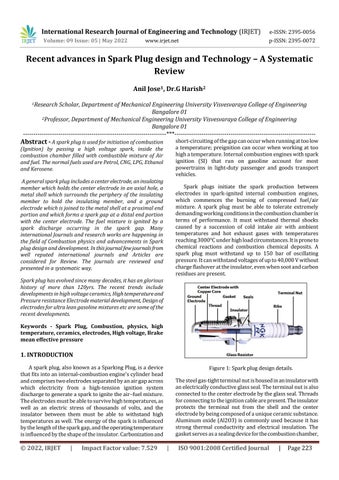
Figure 1: Spark plug design details. The steel gas-tight terminal nut is housed in an insulator with an electrically conductive glass seal. The terminal nut is also connected to the center electrode by the glass seal. Threads for connecting to the ignition cable are present. The insulator protects the terminal nut from the shell and the center electrode by being composed of a unique ceramic substance. Aluminum oxide (Al2O3) is commonly used because it has strong thermal conductivity and electrical insulation. The gasket serves as a sealing device for the combustion chamber,

|

ISO 9001:2008 Certified Journal

|

Page 223


Turn static files into dynamic content formats.
Create a flipbook