International Research Journal of Engineering and Technology (IRJET) Volume: 09 Issue: 05 | May 2022 www.irjet.net
e-ISSN: 2395-0056 p-ISSN: 2395-0072
Predictive Modeling for Topographical Analysis of Crime Rate Prof. Vrushali V. Kondhalkar1, Antara More2, Bhawana Singh3, Jaspreet Singh Rahi4, Sudipti Ranjan5 1Prof,
Dept. Of Computer Engineering, Pune, Maharashtra, India Of Computer Engineering, Pune, Maharashtra, India ---------------------------------------------------------------***----------------------------------------------------------------research, and this makes crime predictable. Predicting Abstract - Criminal activities are increasing all over the 2,3,4,5 Dept.
world. It is important to reduce crime as it directly affects the country's economic growth. There is therefore an urgent need for security agencies to fight crime reduction in the community. The proposed system enables us to detect crime and resolve crime cases quickly based on data collected using machine learning strategies. The system helps to predict the type of crime in a particular area based on crime patterns. In this project, we will be using the machine learning method. Contains important information about crime reporting such as date, type of crime, crime scene, etc. The data is downloaded from a website called kaggle.com and is processed in advance so that we can extract the most important environmental features of crime reporting. such as a few streets or places, days, times, and places with a higher crime rate than others. This data is used as an incentive to predict and resolve crime quickly. This work will help us find a way to improve the crime detection system, the type of crime that will occur in a particular area, and how to improve investigative efforts of any kind of crime.
crime patterns is an important function in developing effective crime prevention strategies or to develop investigative efforts based on prior data acquisition such as case information, location, date, and time. Here, we use machine learning techniques to predict crime and its types in crime areas. Machine Learning is a kind of practical wisdom that helps us to identify patterns using data analysis. There are three stages:
Keywords: Machine learning, Crime prediction
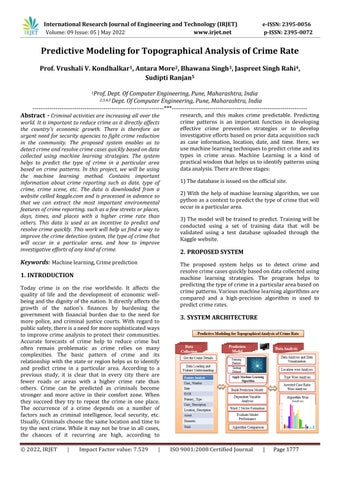
The proposed system helps us to detect crime and resolve crime cases quickly based on data collected using machine learning strategies. The program helps to predicting the type of crime in a particular area based on crime patterns. Various machine learning algorithms are compared and a high-precision algorithm is used to predict crime rates.
1. INTRODUCTION Today crime is on the rise worldwide. It affects the quality of life and the development of economic wellbeing and the dignity of the nation. It directly affects the growth of the nation's finances by burdening the government with financial burden due to the need for more police, and criminal justice courts. With regard to public safety, there is a need for more sophisticated ways to improve crime analysis to protect their communities. Accurate forecasts of crime help to reduce crime but often remain problematic as crime relies on many complexities. The basic pattern of crime and its relationship with the state or region helps us to identify and predict crime in a particular area. According to a previous study, it is clear that in every city there are fewer roads or areas with a higher crime rate than others. Crime can be predicted as criminals become stronger and more active in their comfort zone. When they succeed they try to repeat the crime in one place. The occurrence of a crime depends on a number of factors such as criminal intelligence, local security, etc. Usually, Criminals choose the same location and time to try the next crime. While it may not be true in all cases, the chances of it recurring are high, according to © 2022, IRJET
|
Impact Factor value: 7.529
|
1) The database is issued on the official site. 2) With the help of machine learning algorithm, we use python as a context to predict the type of crime that will occur in a particular area. 3) The model will be trained to predict. Training will be conducted using a set of training data that will be validated using a test database uploaded through the Kaggle website.
2. PROPOSED SYSTEM
3. SYSTEM ARCHITECTURE
ISO 9001:2008 Certified Journal
|
Page 1777