
Design and Modelling of Automated Dimensional Check Conveyor Belt System for Categorization of Objec

Page 1

International Research Journal of Engineering and Technology (IRJET)

e-ISSN: 2395-0056

Volume: 09 Issue: 05 | May 2022

p-ISSN: 2395-0072

www.irjet.net

Design and Modelling of Automated Dimensional Check Conveyor Belt System for Categorization of Objects 1Prof.

2Shruti

S. Mahajan,

2Pradnya

Shyam S. Darewar S. Bhosale, 2Vaishnavi A. Adagale, 2Avishkar R. Agavane

Mechanical Department, Professor at P.E.S. Modern College of Engineering, 1186/A, Off J.M. Road, Shivajinagar, Pune, Maharashtra 411005, India 2Bachelor of Engineering, PES Modern College of Engineering, Pune, 411005. ---------------------------------------------------------------------***--------------------------------------------------------------------1.2] Proposed System Abstract: To load and unload raw materials from one 1

manufacturing stage to another, raw materials and products need to be transferred. To avoid defective products, detection or checking is necessary. We manufactured a mechatronics system (a prototype) based on ultrasonic sensors and programming. Using these sensors, we are checking three dimensions of an object in one pass i.e., simultaneously. In the end, the diverter separates the defected object and further transports it. Various design parameters like belt width, belt speed, belt pull, and motor selection are carried out as per the readings taken. The system has reached the requirement of dimensional checking and categorizing the objects.

This proposed system can overcome the problems of the existing system. It gives the convenient approach of automatically detecting the dimensions of the job over the conveyor system using a micro-controller for high accuracy, precision, and fast material handling without any interruption. The dimensional check conveyor system consists of six ultrasonic sensors for the measurement of three dimensions i.e., height, width, and length of an object. The system is T-shaped and consists of three conveyor belts, one primary and two secondary belts. The arrangement of the system is such that two secondary belts are connected perpendicularly to the primary belt. The primary belt consists of a checkbox that includes the above-mentioned ultrasonic sensors. Two sensors for checking one dimension each. A diverter/separator is placed on the junction point of primary and secondary belts which segregates the job as per the aspects being detected.

Key Words: Conveyor Belt, Rollers, Micro-controller, Ultrasonic sensors, Circuit Manufacturing, Arduino Sketch, Embedded C, Proteus Professional.

1] INTRODUCTION For the completion of the tasks on a large scale, manpower and time are seen to be critical constraints nowadays. Automation helps us in reduction of human power, and human errors and increases the speed of operation. The main purpose of our system is to increase the accuracy in dimensional checking of jobs in the industry and then segregate it as accepted or rejected based on quality checking. Industrial machining and processes depend upon computers which reduce human intervention. In the existing system, only one dimension can be checked at a time and is unable to categorize objects as accepted or rejected. The system we designed is capable of overcoming the abovementioned problem.

2] METHODOLOGY

1.1 ] Current scheme The existing system used a proximity sensor for measuring a single dimension at one pass. When the inspection is done, the separation of defected objects is done manually. This process consumes time. Also due to single dimension checking, the efficiency of a system is less as it is semiautomated.

© 2022, IRJET

|

Impact Factor value: 7.529

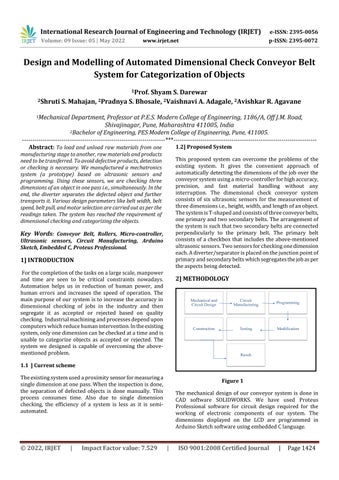
Figure 1 The mechanical design of our conveyor system is done in CAD software SOLIDWORKS. We have used Proteus Professional software for circuit design required for the working of electronic components of our system. The dimensions displayed on the LCD are programmed in Arduino Sketch software using embedded C language.

|

ISO 9001:2008 Certified Journal

|

Page 1424


Turn static files into dynamic content formats.
Create a flipbook