International Research Journal of Engineering and Technology (IRJET)
e-ISSN: 2395-0056
Volume: 09 Issue: 05 | May 2022
p-ISSN: 2395-0072
www.irjet.net
Emotion Recognition through Speech Analysis using various Deep Learning Algorithms Aayushi Arora1, Harshada Jadhav2, Prachi Palkar3 1,2,3 Usha
Mittal Institute of Technology SNDT Women’s University, Mumbai Guide:- Prof. Mohan Bonde, Usha Mittal Institute of Technology SNDT Women’s University, Mumbai
Abstract:
Related Work:
Emotions are reactions or the feeling that everyone has and it plays an important role in human life. Emotions are reflected from speech, hand and gestures of the body and through facial expressions. But now-a-days understanding the emotions has become a challenge, dictating the voice or speech and finding the feeling of the person whether he is happy, sad or angry is important to have a healthy communication between human and machine. In order to build an intelligent machine, it’s necessary to understand the emotion. To overcome this problem and to develop a strong interaction between human and machine we are introducing a speech emotion recognition system which will recognise the emotions beside the voice through speech analysis using various algorithms. Also, we will compare the accuracy of these two algorithms. In this project, we have considered seven emotions such as Neutral, Happy, Sad, Angry, Fearful, Disgusted, and Surprised.
1. 2.
3. 4.
Chenchen Huang, Wei Gong, Wenlong Fu, and Dongyu Feng presented A Research of Speech Emotion Recognition Chengwei Huang,1Ruiyu Liang, Qingyun Wang, Ji Xi, Cheng Zha, and Li Zhao proposed Practical Speech Emotion Recognition Based on Online Learning: From Acted Data to Elicited Data Han et al. worked on Speech Emotion Recognition Using Deep Neural Network And extreme machine learning algorithms Huang et al. speech emotion recognition using CNN
Abbreviations:
CNN- Convonutional Neural Network RNN- Recurrent Neural Network SVC- Support Vector Classifier MFCC- Mel Frequency Cepstral Coefficient Conv2D Convolutional 2D CRF- Conditional Random Field
Keywords: Healthy Communication, RNN, SVC, Emotion Recognition, Speech Analysis, CNN, Feature extraction, Confusion Matrix, RandomForest.
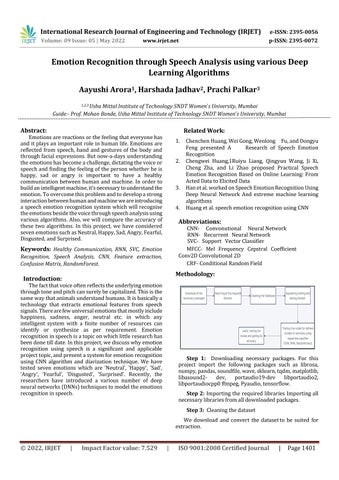
Methodology:
Introduction:
The fact that voice often reflects the underlying emotion through tone and pitch can surely be capitalized. This is the same way that animals understand humans. It is basically a technology that extracts emotional features from speech signals. There are few universal emotions that mostly include happiness, sadness, anger, neutral etc. in which any intelligent system with a finite number of resources can identify or synthesize as per requirement. Emotion recognition in speech is a topic on which little research has been done till date. In this project, we discuss why emotion recognition using speech is a significant and applicable project topic, and present a system for emotion recognition using CNN algorithm and diarization technique. We have tested seven emotions which are ’Neutral’, ’Happy’, ’Sad’, ’Angry’, ’Fearful’, ’Disgusted’, ’Surprised'. Recently, the researchers have introduced a various number of deep neural networks (DNNs) techniques to model the emotions recognition in speech.
Step 1: Downloading necessary packages. For this project import the following packages such as librosa, numpy, pandas, soundfile, wave, sklearn, tqdm, matplotlib, libasound2dev, portaudio19-dev libportaudio2, libportaudiocpp0 ffmpeg, Pyaudio, tensorflow. Step 2: Importing the required libraries Importing all necessary libraries from all downloaded packages. Step 3: Cleaning the dataset We download and convert the dataset to be suited for extraction.
© 2022, IRJET
|
Impact Factor value: 7.529
|
ISO 9001:2008 Certified Journal
|
Page 1401