International Research Journal of Engineering and Technology (IRJET)
e-ISSN: 2395-0056
Volume: 09 Issue: 05 | May 2022
p-ISSN: 2395-0072
www.irjet.net
Photo Editing And Sharing Web Application With AIAssisted Features Kaustubh Jangde1, Vishwajeet Ohal2, Kaustubh Chaudhari3, Anuja Aher4 1-4Student,
Dept. of Computer Engineering, Sinhgad College of Engineering, Maharashtra, India ---------------------------------------------------------------------***---------------------------------------------------------------------
Abstract - In the 21st century, images play a crucial role
application. To establish semantic editing, the recently developed deep learning algorithm of GANs has been used.
in the media. Applying filters and customizing images to one’s desires is commonplace and the need for image manipulation tools has been on the rise for the last decade. We try to build an application using state-of-the-art Machine Learning technology of Generative Adversarial Networks (GANs). GANs have been proven to reduce human efforts for image manipulation and are one of the most suitable techniques for the task today. In addition, GANs provide image generation with unparalleled resolution and high fidelity. The proposed application makes use of this methodology to establish real-time image manipulation on a wide array of platforms using inputs from the user. Since most editing applications require some professional skills for editing an image, we try to make the editing process hassle-free with our AI-assisted features. Furthermore, the application allows users to share images on multiple platforms including our own. Key Words: Generative adversarial StyleGAN, deep learning, image editing.
2.2 Image Transformation using GANs The task of image generation is carried out best by using generative networks. Generative networks can be further classified into two types, viz. Auto Encoders and GANs. Recent literature has shown that GANs have an upper edge in performing image manipulation, especially when dealing with semantic feature editing in various scenarios.
network,
1. INTRODUCTION
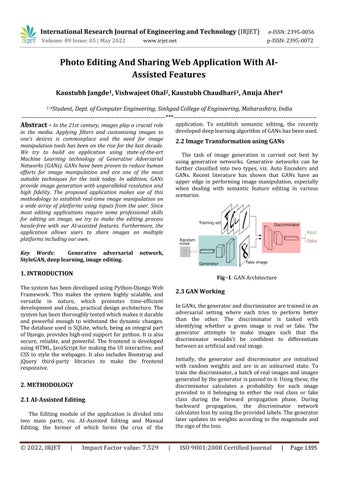
Fig -1: GAN Architecture
The system has been developed using Python-Django Web Framework. This makes the system highly scalable, and versatile in nature, which promotes time-efficient development and clean, practical design architecture. The system has been thoroughly tested which makes it durable and powerful enough to withstand the dynamic changes. The database used is SQLite, which, being an integral part of Django, provides high-end support for python. It is also secure, reliable, and powerful. The frontend is developed using HTML, JavaScript for making the UI interactive, and CSS to style the webpages. It also includes Bootstrap and jQuery third-party libraries to make the frontend responsive.
2.3 GAN Working In GANs, the generator and discriminator are trained in an adversarial setting where each tries to perform better than the other. The discriminator is tasked with identifying whether a given image is real or fake. The generator attempts to make images such that the discriminator wouldn't be confident to differentiate between an artificial and real image. Initially, the generator and discriminator are initialized with random weights and are in an unlearned state. To train the discriminator, a batch of real images and images generated by the generator is passed to it. Using these, the discriminator calculates a probability for each image provided to it belonging to either the real class or fake class during the forward propagation phase. During backward propagation, the discriminator network calculates loss by using the provided labels. The generator later updates its weights according to the magnitude and the sign of the loss.
2. METHODOLOGY 2.1 AI-Assisted Editing The Editing module of the application is divided into two main parts, viz. AI-Assisted Editing and Manual Editing, the former of which forms the crux of the
© 2022, IRJET
|
Impact Factor value: 7.529
|
ISO 9001:2008 Certified Journal
|
Page 1395