International Research Journal of Engineering and Technology (IRJET)
e-ISSN: 2395-0056
Volume: 09 Issue: 05 | May 2022
p-ISSN: 2395-0072
www.irjet.net
AN ADVANCED MONITORING AND HEALTH CARE FOR ASTHMA Monisha. D1, Mano Ranjitham. R2, Amal Stefy Rose. R3, Keerthana. L4, Janani. V5 1Assistant
Professor, Department of Biomedical Engineering, Hindusthan College of Engineering and Technology, Tamil Nadu, India 2Department of Biomedical Engineering, Hindusthan College of Engineering and Technology, Coimbatore, Tamil Nadu, India ---------------------------------------------------------------------***---------------------------------------------------------------------
Abstract - Asthma is a common chronic disease that affects
The method proposed is a prototype model for wearable band asthma monitoring system. An IoT based alert system will help the patients to be treated in time, that will provide the patients with needed medical assistance in correct time.
most of the children world-wide. It is characterized by continuous cough, wheezing, shortness of breath, reversible air flow limitation and bronchial hyperresponsiveness. Asthma in young children is difficult to diagnose as lung function measurements are not much reliable in young children. Symptoms that the young children possess are not necessary to be asthma specific symptoms. This proposed system is to provide support and help the children to be diagnosed and treated in advance to reduce the chances critical complications. The sensors implemented in this prototype detect the pollution and dust particles levels. If any difficulties in breathing is detected among the children, the IOT alert system triggers an alarm and alert the emergency contact person’s device connected to the alert system through message notifications. In this way, proper medical assistance can be given to the children immediately.
The signals are obtained from the sensors and can be monitored with the help of the mobile application, BLYNK. Blynk is an IoT platform for android devices that are connected to Internet. The prototype model is connected with a specific user name and password for a particular patient. The android device with that username and password gets connected automatically. N number devices can be connected to a single patient that will be helpful in giving alert to doctors, nurses and care-takers at the same-time. The real time values have been monitored from the connected devices through Blynk application.
Key Words: Node MCU, Blynk Server Application, Humidity Sensor, Gas Sensor, Dust Sensor
Therefore, patients’ condition can be monitored from distant location and an emergency alert in emergency conditions will be given to save the lives of the patients with the help of this real-time monitoring.
1.INTRODUCTION Asthma, a respiratory disease, is primarily caused by genetic inheritance and it can also be allergy induced. It causes difficulties in breathing and make challenges in physical activities for people of all ages. [1] Although the healthcare support are getting upgraded in Indian hospitals over the recent years, there is less than one doctor for every 1000 population (0.62:1000). This ratio is less than the World Health Organization (WHO) requirement (1:1000). [2] In recent years, Asthma appears to be the one of the most common disease that needs hospitalization. Using a low-cost sensor-based IoT system can help in management of these diseases. [3] This paper describes a cost-effective portable model of health monitoring system for asthma monitoring. The abnormality is detected with alert notification. [1][3] An android application is used to record the vital signs to avoid burden and maintenance cost of medical servers. [4] The signals are obtained from the sensors and can be monitored through android application. The real-time value can be monitored from the connected device. [1][3][4] The patient’s condition is monitored from distant location and emergency alert is given to safeguard the life of patients using real-time monitoring.[5]
© 2022, IRJET
|
Impact Factor value: 7.529
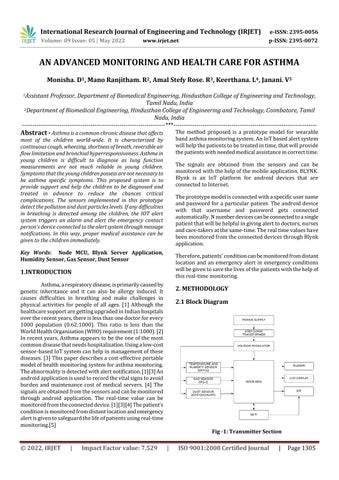
2. METHODOLOGY 2.1 Block Diagram
Fig -1: Transmitter Section
|
ISO 9001:2008 Certified Journal
|
Page 1305