International Research Journal of Engineering and Technology (IRJET)
e-ISSN: 2395-0056
Volume: 09 Issue: 05 | May 2022
p-ISSN: 2395-0072
www.irjet.net
BEHAVIOR OF TALL MASONRY CHIMNEYS UNDER WIND LOADINGS USING CFD TECHNIQUE DEEPAK SINGH1, PUKHRAJ SAHU2 1Research
scholar, Department of Civil Engineering, Govt. Engineering College, Jagdalpur. Professor, Department of Civil Engineering, Govt. Engineering College, Jagdalpur. -------------------------------------------------------------------***-------------------------------------------------------------------2Assistant
Abstract: The design of building structures significantly affects its aerodynamic characteristics. The current research studies various researches conducted to determine the effect of building design on drag force and shear. The study conducted by various researchers includes experimental and numerical methods to determine aerodynamic characteristics. The research findings would provide useful information to engineers which could assist them in improving designs of building structures. This study proposes a technique based on Computational Fluid Dynamics(CFD) to calculate wind induced response of tall masonry chimneys using Finite Volume Method (FVM) by ANSYS. Key Words: Aerodynamics, Building design, Drag force, Shear, Wind induced response, CFD, FVM. 1. INTRODUCTION
In the laminar flow regime, Hyeog Yoon et al [3] conducted a parametric investigation to elucidate the properties of flow past a square cylinder tilted with respect to the main flow. A topological classification of the linked flow patterns is attempted, yielding three unique patterns in total. The effects of Reynolds number and angle of incidence on flowinduced forces on the square cylinder were investigated in depth. For the ranges of the two parameters considered, contour diagrams of force and moment coefficients, Strouhal number, rms of lift-coefficient fluctuation, as well as a flow-pattern diagram, are proposed.
Aerodynamics is a field of dynamics that studies how air moves, especially when it collides with a solid object. The calculation of forces and moments acting on an item is made possible by understanding the motion of air around the object (also known as a flow field). The issues that designers face while designing super-tall buildings include wind influences. Super-tall buildings are more vulnerable to winds due to their slenderness, low natural frequencies, low inherent dampening level, and high wind speed at upper levels. With breakthroughs in structural design and high-strength materials, modern tall structures are becoming more taller. Every increase in height, however, introduces a new challenge. Building weight and damping are reduced, and slenderness is increased, thanks to efficient structural systems, high-strength materials, and increased height. .Understandably, an appropriate building shape and architectural alterations are equally essential and successful design options for reducing wind produced motion by changing the flow pattern around the building. . Drag forces are referred to as along wind or just wind [1]. Structures are subjected to aerodynamic forces caused by the wind, including the drag (along wind) force operating in the direction of the mean wind flow. 2. LITERATURE REVIEW Cuong Nguyen et al [2] investigated the dynamic torsional behaviour of tall buildings under wind loads using a CFD analysis on different aspect ratios of rectangular tall buildings. The numerical outcomes are comparable to the experimental outcomes.
© 2022, IRJET
|
Impact Factor value: 7.529
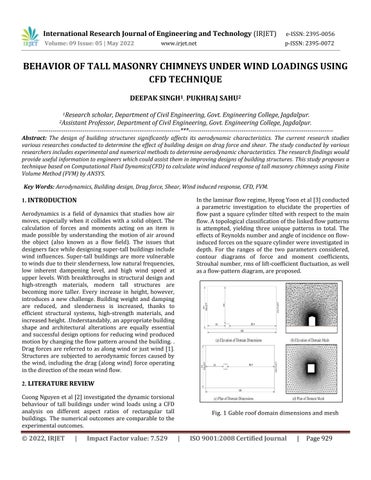
Fig. 1 Gable roof domain dimensions and mesh
|
ISO 9001:2008 Certified Journal
|
Page 929