
A REVIEW ON LATENT FINGERPRINT RECONSTRUCTION METHODS

Page 1

International Research Journal of Engineering and Technology (IRJET)

e-ISSN: 2395-0056

Volume: 09 Issue: 05 | May 2022

p-ISSN: 2395-0072

www.irjet.net

A REVIEW ON LATENT FINGERPRINT RECONSTRUCTION METHODS Pooja Das1, Prof. Kanjana G2 1 PG

student, Dept. of Electronics and communication Engineering, LBSITW, Kerala, India Professor, Dept. of Electronics and Communication Engineering, LBSITW, Kerala, India ---------------------------------------------------------------------***--------------------------------------------------------------------The minutiae (set of minutia points) are the most effective Abstract - Fingerprints are the most important means of 2Assistant

feature among these three types of characteristics and is most typically utilized in fingerprint matching and recognition systems. It was believed that it is not possible to reconstruct a fingerprint image from its extracted minutiae set. However, it has been demonstrated that it is possible to reconstruct the fingerprint image in this way and the reconstructed image can be matched to the original fingerprint image with a reasonable high accuracy. The goal of fingerprint reconstruction from a set of minutiae is for the rebuilt fingerprint to look like the original.

identification of an individual due to its uniqueness, permanence, acceptability and collectability. And the minutiae-based representation is the widely accepted fingerprint representation method. However, a constraint was taken into account that the minutiae points are entirely insufficient for the latent fingerprint reconstruction. Latent fingerprints are fingerprint impressions left at crime scenes by criminals that have been used as primary evidence in criminal investigations. The quality of latent fingerprints is typically poor, with complicated background noise, distortion, and a limited fingerprint region. As a result, image enhancement is required for the reliable identification. A lot of research is being done to automate all of the major processes in the latent fingerprint identification process. The performance of several state-of-the-art latent fingerprint identification systems, on the other hand, is far from satisfactory. The existence of noise, distortion, little information, and a big database make designing a latent fingerprint identification system extremely difficult. The purpose of this paper is to make a comparative analysis of existing latent fingerprint reconstruction methods.

The existing fingerprint reconstruction methods consist of two major steps: i)

Orientation field reconstruction and

ii) Ridge pattern reconstruction. Only when the reconstructed image matches the original fingerprint image on the minutiae points is considered as the successful fingerprint reconstruction.

Key Words: Minutiae, Latent fingerprint, fingerprint reconstruction, image identification system.

enhancement,

fingerprint

1. INTRODUCTION Fingerprint recognition is one of the most effective method for the identifying an individual. This is used to confirm the identity of a person by comparing the fingerprint impression of two fingerprints. Even with the new emerging techniques in the field of biometrics, fingerprints have the most reliable physiological traits due to their uniqueness, permanence, collectability and acceptability. Thus, it is used in many applications today in the field of criminology, banking etc.

(a)

|

Impact Factor value: 7.529

(c)

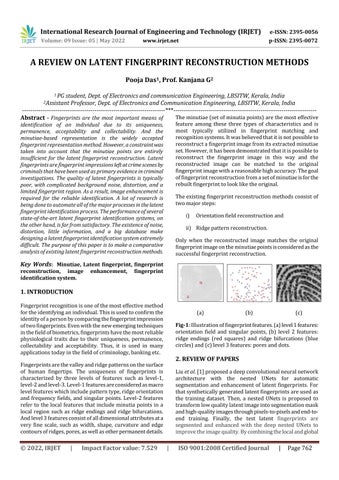
Fig-1: Illustration of fingerprint features. (a) level 1 features: orientation field and singular points, (b) level 2 features: ridge endings (red squares) and ridge bifurcations (blue circles) and (c) level 3 features: pores and dots.

2. REVIEW OF PAPERS

Fingerprints are the valley and ridge patterns on the surface of human fingertips. The uniqueness of fingerprints is characterized by three levels of features such as level-1, level-2 and level-3. Level-1 features are considered as macro level features which include pattern type, ridge orientation and frequency fields, and singular points. Level-2 features refer to the local features that include minutia points in a local region such as ridge endings and ridge bifurcations. And level 3 features consist of all dimensional attributes at a very fine scale, such as width, shape, curvature and edge contours of ridges, pores, as well as other permanent details.

© 2022, IRJET

(b)

Liu et al. [1] proposed a deep convolutional neural network architecture with the nested UNets for automatic segmentation and enhancement of latent fingerprints. For that synthetically generated latent fingerprints are used as the training dataset. Then, a nested UNets is proposed to transform low quality latent image into segmentation mask and high-quality images through pixels-to-pixels and end-toend training. Finally, the test latent fingerprints are segmented and enhanced with the deep nested UNets to improve the image quality. By combining the local and global

|

ISO 9001:2008 Certified Journal

|

Page 762


Turn static files into dynamic content formats.
Create a flipbook
A REVIEW ON LATENT FINGERPRINT RECONSTRUCTION METHODS by IRJET Journal - Issuu