
Signature Forgery Detection Using Convolutional Neural Network

Page 1

International Research Journal of Engineering and Technology (IRJET)

e-ISSN: 2395-0056

Volume: 09 Issue: 05 | May 2022

p-ISSN: 2395-0072

www.irjet.net

Signature Forgery Detection Using Convolutional Neural Network Ms.KAVITHA.A.K1, KEERTHANAH.M2, BHAVYA.K.B3, JANANI.J4 1Assistant

Professor, Dept. Of Electronics and Communication Engineering, Tamil Nadu, India Student, Dept. of Electronics and Communication Engineering, Tamil Nadu, India ---------------------------------------------------------------------***--------------------------------------------------------------------3. PROPOSED SYSTEM Abstract - Each person’s signature may be distinctive. 2, 3, 4 UG

Signatures, on the other hand, provide a number of difficulties because two signatures created by the same individual may appear to be extremely identical. Even when two signatures are signed by the same person, several features of the signature can differ. A Convolutional Neural Network (CNN) based solution is proposed in this paper in which the model is trained on a dataset of signatures and predictions are produced as to whether a given signatures is real or forged.

The handwritten signature is a behavioural biometric that is based on changing behaviour rather than any physiological aspects of the individual signature. Because a person's signature changes over time, verification and authentication are necessary. It may take a long time for the signature to be authenticated because of the flaws that must be corrected. Higher signature irregularity might sometimes contribute to a higher rate of false applications.

Key Words: Convolution Neural Network, Handwritten signature, Dataset, Image Preprocessing, Data Augmentation.

1. INTRODUCTION A handwritten signature is a scripted name or legal mark made by hand with the intention of permanently authenticating the writing. Because signatures are created by moving a pen across a piece of paper, movement is possibly the most crucial feature of a signature. Signature verification is critical because, unlike passwords, signatures cannot be changed or forgotten because they are unique to each individual, and thus is regarded as the most significant way of verification. Signature verification techniques and systems are separated into offline signature and online signature methods. Although small-scale data studies have received a lot of attention in recent years, most deep learning approaches still require a significant number of samples to train their system. To put it another way, most studies still require several (multiple) signature samples to complete their training process. It offers an off-line handwritten signature verification approach based on Convolutional neural networks in this work (CNN).

2. EXISTING SYSTEM The existing technology makes use of digital signatures, generating one for each column and embedding it in the least significant bits of selected pixels in each associated column. The message digest 5 technique is used to generate digital signatures, and the signature is embedded in the allocated pixels using the four least significant bits replacement process. The digital signature's embedding in the targeted pixel is absolutely harmless and undetectable to the human visual system. The suggested forgery detection technique has shown promising results against a variety of forgeries put into digital photos, successfully detecting and pointing out fabricated columns. © 2021, IRJET

|

Impact Factor value: 7.529

|

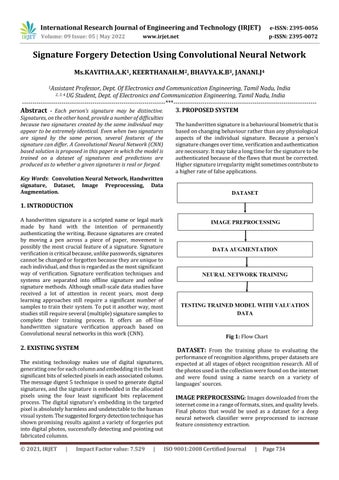
Fig 1: Flow Chart

DATASET: From the training phase to evaluating the performance of recognition algorithms, proper datasets are expected at all stages of object recognition research. All of the photos used in the collection were found on the internet and were found using a name search on a variety of languages' sources. IMAGE PREPROCESSING: Images downloaded from the

internet come in a range of formats, sizes, and quality levels. Final photos that would be used as a dataset for a deep neural network classifier were preprocessed to increase feature consistency extraction.

ISO 9001:2008 Certified Journal

|

Page 734


Turn static files into dynamic content formats.
Create a flipbook