
Authentication and Tracking of Government Benefits Using Blockchain

Page 1

International Research Journal of Engineering and Technology (IRJET)

e-ISSN: 2395-0056

Volume: 09 Issue: 05 | May 2022

p-ISSN: 2395-0072

www.irjet.net

Authentication and Tracking of Government Benefits Using Blockchain Rushikesh kamble 1, Renuka Patil 2, Riya Shelwante 3, Bhagyashri Kankekar 4, 5Mrs. R.T.Waghmode 1,2,3,4 Students,

Department of Computer Engineering in Degree, Sinhgad Institute of Technology and Science Professor, Dept. of Computer Engineering, Sinhgad Institute of Technology and Science College, Pune ---------------------------------------------------------------------***--------------------------------------------------------------------2. PROJECT MODULE Abstract - India, the fastest growing economy in the 5

world, has a great potential in attracting global customers and adapting to new technologies and changes. Digitalization has great capabilities which in turn improve and enhance the connectivity in nearly every sector of its economy. But at times the distribution of these approaches is uneven among a few sectors of government. Adapting to the latest growing technology will in turn help in bringing great value and a drastic change in the mode of operations/work for the large group of people out there. Blockchain is one such technology. Due to its feature-like decentralized approach, secure, immutable, tamper-proof nature it is being adopted by every sector globally.

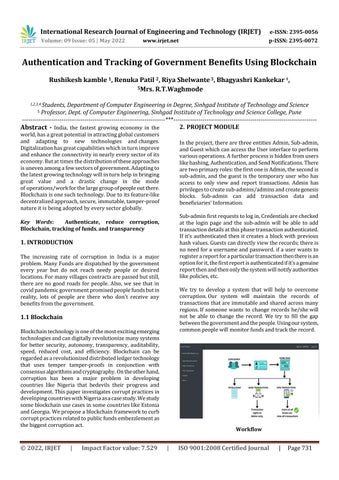
In the project, there are three entities Admin, Sub-admin, and Guest which can access the User interface to perform various operations. A further process is hidden from users like hashing, Authentication, and Send Notifications. There are two primary roles: the first one is Admin, the second is sub-admin, and the guest is the temporary user who has access to only view and report transactions. Admin has privileges to create sub-admins/admins and create genesis blocks. Sub-admin can add transaction data and beneficiaries’ Information. Sub-admin first requests to log in, Credentials are checked at the login page and the sub-admin will be able to add transaction details at this phase transaction authenticated. If it’s authenticated then it creates a block with previous hash values. Guests can directly view the records; there is no need for a username and password. if a user wants to register a report for a particular transaction then there is an option for it, the first report is authenticated if it’s a genuine report then and then only the system will notify authorities like policies, etc.

Key Words: Authenticate, reduce corruption, Blockchain, tracking of funds, and transparency

1. INTRODUCTION The increasing rate of corruption in India is a major problem. Many Funds are dispatched by the government every year but do not reach needy people or desired locations. For many villages contracts are passed but still, there are no good roads for people. Also, we see that in covid pandemic government promised people funds but in reality, lots of people are there who don't receive any benefits from the government.

We try to develop a system that will help to overcome corruption. Our system will maintain the records of transactions that are immutable and shared across many regions. If someone wants to change records he/she will not be able to change the record. We try to fill the gap between the government and the people. Using our system, common people will monitor funds and track the record.

1.1 Blockchain Blockchain technology is one of the most exciting emerging technologies and can digitally revolutionize many systems for better security, autonomy, transparency, auditability, speed, reduced cost, and efficiency. Blockchain can be regarded as a revolutionized distributed ledger technology that uses temper tamper-proofs in conjunction with consensus algorithms and cryptography. On the other hand, corruption has been a major problem in developing countries like Nigeria that bedevils their progress and development. This paper investigates corrupt practices in developing countries with Nigeria as a case study. We study some blockchain use cases in some countries like Estonia and Georgia. We propose a blockchain framework to curb corrupt practices related to public funds embezzlement as the biggest corruption act.

© 2022, IRJET

|

Impact Factor value: 7.529

Workflow

|

ISO 9001:2008 Certified Journal

|

Page 731


Turn static files into dynamic content formats.
Create a flipbook