International Research Journal of Engineering and Technology (IRJET)
e-ISSN: 2395-0056
Volume: 09 Issue: 05 | May 2022
p-ISSN: 2395-0072
www.irjet.net
MOUSE SIMULATION USING NON MAXIMUM SUPPRESSION Mr.Ravisankar S1, Mr.Sanjay Nanthan S2, Ms.Shivani S3, Mr.Sivasampath B4 , Ms.Varsha K5 Assistant Professor, Department of CSE, Coimbatore Institute of Technology, Coimbatore, Tamil Nadu, India 2,3,4,5 Department of CSE, Coimbatore Institute of Technology, Coimbatore, Tamil Nadu, India ---------------------------------------------------------------------***--------------------------------------------------------------------deployed after Single Shot Multi box Detection is used to Abstract - The main aim of this project is to achieve the 1
identify anchor boxes or bounding boxes for the given input images. Using Open CV, web camera is accessed, and video is recorded and converted into number of frames. Computations regarding functionalities for the gestures, after being taken as input, are done within the system itself. The main aim is to create a cost-free hand recognition software for laptops and PCs with external webcams.
various functions of a mouse virtually. In this, the position of the cursor can be controlled without using any electronic devices as an input. For instance, cursor may perform operations like dragging, capturing an image, zooming in and out can be performed with different hand gestures. Hand gestures is captured by using webcam and it is considered as an input device. With the help of this, we can identify the color of the hand and decide the position of the cursor accordingly. Since the environment may contain noises, lighting issues, and background merge of different objects. Therefore, it becomes imperative that the color determining works accurately. Initially, the image is captured by using the webcam and the human hand is extracted amidst the noises in the image. The position of the human hand is stored in the model using the coordinate system. The fingertip location is mapped to RGB images to control the mouse cursor based on a virtual screen. To achieve this, Single Shot Multi box Detection algorithm (SSD) along with the combination of Non- Maximum Suppression (NMS) algorithm is deployed. The motive of this work is to make the machines interact with the human environment and to verify the adaptability to the growing AIdependent world.
1.1 CNN Deep Learning algorithms such as Convolutional Neural Network (ConvNet/CNN) learn to assign weights and biases to various aspects/objects in an image and determine the importance of each. The pre-processing required in a ConvNet is much lower as compared to other classification. With ConvNets, images are reduced into a form that is easier to process without losing the essential features that are crucial for a good prediction. There are three layers in convolutional neural networks, 1. 2. 3.
Convolutional layer Pooling layer Fully connected layer
Key Words: Virtual mouse, Single shot multibox detection, non-maximum suppression, Open CV, Media Pipe
1. INTRODUCTION People want compact electronic devices that enable human – computer interactions. Human computer interactions (HCI) began in the early 1980’s as a field of study and practice. One of the simplest and most significant ways of human communication is through hand gestures that people tend to make even unknowingly. The main objective of this project is to setup a system that would reduce the need for major hardware components since most of it face the threat of durability and propose a system that would control the functionalities of a mouse using just hand gestures. The system is designed and implemented to perform the functions of a traditional mouse for which image or object detection plays a major role. To achieve this, Media Pipe is used which uses an algorithm called Non – Maximum Suppression algorithm which aids in detecting the hand gestures accurately to perform functionalities. This is
© 2022, IRJET
|
Impact Factor value: 7.529
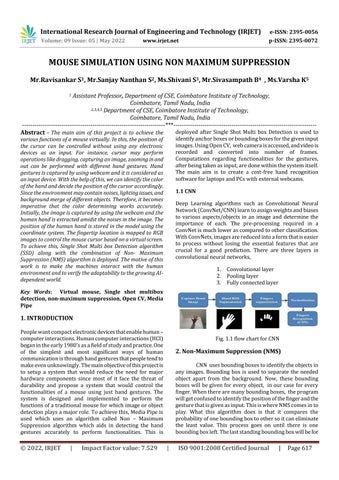
Fig. 1.1 flow chart for CNN
2. Non-Maximum Suppression (NMS) CNN uses bounding boxes to identify the objects in any images. Bounding box is used to separate the needed object apart from the background. Now, these bounding boxes will be given for every object, in our case for every finger. When there are many bounding boxes, the program will get confused to identify the position of the finger and the gesture that is given as input. This is where NMS comes in to play. What this algorithm does is that it compares the probability of one bounding box to other so it can eliminate the least value. This process goes on until there is one bounding box left. The last standing bounding box will be for
|
ISO 9001:2008 Certified Journal
|
Page 617