
Random Walks in Statistical Theory of Communication

Page 1

International Research Journal of Engineering and Technology (IRJET)

e-ISSN: 2395-0056

Volume: 09 Issue: 05 | May 2022

p-ISSN: 2395-0072

www.irjet.net

Random Walks in Statistical Theory of Communication Pritish Vinayak Wagh1, Kalpit Dattatray Raut2, Priti Dilip Bera3 1,2,3Department

of Electrical Engineering, Veermata Jijabai Technological Institute, Mumbai ---------------------------------------------------------------------***---------------------------------------------------------------------

Abstract - In a statistical theory of communication, the

probability theory is the backbone of random walks and it enables the process simplicity to measure or to control complex engineering and scientific problems. In particular, this random walk model will enable us to study the longtime behavior of a prolonged series of individual observations.

probabilistic approach helps the random process to achieve some specific objectives. A random walk is an example of a random process. A random walk is a random process that describes a path that consists of a succession of random steps in some mathematical space. In statistical theory, the random walks are of two types namely, Discrete type random walks and continuous-time random walks. The continuous-type random walk is an example of a ‘Brownian motion’. In this article, we aim to provide a comprehensive review of classical random walks. We first review the knowledge of classical random walks and Brownian motion, including basic concepts and some typical algorithms. Then we introduce the actual representation of random walks in 2-D and 3-D spaces. This study aims to contribute to this growing area of research by exploring random walks and their applications.

2. Methodology Consider a sequence of independent random variables that assume values +1 and -1 with probabilities ‘p’ and ‘q = 1 – p’, respectively. A natural example is the sequence of bernoulli trials X1, X2, …….. Xn with probability of success equal to ‘p’ in each trial. where Xk = + 1 if the kth trial results in a success and Xk = -1 otherwise. Let Sn denote the partial sum

Key Words: Random walks, Statistical theory,

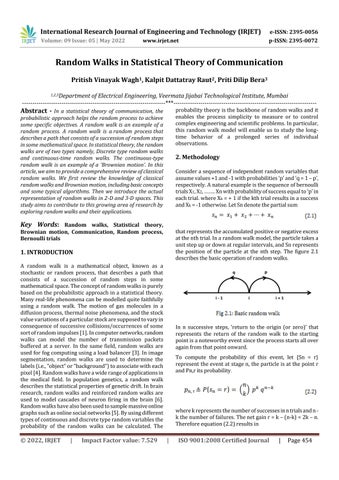
that represents the accumulated positive or negative excess at the nth trial. In a random walk model, the particle takes a unit step up or down at regular intervals, and Sn represents the position of the particle at the nth step. The figure 2.1 describes the basic operation of random walks.

Brownian motion, Communication, Random process, Bernoulli trials

1. INTRODUCTION A random walk is a mathematical object, known as a stochastic or random process, that describes a path that consists of a succession of random steps in some mathematical space. The concept of random walks is purely based on the probabilistic approach in a statistical theory. Many real-life phenomena can be modelled quite faithfully using a random walk. The motion of gas molecules in a diffusion process, thermal noise phenomena, and the stock value variations of a particular stock are supposed to vary in consequence of successive collisions/occurrences of some sort of random impulses [1]. In computer networks, random walks can model the number of transmission packets buffered at a server. In the same field, random walks are used for fog computing using a load balancer [3]. In image segmentation, random walks are used to determine the labels (i.e., “object” or “background”) to associate with each pixel [4]. Random walks have a wide range of applications in the medical field. In population genetics, a random walk describes the statistical properties of genetic drift. In brain research, random walks and reinforced random walks are used to model cascades of neuron firing in the brain [6]. Random walks have also been used to sample massive online graphs such as online social networks [5]. By using different types of continuous and discrete type random variables the probability of the random walks can be calculated. The

© 2022, IRJET

|

Impact Factor value: 7.529

In n successive steps, ‘return to the origin (or zero)’ that represents the return of the random walk to the starting point is a noteworthy event since the process starts all over again from that point onward. To compute the probability of this event, let {Sn = r} represent the event at stage n, the particle is at the point r and Pn,r its probability.

where k represents the number of successes in n trials and n k the number of failures. The net gain r = k – (n-k) = 2k – n. Therefore equation (2.2) results in

|

ISO 9001:2008 Certified Journal

|

Page 454


Turn static files into dynamic content formats.
Create a flipbook