
Object Detection for Autonomous Driving

Page 1

International Research Journal of Engineering and Technology (IRJET)

e-ISSN: 2395-0056

Volume: 09 Issue: 05 | May 2022

p-ISSN: 2395-0072

www.irjet.net

Object Detection for Autonomous Driving Shikhar Semwal1, Vibhor Sharma2 1Student,

Dept. of Information Technology Professor, Dept. of Information Technology 1,2Maharaja Agrasen Institute of Technology Rohini, Delhi ---------------------------------------------------------------------***--------------------------------------------------------------------2Assistant

Abstract –The first ever production car came out in 1886

when Carl Benz applied for a patent for his vehicle which was powered by a gas engine. Ever since then the world has witnesses tremendous changes in the automotive sector. Earlier vehicles were handmade – some even to this date – whereas nowadays manufacturing is automated wherein vehicles are assembled through robots at the assembly line of the manufacturing plant. Technology has come a long way in order to develop intelligent transportation – to make transportation smart and effective. Some decades ago, who could have thought that one day cars will be able to drive themselves without an active driver, but self-driving technology has made this possible. The paper briefly discusses various object detection algorithms used nowadays which may be used in the backend of autonomous driving technology incorporated into these self-driving vehicles. The paper also discusses haar features, and the comparision of haar cascade classifier with YOLO V4 object detection algorithm with emphasis on specific use cases which is vehicle and pedestrian detection with varying accuracy.

Fig -1: Self-Driving Car | Source: Intelligent Transport

2. HAAR CASCADE ALGORITHM

Key Words: autonomous driving, intelligent transportation, self-driving technology, haar features, YOLO V4, object detection 1. INTRODUCTION An autonomous vehicle or what we call a self-driving car is a car that is capable of driving itself without the help or interference of a driver under general circumstances. These kinds of cars are equipped with certain other technologies that assist the driver in optimal driving and avoiding obstacles on the road. Some of these technologies are Automatic Brake Assist feature, Lane Keeping Assistant, Blind Spot Monitoring System, Adaptive Cruise Control and some with even Auto-Pilot like the Tesla which is essentially an amalgamation of the different technologies fused into one.

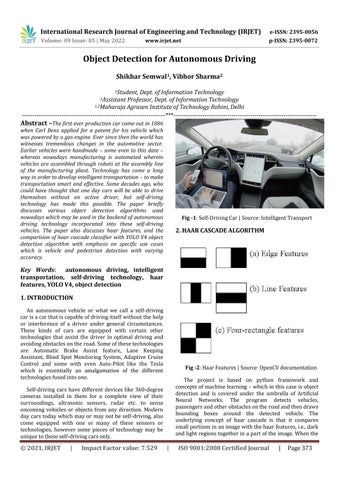
Fig -2: Haar Features | Source: OpenCV documentation The project is based on python framework and concepts of machine learning – which in this case is object detection and is covered under the umbrella of Artificial Neural Networks. The program detects vehicles, passengers and other obstacles on the road and then draws bounding boxes around the detected vehicle. The underlying concept of haar cascade is that it compares small portions in an image with the haar features, i.e., dark and light regions together in a part of the image. When the

Self-driving cars have different devices like 360-degree cameras installed in them for a complete view of their surroundings, ultrasonic sensors, radar etc. to sense oncoming vehicles or objects from any direction. Modern day cars today which may or may not be self-driving, also come equipped with one or many of these sensors or technologies, however some pieces of technology may be unique to these self-driving cars only.

© 2021, IRJET

|

Impact Factor value: 7.529

|

ISO 9001:2008 Certified Journal

|

Page 373


Turn static files into dynamic content formats.
Create a flipbook