International Research Journal of Engineering and Technology (IRJET) Volume: 09 Issue: 05 | May 2022
www.irjet.net
e-ISSN: 2395-0056 p-ISSN: 2395-0072
A REVIEW ON CANCELABLE BIOMETRIC AUTHENTICATION Akhila Ashok J1, Prof. Kanjana G2 1PG
Student, Dept. of Electronics & Communication Engineering, LBSITW, Kerala, India Professor, Dept. of Electronics & Communication Engineering, LBSITW, Kerala, India ---------------------------------------------------------------------***--------------------------------------------------------------------2Assistant
Abstract - Biometric authentication automatically
● Reusability/Revocability: Trustworthy revocation and reissue inside the event of compromise.
compares a user’s biometric to a stored biometric template in order to confirm a user’s identity. Biometrics has a lot of advantages. Compared to credit cards and passwords, biometrics are constantly associated with a user. So it cannot be restored. Cancelable biometric is a biometric template safety technique. The principle behind cancelable biometrics is that a biometric image of a sample is transformed into another form. It is very difficult to find the original biometric image from the transformed one. The main purpose of this paper is to make a comparative analysis of existing cancelable biometric techniques.
● Non-invertibility: Non-invertibility of template computation to avoid recovery of original biometric statistics. ● Performance: The expression should not decay the recognition performance. Cancelable biometric has gained a lot of interest in recent times. During this system, rather than storing the original biometric, it's converted using a one way function. The conversion can be applied either in the original form or in the feature form. It absolutely shows that this manner of constructing biometric templates has the preferable properties of cancelable biometric templates. It provides privacy and security since it's computationally delicate to recover the original biometric from a converted one. It prevents cross-matching between databases since each operation uses a distinct metamorphosis. And it doesn't degrade the delicacy of an identical algorithm because the statistical characteristics of features are roughly maintained after metamorphosis.
Key Words: Biometrics, Biometric authentication, Cancelable biometrics, Attack via record multiplicity, Deep learning
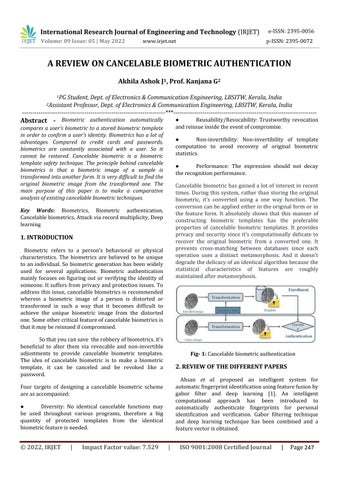
1. INTRODUCTION Biometric refers to a person's behavioral or physical characteristics. The biometrics are believed to be unique to an individual. So biometric generation has been widely used for several applications. Biometric authentication mainly focuses on figuring out or verifying the identity of someone. It suffers from privacy and protection issues. To address this issue, cancelable biometrics is recommended wherein a biometric image of a person is distorted or transformed in such a way that it becomes difficult to achieve the unique biometric image from the distorted one. Some other critical feature of cancelable biometrics is that it may be reissued if compromised. So that you can save the robbery of biometrics, it's beneficial to alter them via revocable and non-invertible adjustments to provide cancelable biometric templates. The idea of cancelable biometric is to make a biometric template, it can be canceled and be revoked like a password.
Fig- 1: Cancelable biometric authentication
2. REVIEW OF THE DIFFERENT PAPERS Ahsan et al. proposed an intelligent system for automatic fingerprint identification using feature fusion by gabor filter and deep learning [1]. An intelligent computational approach has been introduced to automatically authenticate fingerprints for personal identification and verification. Gabor filtering technique and deep learning technique has been combined and a feature vector is obtained.
Four targets of designing a cancelable biometric scheme are as accompanied: ● Diversity: No identical cancelable functions may be used throughout various programs, therefore a big quantity of protected templates from the identical biometric feature is needed.
© 2022, IRJET
|
Impact Factor value: 7.529
|
ISO 9001:2008 Certified Journal
|
Page 247