International Research Journal of Engineering and Technology (IRJET)

Volume: 09 Issue: 05 | May 2022 www.irjet.net
e ISSN: 2395 0056
p ISSN: 2395 0072
USING IMAGE CLASSIFICATION TO INCENTIVIZE RECYCLING
Yash Bavaskar1 , Vinay Vishwanathan2 , Nair Rakesh3 , Aniket Khandekar4, Prof. Dhiraj Amin5
1,2,3,4 B.E Student, Department of Computer Engineering, Pillai College of Engineering, Navi Mumbai, India 410206
5 Faculty, Department of Computer Engineering, Pillai College of Engineering, Navi Mumbai, India 410206
***
ABSTRACT Recently the topic of recycling and climate change is a debating point and many Non Governmental Organizations are campaigning for change in governmental policies in many countries around the world. One of the factors of climate change is the improper disposal of trash. In India only 5% of household waste is recycled, 77% is disposed into open dumps and 18% is compostable. Most Indian household waste can be recycled as materials that can be recycled are glass, plastic, paper, wood, and metal. The goal of this project is to solve the problem of creating a web application/website to promote recycling. With the help of a website and the use of object identification, this is possible. Object identification refers to a machine learning based algorithm and networks to identify objects and labels them without any user interaction or approval. There are many methods for object identification, for example, Convolutional Neural Networks (CNN). This method is much more complex and computationally intensive however using Image processing for object detection. Image processing is less computationally intensive and relatively easier to implement for a website/web application. Image processing is a method of processing images into a digital format and performing operations to get an enhanced version of the image or extract information.
Unmanned Aerial Vehicles [3]. CNN is a deep learning techniqueusedforobjectdetectionandmanyalgorithmsuse CNNasabaseintheirarchitecture.
2. LITERATURE SURVEY
A.SingleShotMultiboxDetector(SSD):Itisoneofthemost efficient detectors on the market, and it is also one of the fastestandmostprecise.Detectobjectscomprisestwobasic steps: feature map extraction and convolution filter applications [4]. The SSD design is based on the VGG16 architecture, which is a very accurate classification and detection model that scores 92.7 percent accuracy in ImageNet's[5]5tests.
B. YOLO (You only look once): A cutting edge object identificationmethoddesignedforreal timeapplications.Itis notaclassifierasanobjectdetector.Itfunctionsinamanner wheretheinputissplitintoanSxScellgrid,eachofwhichis accountable for confidence ratings, bounding boxes, and probabilitymaps.Itclassifiesandcreatesthem.Theforecasts are formed by combining the outcomes of the preceding procedures.
1. INTRODUCTION
Climatechangeisanimmensetopicofdebateworldwide andsolvingproblemsthatcontributetoclimatechange is an area of growing interest. Several attempts from the governments around the world are being made but the progressisslowasthereareinconsistenciesintheprocess suchasalackoftransparencybetweencivilbodiesandthe general population. To give more emphasis on the environmentgovernmentsdospendonmarketingtheeffort via social mediaandbillboardsandbanners.To solveand makethegeneralpopulationmoreawareandincontrolofa website/web application using Image processing and enhanceduserexperience.Theusercanuploadapictureofa recyclablepieceofmaterialandgetaquotationbasedonthe number of Recycle points. Image processing is used to extractinformationfromimages.Throughimageprocessing, itispossibletoidentifyobjects.Thisidentificationofobjects is technically called Objection. This technique is used for
Impact Factor value: 7.529
C. Faster region CNN: A cutting edge CNN deep learning object detector approach. The network here receives the inputimageintoaconvolutionnetworkthatprovidesamap ofitsfeatures.Ratherusingaselectivesearchalgorithmto identify the region made in the previous iterations. A differentandseparatenetworkisusedtolearnandpredict theseregions[4]
D. Image Processing using Haar Classifier: An object recognition program that identifies objects in an image and/or video. It is a machine learning approach that uses positiveandnegativeimagestotraintheclassifier.
E. Image Processing in conjunction with CNN: Uses a similarprocessastheHaarclassifieralgorithmbutusesthe image’s negativemaskstogetthecoordinates thatarenot black in contrast. The coordinates are then recorded and classified.
9001:2008
International Research Journal of Engineering and Technology (IRJET)
Volume: 09 Issue: 05 | May 2022 www.irjet.net
2.1 SUMMARY OF RELATED WORK
ThesummaryoftheliteratureispresentedinTable1.
Table 1 Summary of literature survey
Literature Advantages Disadvantages
Viola,Paul& Jones,Michael, [6]
In object detection, pioneers paved thepathformore recent and more advanced techniques. Still relevant today. Guaranteed output and technically sound.
Itisdatedandmore new methods are available which can be implemented easier.

Magalhães,Rafael &Peixoto,Helton. [4]
SSD: Accurate and faster and improves the detection at a differentscale.
YOLO: Fast as it can process 45 frames per second
Faster R-CNN: Improves the training and detection time fromRCNN
SSD: Difficult to predict and classify smallobjects.
YOLO: Struggles to detect small objects andcloseobjects
Faster RCNN: The search algorithm is slow and time consuming
Jalled,Fares& Voronkov,Ilia. [7]
FollowsViolaand Jones’s concept and seems to be an implementation for object detection
3. PROPOSED WORK
Datasetofimageshas tohavelessnoiseand all images should have correctdensity andcontrast.
Theexistingsystemismanualanditseemstobeunfairasit reliesonweightscalesownedbyscrapdealersandinsteadof rewardpointsitisasmallmonetaryreward dependingon thepriceofthematerialbythekilo.Toincentivizeusersto recycle and to have a greater reach and accessibility to everyone, a web application, where the user can upload images of their recyclable material and using image classification algorithms the material is identified and a certainnumberofpointsisgiven.Onceacertainamountis giventheuseristhencommittedtotakingthematerialtoa
e ISSN: 2395 0056
p ISSN: 2395 0072
nearbydroppoint.Oncetheexchangeisdonethecommitted pointsarecreditedtotheuser’saccount.Inthefuture,once theuserhasasubstantialnumberofpoints,theycanchange itforvouchersandgiftcards.Inmore simplewordsitisa rewards program for recycling. Controlling the computer mouseusingtheeyesmovement
3.1 SYSTEM ARCHITECTURE
The architecture of the system is shown in Figure 1. Each blockisalsodescribedinthissection.
Fig 1: Proposed Architecture of the System
A. User and Login block Using industry standard authenticationmethodstheuserhastheircredentialswhen logging into a website. All credentials are to be encrypted andprotectedinthedatabasewiththeDBAbeingasingle personandthepasswordbeingencrypted.
B. Image Upload Heretheimagewhichistakenbytheuser is uploaded to the website. The image is saved in the database and goes through the object identification algorithm.
C. Image Classification/Object Heretheimageisanalyzed usinganobjectidentificationalgorithm.Theimageisbroken downintonegativeandpositiveimages.Itsmaskisusedto plotthepointsofthehighestcontrastpointsandlaterusing the trained prediction algorithm it is then classified. The outputofthisstagecanonlybeoneoftheseoptions:paper, plastic, wood, and metal. All the data is saved in a NoSQL databaseanddetailsofthetypeofmaterialaresavedinan arraycontainingtheuser’sdetails.
D. Data Storage - Using RESTAPIs,simple CRUD(Create, Read,UpdateandDelete)operationsareusedtocorrespond theinputdetailswiththeuser.Thiswillallowthewebsiteto be more dynamic and use fewer resources in terms of runningthisbackendprocessonitsown.UsingRESTAPIs allows websites to be more responsive as well as adds an extralayerofsecurityasthedataisbeingstoredinpseudo cloudstorage.
E. Transactional Details Thispartreferstothepointand rewardstheuserispromisedafterrecyclingthematerials andfulfillingthecommitmentofrecyclingoncethematerials aredroppedoffatthenearestrecyclingstation.
© 2022, IRJET | Impact Factor value: 7.529 | ISO 9001:2008 Certified
International Research Journal of Engineering and Technology (IRJET)
Volume: 09 Issue: 05 | May 2022 www.irjet.net
3.2 DATASET AND PARAMETERS
Totraintheimageclassificationmodel,Imagedatasetsare readily available through open source datasets and paid datasets.Anexampleofan open sourcedatasetwouldbe OpenImagesandapaidonewouldbeImageNet.
3.3 METHODOLOGY
Tocreateanimageclassificationmodeltoidentifywhattype ofobjectisheadedforrecycling,twomaintechnologieswere used;apre trainedmodelcalledResNetwasused,andavery popularandeasy to usepythonlibrarycalledFastAI.
ResNet ResNet standsforResidualNeuralNetworkwhich isaConvolutionalNeuralNetworkconsistingofaseriesof layers. Specifically, ResNet34 is a 34 layer CNN already trained dataset on the ImageNet. An already trained Convolutional Neural Network model will perform a new image classification task since it has previously learned visualfeaturesandcanpassontheknowledge.
ThisismainlybecausetheirabilitytooutlineDeepNeural Networksshouldperformcomparativelybetterthanother insubstantialnetworksonpaper.
ResNetwascreatedtobypassandsolvethisproblemusinga methodcalledRandom accessconnections.Itisverymuch possible to adjust the bias and weights if the nodes in a certainlayerhavesub optimalvalues.Theoptimalnodeisto beusedinthequestion.Changesaremadetonodesonlyas needed(whentherearenoremainders)
Thedirectaccesslinksemploythefunctionofidentitytogive critical information to subsequent layers. This method diminishes the Neural Network to a certain extent. Also allows ResNets to possess deep architectures and behave morelikeflatneuralnetworks.
Randomaccessbindingsapplytheidentityfunctiontopass informationtosubsequentlayerswhencustomizationsare needed. This makes the neural network short wherever possible,allowingResNetstohavedeeparchitecturesand behavemorelikeflatneuralnetworks.The34inresnet34 referstothenumberoflayerspresent
FastAI - FastA1isapythonlibrarythatisopensourceand baseduponPyTorch,whichisoneofthemodernandflexible deeplearningframeworks.
e ISSN: 2395 0056
p ISSN: 2395 0072
3.3.1 PERFORMANCE METRICS OF IMAGE CLASSIFICATION MODEL
Fig 3.3.1.1 Learning Rate Graph
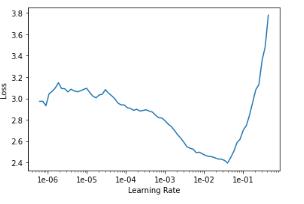
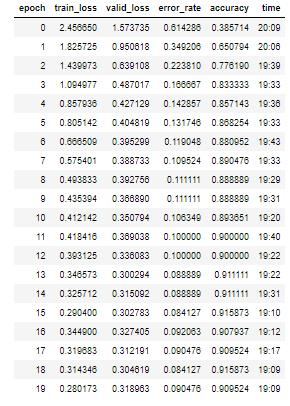
The model was performed for 20 epochs. The fitting method’s speed of learning decreases with each epoch, bringingitevenclosertotheperfectfit.Themodelaccuracy wasthehighestinepoch18butdecreasedinepoch20and later.
Table 3.3.1.2 Epoch Table
Volume:
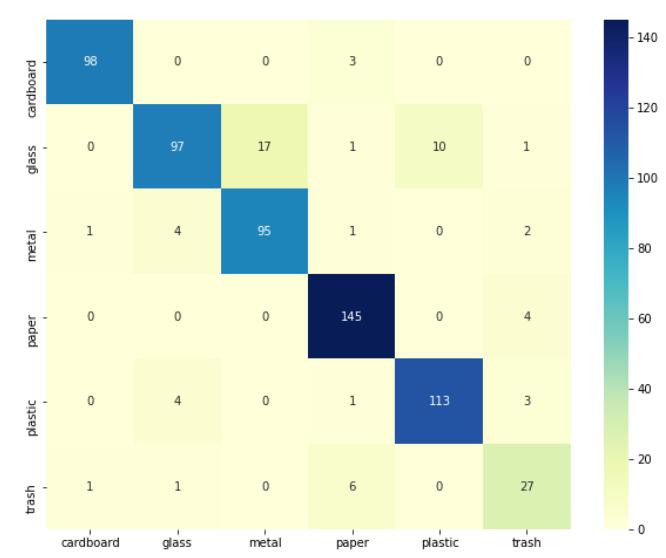
Fig 3.3.1.3 Confusionmatrixfortraining,heretheplasticis beingconfusedformetalmostofthetime,andglassisbeing confused for plastic, another confusion is where trash is beingconfusedwithpaperandthelastsignificantcardboard isconfusedwithpaper.
e
p
2395
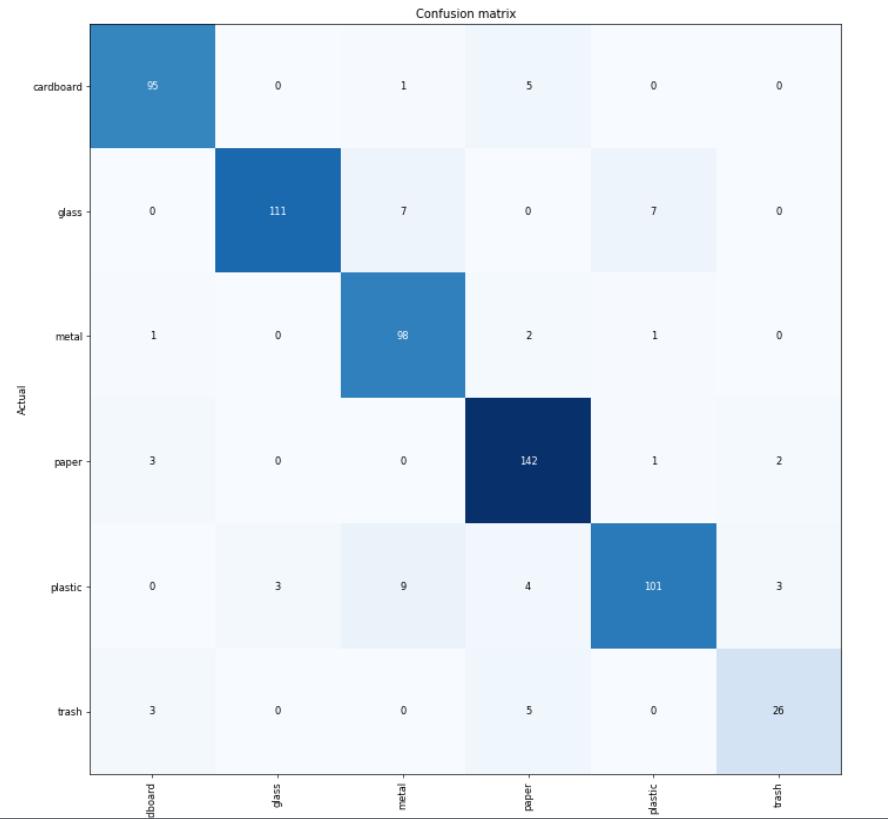
Fig 3.3.1.4 Testconfusionmatrix:Again,themodelseemsto have confused glass for metal and glass for plastic. In conclusion,themachinelearningmodelusingtransfer based learning is highly accurate and can classify the images appropriatelyhoweverthereisstillconfusionwhenimages containingobjectshavesimilarcontrastsandfeatureslike reflectionsfromplasticobjectscanmimicmetalreflections.
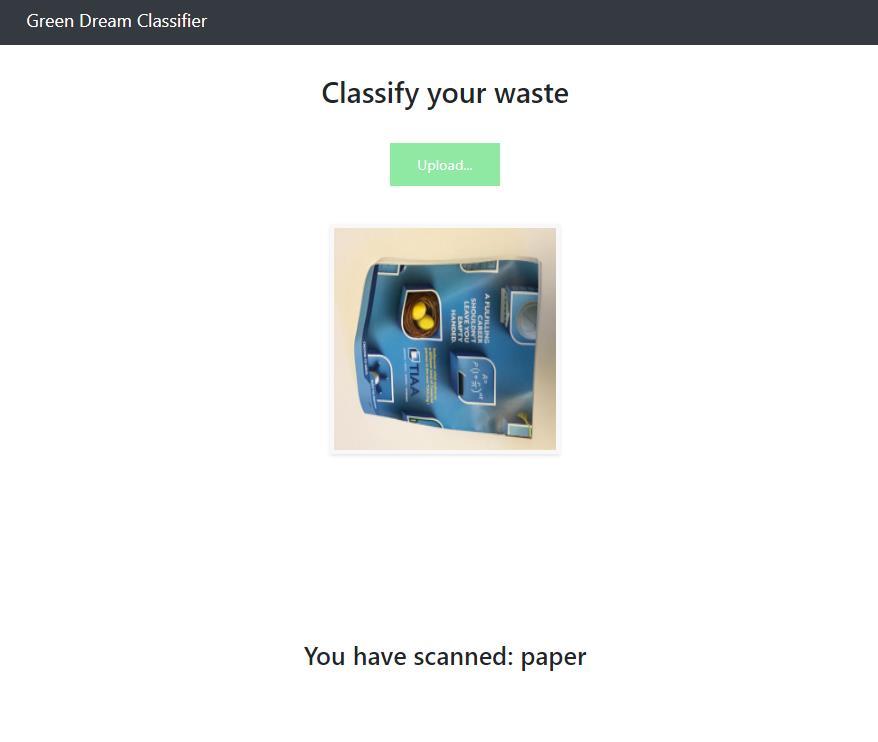
Fig 3.4.1.5 Working of the application
ACKNOWLEDGEMENT
It is our honor to offer our sincere greetings to the supervisor, Prof. Dhiraj Amin, for his beneficial contributions, professional guidance, the needed encouragement, profound collaboration, and constructive criticismwhichhelpedusalotinthisjourneythroughoutthe work.WespoketoourComputerScienceDepartmentHead, Dr. Sharvari Govilkar, and our Principal, Dr. Sandeep M. Joshi, we sincerely thank him for invigorating us and allowingustopresentthiswork.
REFERENCES
1. TheTimesofIndia.2020.In30years,Indiatipped todoubletheamountofwasteitgenerates Times of India. [online] Available at: <https://timesofindia.indiatimes.com/india/in 30 years india tipped to double the amount of waste itgenerates/articleshow/74454382.cms#:~:text=In %20India%2C%2077%25%20of%20waste,and%2 0just%205%25%20is%20recycled.&text=A%20sig nificant%2034%25%20of%20all,recovered%20thr ough%20recycling%20and%20composting.> [Accessed31October2021].
2. GeeksforGeeks. 2021. Digital Image Processing Basics GeeksforGeeks. [online] Available at: <https://www.geeksforgeeks.org/digital image processing basics/>[Accessed10October2021].
3. PayalMittal,RamanSingh,AkashdeepSharma,Deep learning basedobjectdetectioninlow altitudeUAV datasets: A survey,Image and VisionComputing,Volume104,2020,104046,ISSN02
International Research Journal of Engineering and Technology (IRJET)
Volume: 09 Issue: 05 | May 2022 www.irjet.net
62 8856,https://doi.org/10.1016/j.imavis.2020.10404 6.(https://www.sciencedirect.com/science/article/ pii/S0262885620301785)[accessedOct13,2021]
4. Magalhães,Rafael& Peixoto,Helton.(2019).Object RecognitionUsingConvolutionalNeuralNetworks. Available: 10.5772/intechopen.89726. [accessed Oct13.2021]
5. Forson, E., 2017. Understanding SSD MultiBox Real Time Object Detection In Deep Learning. [online] Medium. Available at: <https://towardsdatascience.com/understanding ssd multibox real time object detection in deep learning 495ef744fab>[Accessed14October2021].
6. Viola,Paul&Jones,Michael,“RapidObjectDetection usingaBoostedCascadeofSimpleFeatures” IEEE Conf Comput Vis Pattern. Available:https://www.researchgate.net/publicatio n/3940582_Rapid_Object_Detection_using_a_Booste d_Cascade_of_Simple_Features [accessed Oct. 13,2021]
7. Jalled, Fares & Voronkov, Ilia. (2016). Object Detection using Image Processing. Available: https://www.researchgate.net/publication/310769 942_Object_Detection_using_Image_Processing [accessedOct15,2021]
BIOGRAPHIES
YashBavaskar, Student of Pillai College of Engineering, NewPanvel, Pursuing Bachelor’s of Engineering DegreeinCE UniversityofMumbai
VinayVishwanathan, StudentofPillaiCollegeofEngineering, NewPanvel, Pursuing Bachelor’s of Engineering DegreeinCE UniversityofMumbai


e ISSN: 2395 0056
p ISSN: 2395 0072
NairRakesh, StudentofPillaiCollegeofEngineering, NewPanvel, Pursuing Bachelor’s of Engineering DegreeinCE UniversityofMumbai AniketKhandekar, StudentofPillaiCollegeofEngineering, NewPanvel, Pursuing Bachelor’s of Engineering DegreeinCE UniversityofMumbai


Prof.DhirajAmin, Professor at Pillai College of Engineering,NewPanvel,Department ofComputerEngineering

Impact Factor value: 7.529
9001:2008