International Research Journal of Engineering and Technology (IRJET)

Volume: 09 Issue: 04 | Apr 2022 www.irjet.net
e ISSN: 2395 0056
p ISSN: 2395 0072
International Research Journal of Engineering and Technology (IRJET)
Volume: 09 Issue: 04 | Apr 2022 www.irjet.net
e ISSN: 2395 0056
p ISSN: 2395 0072
1 4Student of Computer Science & Engineering Department, GHRU Amravati, Maharashtra, India
5Professor, Computer Science & Engineering Department, GHRU Amravati, Maharashtra, India
***
Abstract The Notary office,which isresponsibleforissuing a variety of important certificates, still uses manual processes and relies on paper documents from other government agencies. This causes a slew of problems. Non local paper materials are rejected by the Notarial Office due to their reduced credibility in the local area, and as a result, cross border services are unavailable. Because copiesofpaperitems have been stored, it is also easy to leak sensitive information. Because of its benefits, a blockchain based solution is ideal to address the issues in this scenario (e.g, decentralized, immutability, transparency, auditability).
This system was built on top of the Hyperledger Fabric. Furthermore, we use smart contracts to substitute manual activities, create multiple ledgers to offload different types of transactions, and encrypt privatedataasnecessary.Attheend of the day.
Key Words: Blockchain, Notary Office, E government, certificate, Security, Encryption, AES, SHA.
Residents in numerous nations rely on government certifications on a daily basis. On the other side, citizens' faithingovernmentiserodedduetoalackoftransparency, excessivebureaucracy,andeveninstancesofcorruption.The Notary Office has most official certifications to establish estate ownership, familial links, death, and so on. The purpose of creating a Notary Office is to standardize the certification process, minimize the number of certificate papers,andimprovecertificationvalidityandacceptance.To produce a specific certificate, the Notary Office requires documentssignedbyothergovernmentoffices.Thecurrent notary process is under the manual handling and we are tryingtobringthatmanualhandlingprocessontothedigital platform where people can apply for different certificates from their home and no need to visit physically in any Notaryoffice.
Blockchains are distributed record that allows participants to interact with one another in a safe, irreversible manner without the use of middlemen and blockchain basedsystemhasahighlevelofavailabilityand transparency In addition, to secure personal sensitive information, a symmetric encryption function has been included to encrypt user personal data and prevent from
Impact Factor value: 7.529
data misuse, On the other hand, we feel that the design providedcanbeusedtoawiderangeofgovernmentsectors.
The blockchain was created in order to build a decentralizedandtrustworthycryptocurrencythatmayhelp peopleavoidfinancialrisk.Blockchaintechnologyisnowa prominent and promising technology that is being usedin areas other than bitcoin, such as Internet of Things (IoT) Electronichealth,financialapplications,crowdsourcing,and e government. Blockchain can be utilized to improve government service in efficiency and effectiveness (e.g., transparency,lowercosts,accuraterecord keeping)[5]Ithas a promising future in optimizing the business processes through secure sharing of data [06] Using blockchain technologytoofferapublicnotaryservicecanalsoenables someactivitieswiththepublic andprivatesectorssuchas residency approaches in Estonian [08]. Their technique, which is based on a three level electronic certificate architecture,constructsandsimulatesthissystem,and the findings demonstrate that it can greatly reduce the size of electronic certificate data flow.[09] In [10] build an electroniccertificatescatalogsharingsystem(ECCS)basedon the Hyper Fabric(v1.1) for all circumstances involving the exchangeofelectroniccertificatesReference[17]displaysa Blockchain system that uses proof of concept (POC) consensustoeasethevisibilityofshareddataamongmany stakeholders, as well as smart contracts to automate decision making in cell tower and building modifications. ChenfuXuetal..AccordingtoPengbinHanetal.Authorsin [18]designadigitaleducationcertificateprototypeutilizing thepermissionedframeworkHyperledgerFabric(V1.4).
Blockchaintechnologyisusefulforelectronicgovernment servicesingeneral.Researchers,ontheotherhand,generally concentrateondevelopingtheirsolutionusingtheblockchain infrastructure.Whendiscussingthepracticality,theyseldom take other governments into account. People do, after all, want more throughput and lower latency, and the performanceofablockchainsystemisinextricablyinfluenced bythedistancesbetweengovernmentsandthevariedlevels ofdevelopmentofcities.Asaresult,weofferastrategythat takes this issue into account and achieves superior performanceinparticular
9001:2008
Prof. Rais Abdul Hamid Khan5
International Research Journal of Engineering and Technology (IRJET)
Volume: 09 Issue: 04 | Apr 2022 www.irjet.net
Blockchaintechnologywasfirstlyintroducedin2008for cryptocurrencytransactionsbecauseitisatechnologythat keepsthetrackofeveryrecordandstoredatainsuchaway thataltering,hackingisdifficultorimpossible.Eachblockon thechaincomprisesanumberoftransactions,andwhenever anewtransactiontakesplaceontheblockchain,arecordofit isaddedtoeachparticipant'sledge.
Itmeansthatifoneblockinachainischanged,itwillbe obvious that the entire chain has been tampered with. If hackers wanted to take down a blockchain system, they'd havetochangeeveryblockinthechainacrossalldistributed versions.Nowdaysblockchaintechnologyisgettingusedon differentplatformslikemarketing,healthcareetc.becauseof it’ssecurityandefficiency.
Theexistingnotarysystemmanagementsystemhasissues suchas:
Datainsecurity,absenceofanotaryofficerinyourregion,if theofficerisinaccessible,yourjobwillbedelayed.Thedata acquired bythe officer to generate the certificate is maintained in his office, which takes up a lot of space and demandstheofficermanagesallofthefiles,whichoftenleads toerroneousdata.
Inproposedsystem,blockchaintechnologyisusedwith IPFSserverbecauseblockchaintechnologyisnotsuitablefor storing large amounts of data.Each file uploaded to the networkisgivenauniquecryptographichashvalueonthe ipfs server, which allows the ipfs network to detect duplicationandmonitorversionhistoryforeachfile.
We areusingthe Advanced Encryption Standard and SecureHashingAlgorithmtoencryptthedata.TheAdvance Encryption Standardis a symmetric block cypher that can encrypt and decrypt data. Encryption changes data to a unintelligible form called ciphertext, while decryption convertsitbacktoitsoriginalformcalledplaintext.Everyfile thattheusersubmitswillbeassignedauniquehashvalue thatcannotbeduplicatedbyanyotherpieceofdata.
The notary system is processed using a variety of technologies;thefirsttoolusedtobuildthenotarysystem wasEclipseIDE.Itprovidesagraphicaluserinterface(GUI) thatallowsustoaccessthecodeeditor,compiler,interpreter, and debugger from a single location. The backend of the system is written on Java Enterprise Edition and Java 16. Database connectivity and peer to peer web access are amongthesystemsandservicessupportedbyJava.Python 3.9 is used to write the document encryption techniques. ApacheTomcatservesastheserverforthenotarysystem. UsingtheTCP/IPprotocol,theapacheserverallowsclients andserverstocommunicateovernetworks.
The open source java application server Tomcat is the most extensively used. Before publishing it to the main server,weutilizethexamppapacheservertotestthewebsite andclientoncomputers.Javaservletsareusedtoenhance
2022, IRJET
e ISSN: 2395 0056
p ISSN: 2395 0072
the capabilities of a server that hosts a request response application.NotarysystemalsoutilizingJSP/JavaBeansfor server sideprogramming.Abeanwrapsnumerousobjects into a single object that may be accessed from multiple locations.TheMVCapproachisproposedbecauseisfollows themodel view controller.ThedatabaseinuseisthemySql database, which is open source software and the quickest database.Allofthedatareceivedissavedinastructuredway usingthemySqldatabase.
Impact Factor value: 7.529
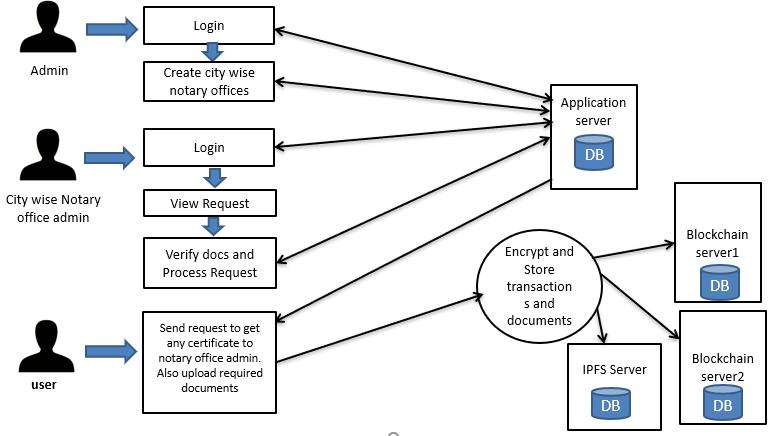
We developed four databases based on the notary system concept.Thefirstistheapplicationserver,whichisApache Tomcat, which allows clients and servers to connect over networksviatheTCP/IPprotocol.Theothertwoserversin the system are used tostoredata in a structured way ina MySQL database. Because ofblockchain technology is insufficientforstoringvastamountsofdata;thefinalserver willbeanIPFSserverthatwillstoretheencryptedfile.
Theadministheorganization'sleaderhehasfullaccessto thesystemandcanviewallofthesystem'sfeaturesthatare hidden from the city's wise officers and users. The senior admin's job is to create notary officers for each city and ensurethateverythinginthesystemisrunningproperly.The administrator has the ability to remove and create the profilesofcitywiseofficialsanduserswhoareattemptingto underminethesystembysubmittingfraudulentdocuments. Comingtousersideworkingtheusermustregisterwiththe notarysystembyprovidingalloftherelevantinformation, such as an email address, a cell phone number, and an address.Afterregisteringonthesystem,theusermustlogin tothesystemwithhislogincredentials.Afterloggingin,the applicationserverwillverifyfortheuser'scredentials.Ifthe specifiedcredentialsarefoundontheserverandmatchwith theusers,thenuserwillbegrantedaccesstothesystem.
User management options involve registration, log in, upload documents, send a certificate request to a notary
9001:2008
International Research Journal of Engineering and Technology (IRJET)
Volume: 09 Issue: 04 | Apr 2022 www.irjet.net
officer if necessary, see the progress of your application, passwordrecovery,anddownloadingtheissuedcertificate. All of these functionsare available to the user throughhis panel. The notary officer’ s panelcontains view requests, verify the documents provided by the user, assign the certificate,anduploadforms.Thenotaryofficermustprovide a list of certificates that he may issue, such as birth certificatesandmarriagecertificates,aswellastheformthat theusermustfillout.Afterthelisthasbeenuploadedbythe officer, the user may view it and apply for the various certificatesthatarerequired.However,beforeapplyingfor the certificate, the user must upload all of his required documentsasinstructedbythenotary.Aftersubmittingan applicationforacertificate,theusercanchecktheprogressof his application. The officer can see how many individuals haveappliedforthecertificateandthenverifyalloftheuser's documents. Iftherearenoconcernswiththeverification,the officer will generate the certificate and transmit it to the user's account. After that, the user must authenticate his identityviaOneTimePasswordbeforehecandownloadthe certificate. All document exchanges are done in encrypted manneradditionally;dataissavedintheformofencrypted filesontheserver.
Becauseofitsextensiveuseandgreatefficiency,wechose theAESmethodtoencrypttransactionstoavoidtheleakage ofsensitiveinformation.Althoughthedifferenceparameter affects the efficiency of many algorithms, the AES method achieves the best results in a variety of use situations, including time consumption, response time, request executionpersecond,andbatterypowerconsumption.
TheAESalgorithmiswell suitedtohandlingahigh volumeoftransactionswhilealsoencryptingcertificates. Furthermore, no extra components are required to implement this technique, resulting in a reduction in the complexityofourframework.Insteadofstoringencryption informationonadevice,userssimplyneedtorecallasetof words or numbers. After a user uploads a document, AES generatesa32 bitkeytoencryptitandstoreitonanIPFS serveraswellasdistributedblockchainservers.
5.1 Algorithm’s.
Algorithm 1 materialencryption
importos fromCrypto.CipherimportAES fromCrypto.HashimportSHA256 fromCryptoimportRandom defencrypt(key,filename): chunksize=64*1024 UPLOAD_DIR=os.getcwd()+"\\Documents\\" outputFile="enc_"+filename
e ISSN: 2395 0056
p ISSN: 2395 0072
filename=UPLOAD_DIR+filename outputFile=UPLOAD_DIR+outputFile filesize=str(os.path.getsize(filename)).zfill(16) IV=Random.new().read(16)
encryptor=AES.new(key,AES.MODE_CBC,IV)
withopen(filename,'rb')asinfile: withopen(outputFile,'wb')asoutfile: outfile.write(filesize.encode('utf 8')) outfile.write(IV)
whileTrue: chunk=infile.read(chunksize) iflen(chunk)==0: break eliflen(chunk)%16!=0: chunk+=b''*(16 (len(chunk)%16)) outfile.write(encryptor.encrypt(chunk))
defdecrypt(key,filename,dpath1): chunksize=64*1024 outputFile=filename[11:] outputFile=dpath1 withopen(filename,'rb')asinfile: filesize=int(infile.read(16)) IV=infile.read(16)
decryptor=AES.new(key,AES.MODE_CBC,IV) withopen(outputFile,'wb')asoutfile: whileTrue: chunk=infile.read(chunksize) iflen(chunk)==0: break outfile.write(decryptor.decrypt(chunk)) outfile.truncate(filesize) defgetKey(password): hasher=SHA256.new(password.encode('utf 8')) returnhasher.digest()
Algorithm 2 hashingalgorithm defgetKey(inputText): hasher=SHA256.new(password.encode('utf 8')) returnhasher.digest()
For SHA(Secure hashing Algorithm) we have imported followingpackagefromCrypto.HashimportSHA256
International Research Journal of Engineering and Technology (IRJET)
Volume: 09 Issue: 04 | Apr 2022 www.irjet.net
An electronic certificate sharing system based on consortium blockchain is being developed in this notary project to meet the issues of government services, particularlyintermsofauditability,efficiency,andprivacy.A prototypeimplementationisusedtoassessperformance.In this paper, we examine the needs of the Notarial Office, which issues certificates to residents, and find that a blockchain basedsolutioncanhandlethemajorityofissues thatariseintheseoffices.Inaddition,wehaveimprovedthe performance of the blockchain network by changing the commonly utilized structure. All transactions are now classifiedaslocaltransactions,whicharethenoff loadedto separateledgers.Theexperimentsshowthatthisstrategy performs well. We may also assume that the real performancewillbehighersincethedistancemetricandthe degreeofdevelopmentofcitiesmustbeconsidered.Finally, weoffersecurityassessmentsonavarietyoftopics.
Itcanassistinimprovingtransactionefficiencyand reducingtransactionstoragespace,forexample,entrieson the local ledger do not need to be maintained andcan be used to create certificates as materials in our case. In our circumstance, we needed to produce the certifications as materials.
However, we must examine the consistency of informationacrossmultipleblockchains,butforgovernment actions,eachentityhasahighlevelofconfidence.Insome cases,thisimplieswemayutilizeentriesfromalocalledger belongingtoasinglecityasextrainformationfortheglobal ledger.
[1] T. T. Kuo, H. Zavaleta Rojas, and L. Ohno Machado, ‘‘Comparison of blockchain platforms: A systematic reviewandhealthcareexamples,’’J.Amer.Med.Inform. Assoc., vol. 26, no. 5, pp. 462 478, May 2019, doi: 10.1093/jamia/ocy185.
[2] Y. K. Tomov, ‘‘Bitcoin: Evolution of blockchain technology,’’inProc.IEEEXXVIIIInt.Sci.Conf.Electron. (ET),Sep.2019,pp.1 4.
[3] A.Shahnaz,U.Qamar,andA.Khalid,‘‘Usingblockchain for electronic health records,’’ IEEE Access, vol. 7, pp. 147782 147795,2019
[4] S. Ølnes and A. Jansen, ‘‘Blockchain technology as s supportinfrastructureine government,’’inElectronic Government, M. Janssen, K. Axelsson, O. Glassey, B. Klievink,R.Krimmer,I.Lindgren,P.Parycek,H.J.Scholl, andD.Trutnev,Eds.Cham,Switzerland:Springer,2017, pp.215 227.
[5] D.Yermack,‘‘Corporategovernanceand blockchains,’’ Rev.Finance,vol.21,no.1,pp.7 31,Mar.2017.
[6] A.Kaur,A.Nayyar,andP.Singh,‘‘Blockchain:Apathto thefuture,’’CryptocurrenciesBlockchainTechnol.Appl., pp. 25 42, May 2020, doi: 10.1002/9781119621201.ch2.
[7] N.Diallo,W.Shi,L.Xu,Z.Gao,L.Chen,Y.Lu,N.Shah,L. Carranco, T. C. Le, A. B. Surez, and G. Turner, ‘‘EGov
e ISSN: 2395 0056
p ISSN: 2395 0072
DAO: A better government using blockchain based decentralized autonomous organization,’’ in Proc. Int. Conf. eDemocracy eGovernment (ICEDEG), Apr. 2018, pp.166 171
[8] C.SullivanandE.Burger,‘‘E residencyandblockchain,’’ Comput. Law Secur. Rev., vol. 33, no. 4, pp. 470 481, Aug.2017.
[9] P.Han,A.Sui,T.Jiang,andC.Gu,‘‘Copyrightcertificate storage and trading system based on blockchain,’’ in Proc. IEEE Int. Conf. Adv. Electr. Eng. Comput. Appl. (AEECA),Aug.2020,pp.611 615
[10] C. Xu, H. Yang, Q. Yu, and Z. Li, ‘‘Trusted and flexible electronic certificate catalog sharing system based on consortium blockchain,’’ in Proc. IEEE 5th Int. Conf. Comput.Commun.(ICCC),Dec.2019,pp.1237 1242.
[11] H.Cheng,J.Lu,Z.Xiang,andB.Song,‘‘Apermissioned blockchainbased platform for education certificate verification,’’inBlockchainandTrustworthySystems,Z. Zheng, H. N. Dai, X. Fu, and B. Chen, Eds. Singapore: Springer,2020,pp.456 471
[12] V. Buterin. (2014). A Next Generation Smart Contract and Decentralized Application Platform. [online] Available: https:// cryptorating.eu/whitepapers/Ethereum/Ethereum_whi te_paper.pdf
[13] ABlockchainPlatformfortheEnterprise.Accessed:Dec. 1, 2020. [Online]. Available: https://hyperledger fabric.readthedocs.io/en/release2.1/
[14] M.B.Yassein,S.Aljawarneh,E.Qawasmeh,W.Mardini, andY.Khamayseh,‘‘Comprehensivestudyofsymmetric keyandasymmetrickeyencryptionalgorithms,’’inProc. Int.Conf.Eng.Technol.(ICET),Aug.2017,pp.1 7.
[15] S. Ølnes, J. Ubacht, and M. Janssen, ‘‘Blockchain in government: Benefits and implications of distributed ledgertechnologyforinformationsharing,’’Government Inf.Quart.,vol.34,no.3,pp.355 364,2017.
[16] F.Casino,T.K.Dasaklis,andC.Patsakis,‘‘Asystematic literature review of blockchain based applications: Current status, classification and open issues,’’ Telematics Informat., vol. 36, pp. 55 81, Mar. 2019. [Online]. Available: http://www.sciencedirect.com/science/ article/pii/S0736585318306324
[17] H. Treiblmaier and C. Sillaber, A Case Study of Blockchain InducedDigitalTransformationinthePublic Sector.Cham,Switzerland:Springer,2020,pp.227 244, doi:10.1007/978 3 030 44337 5_11.
[18] H.Cheng,J.Lu,Z.Xiang,andB.Song,‘‘Apermissioned blockchainbased platform for education certificate verification,’’inBlockchainandTrustworthySystems,Z Zheng, H. N. Dai, X. Fu, and B. Chen, Eds. Singapore: Springer,2020,pp.456 471.
2022, IRJET | Impact Factor value: 7.529 | ISO 9001:2008
International Research Journal of Engineering and Technology (IRJET)
Volume: 09 Issue: 04 | Apr 2022 www.irjet.net
Mr.AdityaYashvantVyas. PursuingBachelor ofTechnology. (ComputerScience&Engineering).

e ISSN: 2395 0056
p ISSN: 2395 0072
Mr.VidulAbhiramDabir. PursuingBachelor ofTechnology. (ComputerScience&Engineering).

Mr.RitwikMilindDhande. PursuingBachelor ofTechnology. (ComputerScience&Engineering).
Mr.PranavPurshottam Madeshwar. PursuingBachelor ofTechnology. (ComputerScience&Engineering).
Prof RaisAbdulHamidKhan. Computer Science & Engineering Department, G.H.RaisoniUniversity,Amravati, Maharashtra,India